PART 1
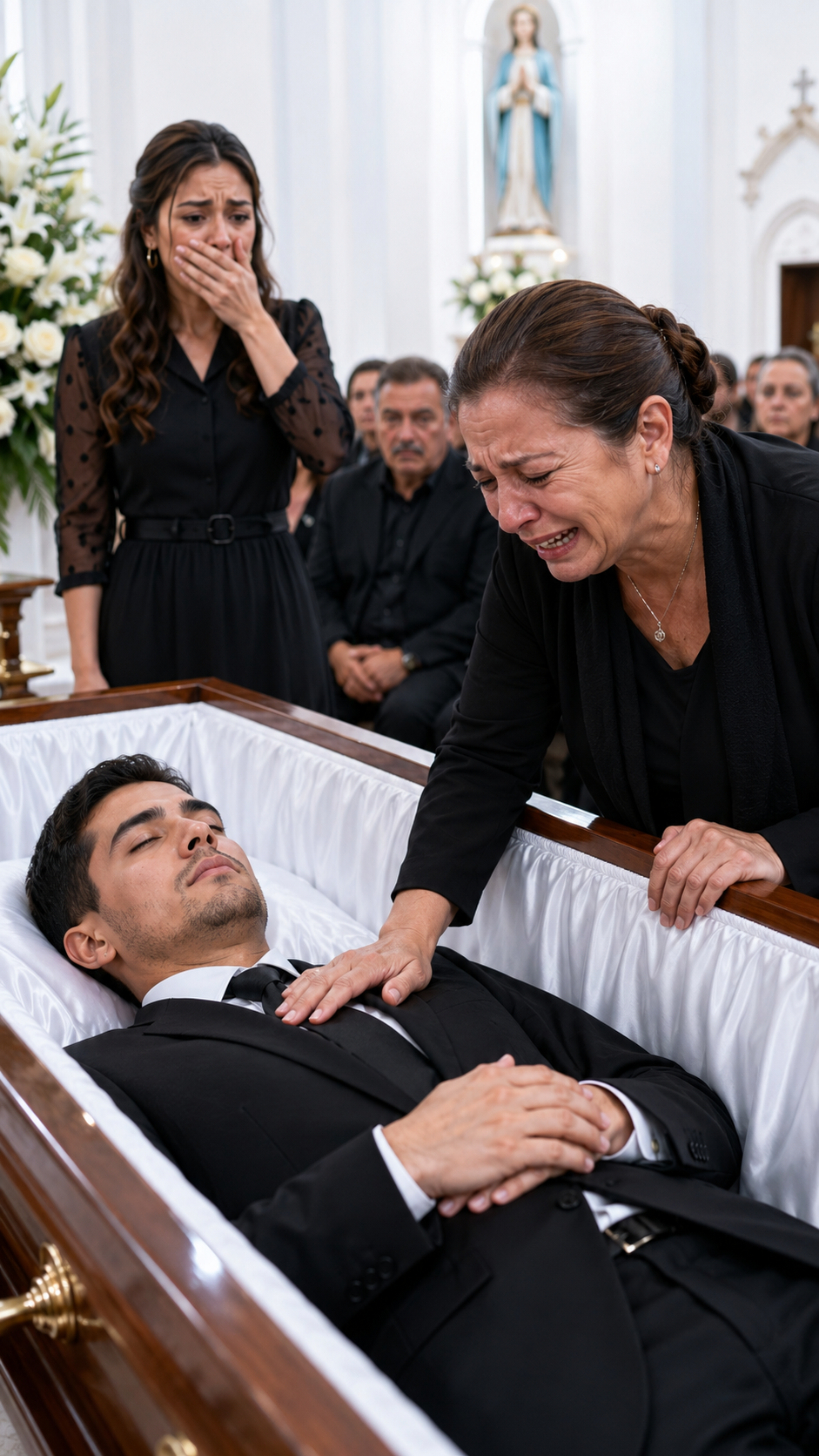
—If you lower that casket without me seeing my son first, I swear to God I’ll be buried standing right here.
Doña Socorro's voice sliced through the funeral chapel like a scream from the depths of every mother’s heart.
At 67, with gray hair plastered to her forehead by sweat, her shoes caked in dirt, and a black shawl awkwardly draped over her shoulders, she had traveled all night from Lagos de Moreno to Guadalajara. No breakfast, no sleep—just a single thought piercing her mind: to see her only son, Andrés, one last time.
But when she arrived, the casket was already closed.
The funeral staff was ready to take it to the cemetery.
Before her stood Paola, Andrés's wife, dressed elegantly in black, her makeup untouched, and a coldness that felt too calculated.
—Mrs. Socorro, please don’t make a scene —Paola said, pursing her lips—. Andrés asked that no one see him like this.
Doña Socorro glared at her, her eyes aflame with grief.
—My son called me even to ask how much salt went in the rice. Don’t you dare invent his last wishes for me.
The room fell silent.
There were two partners from Andrés’s company, several employees, a nervous lawyer, and a huge wreath with golden letters that read: “To my beloved husband.”
But something didn’t add up.
No one had told doña Socorro.
She found out from a neighbor, with a blunt message that nearly shattered her world:
“Doña Soco, I’m so sorry about Andrés. I didn’t know you wouldn’t be coming to the funeral.”
She had called her son twelve times.
Nothing.
Called Paola.
Nothing.
Called acquaintances until one whispered that Paola had organized everything quickly, with a closed casket and immediate burial.
Doña Socorro had raised Andrés alone, selling gorditas outside a high school. She ironed uniforms, bought used books, walked in the rain to take him to class, and often went without dinner so he could study.
So when Paola stepped in front of the casket, the mother felt a fire ignite within her.
—Open it —she commanded.
—No.
—Open it right now.
Paola stepped closer and whispered venomously:
—You and Andrés hardly spoke anymore. Don’t come now pretending to be the saintly mother.
That hurt.
Because it was a half-truth.
Ever since Andrés married Paola, he had distanced himself from his mother. Paola controlled his calls, his schedule, his meetings, his money. Doña Socorro had noticed it from the start.
—That woman doesn’t love you, son. She manages you.
Andrés got so angry he stopped visiting her on Sundays.
But one fight doesn’t erase a lifetime.
Doña Socorro shoved Paola with a force that took everyone by surprise. The staff tried to hold her back, but she broke free like a wounded beast.
She placed her hands on the casket.
She lifted it.
Andrés lay there, pale, lips purple, face unmoving.
Doña Socorro let out a groan and leaned in to kiss his forehead.
Then she saw it.
A tiny tremor in his eyelid.
Then, his chest rose slightly.
Almost nothing.
But enough.
—He’s alive —she whispered.
No one answered.
Doña Socorro turned to everyone, trembling with rage.
—My son is alive, you bastards! He’s breathing!
Paola stepped back, as white as a wall.
—That couldn’t happen… —she murmured.
And in that moment, everyone understood this wasn’t a medical mistake.
It was something much worse.
PART 2
—Call an ambulance! —doña Socorro screamed, thrusting her hands into the casket as if she could pull her son back from death—. Move, for the love of God!
The first to react was Martín, an old friend of Andrés who worked at his software company. Shaking, he pulled out his cell phone and dialed 911.
Paola remained pressed against the wall.
She wasn’t crying.
Wasn’t shouting.
Wasn’t praying.
She just stared at the open casket, a fear that didn’t seem like pain, but rather a fury at being caught.
—You knew —doña Socorro said, refusing to look away from Andrés—. You knew my son wasn’t dead.
—Don’t say stupid things —Paola replied, trying to regain her voice—. There was a certificate. There was a doctor.
—What doctor?
Paola didn’t answer.
When the paramedics arrived, the whole chapel erupted into chaos. They examined Andrés, applied oxygen, checked his pulse, and confirmed the impossible.
He was still alive.
Weak, cold, with almost imperceptible breathing, but alive.
—He’s in critical condition —said one paramedic—. We need to move him now.
Doña Socorro climbed into the ambulance without asking permission. She took his cold hand and pressed it to her chest.
—Don’t leave me, son. You still owe me pozole on Sunday. Don’t do this to me.
At the Civil Hospital, the doctors admitted him urgently. Hours passed. Doña Socorro paced the waiting room, a rosary tangled in her fingers, while Martín stayed by her side.
Just before dawn, Commander Estela Rivas from the prosecutor’s office arrived.
—Mrs. Socorro, this is no longer a family matter —she said seriously—. No one appears breathing inside a casket by accident.
Doña Socorro glanced down the hallway, where Paola was talking to a lawyer in a pricey suit.
—Then start with the one who was most eager to bury him.
The first pieces of evidence came quickly.
The death certificate had a forged signature.
The doctor mentioned denied ever examining Andrés.
The funeral home confessed that Paola had paid cash for an urgent service, with clear instructions: closed casket, quick transfer, no opening.
But the strongest evidence emerged from Andrés’s office.
Forty-eight hours before the alleged death, someone had modified the legal powers of the company. If Andrés died, Paola would take complete control of the accounts, shares, contracts, and properties.
Doña Socorro felt her legs buckle.
—It wasn’t love —she murmured—. It was ambition.
Then Martín handed his phone to the commander.
—Andrés sent me this three days before.
The message read:
“Martín, I found strange transfers. Paola moved money without authorization. If something happens to me, look for my mom. Don’t let her sign anything.”
Doña Socorro covered her mouth.
—My son wanted to warn me… and I thought he didn’t care anymore.
The commander shook her head.
—You arrived just in time. That’s why he’s alive.
Paola was taken in for questioning that same morning.
At first, she played the offended party. Claimed Andrés was sick, that she only respected his wishes, that doña Socorro was a conflictive woman who never accepted her marriage.
But when the commander laid out the funeral home videos, the forged documents, the transfers, and Andrés’s message, Paola stopped pretending.
Her face hardened.
—Andrés was weak —she spat—. Always thinking of his employees, his mom, paying taxes, doing things “right.” That’s how no one gets big.
The commander stared at her, unblinking.
—What did you give him?
Paola clenched her jaw.
—A medication. He was only supposed to appear dead for a few hours. I needed time to finalize the transfers.
—You were going to bury him alive.
Paola looked down but not out of guilt.
—I never thought that old woman would dare to open the casket.
When doña Socorro heard this, she didn’t cry.
She stood still.
As if something inside her had broken forever.
Hours later, a doctor emerged from intensive care.
—Mrs. Socorro… your son has woken up.
The mother walked to the room with trepidation. Andrés was full of wires, oxygen, cracked lips, and a dark mark near his neck.
But his eyes were open.
—Mom… —he whispered.
Doña Socorro pressed her hands to her chest.
—I’m here, son. No one will touch you again.
Andrés began to cry like a child.
—I’m sorry. I distanced myself from you. I left you alone.
She kissed his hand over and over.
—A son can get lost, Andrés. But a mother never stops looking for him.
He closed his eyes.
—You were right about Paola.
The next day, he requested to testify.
The commander turned on a recorder. Doña Socorro wanted to leave, but Andrés squeezed her hand.
—Stay. I don’t want to hide anything anymore.
Andrés recounted how for two months he noticed strange movements in the company. Paola created fake consultancies, altered contracts, opened accounts without authorization, and diverted funds.
When he confronted her, she laughed.
Told him he had no vision, that he still thought like “the son of a secretary,” and that a big company needed cold decisions.
—That night I told her I was going to report her —Andrés explained—. She calmed down too much. She apologized, made tea, and said we would talk calmly the next day.
He paused.
His voice cracked.
—Then I started to feel dizzy. I wanted to call you, Mom, but I was embarrassed. I thought you wouldn’t answer because of everything I did to you.
Doña Socorro cried in silence.
—Then I started to hear voices. I felt cold. I couldn’t move. I heard Paola say it would all be over in a few hours. Then I heard prayers, footsteps, flowers… and your voice.
The commander took a deep breath.
—Your mother saved your life.
Andrés looked at doña Socorro.
—As always.
The news exploded across Mexico.
“Mother opens casket and discovers her son is still alive.”
“Businesswoman attempts to bury her husband alive to seize the company.”
“A mother arrived late to the funeral and changed the entire story.”
But doña Socorro didn’t care about the cameras. She just wanted Andrés to sleep without fear again.
For weeks, he woke up screaming that he couldn’t breathe. He couldn’t stand closed doors. He couldn’t see boxes, dark rooms, or white flowers.
Doña Socorro slept in a chair by his bed. She brought him chicken broth, gelatin, hibiscus water, and tortillas wrapped in napkins.
—You’re always so stubborn —she said—. Even in dying you came back fighting.
Andrés smiled weakly.
—I came back for you.
A month later, the trial began.
The courtroom was filled with journalists, employees, and family members who had preferred silence before. Paola arrived in handcuffs, dressed in gray, perfectly styled, without a single tear.
She didn’t seem remorseful.
She seemed annoyed at having lost.
The prosecutor presented everything: medical reports, videos, forged signatures, transfers, messages, altered contracts, and the confession of the doctor who accepted money to sign a death he never verified.
Then Andrés took the stand.
He was still weak, but spoke clearly.
—I loved Paola. I trusted her with my home, my work, and my life. But she didn’t want to walk with me. She wanted to keep it all. When she realized I was going to uncover her, she decided to erase me.
Then he looked at his mother.
—For years I mistook my mother’s love for control. I was ashamed of my roots, of her job, of her way of speaking, of her calling me “son” in front of my partners. Today I understand that no success is worth it if to achieve it you let go of the hand that held you when you had nothing.
Doña Socorro covered her face to cry.
When it was her turn to testify, everyone expected to see her broken.
But she sat tall.
Looked at the judge.
And spoke without trembling.
She recounted how Andrés’s father left when she was pregnant. How she sold food on the street, how she washed other people's clothes, how she saved coins to pay for his university, how she pretended not to be hungry so he could eat.
Then she looked at Paola.
—You thought I was an ignorant old woman. You believed that with expensive flowers, a black dress, and a closed casket, you could silence me. But a mother recognizes her child even when everyone claims him dead. All it took was to see him breathe once.
The courtroom fell silent.
When the judge gave Paola the floor, she simply said:
—I built that company too. I deserved more.
The judge responded harshly:
—Believing you deserve something does not give you the right to take a life.
The verdict was severe: 15 years in prison for attempted murder, fraud, forgery, and criminal conspiracy. Moreover, she lost all rights to Andrés’s assets, shares, and accounts.
As she left the courthouse, reporters surrounded doña Socorro.
—What would you say to mothers whose children drift away?
She hugged Andrés’s arm.
—that distance doesn’t always mean forgetfulness. Sometimes children get lost trying to prove they can manage alone. But if a mother feels something is wrong, she should not stay silent. A mother’s intuition is not gossip. Sometimes it’s the last alarm before tragedy.
Andrés lowered his head.
—And what did you learn? —they asked.
He looked at his mother.
—that one can have a company, money, and a name on the door… but if you despise your roots, you end up poorer than before.
The recovery was slow.
Andrés had to rebuild his company from scratch. He fired the accomplices, audited contracts, returned money, and accepted losing clients to clear his name.
But this time, he didn’t do it alone.
Every Friday, he had dinner with doña Socorro. Sometimes in a little diner, sometimes at his house, with beans, red rice, and warm tortillas.
—I used to call you when I had extra time —he said one night—. Now I know that time isn’t extra. It’s set aside for those who matter.
Doña Socorro smiled.
—So many expensive studies to learn something so simple, son.
Months later, Andrés created a scholarship for underprivileged youth wanting to study technology. He called it “Roots.”
At the inauguration, he asked his mother to cut the ribbon.
—This is yours too.
She shook her head, embarrassed.
—I know nothing about computers.
Andrés took her hand.
—But you know about loyalty. And that’s worth more than any business.
The story didn’t go viral just because a mother opened a casket and found her son alive.
It went viral because thousands understood something uncomfortable: sometimes we ignore the voice that loves us most until life forces us to listen to it from the brink of death.
Paola lost her freedom for turning love into a business.
Andrés lost his arrogance but regained his mother.
And doña Socorro proved that true love doesn’t always arrive elegantly or whispers softly.
Sometimes it arrives late to a funeral home, pushes whoever needs pushing, and opens a casket even when everyone says not to.
Because a mother can make many mistakes.
But when she feels her son is still breathing, even death dares not contradict her.





