PART 1
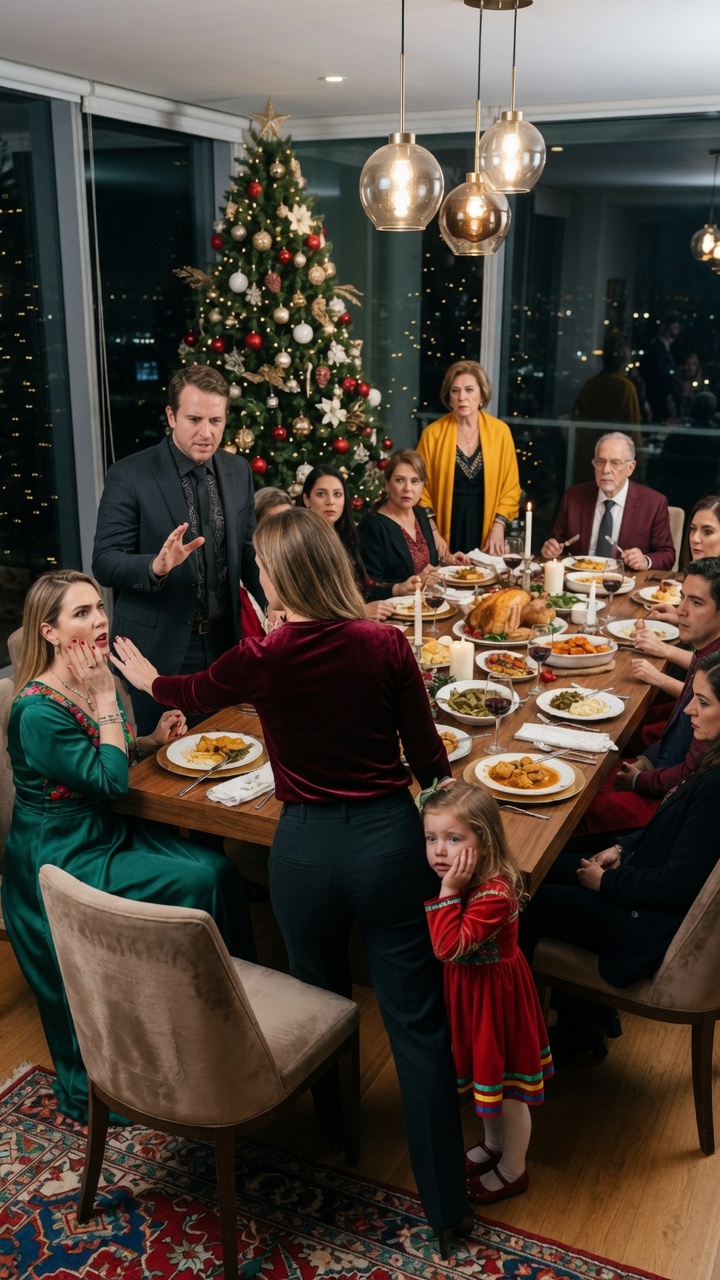
The slap echoed so loudly that even the Christmas carol on the TV seemed to fade.
At the dining table of the Polanco penthouse, there was turkey, cod, romeritos, expensive wine, and an entire family pretending to be civilized with silver cutlery. But no one moved when Isabela, just five years old, brought her hand to her cheek.
Her aunt Camila, Javier's sister, stood over her in a designer red dress, a glass in her hand.
"So she learns not to make faces at a decent table," she said, as if she had just corrected a servant and not struck a child.
Renata Vargas felt the blood rush to her head.
For seven years, she had tolerated that family's comments. Her Puebla accent. Her clothes not being designer. How Javier "had taken care of her." How Isabela was "too sensitive."
But that night, they crossed a line that had no return.
"What did you just do to my daughter?" Renata asked, standing up.
Camila smiled contemptuously.
"What you don’t do: educate her."
Isabela lowered her gaze. Her eyes were full of tears, but she wasn’t crying. That was what finally shattered Renata's heart. Her little girl was already learning to swallow her pain to avoid upsetting the adults.
"I just asked if I could have a piece that wasn’t burned," Isabela whispered.
Doña Begoña, the mother-in-law, placed her glass on the white tablecloth.
"Renata, don’t exaggerate. Kids need to behave. In this family, we don’t throw tantrums over everything."
Álvaro, the father-in-law, stared at his plate as if the turkey was more important than his granddaughter's red cheek.
And Javier, Renata's husband, clenched his jaw.
Renata waited for a word.
Just one.
She waited for him to stand up, to hug their daughter, to look at his sister and tell her to never touch her again.
But Javier merely murmured:
"Renata, please. Don’t ruin dinner. It’s Christmas Eve."
The phrase fell on the table like another slap.
Renata looked at him slowly.
"I’m not ruining dinner," she said with a calmness that frightened everyone. "I’m ruining the lie."
Camila let out a laugh.
"What lie, loser?"
Renata walked up to her and took the glass from her hand before it spilled.
"You will not come near my daughter again."
"And what are you going to do?"
Renata didn’t shout. She didn’t cry. She didn’t plead.
She simply picked up Isabela, took out her phone, and looked at the entire family sitting under the enormous tree.
"This is the last Christmas you spend in this house."
Doña Begoña stood up, furious.
"Excuse me? This house belongs to my son."
Javier turned pale.
And right there, before anyone could respond, Renata called her lawyer and said:
"Valeria, bring me the file. And send two moving trucks to Polanco. Tonight."
PART 2
The silence that followed was different from the one after the slap.
It was no longer the elegant silence of a rich family wanting to cover up an embarrassment. It was the silence of people who had just heard a dangerous word: file.
Javier finally stood up.
"Renata, hang up. You’re making a fool of yourself."
She adjusted Isabela against her chest. The girl still felt warm on her cheek and trembled a little, like someone holding back tears to not disturb.
"No, Javier. The fool was you asking for calm after your sister slapped your daughter."
Camila threw her napkin on the table.
"It was a slap, not a murder. Seriously, how dramatic."
Renata looked at her with icy sadness.
"To you, it was a slap. To her, it was learning that an adult could hurt her and everyone could keep dining."
Doña Begoña slammed her palm on the table.
"Enough! You’re going to apologize to Camila for making this scene."
Renata let out a dry laugh.
"You still don’t understand, do you? I’m no longer asking for permission."
She walked out of the penthouse with Isabela in her arms. No one followed her. Javier didn’t even reach the elevator.
In the lobby, the guard noticed the red mark on the girl’s face and froze.
"Mrs. Renata… do you need help?"
"Yes," she replied. "I need you to save the videos from the cameras tonight."
The guard understood immediately.
First, they went to the hospital. The doctor examined Isabela carefully, took photos, wrote a report, and asked who had hit her.
Isabela answered softly:
"My aunt Camila."
"Were there adults present?"
The girl nodded.
"My dad."
The doctor said nothing, but her pen paused for half a second. And that half second confirmed to Renata that what had happened could no longer be brushed off as a "family matter."
At 11:58, Valeria Márquez arrived at the hospital with a black folder.
"Are you sure?" she asked.
Renata looked at her daughter sleeping on the gurney.
"I was sure for seven years trying to fit in. Today I am awake."
At 12:40 AM, they returned to Polanco.
In front of the building were two white trucks and six loaders with sleepy faces. Valeria had copies of titles, invoices, and a preliminary notice.
When they went up, Javier opened the door with red eyes.
"Where have you been? My mom is hysterical."
Renata entered without putting Isabela down.
"How strange. When your daughter was hurt, you weren’t so concerned about the hysteria."
Doña Begoña appeared from the living room almost intact, still wearing pearls and borrowed dignity.
"What does this mean?"
Valeria stepped forward.
"It means my client will remove her personal belongings and will formally notify the termination of the lease tomorrow."
Camila frowned.
"Lease? What is this old woman talking about?"
Valeria opened the folder.
"That this penthouse does not belong to Javier Villarreal. It belongs to Renata Vargas Salcedo. She bought it three years before the marriage. Separate property regime. Mortgage paid off by her. Property taxes, maintenance, furniture, and services paid by her."
Doña Begoña's face changed.
First, disbelief.
Then rage.
Then fear.
"Javier…" she whispered.
He didn’t look at her.
Renata understood everything with that gesture. Javier always knew. He had let his mother call her a freeloader in her own house. He had allowed Camila to humiliate her under a roof that Renata paid for. He had let Isabela ask for permission to exist at a table bought with her mother’s work.
Camila snatched a page from the folder.
"This is false."
Valeria pointed to the seal.
"Public Property Registry, sweetheart. False is the fancy last name when it's upheld with someone else's money."
The loaders began to come in.
First, the large painting from the living room, a Puebla painting that Doña Begoña always said was "very artisanal" until her friends praised it.
Then the lamps.
Then the dishes.
Then the glassware.
Then the rugs.
Then the chairs where no one had stood up to defend a little girl.
Camila tried to stop a loader carrying a silver tray.
"That belongs to my mom!"
Valeria raised an invoice.
"Purchased by Renata. Palacio de Hierro, December 18. Do you want a copy?"
Camila fell silent.
The living room began to look like it really was: huge, cold, empty. Without Renata's belongings, the elegance crumbled like cheap scenery.
Javier followed Renata down the hall.
"Please, don’t do this in front of everyone."
She opened Isabela's room and began to pack pajamas, stories, and a teddy bear into a suitcase.
"Are you embarrassed in front of everyone? Weren’t you embarrassed in front of everyone when your sister hit your daughter?"
"I froze."
"No, Javier. You chose."
He closed his eyes.
"My mom was going to explode. Camila was out of control. I thought…"
"You thought of everyone but Isabela."
Javier was left without defense.
At 1:30, the trucks left.
Renata didn’t take the table. She left the cold turkey, the dirty glasses, and the lit tree. She wanted those lights to illuminate what remained when they removed the money from the woman they called "low-class."
Before leaving, Valeria handed a paper to Javier.
"Any communication will be in writing. The medical report, the building videos, and the testimonies will be preserved. Camila must not approach the minor."
Doña Begoña shouted from the living room:
"You’re going to destroy this family!"
Renata paused at the door.
"No. You destroyed it when you decided that a little girl was worth less than a dinner."
That night she didn’t return to the apartment she shared with Javier. Valeria took her to her house in Coyoacán. Her mom, Doña Amalia, opened the door in a robe, gray braids, and the smell of punch.
She didn’t ask anything.
She just hugged Renata.
And Renata, who had held it together in the hospital, in the elevator, and in front of the entire Villarreal family, finally cried.
She cried without perfect makeup.
Without a straight back.
Without apologizing for feeling.
Isabela woke up on the couch.
"Are we going to be kicked out of here too?"
Renata knelt in front of her.
"No, my love. No one is going to kick you out for telling the truth."
"Is dad mad at me?"
Renata felt something break inside her.
"No. And if he is, that’s his problem. You did nothing wrong."
The next day, the family chat exploded.
A cousin sent a photo of the empty living room with the message:
"Renata has gone crazy and stole half the house on Christmas."
The comments came like stones.
"Climber."
"Poor Begoña."
"Javier should take the girl away from her."
Valeria took Renata's phone and wrote a single response:
"Out of respect for a minor, I will not discuss this here."
She attached an image.
It was not Isabela's cheek.
It was not the report.
It was the first page of the title, with Renata's name on it.
The chat went silent.
Then an aunt wrote:
"Begoña, was the penthouse Renata’s?"
No one responded.
Sometimes truth doesn’t need scandal. It only needs a seal.
On December 26, Camila received a notice to stay away from Isabela. On the 28th, Doña Begoña was informed that she had to vacate the property within the legal timeframe.
Her pride became poison.
She sent messages.
"You’re leaving us on the street."
"A good wife doesn’t humiliate her husband."
"Your daughter is going to hate you for separating her family."
Renata didn’t respond.
The only time she answered was when Doña Begoña wrote:
"Your father would be ashamed of you."
Renata looked at the photo of her dad, a rural teacher who had sold his truck to pay for her university.
Then she wrote:
"My dad taught me not to kneel in houses I bought myself. Don’t bring his name up again."
Doña Begoña never mentioned it again.
Javier took days to understand that he couldn’t fix it with flowers. He asked to see Isabela, but Valeria was clear: supervised visits, parenting therapy, and no presence of Doña Begoña or Camila.
The first visit was in a family center in Del Valle.
Javier arrived without gifts. Only with a notebook.
When Isabela entered with her teddy bear, he knelt but didn’t hug her.
"Hello, my love. I wrote this because I don’t want to fail you again."
The psychologist listened as Javier told her:
"When your aunt hurt you, I should have stood up. I didn’t because I was afraid of my mom. That fear was mine, not yours. It was wrong for you to pay for my cowardice."
Isabela asked:
"Does Grandma love me?"
Javier cried.
"I don’t know if she knows how to love well. But you don’t have to be near anyone who hurts you, even if they’re family."
When the psychologist told Renata, she didn’t forgive everything. But she breathed differently. For the first time, Javier had spoken as a father and not as an obedient son.
Months later, Camila agreed to apologize in writing and pay for child therapy. She didn’t do it out of kindness. She did it because her social circle began to find out that the story of "the aggressive sister-in-law" had a five-year-old girl at its center.
Doña Begoña resisted until the last day.
When she finally delivered the penthouse, Renata went up alone. She walked to the empty dining room and stared at the spot where her daughter had been hit.
There was no tree anymore.
No turkey.
No voices saying she exaggerated.
Just white walls and a huge truth.
"No more," Renata said out loud.
She sold the penthouse two months later. With that money, she bought a house in Coyoacán, with a patio, an old-tiled kitchen, and a yellow room for Isabela.
They also adopted a dog from Xochimilco. Isabela named him Buñuelo because he was round, sweet, and a thief of bread.
The divorce was finalized in September.
Javier didn’t ask for money. He didn’t fight for the penthouse. He continued attending therapy and learned small things he used to think were secondary: making lunch, braiding hair, arriving early, listening without justifying his mother.
One day, Isabela came back from seeing him with a beaded bracelet.
"Dad said that caring isn’t just working. It’s also being there."
Renata smiled sadly.
"That’s good, my love."
"Can I still love him?"
"Of course. Loving your dad doesn’t mean forgetting what happened. It means your heart is yours."
The next Christmas Eve was different.
At the house in Coyoacán, there were tamales, punch, buñuelos, mismatched plates, and burnt cookies.
When Isabela saw the tray, she froze. Then she looked up at her mom.
"Can I eat one that isn’t burnt?"
For a second, the past crossed the kitchen again.
Renata took a deep breath and picked up a black cookie by the edge.
"Of course. These taste like experience."
Isabela let out a full laugh.
Free.
Without fear.
That sound filled the house better than any Christmas carol.
At midnight, Renata raised her cup of punch.
"To Isabela," she said. "Because her little face shouldn’t have to bear the lesson we all learned. And because from that night, this house has a rule: no one has to stay silent to be loved."
Isabela raised her hot chocolate.
"And to Buñuelo, who almost doesn’t pee in the kitchen anymore."
Everyone laughed.
Later, when the house fell quiet, Isabela sat on Renata’s lap.
"Mom, do you remember when they closed the door on us?"
"Yes."
"I thought we didn’t have a house anymore."
Renata looked at the illuminated kitchen, the crooked tree, the sleeping dog, and the keys on the table.
"I was scared too."
"But we did have one."
Renata kissed her hair.
"Yes, my love. It’s just that we hadn’t arrived yet."
That night, before sleeping, Renata took the key to her new house.
It weighed little.
Much less than the key to the Polanco penthouse.
But it opened something bigger.
It opened a door that no one would ever close on her from the inside again.
And a life where her daughter would never have to apologize for being hurt.





