PART 1
"Let her come. I want to see her sitting in the back, watching what she could never have."
That was what Doña Graciela Arriaga said as she reviewed the cream invitations with golden edges, printed for the most talked-about wedding in San Miguel de Allende.
It wasn’t an invitation. It was a humiliation scented with expensive perfume.
The recipient was Valeria Soto.
Four years earlier, Valeria had loved Leonardo Arriaga with a tenderness so pure it was almost painful. He was the only son of a family that owned boutique hotels in Querétaro, Los Cabos, and the Riviera Maya. His last name graced social magazines, opened doors, and made people smile more when Doña Graciela entered a room.
Valeria had none of that.
She was a primary school teacher in Morelia, the daughter of a van driver and a woman who sold meals outside a clinic. She had simple hands, a calm voice, and one dream: to open a center where adult women could finish their secondary education without feeling shame.
Leonardo met her in a university café, when she patiently explained a topic he didn’t understand. From that moment on, he began looking for any excuse to see her.
With Valeria, Leonardo wasn’t “the young Arriaga.” He was just Leo.
He promised her a house with clay pots, Sundays with chilaquiles, children running in their socks, and a life without pretenses.
But the day he took her to the family mansion in Lomas de Chapultepec, Doña Graciela smiled at her like one smiles at an employee.
"You’re very pretty, Valeria. So natural. Though to enter certain families, you need more than a good heart."
Valeria understood the blow.
Leonardo pretended not to hear it.
Then came the worst.
Before discussing a commitment, Doña Graciela demanded medical tests.
"It’s not an offense," she said, adjusting her pearls. "It’s responsibility. The Arriaga family doesn’t improvise heirs."
Valeria accepted because Leonardo swore nothing would change.
The doctor said Leonardo had low fertility and that Valeria had a hormonal disorder that could complicate a pregnancy. Difficult, but not impossible.
Doña Graciela took the word "difficult" and turned it into a condemnation.
"A woman who cannot guarantee children is of no use to my son."
Valeria looked at Leonardo, waiting for a defense, a phrase, a "that’s enough."
He looked down.
That silence shattered her.
That same night, Valeria left with a small suitcase. Leonardo didn’t chase her. He didn’t knock on her door. He didn’t fight. He didn’t ask.
Two months later, Valeria fainted at school.
In a public clinic, the ultrasound showed three tiny heartbeats.
Triplets.
Valeria cried sitting in the bathroom, holding the image as if it were a secret capable of changing her life. She didn’t return. She didn’t want her children to be treated as proof, threat, or trophy.
She moved, changed her number, and accepted help from an old principal named Elsa. That’s how Emilio, Bruno, and Camila were born. Premature, fragile, stubborn as miracles.
Four years passed.
Leonardo became what his mother wanted: director of Arriaga Hotels, perfect suit, magazine smile, and a girlfriend chosen as if she were part of a business alliance.
Fernanda Luján, heir to real estate developers, elegant, educated, beautiful even when serious.
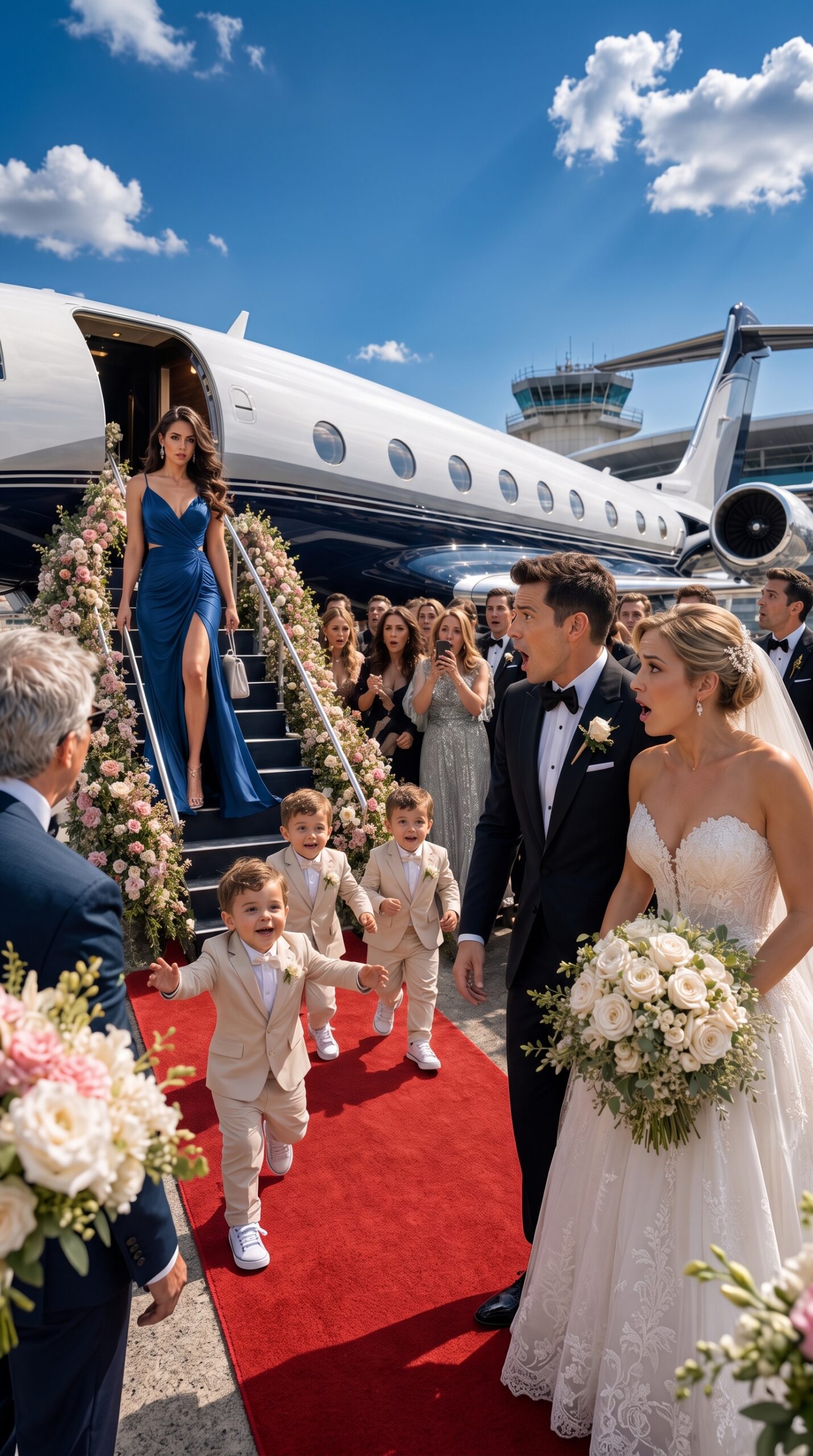
The wedding would be in a super expensive hacienda in San Miguel de Allende, with white flowers, fine mariachi, politicians invited, society influencers, and photographers ready to capture “the event of the year.”
Then Doña Graciela decided to cap off her cruelty.
She invited Valeria.
"Let her see that my son did find a woman of his level."
But Valeria was no longer the broken girl she imagined.
On the afternoon of the wedding, a black truck stopped in front of the hacienda. Valeria stepped out in a simple ivory dress, her hair pulled back, and a calm that didn’t ask for permission.
Then three four-year-olds got out.
Two boys and one girl.
They had Leonardo’s dark eyes, his childhood wavy hair, and the same dimple on the left cheek that appeared in old Arriaga photos.
The music began to fade.
Leonardo stood frozen next to the altar.
Doña Graciela turned pale.
Camila squeezed Valeria’s hand, looked at the groom, and asked with brutal innocence:
"Mom… is that man the dad who never came for us?"
PART 2
The garden fell so silent that the sound of a glass hitting the floor echoed.
Fernanda, dressed as a bride, didn’t look at Valeria first. She looked at the three kids. Then she turned to Leonardo, and in her eyes appeared a truth that had probably been haunting her chest for months.
"Did you know?" she asked.
Leonardo opened his mouth, but not a single word came out.
"No," he finally said, his voice cracking. "I swear I didn’t know."
Fernanda let out a small, joyless laugh.
"Maybe you didn’t know about them. But you did know you never loved me completely."
He tried to step closer.
She backed away.
"For two years, I asked you if you were happy. You always said yes. But every time we talked about kids, a home, a future, you stared into the void. Now I understand who you were looking at."
Doña Graciela reacted as if the shame were Valeria’s fault.
"This is a lack of respect. How dare you come like this?"
Valeria pulled the invitation from her bag and held it up for everyone to see.
"You invited me, Doña Graciela. It says right here that my presence was very important."
Murmurs grew.
An aunt of Fernanda covered her mouth. A businessman from Monterrey stopped recording. The photographer lowered his camera, nervous, unsure if he was witnessing a scandal or a tragedy.
"I invited an ex-girlfriend," Graciela said through clenched teeth. "Not a woman who comes to invent children in front of everyone."
Valeria didn’t raise her voice.
"I didn’t come to invent anything. I came with your grandchildren."
Leonardo took a step toward the kids.
Camila hid behind Valeria. Bruno hugged a plastic dinosaur to his chest. Emilio, the oldest by two minutes, stood in front of his siblings with a seriousness that didn’t match his four years.
"Don’t come any closer," he said.
Leonardo stopped as if he had been hit in the chest.
"You’re right," he whispered. "They don’t know me."
Bruno looked at him with wide, fearful eyes.
"Did you know we existed?"
Leonardo swallowed hard.
"No."
Emilio didn’t blink.
"And did you look for my mom?"
Valeria fell silent. That question didn’t belong to her.
Leonardo looked at the floor, the same floor he had stared at four years ago when he should have defended her.
"No," he confessed.
Camila peeked out from behind Valeria.
"Why?"
That question, asked by a girl in a yellow dress with a crooked bow, tore off his last mask.
"Because I was a coward. Because I let my mom decide for me. Because when I should have taken care of your mom, I stayed silent."
Doña Graciela approached angrily.
"Enough, Leonardo! You don’t have to lower yourself in front of a woman who…"
"Shut up, Mom."
No one expected that.
Doña Graciela froze.
Leonardo looked at her with eyes full of shame.
"I heard you humiliate her. I heard you say she was worthless. And I did nothing. I won’t repeat it today."
Fernanda slowly took off her engagement ring and placed it on a table covered with roses.
"I’m not going to marry to save a last name," she said. "Valeria deserved respect. These kids deserved a father. And I deserved a man who wouldn’t use my life to hide his cowardice."
Graciela tried to grab her arm.
"Fernanda, think of the scandal. Think of your family."
Fernanda looked at her with a dignity that made her seem taller than everyone.
"My family will survive a canceled wedding. What I wouldn’t survive is a hollow marriage."
Then she turned to Valeria.
"Thank you for arriving before I made the most expensive mistake of my life."
And she walked out of the garden.
The veil dragged white petals like remnants of a lie.
The wedding ended without a wedding.
But the real war began an hour later.
Leonardo asked to speak with Valeria in a private room in the hacienda. The kids were with Elsa, the woman who had accompanied Valeria since the pregnancy and whom they called "Abuelita Elsa."
Leonardo stood, still in his wedding suit.
"Why didn’t you tell me?" he asked.
Valeria let out a bitter laugh.
"For what? For your mother to ask for proof? For her to say they were someone else’s? For you to look at the floor again?"
He didn’t defend himself.
"I deserve it."
"I didn’t come back for you, Leonardo. I came for them. Camila asked me why her classmates had dads at the kindergarten festival and she didn’t. Bruno said maybe his dad was lost. Emilio didn’t ask anything, but he stopped drawing complete families."
Leonardo’s face crumbled.
"I didn’t know."
"You didn’t know because you chose not to know."
Valeria opened her bag and placed a blue folder on the table.
Inside were birth certificates, ultrasounds, incubator photos, hospital receipts, medical reports, and a DNA test arranged months earlier by her lawyer.
Leonardo read the sheet with trembling hands.
Probability of paternity: 99.9%.
He sat down as if his legs could no longer hold him.
"They’re mine."
Valeria corrected him calmly.
"They’re their own. You’re their biological father. Being their dad, you still have to earn that."
At that moment, the door burst open.
Doña Graciela entered with a family lawyer and a hardened face.
"Then let’s talk about custody."
Valeria didn’t move.
She looked first at Graciela, then at the lawyer, and finally at Leonardo.
"Custody?" she asked.
Graciela lifted her chin.
"They are Arriaga. You can’t pretend that three children with that blood live hidden in Morelia, without a future, without a quality education, without the place they deserve."
Valeria smiled without joy.
"How curious. Four years ago, that blood wasn’t worth much when you said I was a defect."
The lawyer cleared his throat.
"Ms. Soto, the family just wants to ensure the wellbeing of the minors."
"Sir," Valeria replied, "if you use the word wellbeing to mean money again, this conversation ends here."
Leonardo stood up.
"Mom, leave."
Graciela looked at him as if she didn’t understand.
"What did you say?"
"I said to leave."
"Leonardo, you’re upset. She’s manipulating you."
"No. You manipulated me for years. You manipulated Fernanda. You manipulated everyone. And you nearly destroyed the lives of three children before meeting them."
Graciela pointed at the folder.
"Are you going to accept everything without a fight? Are you going to let her control the heirs of the family?"
Leonardo took the DNA test.
"I’m not going to fight against the mother of my children so you can turn them into decorations of the last name."
The phrase left her breathless.
The lawyer closed the briefcase uncomfortably.
"Mrs. Arriaga, perhaps it’s best that we leave."
Graciela exited, but her gaze promised poison.
When they were alone, Leonardo looked smaller inside his expensive suit.
"I’m not going to let her attack you again," he said.
Valeria looked at him for a long time.
"The problem is you let her before."
"I know."
"And that doesn’t erase itself with a sweet phrase after ruining a wedding."
"I know."
"My children don’t need last names in magazines, fancy parties in haciendas, or gifts delivered by a chauffeur. They need stability. They need adults who keep their promises. They need to know that if someone promises to arrive at ten, they arrive at ten. Not at ten-thirty because they had a meeting."
Leonardo nodded.
"I’ll do whatever you decide. Legal agreement, therapy, supervised visits, whatever it takes. I don’t want to win. I want to repair."
Valeria looked down at the folder.
There lay four years of fevers, diapers, debts, sleepless nights, doctor’s appointments, first steps, birthdays without a father, and questions she answered with a tight heart.
None of that would return.
"We’ll start slow," she finally said. "In family court. Short visits. No press. No mother near them until I consider it safe."
Leonardo breathed as if that minimal opportunity was more than he deserved.
"Thank you."
"Don’t thank me. Fulfill your promises."
And for the first time, he did.
The next day, the story exploded on social media.
"Ex-girlfriend arrives with triplets at hotel heir's wedding."
"Bride cancels wedding in San Miguel."
"The scandal that brought down the Arriagas."
Doña Graciela tried to control the narrative. She called journalists, society friends, a TV host who owed her favors. She wanted to leak that Valeria had arrived for money.
Leonardo stopped her with a brief statement:
"Valeria Soto did not lie. My children exist because she had the courage to raise them alone. I failed by not searching for her and not defending her when I should have. I ask for respect for her, for Fernanda, and for the children."
Graciela called him, furious.
"You’ve just destroyed us."
"No, Mom. I just stopped lying."
The first visits were in Morelia.
Leonardo understood that being a dad wasn’t crying in front of a judge or signing big checks. It was sitting on the floor building blocks. It was learning that Bruno couldn’t stand carrots in rice, that Camila slept with a light on, and that Emilio got serious when he was scared.
He also met Julián.
Julián was an architect, a friend of Elsa’s, and the man who had taken Valeria to the hospital when the triplets were born too early. He had bought medicine, carried strollers, fixed leaks, and waited outside emergencies without asking anything in return.
The kids called him "Uncle Juli."
Leonardo wanted to feel jealous but didn’t dare. That man had been where he hadn’t.
One afternoon, Bruno fell in the yard and scraped his knee. Leonardo ran first.
"It’s okay, champ. I’m here."
Bruno cried and hugged him without thinking.
Leonardo stood frozen.
It was the first time one of his children sought him out.
Valeria watched from the door. She didn’t smile. But she didn’t look away either.
That night, Leonardo said to her:
"I know I arrived late."
"Yes."
"I know Julián was there when I wasn’t."
"Yes."
"I’m not going to compete with him."
"You’d better not," Valeria replied. "He never competed with you. He protected what you abandoned before knowing it existed."
Leonardo lowered his head.
"I respect him. If my children love him, I’ll be grateful they have him."
Valeria saw something different in him. Not a magical redemption, because those don’t exist, but a real crack in the cowardly man she had left behind.
Six months passed.
Leonardo arrived at the kindergarten festival without guards, without a photographer, and without a flashy watch. He arrived twenty minutes early. He sat in the back, where Valeria indicated.
When Camila saw him from the stage, she hesitated for a second.
Then she raised her little hand.
"Hi, Dad," she said softly.
The microphone caught it.
Leonardo cried without hiding.
Emilio didn’t smile, but when it was over, he approached and handed him a drawing. It was three children, a mom, Elsa, Julián, and a tall man standing a little far away.
"You still don’t fit close," Emilio said.
Leonardo received the drawing like a just sentence.
"That’s fine. I’m going to earn my place."
Weeks later, Graciela asked to see Valeria. She arrived at the community center Valeria had finally opened in Morelia: "Casa Raíz." She didn’t wear pearls, a chauffeur, or that queenly look that once belittled people.
Inside, older women read aloud. A 61-year-old construction worker wrote his full name for the first time. A young mother solved divisions while her baby slept in a stroller.
Graciela walked through the place in silence.
"I was wrong about you," she finally said.
Valeria didn’t respond.
"I treated you as if you weren’t enough. And you built something more worthy than all we ever boasted."
Valeria crossed her arms.
"I’m not going to forgive you today just because you found the right words."
"I understand."
"My children are not a prize for repentant grandmothers. If they ever meet you, it will be slowly. And if you try to measure them as you measured me, you won’t see them again."
Graciela looked down.
"I accept."
Valeria didn’t entirely believe her. But she understood that shame sometimes begins to break pride from within.
The moment everyone remembered came during the official inauguration of Casa Raíz.
There were neighbors, teachers, local reporters, students, and children running among plastic chairs. Elsa was handing out hibiscus water. Julián was setting up a sound cable. Leonardo arrived with simple flowers. Graciela appeared behind, quiet, without drawing attention.
Valeria stepped up to a small platform.
"This place is for those who once heard they were not enough," she said. "For those measured by their money, their last name, their body, their origin, or by someone else’s idea of what a family should be."
She looked at her children. Then at Leonardo. Then at Graciela.
"No one has the right to decide the worth of another person just because that person doesn’t fit their mold."
Applause filled the yard.
Leonardo cried.
Graciela did too.
And Valeria, the woman invited to a wedding to be humiliated, stood before everyone, bigger than ever.
Not because she had destroyed those who looked down on her.
But because she built a life so full of love, purpose, and dignity that those who once gazed down had to lift their eyes to see her.
Sometimes, the best response isn’t revenge.
It’s surviving without becoming cruel.
It’s protecting children without teaching them hate.
It’s showing that a last name can buy haciendas, flowers, covers, and silences, but it can never buy the courage to stay when love is costly.
And that afternoon, while Camila took one hand of Valeria and another of Leonardo, Bruno ran to Julián, and Emilio leaned on Elsa, everyone understood something that hurt and healed at the same time:
the children don’t need perfect adults.
They need honest adults who arrive, stay, and learn to love without turning them into trophies.





