PART 1
—Tell the doctor you slipped in the bathroom... or when you get home, you won't wake up again.
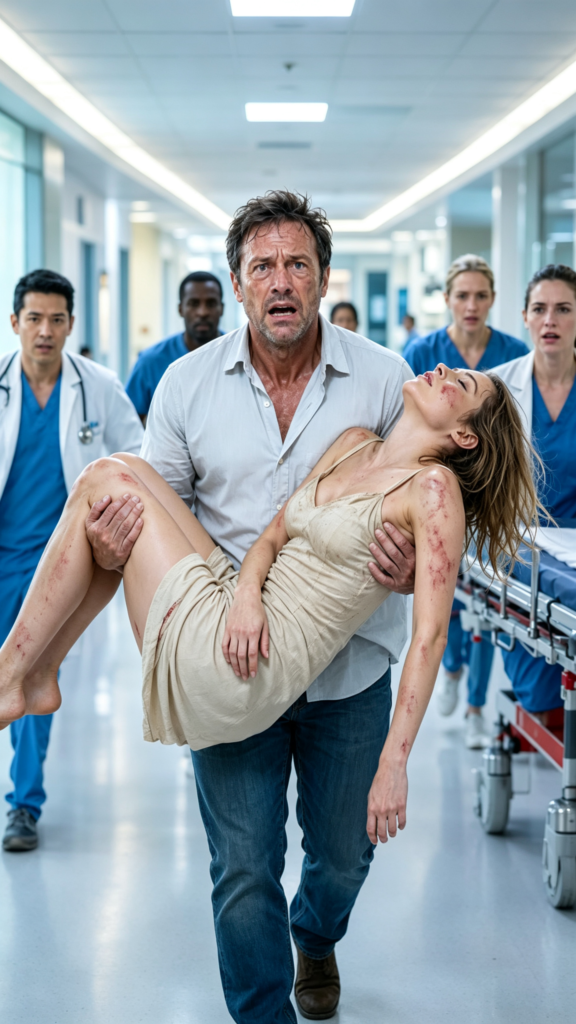
That was the first thing Valeria Montes heard when she opened her eyes in the ER, under a glaring white light that burned her eyes.
She was 26 years old, with a split lip, a throat on fire, and a headache so intense she wasn't sure if she was alive or dreaming. Beside her was Ernesto Cárdenas, her stepfather, in a crisp blue shirt, a gold watch, and a face of concern that looked rehearsed in front of the mirror.
On the other side was her mother, Luisa, clutching her purse as if the last vestiges of dignity she had left were hidden inside.
—It was an accident, doctor —Luisa said as soon as the doctor entered—. She fell coming out of the shower. My daughter is always distracted, you know how young people are.
Valeria tried to speak, but Ernesto squeezed her hand beneath the sheet. It didn't feel like a gesture of affection. It felt like a warning.
—Right, Vale? —he murmured, smiling without showing his teeth—. You fell all by yourself.
She didn't respond.
Because the truth wasn't in the bathroom.
The truth lay in that house in the Independencia neighborhood of Monterrey, where Ernesto turned every night into a minefield. Sometimes he exploded because the soup was cold. Other times because Valeria left a cup out of place. And when he arrived drunk, he'd sit in the living room, take off his shoes, and yell:
—Valeria, come here. I'm bored.
Luisa always looked down.
She never called anyone. Never intervened. Never opened the door for her daughter to escape.
She just repeated:
—Don't answer, honey. You know how he gets.
That night everything started over $300.
Valeria had hidden the money in a notebook, thinking of using it to buy a bus ticket and leave for Saltillo with a friend. Ernesto found it while rummaging through her things.
—You were going to run off like a rat? —he asked, throwing the notebook at her chest.
Valeria felt something inside her shatter.
—I'm not yours.
Ernesto let out a dry laugh.
—Of course you are. You eat here, sleep here, and your mother lives thanks to me.
Luisa appeared in the kitchen doorway, pale.
—Valeria, please, be quiet.
But Valeria couldn’t hold back anymore.
—No, Mom. The one who should be ashamed is you. Because you see everything and still serve him dinner.
Silence fell heavily.
Ernesto walked toward her slowly, as if savoring every second before the blow. He shoved her against the table. Then against the wall. Valeria tried to shield herself, but he grabbed her by the neck.
Luisa cried.
But didn't move.
—Apologize —she pleaded—. Don’t make him angrier.
Valeria, nearly out of breath, managed to say:
—You’re killing me too.
Then there was only the floor, blood, and darkness.
Now, in the hospital, the doctor attending her was Dr. Mateo Salinas. He was young, serious, with weary eyes from having heard too many lies.
He looked over the bruises on her arms. Then her neck.
—Did she say she fell in the bathroom? —he asked.
—Yes, doctor —Luisa replied quickly—. It was quite a scene.
The doctor didn't take his eyes off Valeria.
—What a strange bathroom. Because these marks look like fingers.
Ernesto clenched his jaw.
—Doctor, my stepdaughter is exaggerating. She has had issues since her father died. Don't make a scene.
Dr. Mateo picked up the phone.
—I need police support in the ER. Cubicle 6. Possible domestic violence.
Ernesto stopped pretending.
He leaned close to Valeria and whispered:
—Deny this right now.
Valeria looked at him with swollen eyes.
—No.
And when Ernesto realized she was going to speak, his expression changed in a way so cold that even Luisa began to tremble.
Because Valeria hadn’t just survived.
She had come to the hospital with the evidence that could drown them forever.
PART 2
The police entered the cubicle silently, but Ernesto made a scene as if the hospital were his.
—This is ridiculous —he shouted, raising his voice—. I brought her because I was worried. If I were guilty, do you think I’d be here?
Luisa nodded immediately, with red eyes.
—My daughter gets confused a lot. Since she lost her father, she has become difficult. Sometimes she makes things up. We just want to help her.
Valeria closed her eyes.
There it was again.
Her pain turned into madness. Her fear turned into “drama.” Her silence used as proof that no one should believe her.
Dr. Mateo stood by the stretcher.
—While she is under medical care, no one will speak for her.
Ernesto looked him up and down.
—You don’t know who you’re talking to.
—To someone who shouldn’t be threatening in a hospital —the doctor replied.
A nurse entered with a transparent bag containing Valeria's belongings: her stained pants, a hair tie, and her shattered phone.
Valeria took it with trembling fingers. She failed the code twice. On the third try, she unlocked it.
Ernesto paled when he saw what he was looking for.
—Valeria, give me that phone.
She opened a folder labeled “assignments.”
Inside were audios, photos, short videos, screenshots, and notes with dates.
Four years of silence saved up.
The first audio played from a police officer's phone.
Ernesto's voice filled the cubicle:
—I find it amusing to see you tremble. No one is getting you out of here, ungrateful brat.
Then Luisa’s voice was heard:
—Don’t hit her in the face, Ernesto. My sister is coming tomorrow, and she’s going to ask.
The nurse froze.
Luisa covered her mouth.
—That’s not how it happened... it’s edited.
Valeria let out a broken laugh.
—Is it also edited when you told the neighbor I fell because I was taking pills?
Ernesto took a step toward the stretcher.
—Fucking liar.
The police stopped him.
—You stay where you are —one ordered.
But Valeria hadn’t even shown the worst part yet.
—There’s another folder —she said.
The police officer brought the phone closer. She pointed to an app hidden behind a recipe icon.
There were scanned documents, bank deposits, contracts from a waterproofing company, and photographs of fake receipts. There was also a copy of Valeria’s father’s will.
And something that made Luisa stop crying.
Valeria’s father’s signature appeared on a contract dated 18 months after his death.
—My dad left me the house and a savings account —Valeria said in a low voice—. Ernesto forged documents to put everything in my mother’s name. Then they used that money to start their business.
Ernesto turned pale.
Until that moment, he thought the problem was the beatings.
But this was no longer just violence.
It was fraud, forgery, and inheritance theft.
Luisa began shaking her head.
—I didn’t know, daughter. Ernesto told me it was a normal procedure.
Valeria looked at her with dry sadness.
—You signed six times, Mom. And one of those signatures was in front of the notary.
The silence was brutal.
Because Luisa wasn't just a scared woman trapped with a violent man. She had also received jewelry, a used truck, trips to Mazatlán, and a comfortable life paid for with what Valeria’s father left to protect his daughter.
Valeria hadn’t gathered evidence out of revenge.
She had done it because she understood something horrible: if she escaped without documents, Ernesto would find her; if she reported without proof, Luisa would lie again; if she screamed alone, everyone would say she was resentful.
So she waited.
She endured more than any person should endure.
And that night, when Ernesto left her unconscious, fear turned into evidence.
The social worker arrived before dawn. The hospital documented every injury with photographs. Dr. Mateo wrote in the report that the marks did not correspond to an accidental fall. The police notified the Prosecutor’s Office and requested protective measures.
Ernesto was removed from the hospital.
Before leaving, he managed to turn around.
—When you get out, you will apologize on your knees.
Valeria replied, almost voiceless:
—I’m not going back to that house.
Luisa wanted to stay.
—I’m her mother —she said, crying—. She needs me.
Valeria didn’t look at her.
—I needed a mom when he was choking me. Today I need witnesses.
Two days later, agents raided the house in the Independencia neighborhood.
In the master bedroom closet, they found folders with false deeds, copied identifications, and pay stubs from workers who never received their full wages. In Ernesto’s workshop, they discovered inflated invoices and receipts from elderly people who had been charged for repairs that were never completed.
They also found a USB drive stuck under a table.
Valeria had hidden it there three months earlier.
Inside that drive was a video taken from a small camera placed inside a broken speaker. It showed Ernesto counting money alongside Luisa.
—The girl’s house is already clean —he said—. If one day she goes crazy, you just say she was always unstable.
Luisa asked:
—And if she finds her father’s papers?
Ernesto laughed.
—With what lawyer is she going to fight? She doesn’t even have a way out of here.
That video changed everything.
Luisa’s defense crumbled before it even began.
In the following weeks, Valeria lived in a temporary shelter. She slept little. Woke up at any knock on the door. Sometimes the smell of chlorine from the hospital would bring back the image of the stretcher, Ernesto’s hand squeezing her fingers, her mother’s voice saying she had just fallen.
Dr. Mateo visited her once, accompanied by the social worker.
He didn’t come as a hero or savior.
He just said:
—What you said that night mattered. A lot.
Valeria looked down.
—I took too long.
—No —he replied—. You survived as long as you could.
That phrase stuck with her.
Three months later, the initial hearing filled a small courtroom. Ernesto arrived in a gray suit, hair slicked back, with the same arrogance as always. He looked at everyone as if they were his employees.
Luisa arrived behind him, without makeup, a rosary between her fingers. She was crying, but Valeria already knew that cry. It wasn’t complete remorse. It was fear of paying the price.
The Public Prosecutor was clear from the start:
—We are not facing a domestic accident. We are facing years of violence, cover-up, threats, forgery, and dispossession.
Ernesto’s lawyer tried to tarnish Valeria’s reputation.
—You hated my client, didn’t you?
Valeria took a deep breath.
—I hated what he did. And I hated that my mother allowed it.
—But you recorded him for years. That sounds calculated.
—Yes —she said.
There were murmurs.
The lawyer smiled.
—So you admit you planned to destroy him.
Valeria stepped closer to the microphone.
—No. I planned to stay alive long enough for them this time not to be able to say I fell.
The courtroom fell silent.
Then came the evidence.
Photographs with dates. Old medical reports. Messages where Luisa canceled appointments with psychologists because “the girl was making things up.” Audios where Ernesto boasted that hitting her was his way of relieving stress.
Then the video from the USB drive appeared.
Luisa’s voice echoed in the courtroom:
—As long as Valeria doesn’t marry or have children, no one will claim that house.
Valeria felt her chest freeze.
That was the twist she hadn’t even expected.
Her mother hadn’t just kept silent out of fear.
She had calculated that as long as Valeria remained alone, broken, and locked away, no one would fight for her.
Ernesto sank into his chair.
Luisa dropped the rosary.
For one second, Valeria felt like that twelve-year-old girl who cried at her father’s funeral while her mother promised her:
—I will always take care of you.
What an expensive lie.
Dr. Mateo testified at the end.
He explained that the injuries on the neck were consistent with manual pressure, that there were recent and old bruises, and that calling 911 was not extraordinary bravery but a medical and human obligation.
The lawyer asked:
—Could he have been mistaken?
The doctor looked at him without blinking.
—A fall doesn’t leave fingerprints around a throat.
The judge charged Ernesto with aggravated domestic violence, threats, fraud, forgery, and abuse against the elderly. Luisa was charged with cover-up, forgery, perjury, and dispossession.
Months later, the sentence arrived.
Ernesto received 19 years in prison.
Luisa received 6 years.
When the guards handcuffed Ernesto, he finally lost his mask.
—You destroyed this family! —he shouted at Valeria.
She didn’t cry.
—No. You destroyed it when you confused home with prison and love with silence.
Luisa broke down when they took her away.
—Valeria, forgive me. I’m your mother.
Valeria looked at her one last time.
—A mother doesn’t teach her daughter to endure blows. A mother opens the door.
One year later, Valeria recovered part of her father’s inheritance. She didn’t buy a huge house or a truck to show off. She rented a small apartment in San Pedro, with big windows, plants on the balcony, and a lock that only she could open.
The first night, she woke up at 3:17 AM with her heart racing.
There were no screams.
There were no heavy footsteps.
There was no voice calling her from the living room.
Just the distant noise of cars and the air moving the curtains.
Valeria cried silently, not because she was sad, but because for the first time her body understood that it no longer had to defend itself.
She then founded a support network for women who had no evidence, money, or family to believe them. She taught them to save audios, back up photos, seek medical attention, and ask for help without alerting the aggressor.
She never said that reporting was easy.
She told the truth:
—It’s scary. But it’s scarier that they keep telling the story for you.
Ernesto sent her two letters from prison.
Valeria didn’t open any.
Luisa sent seven.
Valeria kept only one, not out of affection, but to remember what she would never allow again.
Because for years Ernesto believed Valeria’s pain was his amusement. And Luisa believed a daughter could sacrifice herself to maintain a comfortable life.
But in the end, the man who thought he was untouchable ended up talking to walls.
And the mother who asked for silence ended up hearing the hardest noise of all: that of a daughter who never returns.
Valeria learned that freedom doesn’t always start by running.
Sometimes it starts on a stretcher, with a marked throat, when a woman decides to look at the doctor and say:
—I didn’t fall. I was harmed. And this time, I will speak.





