PART 1
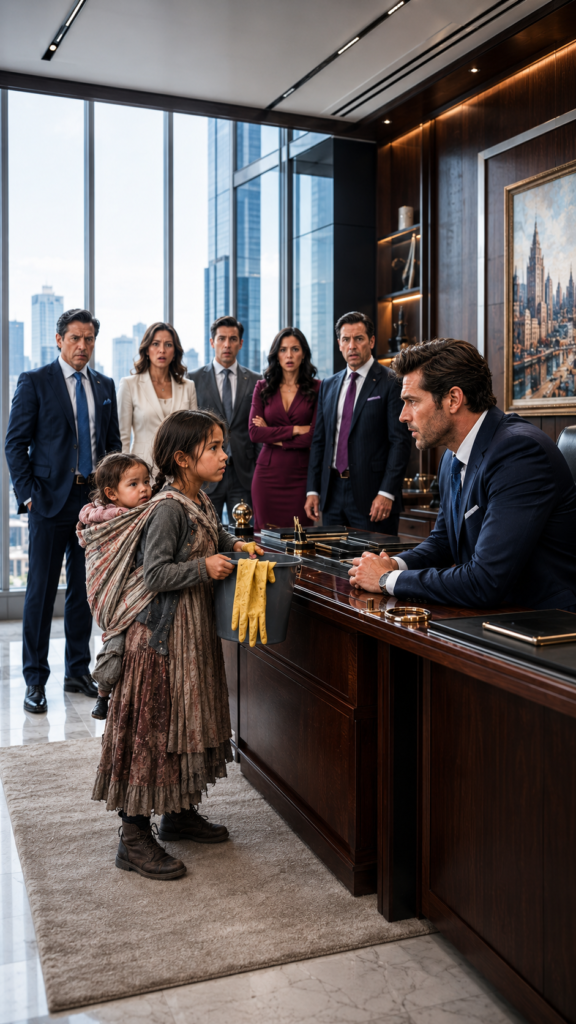
—Can you give me a job? My baby sister hasn’t had milk since yesterday.
The voice belonged to a tiny girl, standing before the reception desk of the Arriaga Tower in Santa Fe. Outside, a freezing rain fell as employees entered, shaking umbrellas, more concerned about their shoes than the soaked little girl.
She was 8 years old. Wearing an oversized green sweater, torn sneakers, and a backpack tied closed with a shoelace, she held a 6-month-old baby wrapped in a wet blanket against her chest.
The receptionist, Lorena, frowned.
—You can’t be here. Where’s your mom?
—I don’t know.
—And your dad?
The girl looked down.
—We don’t have one.
The guard approached and took out his radio.
—Should I escort her outside?
The girl hugged the baby tighter.
—I saw they’re looking for help in the cafeteria. I can sweep, wash dishes, clean bathrooms. I don’t want money. Just a can of milk.
Some people glanced her way. No one stopped.
At that moment, Julián Arriaga, the CEO of the construction company occupying 20 floors of the building, entered. He was 49, impeccably dressed, with the weary expression of someone who had learned to solve everything with contracts.
He heard the girl just as the guard opened the door to the rain.
—Wait.
Julián walked over to her and knelt down.
—What’s your name?
—Ximena.
—And her?
—Sofía. She’s my baby sister.
The baby barely opened her eyes. Ximena pulled out an empty bottle and let the last drop clinging to the plastic fall onto her lips.
Julián felt a hard hit in his chest.
—Who told you that you have to work for a baby to eat?
Ximena stepped back.
—Don’t separate us, sir. I can take good care of her.
Lorena insisted it might be a scam, pointing to the cameras. She said the girl had been wandering the lobby for almost an hour.
Julián ordered them to check the recordings.
The video showed Ximena entering through the revolving door, leaving, returning, and hiding behind a column every time she spotted a patrol. Then a woman in a red jacket was seen following her from the street, taking photos and sending messages.
—Zoom in on the image —Julián requested.
The woman was Brenda, the cousin of Ximena’s mother and supposed caretaker for the girls.
But the worst came when Ximena opened her backpack to look for a diaper. A folded sheet fell out, written in crayon:
“Get milk. Change diaper. Don’t cry. Get money. Don’t come back without formula. If I fail, Brenda takes Sofía.”
Julián looked up toward the entrance.
The woman in the red jacket had just stormed through the doors, furious, shouting for them to return “her girls.”
And no one could imagine what she was about to confess.
PART 2
Brenda entered the lobby filming with her phone, playing the victim.
—This is kidnapping! —she screamed—. That girl is a liar, and you’re stealing her from her family!
Ximena didn’t run toward her.
She placed herself in front of the makeshift stroller where an assistant had laid Sofía down, opening her arms as if her body could become a wall.
Julián observed that gesture and understood that fear needed no explanation.
Julián took the girls to a private room, called a pediatrician, and notified Child Protection Services. Brenda threatened with lawyers and swore it was all an exaggeration.
—I provide them shelter —she said—. Do you know how much it costs to take care of two creatures that aren’t even mine?
Doctor Elisa confirmed that Sofía was dehydrated, underweight, and had overdue vaccinations. Ximena had anemia, old bruises, and exhaustion.
When Elisa asked when Ximena had eaten, she replied:
—Sofía needs more because she’s a baby.
She said nothing about herself.
Brenda crossed her arms.
—She’s always dramatic. Just like her mother.
That phrase changed Ximena’s expression.
Julián noticed.
—Where’s your mother?
—She left with a man —Brenda quickly replied—. She abandoned them months ago.
—What’s her name?
—Verónica Méndez.
—Did she file a missing person report?
Brenda fell silent.
Soon, Alma Rivera, a social worker, and lawyer Tomás Leal, a Child Protection representative, arrived. Their straightforward questions sank Brenda: she named an elementary school that had been closed for two years, couldn’t say what formula Sofía drank, nor when she last went to the pediatrician.
—No one will scold you for telling the truth.
The girl tightened the crayon sheet.
—Brenda said that if I spoke, they’d send Sofía to another family and me to a place for big girls.
—Our priority is to keep them together —Alma explained—. But we need to know what was happening at home.
Ximena looked at her sister.
Then she spoke.
They lived in a small apartment in the San Rafael neighborhood. After Verónica vanished, Brenda moved in, collected the support payments for the girls, sold belongings, and spent whole nights out.
Ximena learned to prepare bottles, wash diapers, and heat water. If Sofía cried, Brenda screamed. If there was no food, she sent the girl to ask for credit; if she returned empty-handed, she slept in the hallway.
—That’s not true —Brenda interrupted—. That girl makes things up because she doesn’t like to obey.
Tomás placed the crayon list on the table.
—Did you send her to get money?
—I taught her responsibility.
Julián clenched his jaw.
—She’s 8 years old.
—In many families, children help. Don’t play the saint, millionaire. You don’t know what it’s like to struggle.
Julián didn’t know what it meant to choose between milk and tortillas, but he did know that no hardship turned abuse into discipline.
The police arrived after reviewing the cameras. The footage showed that Brenda followed Ximena, let her in alone, and watched from a café.
On her phone were 14 messages:
“Don’t come back without money.”
“Tell them your baby is dying.”
“If they give you cash, don’t buy anything.”
“Remember that Sofía depends on you.”
Brenda paled.
—That’s out of context.
—What’s the right context for sending a girl to exploit her sister’s hunger? —Alma asked.
Brenda stopped pretending and made the mistake that would destroy her.
—I just needed her to get 3,000 pesos! —she shouted—. I owe rent and I’m not going to lose the apartment because of two brats.
Ximena flinched.
Sofía began to cry.
The girl ran toward her, but Doctor Elisa gently stopped her.
—Let me hold her for a moment. You’re tired too.
Ximena seemed not to understand.
No one had ever told her before that she could rest.
That afternoon, they examined the apartment. They found the empty refrigerator, six beers, a crib without a mattress, the cupboard locked, and receipts for the support payments withdrawn by Brenda.
They also found medical documents for Verónica.
That was the first twist.
The mother hadn’t left with any man.
She had been admitted four months earlier to a public hospital, confused, without identification, and with a head injury. For weeks, she was an “unknown patient.”
A neighbor saw Brenda arguing with her that night.
When the police interrogated Brenda, she eventually admitted that Verónica had fallen down the stairs during the fight. Instead of calling an ambulance, she left her on the sidewalk of a clinic and returned to the apartment.
Then she took her documents, her bank card, and her phone.
—I thought she would come back —she murmured—. Then I saw I could collect the support.
Ximena listened to the confession from another room.
She only asked:
—is my mom alive?
They located her that night in a rehabilitation center in the State of Mexico. She had regained some memory and had been repeating two names for months: Ximena and Sofía.
When Alma showed her a photograph, Verónica cried before she could speak.
Brenda was arrested for abandonment, fraud, domestic violence, threats, and possible responsibility in Verónica's injuries. Still, the most painful problem remained: the girls needed immediate protection, and their mother still couldn’t care for them.
Ximena heard that they might go to a temporary shelter.
She clung to Sofía.
—I can work. I can cook. I can not go to school. But don’t take her away from me.
Julián felt shame. He had donated money and talked about social responsibility, but in front of a real girl, he discovered that helping wasn’t about posing or paying.
It was about staying when the problem stopped being comfortable.
—I want them to evaluate my home as a temporary shelter —he said.
Alma looked at him seriously.
—Your last name won’t give you privileges.
—I’m not asking for them.
—We will review your life, your background, your emotional stability, your schedules, and your ability to care for two minors.
—Do it.
Julián lived alone in Bosques de las Lomas. He had never been a father; his wife died six years earlier after they had postponed having children until “the right moment.”
That moment never came.
After interviews, background checks, and a home visit, they authorized a provisional placement of 72 hours under supervision.
The girls arrived in an official vehicle.
Ximena entered with a plastic bag, the wet blanket, and the crayon list.
She didn’t look at the pictures or the furniture.
She counted doors.
Located the kitchen.
Asked how much milk cost.
At dawn, Julián found Ximena asleep on the floor next to her sister's crib.
—You can sleep in your bed —he said.
—I can’t hear her quickly from there.
Julián moved the crib to Ximena’s room.
It was the first of many things he would learn.
He also learned that Ximena hid bread, asked for permission to use the bathroom, and ran every time Sofía cried.
—You don’t always have to take care of her —the caregiver explained.
—I do. If she gets sick, it’s my fault.
That phrase haunted Julián for days.
Verónica slowly improved, although she would need months of therapy. When she saw her daughters on a video call, she raised a trembling hand to the screen.
—My girls.
Ximena froze.
—Why didn’t you come back?
Verónica closed her eyes.
—Because I didn’t remember how to come back.
The girl wanted to believe her, but the abandonment had lasted too long to disappear with an explanation.
In-person visits began three weeks later. They were supervised, brief, and painful: Verónica cried, Ximena held Sofía, and Julián waited outside.
One day, Verónica asked to speak with him.
—Thank you for taking care of them.
—Don’t thank me yet. They need to get their mother back.
—Maybe Ximena won’t want me anymore.
Julián thought before replying.
—She loves you. That’s why she’s so angry.
Meanwhile, the investigation revealed a second secret.
Brenda hadn’t just exploited the support payments. She had taken out a loan of 180,000 pesos with falsified documents from Verónica and intended to sell the apartment. She needed the girls to remain invisible to avoid any institution reviewing the guardianship.
That’s why she threatened Ximena with separating her from Sofía.
It wasn’t fear of the DIF.
It was fear of getting caught for the fraud.
When the psychologist explained this to her, Ximena asked if all this had happened because she hadn’t gotten enough money.
—No. Adults placed decisions on your shoulders that were never yours to make. Moreover, thanks to your leaving, they found your mom.
For the first time, her disobedience didn’t seem like a sin.
Over the following months, Julián canceled trips, reduced night meetings, and learned to prepare formula. When a partner asked him not to turn “a social issue” into something personal, he replied:
—It became personal when a girl walked into my building asking to work for milk, and everyone kept walking.
The phrase reached social media, and the case went viral.
Ximena rejected almost everything.
She didn’t trust gifts that appeared quickly.
She trusted routines.
That Julián would return at the promised hour.
That Sofía would have milk every morning.
That the pantry door would never be closed.
One night, Julián arrived two hours late. A meeting got complicated, and his phone died.
He found Ximena sweeping the kitchen at 11:30.
—What are you doing awake?
—I’m compensating.
—Compensating for what?
—You came late because of us. If I help more, maybe you won’t get tired.
Julián knelt before her.
—I came late because I broke a promise. That was my fault.
Ximena held the broom.
—Brenda said that first they help you, and then they make accounts.
—We’re not going to make accounts with you.
—Everyone makes accounts.
Julián didn’t argue.
He sat on the floor.
—Then I’ll have to show you many times.
They remained silent there.
Before going upstairs, Ximena asked:
—If I don’t clean tomorrow, do we stay?
—Yes.
—If Sofía cries all night?
—Yes.
—If I break something expensive?
—Things can be fixed. Girls don’t get returned.
But she left the broom leaning against the wall.
Six months later, Verónica was able to move into a supervised apartment near the rehabilitation center. She had a part-time job, medical assistance, and extended visits with her daughters.
The final decision wasn’t easy. Ximena wanted to go back to her mother, but feared losing the security built with Julián. At the hearing, Verónica said something no one expected:
—I don’t want to get my daughters back as if they were objects. I want to show them I can take care of them. And if they need time with Mr. Arriaga, I will accept that time.
It was the last emotional twist.
The woman everyone believed absent didn’t claim authority. She chose to repair.
The court established a progressive and shared custody temporarily, with Verónica as a recovering mother and Julián as a support guardian. The sisters would remain together at all times.
Brenda received a sentence and lost any right to contact. The apartment was legally protected for the girls, and the fraudulent loan was annulled.
The real transformation didn’t happen in court.
It happened one Sunday morning.
Julián was making misshapen pancakes. Verónica was slicing fruit at the table. Sofía was banging a spoon against her chair. Ximena was staring at her plate.
For months, she had always fed her sister first.
Her hand moved by habit.
Then it stopped.
Sofía had food.
Verónica was there.
So was Julián.
For the first time, there were adults taking care of the baby.
Ximena lifted her fork and tried her own breakfast.
No one scolded her.
No one asked her to work.
No one reminded her how much milk cost.
Verónica covered her mouth to prevent crying. Julián looked toward the stove, pretending to check the pan.
Ximena took another bite.
—Do I have to help today? —she asked.
—Only if you want to —Julián replied.
The girl looked at her mother, at her sister, and at the old crayon list stuck to the refrigerator. It was no longer an order. It was a testament to everything she had survived.
She took a purple crayon and wrote below:
“Eat. Go to school. Play. Ask for help. Be a girl.”
Then she crossed out the phrase “Don’t cry.”
—That rule was wrong —she said.
Verónica approached slowly.
—Yes, my love. It was very wrong.
Ximena allowed her mother to hug her.
It wasn’t a perfect ending. There were therapies, nightmares, and wounds hard to heal.
But that morning, no one charged her for breakfast.
And in a city where hundreds of adults had pretended not to see her, an 8-year-old girl finally discovered that true love doesn’t demand work, silence, or hunger as payment.





