PART 1
Natalia had fifteen minutes left to walk down the aisle when her blood ran cold.
The wedding was at an elegant estate on the outskirts of Querétaro, with white bougainvillea, candles on fine wooden tables, and a mariachi waiting for the bride's entrance.
Everything seemed perfect.
Except for two empty chairs at the head table.
Her parents, Don Hilario and Doña Lupita, should have been there. She had written their names on ivory cards, in golden letters, because she wanted everyone to know who the most important people in her life were.
But they weren’t.
Dressed in her fitted white gown, the veil trembling on her shoulders, Natalia began to search for them among the tables. She passed by Sebastián's uncles, businessmen in expensive suits, and Doña Rebeca's friends, who smelled of imported perfume and spoke as if the world owed them reverence.
Nothing.
Then she heard her mother's voice.
—No, sweetheart, we’re fine here, don’t worry.
Natalia turned.
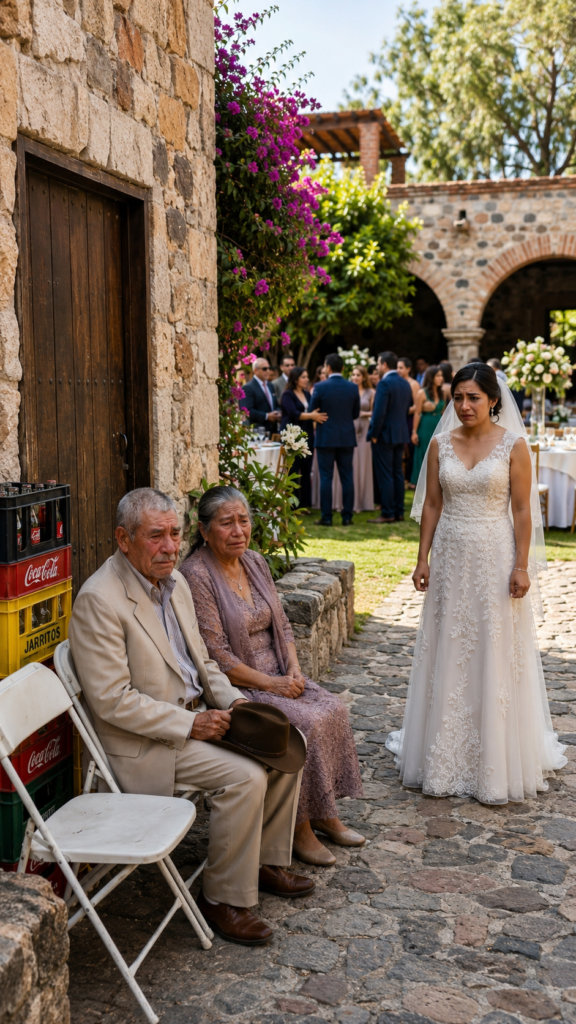
She found them at the back of the garden, by the service door, nearly pressed against some soda boxes and black garbage bags.
Her dad sat on a folding plastic chair, his gray suit ironed so carefully that the creases still showed. His hands, burned from years of selling tacos from a cart in the market, rested on his knees.
Her mom clutched her old purse against her chest, a broken smile trying to mask her humiliation.
Natalia felt the ground open beneath her.
—Who moved my parents? —she asked the wedding coordinator.
Berenice, the wedding planner, turned pale.
—Miss… it was Doña Rebeca’s instruction.
Natalia swallowed hard.
—And Sebastián?
Berenice looked down.
—He said it was fine. That it was better to avoid… discomforts.
The word “discomforts” shattered something inside her.
Sebastián appeared behind her, nervous, adjusting his navy blue jacket.
—Nati, love, don’t start. My mom just wanted to rearrange the tables. You know how these events go.
Natalia looked at him as if she had just discovered a stranger beneath the face of the man who was supposed to pledge eternal love to her.
—Are my parents an embarrassment to you?
He sighed, exasperated.
—Don’t be dramatic. It’s just for appearance's sake. We can introduce them later, okay?
Natalia didn’t shout.
She didn’t cry.
She walked slowly toward the altar, took the microphone waiting for their vows, and looked at all the guests.
The mariachi stopped playing.
Doña Rebeca raised an eyebrow from the head table, a glass of white wine in her hand.
Natalia took a deep breath.
—Before this wedding starts, everyone will know why my parents were hidden by the kitchen.
And at that moment, Sebastián whispered something that broke her completely:
—Please don’t ruin the wedding that your dad couldn’t even afford.
PART 2
The garden fell silent.
Not an elegant silence, the kind that descends before a lovely ceremony. It was a heavy, uncomfortable silence, the kind that forces people to stare at their glass, their napkin, or their phones to avoid facing the collective embarrassment.
Natalia gripped the microphone so tightly that her knuckles turned white.
Her parents remained in the back, unmoving. Don Hilario stared at the ground. Doña Lupita could no longer hold her smile and was wiping her tears with the tip of her shawl.
—Repeat that, Sebastián —Natalia said, her voice firm—. Repeat it here, in front of everyone.
Sebastián turned red.
—I didn’t say anything wrong. I’m just saying my family paid for almost all of this, and my mom has the right to manage the presentation.
Doña Rebeca smiled, satisfied, as if her son had finally learned to speak with “class.”
—Exactly —she interjected, standing up from her chair—. There was no need to create a scene. Your parents are good people, no one denies that, but there are places for everyone.
A murmur ran through the tables.
Natalia slowly turned toward her.
—Places for everyone?
—Oh, sweet girl, don’t play dumb —Doña Rebeca replied, losing her patience—. This wedding is full of partners, doctors, politicians, important people. We couldn’t put a man who sells tacos on the street and a woman who sews for others at the main table. What would they think?
That phrase hit like a stone.
Even some guests from Sebastián’s own family lowered their gazes.
Natalia felt rage rise from her stomach to her throat, but she didn’t break.
—My dad sells tacos, yes —she said into the microphone—. He gets up at 4 in the morning and has been doing it for over 30 years. My mom sews uniforms, hems, dresses, and whatever else is needed. Thanks to those hands, I studied, ate, dressed, and made it here.
She paused.
—And you, with all your fancy last names, didn’t have a shred of shame to sit them next to the trash.
Sebastián approached, trying to take the microphone from her.
—Natalia, that’s enough. We’ll talk about this later.
She took a step back.
—Later doesn’t exist for you.
Then something happened that no one expected.
Camila, Sebastián’s younger sister, stood up from a side table. Her eyes were red, and she held her phone in her hand.
—Nati deserves to know everything —she said.
Doña Rebeca twisted like a snake.
—You shut up.
But Camila walked toward the DJ without asking for permission. She connected her phone to the speaker, and in seconds, a voice note echoed throughout the garden.
It was Doña Rebeca’s voice.
“Sebastián, I already spoke with Berenice. Natalia’s parents will be seated way in the back, where they won’t show up in the photos. I don’t want to explain to my friends who those people are.”
Then Sebastián’s voice was heard.
“Yeah, Mom. Make it discreet. Natalia gets intense about these things, and I don’t want any drama before the ceremony.”
Natalia closed her eyes.
It wasn’t confusion.
It wasn’t a last-minute decision.
It was a planned humiliation.
Sebastián tried to approach again.
—Baby, this is taken out of context.
Natalia let out a dry laugh.
—Taken out of context? How curious. In the full context, you’re also a coward.
Several people stood frozen. An uncle from Sebastián’s side murmured, “how intense.” From Natalia’s side, her cousins were already standing, faces set, ready to defend their elders if anyone stepped out of line.
Desperate to regain control, Doña Rebeca slammed her hand on the table.
—Are you really going to cancel a wedding over two chairs? Is that really the ridiculous thing you’re going to do?
Natalia slowly took off her ring.
The diamond sparkled under the warm lights of the estate.
—I’m not canceling a wedding over two chairs —she said—. I’m canceling a life with a man who saw my parents humiliated and thought first of the photos.
She left the ring on the altar.
—I’m not getting married.
Doña Lupita let out a sob.
Don Hilario slowly stood up. He walked down the central aisle with his hat in hand. He didn’t shout. He didn’t claim. He simply reached his daughter and looked at her with a pride that hurt.
—Let’s go, daughter —he said softly—. Where one has to hide to avoid discomfort, no one stays.
Natalia hugged him.
The white dress crumpled against her father’s simple suit, and for the first time that afternoon, she felt peace.
They began to walk toward the exit.
First, a cousin clapped.
Then an entire table.
Afterward, even some of Sebastián’s friends stood up. It wasn’t a celebratory applause. It was an applause of shame, of respect, the kind that silently says: “you did well.”
Doña Rebeca screamed that it was a lack of class.
An older man, Natalia’s uncle, answered from his table:
—A lack of class is hiding humble people after eating their food, ma’am.
Several waiters muttered an “wow” under their breath.
Sebastián stood by the altar, pale, watching how the bride left on her father’s arm.
But the hardest blow was yet to come.
When Natalia and her parents reached the parking lot, Berenice ran after them with a folder pressed against her chest.
—Miss Natalia, wait. There’s something you need to know.
Don Hilario tensed.
—No, young lady. Leave it be.
But Berenice shook her head and opened the folder on the hood of the old car.
There were the receipts.
Small deposits.
Transfers.
Handwritten notes.
Payments of 500, 800, 1,200 pesos.
—Your dad paid part of the flowers, the mariachi, and the banquet —Berenice confessed, her voice trembling—. For eight months, he came to drop off money. Sebastián asked me not to mention it because he said those contributions might discomfort his family.
Natalia felt something explode in her chest.
She looked at her dad.
—Did you pay for this, Dad?
Don Hilario looked down, ashamed.
—Little by little, daughter. I just wanted your wedding to have beautiful music. For you to feel like a queen, even if it was just for one day.
Doña Lupita broke into tears.
And then Natalia understood the full cruelty.
Not only had they hidden her parents.
They had also hidden his sacrifice.
Doña Rebeca had boasted to her friends about an elegant wedding, while part of that “elegance” stood on the burnt hands of a man who sold tacos and the sleepless nights of a woman who sewed until her back hurt.
Natalia turned around.
She returned to the garden, her dress dragging on the gravel.
Sebastián saw her enter and, for one second, thought she was coming back remorseful.
He even smiled.
But Natalia walked past him as if he didn’t exist. She took the microphone again.
—One last thing —she said, her voice broken but strong—. My dad also paid part of this wedding.
The entire garden froze.
—The mariachi you heard, the flowers on your tables, and part of the food some of you already devoured were funded by my dad. From those same hands you wanted to hide by the kitchen.
Don Hilario, from the entrance, cried without covering his face.
Natalia looked directly at Doña Rebeca.
—People aren’t worth the place you sit them at a party of hypocrites. They’re worth what they give for their own without humiliating anyone.
She dropped the microphone.
And left.
That night, there was no wedding at the estate.
But there was a party in the neighborhood.
Natalia’s cousins organized a caravan with honking horns. The neighbors came out to hear the gossip. Someone brought stewed tacos, another provided soft drinks, an aunt brought cake from the bakery, and, to everyone’s surprise, the mariachi arrived behind them.
When the musicians learned that Don Hilario had paid part of their salary with months of effort, they refused to keep playing for Sebastián’s family.
They planted themselves in front of Natalia’s house and played until past midnight.
Natalia danced barefoot on the sidewalk, her white dress stained with dirt and sauce. Her dad took her hand and twirled her awkwardly, crying and laughing at the same time.
Doña Lupita watched them from a plastic chair.
This time, no one hid her.
The following weeks were a social wildfire.
Doña Rebeca stopped appearing at gatherings. Her club friends, the ones she wanted to impress so much, tore her apart behind her back. Sebastián tried to blame his mother, then invented that Natalia was difficult, then claimed everything had been exaggerated.
No one believed him.
Camila left that house shortly after. She wrote to Natalia to apologize for not having spoken up earlier. Natalia held no grudge against her. On the contrary, she told her that in her home there would always be a warm meal for anyone brave enough to tell the truth.
Months later, Sebastián showed up in front of Natalia’s house.
He arrived in his brand new truck, with a huge bouquet of roses and a destroyed face.
—Nati, forgive me. My mom manipulated me. I love you.
Natalia stood behind the gate, in flip-flops, an old t-shirt, and hands full of flour because she was helping her mom prepare dough.
She didn’t even unlock the padlock.
—I didn’t lose you because of your mom —she said calmly—. I lost you because when you saw my parents humiliated, you chose to protect your last name over their dignity.
Sebastián looked down.
—We can start over. I’ll buy you a house wherever you want.
Natalia smiled sadly.
—you still don’t understand anything, dude. Love isn’t bought. It’s shown when someone tries to trample your own, and you say: “don’t mess with them.”
That was the last time she saw him.
Over time, Natalia and her parents used the savings they had left to improve Don Hilario’s taco stand. They bought a new awning, a large griddle, sturdy tables, and comfortable chairs.
The business grew.
Doña Lupita stopped sewing at dawn. She could finally rest her eyes. Natalia continued to work, helping her parents and healing slowly, without rush.
Until two years later, she met Tomás.
He didn’t arrive in an armored truck or a fancy suit. He came to the stand one rainy day, wearing muddy boots and a construction helmet under his arm. He was a bricklayer and was building a school nearby.
The first thing he did was take off his cap in front of Don Hilario.
—Good afternoon, boss. Excuse me. Are there still tacos for a soaked worker?
Don Hilario laughed.
—Come on, kid. No one leaves here hungry.
Tomás returned the next day.
And the next.
At first, he went for tacos. Then he helped set up the tables. Afterward, he chatted with Doña Lupita as if he had known her all his life.
When he began to court Natalia, he didn’t promise her luxuries. He promised her respect.
—If I ever enter your family, I will treat your parents as sacred people —he told her.
And he kept his promise.
Three years later, Tomás proposed in the living room of the house, in front of Don Hilario and Doña Lupita. The ring was simple, thin gold, bought with honest savings.
To Natalia, it was worth more than any diamond.
The wedding was in a modest hall in the neighborhood. There was mole, carnitas, rice, beans, and cumbia. The chairs were folding, the tables had simple tablecloths, and the flowers were sunflowers bought at the market.
But no one felt less.
When it came time for the toast, Tomás took the microphone.
—Today, the place of honor isn’t for us —he said, looking at Natalia—. It’s for Don Hilario and Doña Lupita, because thanks to them, the woman I’m marrying exists.
Then he seated them in the center of the floor, at the best table in the hall.
Everyone passed by to greet them.
Don Hilario cried in silence. Doña Lupita smiled like a queen.
Natalia looked at them and understood that canceled wedding hadn’t taken away a life from her.
It had saved one.
Because some families believe they have class due to money, last names, and main tables. But true class is evident when no one is forcing you to respect those who can’t return the favor.
And Natalia’s parents, sitting in their simple chairs, always had more greatness than all the rich people of that estate combined.





