PART 1
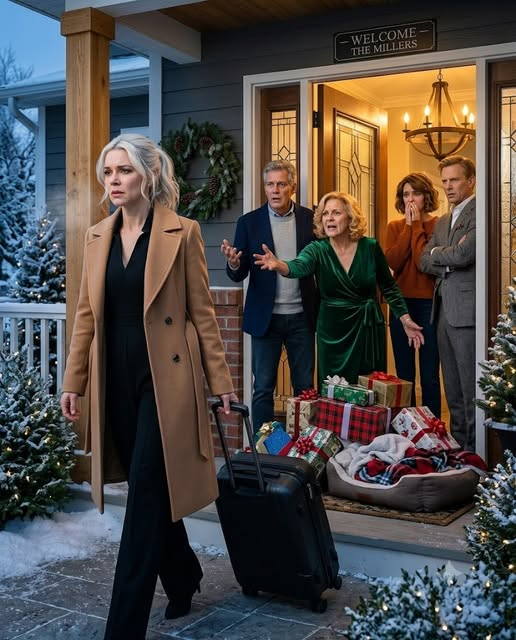
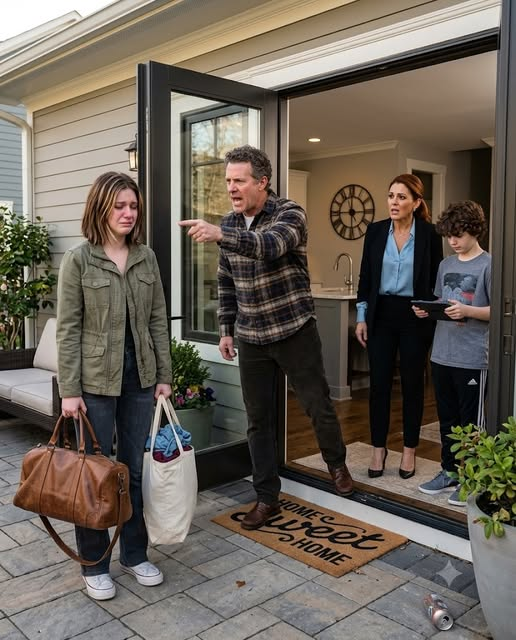
Valeria was thrown out of the house at 12:17 at night.
It wasn’t Raúl, her husband, who kicked her out, even though he had just destroyed her life with a message that said: "I miss you, my love. Tomorrow you tell your wife the truth."
It was her own mother who shut the door.
Doña Teresa looked at her standing in the doorway, with the sleeping baby against her chest, a half-broken diaper bag, and eyes swollen from crying.
"A decent wife endures," she said. "I don’t want scandals or shame here."
And she locked the door.
Valeria stood on the sidewalk of a Neza neighborhood, the cold creeping up her blouse while Mateo, just seven months old, breathed against her neck.
She called two friends.
No one answered.
She tried to call a taxi, but her card wouldn’t go through. Raúl had emptied the account that very afternoon.
So she walked aimlessly to the avenue, hopped on a nearly empty microbus, and without thinking much, got off near the Santa Martha market.
That’s where Doña Luz lived, Raúl’s mother.
The mother of the man who had betrayed her.
Valeria didn’t know if it was pride, exhaustion, or desperation. She only knew she couldn’t sleep on the street with her child.
She knocked softly, almost ashamed.
Before the second knock, the door swung open.
Doña Luz appeared with a shawl over her shoulders, slippers on her feet, and an apron stained with dough.
She didn’t ask what had happened.
She didn’t look surprised.
She simply stepped aside.
"Come in, mija. And hand me the baby for a moment, because nobody stays outside."
Valeria felt her knees weaken.
In the kitchen, there was hot chicken soup, tortillas wrapped in a napkin, and a cup of atole on the table.
As if someone had been waiting for her.
Doña Luz served her a plate.
"Eat, because crying on an empty stomach hurts more."
Valeria hadn’t eaten since the morning.
She cried while she swallowed. She cried, unable to speak. She cried as if each spoonful ripped away a piece of her rage.
Doña Luz didn’t interrupt her.
Afterward, she led her to a room in the back.
The bed was made with clean sheets. Next to the window stood a crib, set up with a blue blanket and a mobile of little stars.
"What luck that I had a crib," Valeria murmured, trying to smile.
Doña Luz lowered her gaze.
"Yes, mija. What luck."
But her voice didn’t sound like luck.
It sounded like a secret.
The next day, Valeria began to notice strange things.
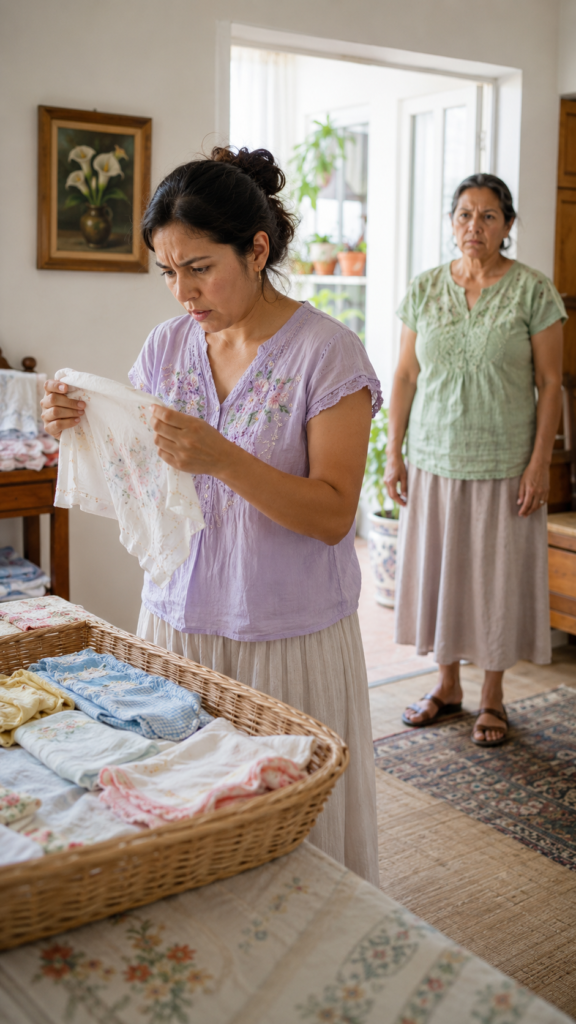
On the nightstand were diapers in Mateo’s exact size. In the closet, folded rompers. In a box, new bottles.
And in the bottom drawer, baby girl clothes.
Dresses, pink socks, embroidered hats.
Mateo was a boy.
When Valeria touched a yellow onesie, Doña Luz appeared in the doorway.
"That doesn’t move," she said.
She didn’t shout.
But her tone made Valeria immediately release the garment.
That afternoon, Valeria told her about the message. She revealed the name of the other woman.
Samanta.
Doña Luz stopped chopping tomatoes.
She wasn’t surprised.
She simply repeated the name quietly.
"Samanta."
Valeria froze.
"Do you know her?"
Doña Luz continued cutting.
"I know many stories, mija."
That night, Valeria got up for water.
The kitchen light was on.
Doña Luz was sitting with an old notebook, writing. Upon seeing her, she quickly closed it.
But Valeria managed to read a name underlined.
"Brenda."
Below it was a date from six years ago.
"Go to sleep, mija," Doña Luz said. "Tomorrow you’ll need strength."
On Saturday morning, there was a loud knock at the door.
Valeria was breastfeeding Mateo when Doña Luz opened it.
It was Raúl.
He had supermarket flowers and his shirt was improperly buttoned.
"I came for Samanta," he said. "She told me she was coming here."
Valeria felt her heart drop to the floor.
Behind Raúl, on the sidewalk, stood a girl with a suitcase, smeared mascara, and a baby in her arms.
"Is this Doña Luz's house?" Samanta asked with a trembling voice. "I was told they would help me here."
Doña Luz looked at her son.
Then at the flowers.
Then at Valeria.
And without uttering a profanity, she slammed the door in Raúl's face.
"We don’t take back trash here," she spat.
Valeria thought she was defending her.
But Doña Luz opened the door again.
Not for Raúl.
For Samanta.
"Come in, mija. And bring the baby, because nobody stays outside."
Valeria lost her breath.
It was the same words.
Exactly the same.
She ran to the back room, opened the forbidden drawer, and started pulling out clothes.
Beneath the girl’s garments were more clothes. And further down, more.
Each pile had a little note with a name.
"Brenda."
"Alma."
"Fabiola."
"Yazmín."
"Carla."
And at the very end, folded apart, was Mateo’s clothes.
With a freshly written note.
"Valeria."
Then she understood why the crib was ready.
Why the soup was hot.
Why Doña Luz knew Samanta's name before anyone explained anything.
It wasn’t a coincidence.
Raúl had been breaking women for years.
And his mother had been waiting for them with a ready crib.
Valeria crumpled the paper with her name.
In the kitchen, Samanta cried just as Valeria had cried.
And Doña Luz, standing between the two, seemed to guard a secret larger than the whole house.
It was impossible to believe what was about to happen.
PART 2
Valeria stepped out of the room with the note in hand.
At first, she didn’t scream.
Because sometimes anger arrives so forcefully that it leaves people mute.
Samanta was sitting at the kitchen table, holding her baby as if someone were going to take her away. Doña Luz had placed a bowl of soup in front of her, just like she had for Valeria.
The scene was identical.
Too identical.
"How many?" Valeria asked.
Doña Luz didn’t look up.
"Not now, mija."
"Don’t call me mija," Valeria snapped, her voice already breaking. "Tell me how many women have slept in that room. How many came with a baby because your son tore them apart."
Samanta stopped crying.
She looked at Valeria.
Then at Doña Luz.
Raúl was still outside, pounding on the door.
"Mom, let me in! Don’t do your little plays! Valeria is exaggerating!"
Doña Luz closed her eyes.
Raúl’s banging echoed again.
"Samanta, let’s go! Don’t get involved with these crazies!"
Valeria walked toward the door.
For one second, everyone thought she was going to open it.
But she locked the top bolt.
Then the latch.
Then wedged a chair against it.
Doña Luz looked at her as if she had just seen something she had been waiting for years.
"Now, speak," Valeria said.
Doña Luz wiped her hands on her apron.
Suddenly, the strong woman—the one who shut doors in her own son’s face—looked older.
More tired.
More broken.
"Come to the room," she murmured.
Valeria didn’t want to obey, but she did.
Samanta also got up, with the baby pressed against her chest.
Doña Luz pulled the entire drawer out and placed it on the bed.
The wood sounded heavy.
As if it wasn’t filled with clothes, but with the dead.
"Read," she said.
Valeria took the first paper.
"Alma. Arrived on May 18. Four-month-old boy. Left with her aunt to Toluca. Now sells jellies outside a primary school."
Samanta grabbed another.
"Fabiola. Arrived without shoes. Premature baby. Left for Querétaro with a job in a small kitchen."
There were names, dates, destinations.
They weren’t memories to boast about.
They were records.
Maps of women who had left alive.
Valeria felt something inside her loosen, but not enough to forgive.
"Why did you keep them written down?" she asked.
"Because when a woman flees at night, the world wants to erase her," Doña Luz said. "I wrote them down so I wouldn’t forget them. To know if they arrived safely. To send them money when I could. To warn them if Raúl was looking for them."
Samanta raised her gaze.
"Has Raúl done this before?"
Doña Luz let out a dry laugh.
Without joy.
"Raúl learned to do this since he was little. I just took too long to accept it."
Outside, Raúl kicked the door.
"Mom, open up or you’ll regret it!"
Doña Luz didn’t even blink.
"Regret lives here already, son," she said, though he couldn’t hear her well. "For six years."
Valeria looked again at the drawer.
There was the name she had seen in the notebook.
Brenda.
The first paper.
But without an address.
Without a destination.
Without a note saying "she made it."
Just the name.
And a date.
"Who was Brenda?" Valeria asked.
Doña Luz sat on the edge of the bed.
The bed creaked.
"Brenda was Raúl's first wife."
Samanta opened her mouth.
Valeria felt a strange pang in her chest.
Raúl had never told her he had been married before.
"First wife?" she repeated.
"They got married civilly when he was 22," Doña Luz said. "They lasted a short time. He said she was crazy, that she was jealous, that she made dramas. I believed him. Because he was my son. Because a mother, when she doesn’t want to see the monster, names it a prank."
Valeria stood still.
That phrase struck her.
Because Doña Teresa, her own mother, had done the same with Raúl.
"Men make mistakes, daughter."
"As long as he brings money home, don’t cause a fuss."
"You can’t act dignified with a baby."
Doña Luz opened the notebook.
The pages were filled with numbers, addresses, receipts taped down, small photos of growing babies.
But the first page only had Brenda.
And an empty space.
"Brenda called me one night," Doña Luz continued. "She told me Raúl had kicked her out, that she had a sick baby, that she had nowhere to go. I was angry with her because my son had filled my head with lies. I told her I couldn’t get involved in couple problems."
Her voice cracked.
"I told her that a good woman endures."
No one said anything.
Even Raúl stopped banging for a moment.
"Three days later, they found Brenda passed out at the Central del Norte. The baby was alive, but she never woke up."
Samanta covered her mouth.
Valeria felt the room shrink.
Doña Luz pulled out a tiny yellow dress from the bottom of the drawer, with an old stain on the collar.
She placed it on her lap as if she were holding someone.
"The girl was saved. She was raised by Brenda’s mother in Zacatecas. They never let me see her. And that was fine. I wouldn’t have let myself in either."
Valeria looked at the dress.
For the first time, she didn’t see a trap.
She saw guilt.
An old, hard, impossible-to-wash guilt.
"Since then, I prepare the crib as soon as I see the signs," Doña Luz said. "The phone face down. The expensive perfume. The outings to meetings. The gifts after screaming. The lies all the same. I start buying diapers before the wife knows she’s going to be thrown out."
Samanta lowered her gaze.
"He told me you hated me."
"He tells all of them something," Doña Luz replied. "To Valeria, he said I was nosy. To Fabiola, he said I was a bitter old woman. To Alma, he said I wanted to take her son away. It’s his way of leaving them alone before he breaks them."
Valeria gritted her teeth.
"And why didn’t you report him? Why didn’t you stop him?"
Doña Luz lifted her face.
That question didn’t offend her.
It pierced her.
"Because I was cowardly. Because I thought picking up the mess was enough. Because I confused helping the victims with stopping the culprit."
The phrase fell like a stone.
Outside, Raúl shouted again.
"Valeria, open up! You’re going to be alone, bitch! Nobody will love you with my son!"
Valeria felt something break.
But this time it wasn’t her.
It was the fear.
She walked to the living room, grabbed her cell phone, and hit record.
Then she removed the chair but didn’t open the door.
She simply brought the phone closer to the door.
"Repeat that, Raúl," she said calmly. "Repeat what you’re going to do to your son’s mother."
Raúl, furious, fell right down.
He screamed threats, insults, confessions disguised as tantrums. He said Samanta was a nobody. That Valeria didn’t have proof. That his mother always ended up fixing everything.
Doña Luz listened from the hallway.
Every word hit her in the face.
Not because she didn’t know it.
But because she was finally hearing it without justifying it.
Then she did something neither of them expected.
She went for her purse, pulled out a thick folder, and placed it on the table.
There were printed screenshots, receipts, copies of transfers, addresses, messages from Raúl to various women, photos of bruises on other arms, medical notes.
Valeria stood frozen.
"You had all this?"
"Yes."
"And you kept it?"
Doña Luz nodded.
"I kept it for when one of you wanted to fight. But none of you came with strength. You came with hunger, with fear, with babies. And I didn’t want to push them."
Valeria looked at Samanta.
Samanta looked at her daughter.
In their eyes were shame, but also rage.
"I didn’t know he had a wife," Samanta said softly. "He swore to me he was separated. When I told him I was pregnant, he changed. He hid me. He said it was for my own good."
Valeria observed her.
A part of her wanted to hate her.
Another part, more honest, understood that Raúl hadn’t brought Samanta in to replace her.
He had put her in the same grinder.
Just on a different shift.
That was the turn that shattered her pride.
They weren’t enemies.
They were living proof of the same abuser.
Two hours later, a patrol arrived, called by a neighbor who had heard the screams.
Raúl tried to play the victim.
He said his wife was crazy.
That his mother was senile.
That Samanta wanted money.
But Valeria had the audio.
Doña Luz had the folder.
Samanta had recent messages where Raúl threatened to take the girl away if she spoke.
That night didn’t resolve everything like in a novel.
There were no applause or dramatic music.
There were statements, exhaustion, signatures, a Public Ministry with a sleepy face, and two babies crying at the same time.
But there was something stronger.
For the first time, Raúl didn’t walk out as if nothing happened.
He spent the night detained for threats and domestic violence while the investigation opened.
And although later his lawyers tried to soften everything, he could no longer control the story.
Because Doña Luz’s notebook spoke.
And it spoke loudly.
Some women returned to testify.
Alma came from Toluca with her five-year-old son. Fabiola sent audios. Yazmín appeared with a folder of photos. Carla recounted how Raúl left her without money at a terminal in Puebla.
Not all wanted to report him.
Not all could.
And no one judged them.
Because surviving is exhausting too.
Doña Teresa, Valeria’s mother, showed up four days later, when the gossip had already exploded in the neighborhood.
She arrived with a bag of sweet bread and a face full of regret.
"Daughter, I didn’t know it was so serious."
Valeria welcomed her at the door.
With Mateo in her arms.
"You did know, Mom. The thing is, you were taught that shame is when a woman leaves, not when a man destroys her."
Doña Teresa cried.
Valeria cried too.
But she didn’t let her in that night.
Not out of revenge.
But because there were doors that couldn’t be opened with sweet bread after being shut with cruelty.
Doña Luz listened to everything from the kitchen.
When Valeria returned, the old woman was heating beans.
"It hurts, doesn’t it?" she said.
Valeria nodded.
"A lot."
Doña Luz smiled sadly.
"But that pain is yours now. Not Raúl's. That means you’re coming back."
Months passed.
Raúl lost his job when it became known that he used shared accounts to control money. The process continued slowly, as things tend to be in Mexico when a woman asks for justice and everyone tells her to be patient.
But something changed.
Doña Luz’s house stopped being a hideout.
It became a refuge.
Neighbors started sending clothes, diapers, milk, contacts for lawyers, part-time jobs.
Samanta stayed for three months. Then she rented a room nearby and started doing nails at home. Over time, she and Valeria learned to talk without Raúl’s name sitting between them.
They weren’t friends immediately.
That would have been a lie.
First, they were two wounded women sharing a roof.
Then they were two mothers watching over each other’s babies when one needed to shower, sleep, or cry without being seen.
That was already enough.
Doña Luz aged quickly after letting the truth go.
As if holding so many secrets had served as a walker, and upon dropping them, her body had charged her all at once.
One December afternoon, while folding diapers, she asked Valeria not to throw the notebook away.
"But don’t use it to live off the tragedy," she said. "Use it so that no one arrives and thinks they’re alone."
She died that winter, asleep, with her shawl on and her apron hanging on the chair.
She didn’t leave much behind.
An old house.
Two cribs.
A drawer full of clothes.
A half-filled notebook.
And Brenda's yellow dress, stored at the bottom.
Valeria could sell the house.
She could leave far away.
She could close the door and say she had done enough.
But one night, at 11:48, there was a soft knock.
A tap.
Then another.
Valeria woke up instantly.
As if the sound had been training her for years.
She opened the door to find a nineteen-year-old girl, with a baby wrapped in a thin blanket and a broken look.
"I was told you help here," she whispered.
Valeria felt her throat tighten.
Behind her, in the kitchen, the soup was already hot.
Not because Valeria knew who was coming.
But because she had learned it was always better to have something ready.
She stepped aside.
"Come in, mija. And bring the baby, because nobody stays outside."
The girl entered crying.
Valeria closed the door.
But not out of fear.
With firmness.
At the bottom of the drawer, the yellow dress remained there.
Not to remember a death.
But to remember a debt.
The debt of not sleeping so deeply.
Of not calling a woman who asks for help exaggerated.
Of not raising children believing there will always be someone cleaning up the mess they leave behind.
Because sometimes a mother’s love saves.
And sometimes, when she protects the culprit too much, she turns him into a monster.