PART 1
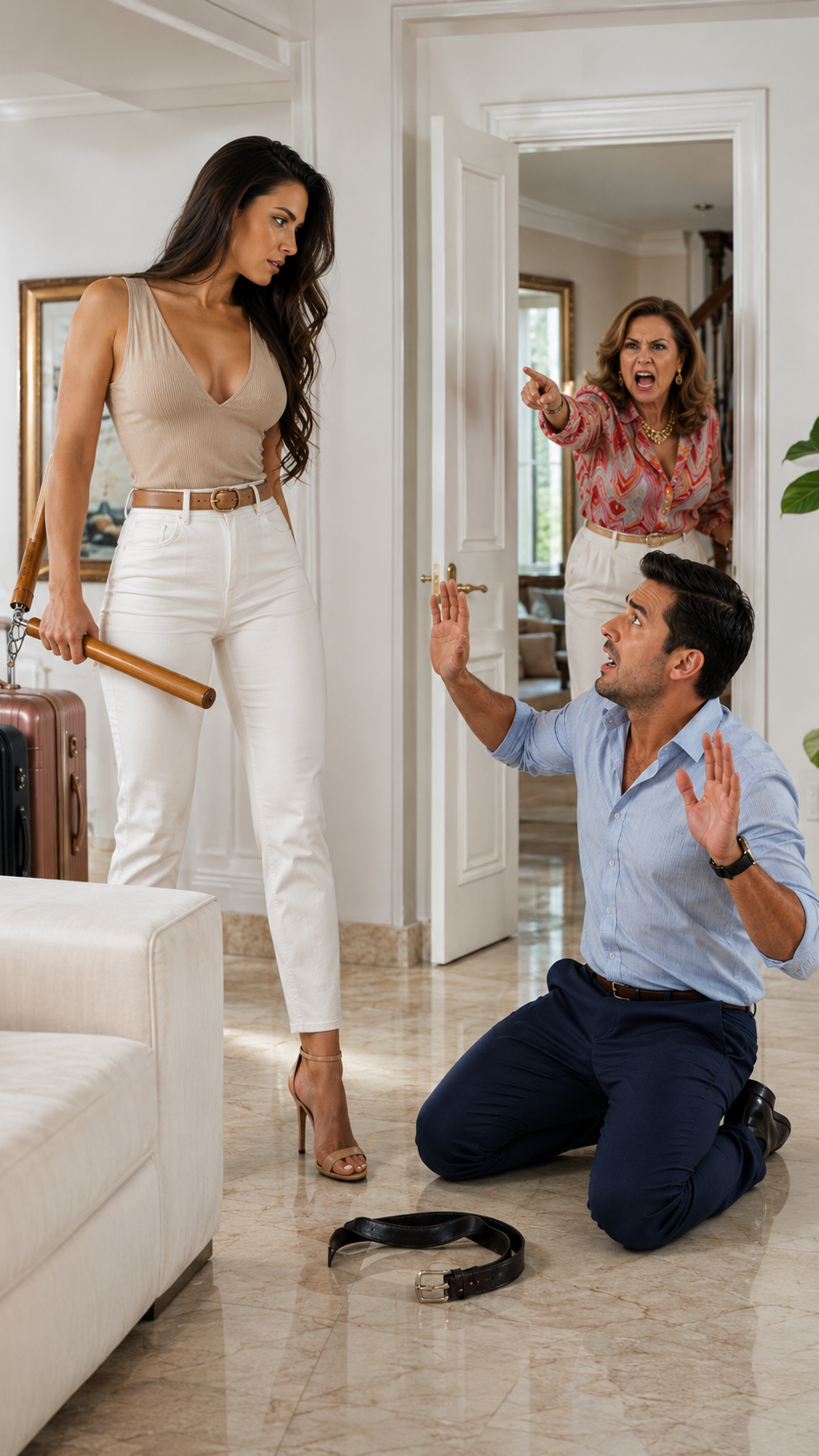
They had barely returned from their honeymoon when Rodrigo locked the apartment door with double bolts.
Valeria was still wearing her light travel dress, her hair damp from the rain in Mexico City, and a suitcase in hand. It had only been 5 days since the wedding.
Then he took off his belt.
The buckle hit the floor with a sharp thud.
"Now you’re going to learn how a wife behaves," Rodrigo murmured, his calmness more terrifying than a scream.
Valeria didn’t back down.
At 27 years old, she was a sports coach at a public high school in Iztapalapa, and most people saw her as a quiet woman. She spoke softly, smiled politely, and hardly ever argued.
What Rodrigo didn’t know was that Valeria had grown up in a neighborhood in Puebla, in the yard of a house where her father had taught self-defense for over 30 years.
By the age of 9, she already knew how to fall without hurting herself. At 13, she could disarm a bigger boy. By 17, she’d won her first regional tournament with wooden nunchucks.
But during their courtship, Rodrigo had only known the sweet Valeria.
He seemed like a good man. An accountant, pressed shirt, soft voice, one of those who brings shells for the mother-in-law on Sundays and greets the father-in-law saying, "Excuse me, sir."
Valeria’s family trusted him.
The wedding was simple, with mole, norteño music, cousins dancing, and her grandfather whispering in her ear:
"Darling, never trade your peace for a ring."
Valeria hadn’t understood the weight of those words back then.
In Valle de Bravo, during their honeymoon, Rodrigo acted strangely. He got upset if she spoke to a waiter. He asked how much money she had with her. He told her that a married woman should inform her husband before going out to buy water.
Valeria thought it was just nerves.
But that night, when they returned to their apartment in the Portales neighborhood, the mask slipped away.
"Starting tomorrow, your salary will be deposited into an account I'll manage," Rodrigo said. "No going out alone, no showing your legs at school, no talking back. My mom says if a woman isn’t corrected in time, she gets out of hand."
Valeria felt a cold sadness.
It wasn’t fear.
It was the shame of believing in someone who had been acting for months.
Rodrigo lifted the belt.
"Is that clear?"
Valeria set her suitcase down beside the couch, opened her sports bag, and pulled out her training nunchucks.
She spun them once.
The air whistled.
Rodrigo paled.
"What are you doing, are you crazy?"
Valeria fixed her gaze on him.
"Good thing you brought out the belt. I couldn’t train on the honeymoon."
He tried to charge at her, clumsy, furious. She spun around, wrapped his wrist with the nunchucks, and applied just enough pressure to force him to release.
The belt fell to the floor.
In less than 10 seconds, Rodrigo was on his knees, sweating, his voice fractured.
Valeria didn’t hit him.
It wasn’t necessary.
"I married to share a life," she said. "Not to become your maid or your prisoner."
Rodrigo didn’t respond.
That night, he slept on the couch.
Valeria locked herself in the bedroom with her suitcase pressed against the door, believing that the worst had been discovering the true man she had married.
But she still didn’t know that the belt was just the beginning.
Because the next day, a notification on Rodrigo’s phone would reveal that his mother and another woman already had a plan for his salary.
PART 2
The next morning, Valeria left before dawn.
She didn’t leave a note. She didn’t make coffee. She didn’t ask anything.
She took a bus to Puebla, with her sports bag on her lap and her heart clenched as if someone had placed a stone inside.
When she arrived at her parents’ house, Don Julián was sweeping the yard where the old training bag still hung. Her mother, Doña Teresa, was making coffee. Her grandfather was sitting under a lime tree, wrapped in his brown jacket.
Upon seeing her enter, the old man didn’t ask.
He simply said:
"You have the eyes of someone who has just seen the cage from the inside."
Valeria broke down.
She told them almost everything. The belt. The rules. The salary. The phrase about correcting a wife.
Doña Teresa cried in silence. Don Julián clenched his fists so tightly that Valeria thought he would rush to the terminal to find Rodrigo.
But the grandfather raised his hand.
"Don’t take away her decision. She doesn’t need you to fight for her. She needs to remember she can leave."
Don Julián placed the old wooden nunchucks on the table, the ones Valeria had trained with as a child.
"Defending yourself isn’t always about winning a fight," he told her. "Sometimes defending yourself is leaving before the mud swallows you."
Valeria returned to Mexico City with those words etched in her mind.
For several days, Rodrigo pretended to be remorseful.
He washed dishes. He ordered food. He spoke softly. He even told her he was ashamed, that he had repeated things from his father, that he wanted to change.
"Honestly, Val, forgive me," he said. "I was overwhelmed by the education I received."
She didn’t fully believe him, but she observed.
And what she saw was worse.
Rodrigo wasn’t remorseful. He was waiting for her to lower her guard.
A week later, Valeria returned from school to find bags, boxes, and sacks in the living room. In the kitchen was Doña Amparo, Rodrigo’s mother, wearing an apron as if the apartment were hers.
"I came to stay for a few days," she said, barely greeting. "My son needs a woman to take care of him, not a rebellious girl who thinks she’s a man because she can kick."
Rodrigo was sitting on the couch, smirking.
He hadn’t warned her.
From that afternoon on, Doña Amparo turned the house into a courtroom.
She criticized Valeria’s clothing, her schedule, her sneakers, her cooking, the soap expenses, the way she sat, even how she answered the phone.
"A married woman shouldn’t be so loose," she repeated.
Rodrigo remained silent.
And in that silence, Valeria understood that he didn’t just allow the attacks.
He enjoyed them.
One night, Doña Amparo called her to the table.
"My son already told me what you did with those sticks," she said. "Humiliating a husband is a sin. If he lifted the belt, it was to correct you. That’s how a home is formed."
Valeria looked at her with sadness.
"A home isn’t formed by blows, ma’am. That’s called fear with a roof."
Doña Amparo slammed her cup on the table.
"That’s why women nowadays end up alone. They can’t take anything."
Days later, Valeria returned early and found her mother-in-law inside her bedroom, stuffing her clothes into a black bag.
"These blouses are going," Doña Amparo said. "A decent wife covers up."
Valeria took the bag from her.
"I bought that clothing. With my money."
The woman threw herself on the bed and began to cry loudly.
Rodrigo entered just then.
"Apologize to my mom!" he ordered. "And on your knees!"
Valeria looked at him.
Something inside her stopped seeking explanations.
She didn’t shout. She didn’t cry. She didn’t argue.
That night, she gathered her documents, salary receipts, IDs, and proof of everything she had paid in the apartment.
Rodrigo and Doña Amparo thought they had broken her.
But the real blow came on a rainy Thursday.
Rodrigo came in drenched, left his phone on the table, and went into the bathroom. The screen lit up.
Valeria didn’t want to look.
But the message appeared in full.
"Have you controlled your wife yet? You told me her salary would help us soon."
The contact read: "Mónica office."
Valeria froze.
Then came another message:
"Your mom is right. First, discipline her, then get her pregnant. That way, she won’t leave."
The water kept running in the bathroom.
Valeria felt the entire apartment shrink.
That night, she said nothing.
She waited.
The next day, when Rodrigo went out to buy cigarettes with his mother, Valeria took the phone he had left charging. She had seen his password several times: his birth date. Predictable, just like his arrogance.
The chat with Mónica was an open wound.
These weren’t messages from a recent affair.
They had been going on for months.
Before the wedding.
Before the honeymoon.
Before Rodrigo looked her in the eyes at the altar.
Mónica worked with him at the accounting firm. In the messages, they laughed at Valeria, her family, her job.
"That little teacher thinks she’s invincible."
"That’s exactly why I chose her."
"What better proof of a man than taming a woman everyone thinks is strong?"
Valeria felt nausea.
She kept reading.
Rodrigo had told Mónica the entire plan. First, win over the family. Then get married. Next, lock her into a routine, take away her control of the money, and make her feel guilty.
"My mom is going to move in with me. Together, we’ll bring her down."
"When she hands over her salary, I’ll be able to take you to Cancun."
"If she gets pregnant, even better. With a baby, no woman gets angry."
Mónica responded with laughing emojis.
Valeria photographed everything.
Every message.
Every mockery.
Every threat.
She also found small transfers to Mónica, made from the account where Rodrigo wanted her to deposit her salary.
She didn’t cry.
Not yet.
She just printed the screenshots at a stationery store, kept the receipts, and called a lawyer recommended by a coworker.
Lawyer Jimena Ríos received her that same afternoon in a small office near the family courts.
She read everything in silence.
When she finished, she closed the folder.
"This isn’t just infidelity," she said. "There’s psychological violence here, threats, attempts at economic control, and family manipulation. If he wants to play the macho, we’ll show him how the law weighs."
Valeria breathed for the first time in days.
That night, she returned to the apartment.
Rodrigo was watching television. Doña Amparo was peeling mangos at the table as if she were the owner of the house.
Valeria placed the folder in front of them.
The dry thud silenced the laughter of her mother-in-law.
"And what trick do you have now?" Rodrigo asked.
"Read," Valeria replied.
He picked up the first page with annoyance.
His face changed in 3 seconds.
Mónica. The salary. The pregnancy. The mother. The belt.
It was all there.
Doña Amparo snatched the page away.
"Men make mistakes," she said, trembling with rage. "A decent wife doesn’t check phones."
Valeria looked at her without hatred.
"A decent mother doesn’t help her son destroy a woman."
The woman stood up.
"Don’t talk to me like that!"
"You asked me to kneel. You interfered with my clothing. You defended your son threatening me with a belt. I’m not disrespecting you. I’m telling you the truth."
Rodrigo tried to move closer.
"Val, listen to me. Mónica doesn’t mean anything. It was all just chaos, dumb messages."
"I’m not your girl," she said. "And tomorrow, we start the divorce."
He laughed nervously.
"Divorce over some messages? You’re exaggerating."
Valeria pulled out another sheet.
"I also have transfers. And I have an audio."
Rodrigo stopped breathing.
The night of the belt, Valeria had activated a voice memo on her phone when she heard the initial threats. She hadn’t recorded everything, but she had enough.
She played 18 seconds.
Rodrigo’s voice filled the room:
"If you don’t understand who’s in charge, I’ll teach you like my dad taught my mom."
Doña Amparo looked down for the first time.
Rodrigo sat there, pale.
"What do you want?" he asked.
"To leave clean. With my things, my money, and my peace."
At the first conciliation hearing, Rodrigo arrived with dark circles under his eyes and Doña Amparo clinging to his arm. Valeria arrived with lawyer Jimena, wearing a blue blouse, her hair tied up, and a calmness that troubled him more than any scream.
When the official asked if both wanted to end the marriage, Valeria said:
"Yes."
Rodrigo cleared his throat.
"Yes, but I want to review the finances."
He pulled out a notebook.
He had noted everything: half of a blender, some sheets, 2 grocery receipts, even some quesadillas he bought "for both of us."
Doña Amparo nodded as if they were defending a fortune.
Lawyer Jimena waited.
Then she opened her folder.
She showed that the rent, the mattress, the dining table, and several services were paid for by Valeria. Then she showed the transfers to Mónica. Then the messages where Rodrigo said his salary "was going to serve them."
The official looked up.
"Sir, do you recognize these messages?"
Rodrigo sweated.
"They were jokes."
The lawyer played the audio from the belt.
The atmosphere shifted.
No one mentioned the quesadillas again.
The agreement was swift: each would keep their own belongings, Rodrigo would return the money taken from the joint account, and Valeria would collect her things with family accompaniment.
As she left the courthouse, Doña Amparo caught up to her on the sidewalk.
"You’re going to regret it. No man wants a woman who doesn’t let herself be controlled."
Valeria looked at her with a peace that hurt.
"Then I’d rather stay alone than live on my knees."
Days later, she returned to the apartment with her father and 2 cousins.
Rodrigo was gone. He had left the keys with the doorman.
The place looked gray, smaller, as if it finally revealed the true size of the cage.
Valeria took her clothes, her documents, her sneakers, her books, a aloe vera plant, and her wooden nunchucks.
Nothing else.
She closed the door without looking back.
She moved to a small apartment in the Narvarte neighborhood, with a window where the morning sun came in. The first night, she slept on a mattress on the floor, surrounded by boxes.
And yet she felt freer than in any bed shared with Rodrigo.
Over time, some colleagues learned her story.
A teacher confessed that her husband reviewed her paycheck every two weeks. A neighbor said her mother-in-law hid her clothes "to teach her a lesson." An ex-student asked how to know if an apology was real or pure manipulation.
Valeria didn’t have perfect answers.
She just repeated what she learned:
Love doesn’t start with fear.
Jealousy isn’t care.
Control isn’t protection.
And a family that asks you to endure violence to maintain appearances isn’t defending your marriage; it’s defending its comfort.
Months later, Valeria learned that Mónica left Rodrigo when she realized there would be no shared salary, no apartment, and no domesticated wife financing her whims.
Doña Amparo returned to her village saying that Valeria had been too proud.
Maybe she was.
Too proud to hand over her money.
Too proud to apologize for not letting herself be hit.
Too proud to call love a prison with a welcoming party.
One Sunday, after training, her father handed her the old wooden nunchucks.
"You no longer need them to defend yourself from him," he said. "But you do need them to remember who you are."
Valeria took them in her hands.
The wood was worn, marked, firm.
Like her.
With scars, but not broken.
That day, she understood that a strong woman isn’t the one who endures more humiliations, more blows, or more lies.
A strong woman is the one who one day gathers her proof, packs her things, opens the door, and leaves before someone convinces her that living on her knees is also called love.





