PART 1
On the afternoon they buried Marco Santillán, Julia thought there was no more space left for pain.
She had watched the casket of her husband descend between white flowers, hushed prayers, and hugs that felt cold. Her children, Emiliano, 16, and Sofía, 9, walked beside her as if the world had lost its floor.
But the worst was not in the cemetery.
The worst awaited her at the door of her own home, in a quiet neighborhood in Querétaro.
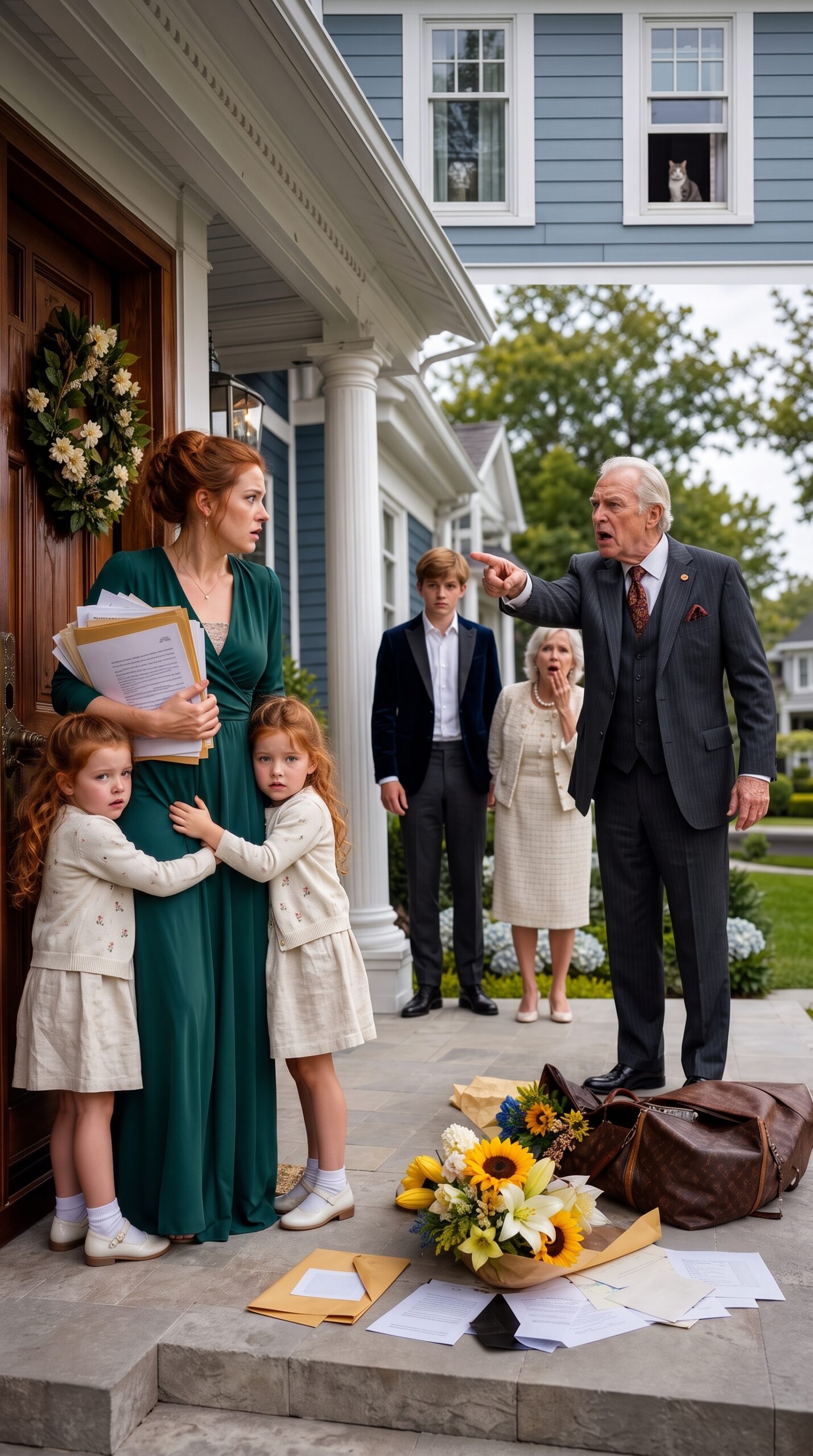
When Julia arrived with the children, still in her wrinkled black dress and swollen eyes, she found the gate locked with a new chain. On the porch stood her in-laws, Don Ricardo and Doña Elvira Santillán, impeccably dressed, as if they hadn’t just said goodbye to their only son.
Don Ricardo held a bundle of keys in his hand.
Doña Elvira clutched her leather purse against her chest, serious, stern, without a tear.
“This property returns to the Santillán family,” Don Ricardo declared. “You and the children can stay in a hotel while the succession is sorted.”
Julia didn’t understand at first.
She gazed at the facade, the bougainvillea Marco had planted for Sofía, the window of Emiliano's room, the pots she watered every morning.
“This is our home,” she replied, her voice breaking.
Doña Elvira looked her up and down.
“Marco helped you as long as he lived. But he’s gone now. We can’t carry a charity case for life.”
Sofía hid behind her mother.
Emiliano clenched his fists.
“Don’t talk to my mom like that.”
Don Ricardo descended the steps slowly, as if the boy had disrespected him in a business meeting.
“Watch your mouth, kid.”
“My dad just died,” Emiliano said. “And you come to throw us out?”
The blow came before Julia could move.
Don Ricardo’s hand hit Emiliano’s face with such force that the boy stumbled against the railing. Sofía screamed. Julia rushed towards her son, but Doña Elvira grabbed her wrist.
With a swift motion, she tore the wedding ring from Julia’s finger.
“This ring belonged to my family,” she said, holding it between her fingers. “It never should have been on your hand.”
Julia felt her blood freeze.
For 12 years, she had worn that ring while caring for Marco through chemotherapy, feverish nights, medical tests, and silences filled with fear.
For 12 years, she had cooked for those in-laws every Sunday, endured their comments, their veiled insults, their “Marco could have married better.”
And now, before the funeral flowers had even wilted, they were throwing her out like an intruder.
“Get in the car,” she told her children.
Emiliano wanted to protest, but Julia gently touched his swollen cheek.
“Into the car, sweetheart.”
When the doors closed, Sofía cried, clutching an old jacket of her dad’s.
Julia opened the glove compartment looking for tissues.
Then she saw the envelope.
Marco had given it to her two months before he died, when he was still pretending he would conquer the disease.
“Open it only if you truly need to,” he’d said.
Julia broke the seal with trembling hands.
The letter was written in Marco's handwriting.
“Julia, if my parents try to get you out of the house, don’t argue. Call attorney Renata Cárdenas. The house is yours. The cabin in Valle de Bravo is yours. My shares are protected for you and the kids. My parents know nothing. And there’s something else: if they try to sell or move documents, show Renata the blue USB.”
Julia stopped breathing.
At the bottom of the envelope, taped inside, was a small blue USB.
At the door, Don Ricardo was already on the phone.
“Yes, tomorrow we’ll show the house. That property is worth millions.”
Julia looked at the USB in her hand and understood that Marco hadn’t just protected them.
He had also uncovered something terrible.
PART 2
Julia dialed attorney Renata Cárdenas's number with frozen fingers.
The lawyer answered on the second ring, as if she had been waiting for that call for weeks.
“Julia, tell me you didn’t open the envelope out of curiosity.”
Julia swallowed hard.
“They threw me out of the house. Don Ricardo hit Emiliano. Doña Elvira took my ring. And he just said they are going to show the house tomorrow to sell it.”
There was a brief silence.
Then Renata’s voice completely changed.
“Stay in the car. Keep the kids with you. I’m coming over with a patrol and certified copies. Do you have the blue USB?”
“Yes.”
“Don’t show it to anyone. That memory could land them in serious criminal trouble.”
Julia looked in the mirror.
Don Ricardo paced back and forth, furious. Doña Elvira stood by the door, clutching Julia’s ring tightly in her hand as if it were a trophy.
Emiliano had a red cheek and a lost look in his eyes.
“Did Dad know they were going to do this?” he asked.
Julia didn’t want to lie to him.
“Your dad knew us better than we thought.”
Half an hour later, a patrol car entered the neighborhood. A gray sedan followed. Renata Cárdenas stepped out, a woman in a navy suit, hair tied back and a firm gaze.
She didn’t greet the in-laws.
First, she went straight to the car.
She checked Emiliano’s face, spoke to Sofía with a tenderness that almost disarmed Julia, and then asked for the USB.
“Marco left everything in order,” she said. “And he also left evidence.”
Don Ricardo let out a dry laugh when he saw the lawyer.
“How ridiculous. My son bought this house before he got married. That woman has no right to anything.”
Renata opened her briefcase.
“Your son established a family trust eight months ago, when his diagnosis worsened. The primary beneficiary is Julia. The contingent beneficiaries are Emiliano and Sofía.”
Doña Elvira blinked.
“That's a lie.”
“No. It’s signed before a notary, with a full capacity medical report, recorded reading, and banking witnesses.”
Don Ricardo turned red.
“Marco was weak. You manipulated him.”
“Marco knew exactly what he was doing,” Renata replied. “He also left specific instructions in case you tried to occupy the property.”
One of the officers looked at Emiliano.
“Did your grandfather hit you?”
The boy hesitated.
Julia took his hand.
Emiliano nodded.
“Yes.”
“I was correcting him,” Don Ricardo said. “He’s my grandson.”
“He’s a minor,” the officer replied. “And you just admitted to an assault.”
Doña Elvira tried to hide the ring in her purse.
Renata stopped her with a sharp phrase.
“That ring is listed as Julia’s personal property. Marco gave it to her during his lifetime. If you take it, we’re also talking about theft.”
“That ring belonged to the Santilláns,” Doña Elvira spat.
“And Marco decided it belonged to his wife.”
Doña Elvira handed the ring over to the officer with mute rage. When it returned to Julia's hands, she didn’t put it on. She merely closed it within her fist.
But the real bombshell came when Renata plugged the USB into her laptop, right there on the hood of the car.
There were audios.
Messages.
Photographs of documents.
And a folder labeled “FAKE SIGNATURE.”
Don Ricardo’s voice came through clearly in a recording:
“If Marco dies quickly, we’ll execute the sale before the widow reacts. The notary already knows what to do.”
Then Doña Elvira’s voice was heard:
“The kids don’t matter. We’ll give that woman some cash, and she’ll be gone. The house in Jurica sells for at least 18 million.”
Julia felt nausea wash over her.
Renata paused the audio and looked at the officers.
“We have evidence of attempted fraud, forgery of documents, and possible collusion with a notary. Additionally, there’s assault against a minor and retention of personal property.”
Don Ricardo lost his arrogance.
“That’s private. That recording doesn’t count.”
“Marco was part of the conversation and recorded it inside his own home,” Renata said. “Besides, he left a copy with the notary and in digital storage. It wasn’t a whim, sir. It was foresight.”
Doña Elvira finally cried.
But not for Marco.
She cried when she realized the house couldn’t be sold.
That night, the in-laws packed their bags under police surveillance. Neighbors watched from their windows, pretending not to see, but recording everything on their phones.
Don Ricardo turned to Julia.
“You poisoned my son against us.”
Julia looked at him with a calmness she didn’t even recognize.
“No. Marco just stopped closing his eyes.”
Doña Elvira pressed her lips together.
“We lost our son.”
Julia glanced at Sofía, still clinging to Marco’s jacket.
“My children lost their dad too. The difference is that you tried to take their home away the same day.”
No one replied.
When they changed the locks, Julia finally entered.
The house smelled of wilted flowers and old coffee. In the living room hung the photo of Marco with the children at the beach, smiling as if death would never touch the door.
Sofía ran to her room and wept on her bed.
Emiliano locked himself in the bathroom.
Julia stood still in Marco’s office, looking at his books, his glasses, the cup where he always left pens.
Renata accompanied her in silence.
Behind a filing cabinet, they found a small safe. Julia hadn’t known it existed.
The combination was written on a note: Sofía’s birth date.
Inside were policies, deeds, passwords, financial statements, and two envelopes.
One said “For Emiliano.”
The other said “For Sofía.”
Julia didn’t open them.
Not that night.
The next day, Renata explained everything calmly.
Marco had discovered that his parents had been using old powers to siphon money from family accounts for years. He also found a draft of the sale of the house with a forged signature, prepared to be presented as soon as he died.
That’s why he acted in secret.
He changed beneficiaries.
Protected the property.
Placed his shares in a trust.
Left his parents an apartment in Mazatlán and a monthly pension sufficient to live well.
But he left them no power over Julia.
No authority to decide about his children.
No right to touch the house.
“He didn’t want revenge,” Renata said. “He wanted you to have peace.”
Julia cried for the first time since the funeral without covering her face.
Three weeks later, Don Ricardo contested everything in court. He claimed that Marco was medicated, confused, and manipulated by his wife.
Renata presented medical reports, videos from the notary, emails from Marco, certified signatures, banking testimonies, and the recordings where the in-laws were planning to sell the house without authorization.
The judge was decisive.
The lawsuit was dismissed.
And the Prosecutor’s Office opened an investigation for attempted forgery and fraud.
Don Ricardo stopped calling.
Doña Elvira never apologized.
She only sent a box with old photos of Marco. On the label, she purposely misspelled Julia’s name as a final gesture of contempt.
Emiliano was no longer bruised in a week.
But it took months for him to say “grandpa” again without rage.
Sofía slept with her dad’s jacket for a long time. Sometimes she spoke softly to it, as if Marco could hear her from the pillow.
Julia learned that grief doesn’t always look like tears.
Sometimes it looks like going to the bank with documents.
Sometimes it looks like changing locks.
Sometimes it looks like making pancakes for two children who ask why the people who say they love you can hurt you so badly.
In time, the house began to breathe again.
Sundays no longer smelled of family trials, but of sweet bread, hot chocolate, and soft music.
In spring, Julia took the children to the cabin in Valle de Bravo.
They opened the windows.
Shook off the dust.
Emiliano repaired the dock with his dad’s tools.
Sofía planted yellow flowers by the entrance.
Julia sat on the porch at sunset and, for the first time, put the ring back on.
Not because she needed to prove she belonged to the Santillán family.
But because Marco, even while dying, had understood something that many living people never comprehend:
A family is not measured by the last name you bear.
It is measured by who protects you when they can no longer gain anything from you.





