PART 1
The first sound Abril Castañeda heard upon entering her new apartment was not the rolling of suitcases or the heavy traffic on Tlalpan Avenue.
It was the click of the lock.
Clack.
A small, dry noise, almost mundane.
But for Abril, it was enough to feel that her honeymoon had just morphed into something else entirely.
Just five days earlier, Mateo Luján had sworn eternal love to her in front of their families in a garden in Cuernavaca, bursting with bougainvillea, soft norteña music, and aunts weeping into their napkins.
He had taken her by the waist, kissed her forehead, and said in front of everyone:
"With Abril, I want a peaceful home, a beautiful life, and a real family."
She believed him.
Abril was 28 years old, a middle school teacher at a public school in Ecatepec, and had been with Mateo for almost three years. He seemed calm, hardworking—one of those men who carry grocery bags without being asked and greet the neighbors with respect.
He also seemed to adore her.
He brought her coffee to school, sent her messages when it rained, and offered to pick her up if she was running late. Even her grandmother Carmen said Mateo was "very proper, very polite."
But that night, in the newly rented apartment in Narvarte, Mateo no longer wore that kind face.
He left the keys on the kitchen table.
Then he took off his black belt, folded it slowly, and held it in his right hand.
Abril was still wearing the light dress from their trip. Her hair smelled of sunscreen and the sea. In her suitcase was a seashell she had picked up in Playa del Carmen, some cheap bracelets, and the now-dry civil bouquet wrapped in paper.
Everything felt like it belonged to another life.
"Mateo, what are you doing?" she asked.
He breathed as if about to explain something reasonable.
"Setting rules before things get out of control."
Abril blinked.
"Rules?"
"Starting tomorrow, you’re going to give me your passwords. Mobile banking, email, payroll, everything. I also want your pay stubs and your signature to check a loan. We’re married now, Abril. You won’t be walking around here like a single woman."
She stared at him in silence.
Mateo continued, colder:
"And those tight blouses you wear to school are over. I don’t want students or teachers looking at you like you’re anything."
Abril felt a knot in her stomach.
"Did your mom tell you to talk to me like that?"
Mateo’s jaw tightened.
"My mom says a wife should be settled from the start. Later, they feel it much because they earn their own money."
Abril then understood she wasn’t facing just any anger.
She was facing a plan.
Her grandfather Ernesto, a former boxer from an old gym in Tepito, had raised her among sacks, bandages, and the bitter smell of liniment. He never taught her to seek out fights. He taught her not to stay still when someone mistook love for control.
"Calmness is trained too, mija," he used to say. "And dignity is not negotiable."
Mateo barely lifted the belt.
He didn’t touch her.
Not yet.
But he wanted her to see the future.
"If you scream," he whispered, "my mom will say you’re crazy. And no one will believe a middle school teacher over my family."
Abril looked down at her gym bag.
Inside were two short practice sticks, the same ones she used in self-defense workshops for teachers.
She pulled them out slowly.
"Don’t threaten me, Mateo."
He let out a mocking laugh.
"Don’t play tough, güey. Put that away before you hurt yourself."
Mateo threw the belt.
Abril moved just once.
She turned her body, grabbed his wrist, and snatched the belt with a clean precision, without anger, without shouting. Mateo fell to his knees on the carpet, red with shame.
She didn’t hit him.
She just placed the belt out of reach of both of them.
"I married to share a life," Abril said. "Not to ask for permission to exist."
Mateo lifted his face.
His eyes no longer held shame.
They held hate.
"You’re crazy."
"No," she replied. "You picked the wrong woman."
That night, Mateo slept on the couch.
Abril locked the bedroom door, but she couldn’t close her eyes.
At 2:17 AM, Mateo’s phone lit up on the kitchen counter.
The message was from his mother, Ofelia.
"Has she reacted? Tomorrow record her if she gets angry. I spoke with Brenda. Without her payroll and her clean Credit Bureau, we won't get approved for the 850,000."
Then another:
"Don’t let her go with her family before signing. If she refuses, we’ll make her seem dangerous."
Abril stood frozen, barefoot on the cold floor.
Then she understood that the belt hadn’t been an impulse.
It had been a trap.
PART 2
Abril didn’t touch Mateo’s phone again.
She took pictures of the screen with her own phone, returned to the bedroom, and sat on the edge of the bed. Outside, motorcycles, trucks, and people returning late from work passed by. Inside, her five-day marriage had just revealed its teeth.
She didn’t cry.
Not because it didn’t hurt.
But because her body had entered that strange calm that comes when danger stops being confusing.
At 7:30 AM, Mateo knocked softly on the door.
"Love, can we talk?"
He entered with two coffees and sweet bread. He looked tired, remorseful, almost tender. If Abril hadn’t seen the messages, she might have doubted herself.
"I’m sorry for last night," he said. "I let my temper get the best of me. We’re tired from the trip. My mom also puts old ideas in my head. Let’s not make a drama of our honeymoon."
Abril watched him.
"Was the belt also an old idea?"
Mateo looked down.
"It was a stupidity."
"And my payroll?"
He froze.
"We’re spouses. It’s normal to share."
"Sharing shouldn’t be forced with threats."
Mateo squeezed the coffee cup.
"You’re exaggerating."
Abril didn’t respond.
That same day, she requested leave from school for a family emergency and went to Ecatepec. Her mom, Rosalba, received her with a pale face. Her dad wanted to get in the car to go find Mateo right then.
But Grandpa Ernesto, at 79 years old with still-strong hands, slammed his palm on the table once.
"You’re not going to do him the favor of becoming the violent one in this story. If they want to paint Abril as crazy, we’re not going to give them the paint."
Then he served her soup.
"First eat, mija. Then we’ll gather evidence. In a serious fight, the important blow isn’t the first one. It’s the one that comes with reason."
Abril returned to the apartment two days later.
She carried a small camera hidden in a clay figure she placed near the bookshelf, a recorder inside her keychain, and the number of a lawyer named Julia Zamora, a specialist in economic violence and family crimes.
For three days, Mateo acted like the perfect husband.
He made chilaquiles.
Sent her flowers at school.
Called her "my queen" in front of the neighbors.
He touched her back in public, as if he wanted everyone to see he was a loving husband.
But every time Abril mentioned her bank account, her RFC, her INE, her payroll stubs, or her Credit Bureau, Mateo tensed up.
On Saturday afternoon, Ofelia arrived.
She didn’t ask for permission.
She walked in with a large suitcase, dark glasses, and the confidence of a woman convinced that any house her son lived in belonged to her.
"I’m going to stay for a few days," she announced. "This marriage needs order. You can tell that no one taught you how to run a household properly."
Abril swallowed hard.
Ofelia started by rearranging the pantry. Then she criticized Abril’s sneakers, her sweatpants, her schedule, her way of speaking, and even how she organized the dishes.
"Working women think they no longer need a husband," she said while folding a napkin. "But a wife with a fixed salary is dangerous if she doesn’t learn humility."
The recorder captured everything.
That night, when Mateo went out for sodas, Ofelia cornered Abril by the sink.
"Sign what my son needs, and you’ll avoid problems."
Abril held her gaze.
"Your son threatened me with a belt the night we returned from our honeymoon."
Ofelia didn’t seem surprised.
Not even a blink.
"You must have done something to get him riled up."
Abril felt a different chill.
It wasn’t fear.
It was confirmation.
"And what if I don’t sign?"
Ofelia barely smiled.
"Then people will know you’re aggressive. That you get upset. That my son lives in fear. You know how this works, mija. A school doesn’t want scandals with a violent teacher."
Later, Mateo’s phone lit up again on the counter.
The message was from Brenda.
"Your mom must have pressured her by now. We need Abril to lose control. To push, scream, or grab something. A video is enough to scare her with the school."
Another came:
"The 850,000 loan won’t go through without her. If they don’t sign this week, the house in Querétaro falls through."
And another:
"After that, you and I are leaving. Enough pretending."
Abril read the screen from a distance, without touching anything. The camera in the clay figure was aimed directly at the kitchen.
Everything clicked into brutal clarity.
Brenda wasn’t just an acquaintance of Mateo’s.
She was his lover.
She worked in finance and had accessed Abril’s information without permission. Mateo had debts, a failed investment, and a plan to buy a house in Querétaro with Brenda using Abril’s job stability as collateral.
If Abril signed, they left her in debt.
If she didn’t sign, they provoked her, recorded her, and used her job as a threat.
They wanted her fear to do what her will would never accept.
On Sunday, they prepared the final blow.
Abril returned from the market with tortillas, fruit, and some yellow flowers she bought just to remind herself that she could still choose pretty things.
Upon opening the door, she noticed the guest room was ransacked.
That room held her school materials: balls, cones, ropes, notebooks, used uniforms she donated to students, and the practice sticks her grandfather gave her when she turned 15.
She heard bags rustling.
She stepped in quietly.
Ofelia stood in front of the closet, stuffing the sticks into a black bag.
"What are you doing with my things?" Abril asked.
Ofelia jumped but raised her chin.
"I’m removing weapons from this house. I’m not going to wait for you to attack my son."
Abril grabbed the bag.
Inside were not only her sticks.
There were an expensive watch still with its tag, two gold bracelets belonging to Ofelia, a folder with copies of her INE, her RFC, her pay stubs, the name of her school, and a loan application with her name written at the top.
The signature was incomplete.
Only she was missing.
Before Abril could speak, Mateo appeared in the doorway with his phone recording.
"Enough, Abril!" he shouted with a terrible performance. "Let my mom go! Everyone will see how you are when no one is watching."
There it was.
The complete scene.
The bag.
The planted jewelry.
The stolen documents.
The video to make her guilty.
Abril dropped the bag and looked directly at the phone.
"Good thing you’re recording," she said with a calmness that made Mateo tremble. "The camera on the bookshelf has been recording since your mom entered this room to hide evidence."
Mateo’s face lost color.
Ofelia was left speechless.
"That’s illegal," she murmured.
"No," Abril replied. "Illegal is using my data, forging an application, planting jewelry, threatening my job, and planning with Brenda how to make me seem violent."
They knocked on the door.
Mateo looked at Ofelia.
Ofelia looked at the bag.
Abril opened the door.
On the other side stood Julia Zamora, her lawyer, with a blue folder full of printouts. Behind her was Abril’s dad, serious, without shouting, with his hands still.
"I’m here for my daughter and her documents," he said. "Nothing more."
Ofelia began to cry as if she had rehearsed it.
"We’re being attacked. Look how this family behaves. My poor son lives terrified."
Julia placed the folder on the table.
"Mrs. Ofelia, it’s in your best interest not to continue acting before knowing how many audios we have."
Abril pulled out the evidence one by one.
Photos of the message at 2:17 AM.
The audio where Ofelia said a wife should sign to avoid problems.
The conversation with Brenda explaining they needed a video.
The video of Ofelia entering the room with the jewelry.
The loan application for 850,000.
The irregular accesses to her financial information.
Mateo’s tone changed immediately.
"Love, this has gotten out of control. Brenda pressured me. My mom wanted to help me. I was desperate, but I do love you."
Abril felt something strange.
It wasn’t sadness.
It wasn’t fury either.
It was a kind of internal cleansing, like when a window finally opens in a room full of smoke.
"Did Brenda also pressure you to marry me, use my payroll, and then leave with her to Querétaro?"
Abril’s dad stepped forward.
"Did you have another woman before marrying my daughter?"
Mateo didn’t answer.
Ofelia, desperate to defend him, ended up sinking him.
"She’s his wife! A wife’s information also belongs to her husband if it’s to support the family."
Julia raised an eyebrow.
"Thank you. That was also recorded."
Then the alliance between mother and son shattered in front of everyone.
Mateo accused Ofelia of messing up the scene. Ofelia screamed that he had begged for help because he couldn’t lose the loan approval. Mateo said that if she hadn’t planted such obvious jewelry, Abril wouldn’t have suspected.
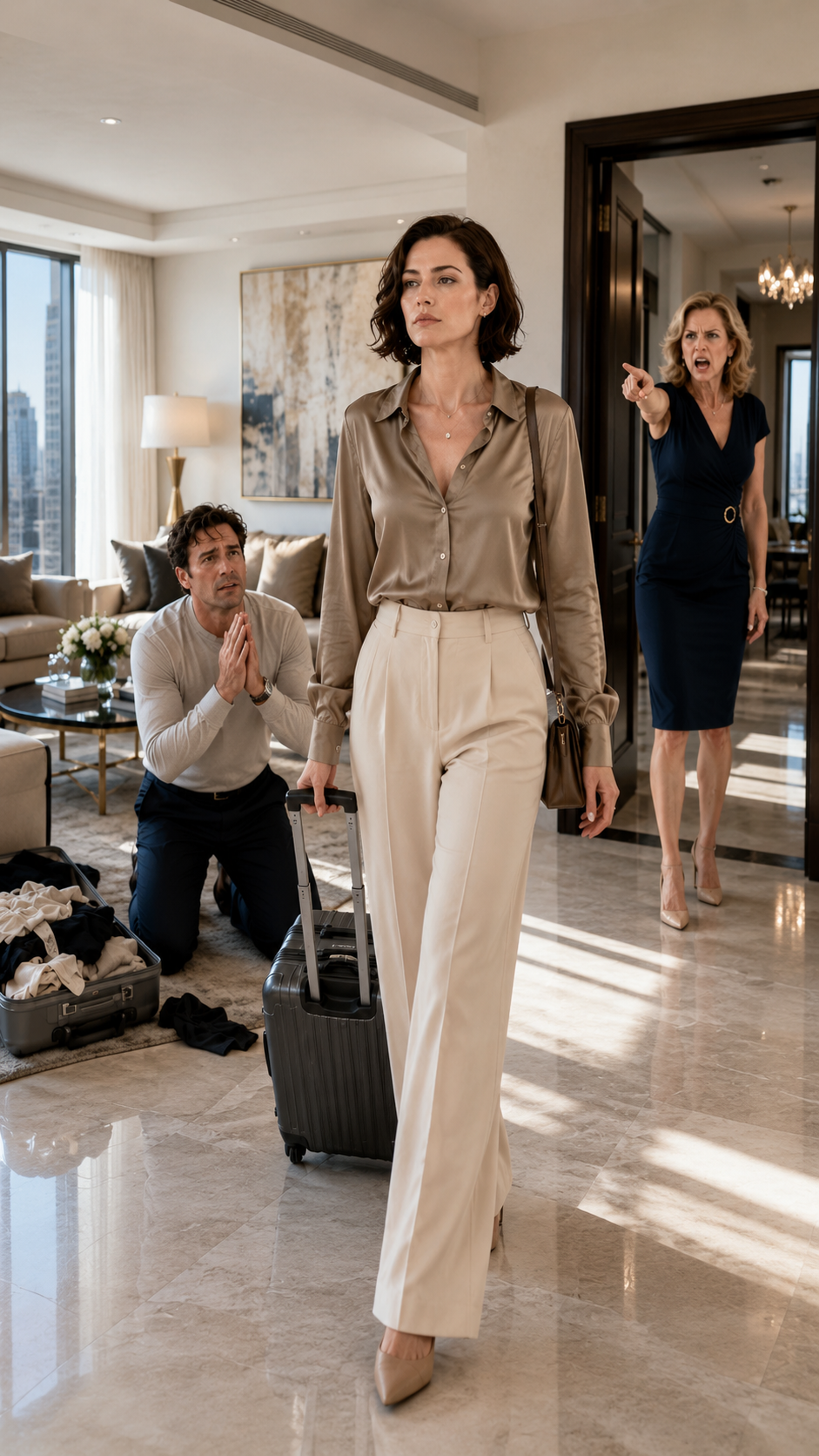
Abril entered the bedroom.
She packed her birth certificate, her documents, her notebooks, three changes of clothes, and her grandfather’s sticks. She didn’t take wedding gifts, the new glasses, or the embroidered sheets with their initials.
She didn’t want memories of a house built like a cage.
Mateo followed her.
"You can’t leave like this. We’re married."
Abril closed the suitcase.
"Marriage is not a prison."
"We can fix this privately."
"Private was what you wanted when you thought the evidence had no sound."
In the living room, Ofelia launched her final poisoned remark:
"A woman as tough as you ends up alone."
Abril turned around.
"Being alone in peace is better than living with people who need to see you on your knees to call you family."
She left the apartment without looking back.
The following months weren’t easy.
There was no victory music or perfect movie scene. There were complaints, statements, legal meetings, sleepless nights, and the obligation to repeat over and over that this wasn’t "a newlywed fight."
Julia requested a protection order, initiated the divorce, and filed complaints for attempted fraud, misuse of personal data, and economic violence. She also submitted a report to Abril’s middle school before Mateo tried to tarnish her name.
The principal called her two days later.
"Teacher Abril, your position is secure. Take all the time you need."
Abril cried when she hung up.
She cried sitting on the floor of her mom’s house, hugging her knees, because sometimes a simple phrase returns the whole world to you.
Brenda was suspended from the financial firm while they investigated unauthorized access. Mateo lost his job when the compliance department received the file. Ofelia tried to present herself as a worried mother, but her own voice betrayed her.
At a hearing, the judge listened to the audio where Ofelia said:
"If we make her react, the school will believe she’s out of her mind."
Ofelia looked down.
Mateo stared at the floor.
Abril didn’t feel pleasure.
Nothing could erase the sound of the lock.
Nothing could return her honeymoon without shadow.
Nothing could turn that belt into something that never happened.
But the consequences served a purpose.
They served to ensure the lie didn’t take her name.
Months later, Abril returned to the apartment with her dad and two cousins to collect the last of her things. Mateo sat on the couch, unshaven, surrounded by boxes and debts.
Without his pressed shirt or confident voice, he looked like any ordinary man.
That was the most disturbing part.
Understanding that danger doesn’t always come shouting. Sometimes it arrives with flowers, signs the marriage certificate, smiles in photos, and waits for the door to close.
"Can’t you really forgive me?" Mateo asked.
Abril looked around the room.
"Forgiveness isn’t permission to return to a cage."
"I loved how strong you were."
She shook her head.
"No, Mateo. You loved imagining you would be the one to tame me."
After that, she returned to Ecatepec.
Her grandmother Carmen awaited her with café de olla. Her grandfather Ernesto sat by the window, with his old bandages on his legs. He didn’t ask her if she wanted to talk. He just made space for her.
Life didn’t heal all at once.
It healed in pieces.
Abril went back to teaching. At first, she was quieter. Her students noticed, but they also saw she was still there: correcting postures, organizing games, teaching balance.
Halfway through the semester, she opened a free self-defense workshop for teachers, students, and mothers.
Nine showed up for the first class.
By the end, there were 52.
Abril always repeated the same phrase:
"Defending oneself doesn’t mean living in fear. It means remembering that your body, your money, your voice, and your decisions belong to you."
A teacher confessed to her that her husband controlled every penny of her salary. A mother told her that her mother-in-law threatened to take her children away. A student said her boyfriend checked her phone.
Abril didn’t judge them.
She listened.
Gave them contacts.
Believed them.
One afternoon, she returned to her grandfather’s old gym. She took the sticks, inhaled deeply, and began to move under the yellow lights.
Her strikes no longer held anger.
They held roots.
Grandpa Ernesto watched her from a folding chair.
"You’re no longer fighting him in your head, are you?"
Abril lowered the sticks.
"No," she said. "I’m returning to myself."
That was the true victory.
Not disarming Mateo.
Not exposing Ofelia.
Not winning papers before the law.
The victory was understanding that leaving a house where they wanted to break her didn’t mean losing a home.
Sometimes, a door locked with a key doesn’t announce the end.
Sometimes it marks the first second of freedom.





