PART 1
"Children are taught respect from a young age, because otherwise they grow up thinking they own the world."
Doña Amparo said that 2 seconds before slapping Valentina.
Lucía Herrera was 32 years old, lived in Guadalajara, and had been married to Raúl Mendoza for 8 years. He was a quiet accountant who always boasted that his family was "very close."
They had 2 children: Valentina, 4 years old, and Leo, 8 months.
Valentina was a cheerful girl, one of those who talked to her dolls as if they were clients at a beauty salon. She loved big bows, crayons, and singing cartoon songs while arranging blocks on the floor.
Leo still smelled of milk, talcum powder, and clean blanket. He laughed when Valentina made faces and cried every time someone with a loud voice got too close.
Lucía's mother-in-law, doña Amparo, was famous in the family for "having a firm hand." In reality, she was a bossy woman who disguised her cruelty with outdated phrases.
"In my house, kids don't talk back."
"You obey adults."
"A slap doesn't kill anyone."
Every Sunday, there was a meal at her house in Zapopan. It was always the same: bean casserole, red rice, warm tortillas, cousins running around, aunts whispering criticisms, and doña Amparo sitting in her chair as if she owned the entire neighborhood.
Lucía usually endured it for Raúl.
He always told her:
"You know how my mom is, love. Don't take it to heart."
But that Sunday, it wasn't a heavy phrase or a poisonous hint.
It was her hand against a child's face.
Valentina was in the living room building a tower with colorful blocks. Lucía was holding Leo near the kitchen, trying to pry a napkin from his mouth before he ate it.
Then doña Amparo raised her voice.
"Valentina, bring me my glass of hibiscus water."
The girl didn't respond. Not out of rudeness. She was 4 years old and focused on keeping her tower from falling.
"Valentina Mendoza, I'm talking to you."
The girl placed another block on top.
Lucía managed to say:
"I'll get it for you, ma'am."
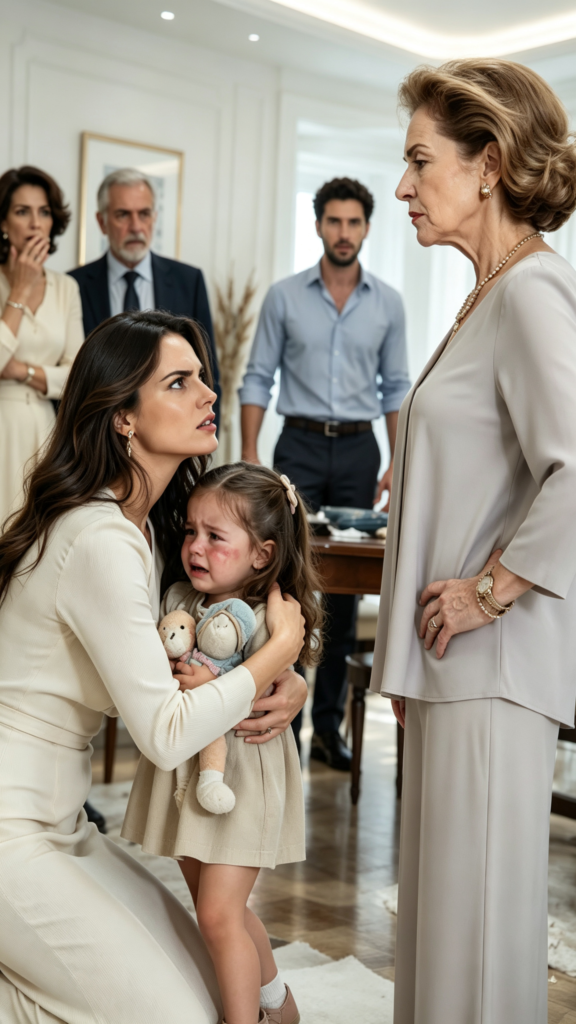
But doña Amparo was already walking toward the girl. She grabbed her by the arm, lifted her abruptly, and slapped her hard, silencing the entire room.
Valentina stood still.
Then she began to cry with a broken, confused pain, as if she didn't understand why someone who should love her had just hurt her.
"When an adult speaks, you obey," said doña Amparo.
Lucía set Leo down in the arms of a cousin and ran to her daughter. She saw the red mark on her cheek, the fear in her eyes, and the trembling little hand trying to cover her face.
Then she looked at her mother-in-law.
"Don't you ever touch my daughter again."
Doña Amparo laughed, offended.
"Oh, don't exaggerate. She's like this because you raise her like a little crystal princess."
Lucía felt something inside her flicker out.
And then she did what no one expected.
She slapped doña Amparo.
The entire room fell silent.
Doña Amparo brought her hand to her cheek and started to cry as if she were the one who had been hit.
"You slapped me in my house! In front of my family!"
"You slapped a 4-year-old girl," Lucía replied, holding Valentina close. "The difference is that you can defend yourself. My daughter cannot."
Raúl was by the dining room.
Pale.
Silent.
Motionless.
That silence hurt Lucía more than any insult.
That night, back at home, Raúl asked her to consider apologizing "to avoid making the problem worse."
Lucía didn't respond.
She just checked her phone and found a video she had accidentally recorded, because minutes earlier she was filming Valentina playing with Leo.
There it was: the order, the strike, the crying.
But also a phrase that no one wanted to hear.
"Let’s see if she learns, because that girl is as useless as her mother."
Lucía froze, phone in hand, not imagining that the worst was just about to begin.
PART 2
The next day, Lucía's phone sounded like it was on speaker in a crowded market.
Messages from sisters-in-law, aunts, political cousins, doña Amparo's neighbors, and even a woman who only greeted her during holiday parties.
Everyone repeated the same version.
That Lucía had lost control.
That she had humiliated an elderly woman.
That a decent daughter-in-law wouldn’t raise her hand against her husband's mother.
In no message did Valentina appear.
No one asked about her cheek.
No one asked if she had slept well.
No one asked why a 4-year-old girl had woken up 3 times in the middle of the night saying, "Mom, I didn't do anything wrong."
Lucía's sister-in-law, Brenda, sent her a long audio message.
"Look, Lucía, my mom may have a strong character, but you know she is a woman of values. Besides, kids used to be raised this way and nobody was traumatized. You made a horrible scene. My mom won't stop crying."
Lucía listened while sitting at the table, her cold coffee in front of her.
She replied with just one phrase.
"Your mom hit Valentina."
Brenda replied in less than a minute.
"You're probably exaggerating. You've always been delicate with the girl."
At that moment, Lucía understood something that froze her more than anger.
They didn't want to know the truth.
They wanted to keep the comfort of blaming her.
That night, Raúl came home from work with a frustrated look. He dropped his keys on the counter, loosened his tie, and said that his family was destroyed.
"My mom is very upset," he murmured.
Lucía looked at him from the living room.
Valentina was asleep on the couch, hugging a blanket. She still had a reddish shadow on her cheek.
"Our daughter was upset too, Raúl."
"I'm not saying my mom was right, but you couldn't hit her."
"So what did you want? For me to thank her?"
"I wanted you to think before reacting."
Lucía let out a dry laugh.
"How curious. You don’t ask your mom to think before hitting a child."
Raúl clenched his jaw.
"She’s my mother."
"And Valentina is your daughter."
He didn't answer.
That silence said it all again.
For the next 3 days, doña Amparo became a professional victim. She posted religious quotes on Facebook, sent chains about respecting parents, and said in family groups that Lucía had attacked her out of pure arrogance.
An aunt even wrote:
"How sad when a woman separates a child from her mother."
Lucía still hadn't responded.
First, she went to a family lawyer in downtown Guadalajara. She didn’t ask for permission. She didn’t warn anyone. She didn’t cry in front of Raúl.
She brought the video, audio messages, text messages, and 12 printed screenshots where the family admitted, without realizing it, that doña Amparo had indeed hit Valentina, but justified it as "correction."
The lawyer reviewed everything in silence.
Then he said:
"This is not a family dispute. This is child protection. And your husband, if he insists on exposing the children, also becomes part of the problem."
Lucía left that office with a blue folder under her arm.
For the first time in days, she breathed.
That night, Raúl told her that on Saturday there would be a meal at Brenda's house to "smooth things over."
"My mom wants to talk to you," he said.
"I'm not taking my children to the woman who hit Valentina."
"She’s their grandmother."
"She’s also the one who left a mark on her face."
"Lucía, it's enough. You're really making a problem."
She got up, went for the blue folder, and placed it on the table.
Raúl looked at her, confused.
"What is that?"
"An answer."
Inside were the 12 screenshots, the copy of the video, a letter from the lawyer, and a formal request for doña Amparo not to have contact with Valentina or Leo.
Raúl turned pale.
"Are you threatening me?"
"No. I'm protecting my children."
"My mom will die if she reads this."
"My daughter was frightened every time someone raised a hand near her since Sunday. But you didn't worry about that, did you?"
Raúl threw the folder on the table.
"You should apologize."
Lucía felt that phrase crash into her chest like a door slamming.
She didn’t scream.
She didn’t cry.
She just took her phone and sent the video to the family group.
Without cropping her own slap.
Without hiding anything.
She wrote underneath:
"This is the complete truth. My daughter is 4 years old. No one has the right to hit her. Whoever defends this will be out of my house and my children’s lives."
The messages stopped for 10 minutes.
Then the fire began.
A cousin wrote:
"I did hear the hit. Sorry for not saying anything."
An uncle sent:
"Amparo, you went too far."
Another woman, a family friend, commented:
"That’s not education. That’s abusing a child."
Brenda called, crying.
"Why did you post that? My mom is devastated!"
"My daughter also cried," Lucía said. "But no one brought her tissues."
"You exposed her as a monster."
"She exposed herself."
Raúl entered the kitchen with his phone in hand.
"Why didn’t you tell me you had video?"
Lucía looked at him sadly.
"Because you were there. You didn’t need proof. You needed courage."
For a few seconds, Raúl seemed to break.
He sat down, covered his face, and took a deep breath.
Lucía thought he would finally say: "Sorry, I failed."
But he murmured:
"My mom won't withstand this shame."
Then something finally broke.
"Well, Valentina didn’t have to withstand her hit."
The following Sunday, doña Amparo appeared at mass.
Lucía had gone with her children because Valentina asked to light a candle for her lost stuffed bunny. Raúl insisted on accompanying them, perhaps out of guilt, perhaps for appearances.
Doña Amparo walked down the central aisle before the final blessing. She wore dark glasses, held a rosary in her hand, and had the broken voice of a soap opera star.
"Father, pray for me!" she said loudly. "My daughter-in-law recorded me to destroy me. She took my grandchildren away. She is ruining my family."
Several people turned to look.
Lucía felt Valentina hide behind her skirt.
Raúl was by her side.
It was her opportunity.
She only had to say one phrase:
"My mom hit our daughter."
But she looked down.
That silence was worse than a betrayal. It was a sentence.
When they got home, Lucía prepared milk for Leo, tucked Valentina in bed, and spoke with Raúl in the kitchen.
"Today I gave you the last chance."
"Don’t start, please."
"No. Today I will start. Your mom lied in front of the whole church, and you were silent again."
"I wasn’t going to create a scene at mass."
"She caused the scene."
"What did you want? For me to humiliate my mother?"
"I wanted you to defend your daughter."
Raúl didn’t respond.
Not again.
The following Saturday, he said he would go see doña Amparo.
"You go," Lucía said.
"I want to take Leo. My mom wants to hold him. She says nothing happened to him."
Lucía felt nauseous.
"Nothing happened to him? Is that the measure? Wait until she hits him too?"
"Don’t be dramatic."
"I’m not dramatic. I’m his mother."
Raúl stormed out, slamming the door.
Hours later, someone sent Lucía a video taken at Brenda’s house. Doña Amparo was in the middle of the living room, surrounded by family, saying:
"Lucía was always an exaggerator. My son is trapped. Those kids need discipline, not a hysterical mother who thinks she has a degree in parenting."
When Raúl returned, he looked embarrassed.
"I didn’t know she was going to say that."
Lucía turned off the video.
"You knew who she was. You just didn’t care as long as her poison fell on me."
That night’s fight was the harshest of their marriage.
Raúl shouted that Lucía was forcing him to choose between his mother and his wife.
She replied:
"Your mom forced you to choose when she hit your daughter. You just don’t want to accept that you’ve already chosen."
The next day, doña Amparo arrived at the house with gifts.
She brought a doll for Valentina and a rattle for Leo. She rang the bell as if nothing had happened.
Lucía barely opened the door.
"I’ve come to see my grandchildren."
"No."
"I’m their grandmother."
"And you are also the person who hit my daughter."
Doña Amparo rolled her eyes.
"Oh, get over it. It was just a little slap."
That phrase closed Lucía’s heart forever.
Raúl appeared behind her.
For a second, Lucía thought he would finally say the right thing.
But he whispered:
"Let her hold at least the baby."
Lucía didn’t respond.
She simply took a step back, closed the door, and left both of them outside.
Doña Amparo started banging on the door like a madwoman. Raúl called Lucía's cell 6 times from the sidewalk. She didn’t answer.
The children were inside.
Safe.
That was the only important thing.
When Raúl entered 15 minutes later, Lucía already had a suitcase on the bed.
"Pack," she said.
"You're not serious."
"I’ve never been more serious."
That night, Raúl went to his mother’s house.
A week later, he received the divorce notification.
First came his furious messages.
"You can’t do this."
"You’re destroying the family."
"My mom was right about you."
Then came the cruel ones.
"You might not even be the mother of Valentina and Leo."
Lucía kept everything.
Every message.
Every audio.
Every threat.
Then came the apologies.
"I understand now."
"I should have defended them."
"Let’s go to therapy."
But there was always a hidden condition: that doña Amparo could see the children, that Lucía would delete the video, that she would stop "making the family look bad."
The family was already broken.
Lucía didn’t break it.
Doña Amparo’s hand and Raúl’s silence broke it.
The divorce was long and cold. Lucía had to move to a smaller house in a quiet neighborhood near Tlaquepaque. It had 2 bedrooms, a cement patio, and a wall where Valentina could stick drawings without anyone telling her she was in the way.
She requested full custody.
Raúl tried to present himself as a confused father, a victim of a resentful wife. But Lucía brought the video, the 12 screenshots, the audios, the church testimonies, and the messages where he doubted his own children to avoid paying alimony.
When the judge read the message where Raúl said, "Maybe they’re not even mine," she looked over her glasses.
Raúl said nothing.
The shame spoke for him.
Lucía obtained full custody. Raúl was left with supervised visits and mandatory alimony. Doña Amparo could not approach the children.
At first, Lucía thought she would feel fear.
But one night, watching Valentina sleep without covering her cheek and Leo breathing peacefully in his crib, she understood something:
A house without shouting is not empty.
It is healing.
Almost 4 years passed.
Valentina grew up. She was now 8 years old, loved drawing dresses, and corrected her brother when he said bad words. Leo ran around the patio with his shoes on the wrong feet and talked about dinosaurs as if he were a scientist.
Raúl appeared less and less. He canceled visits, arrived late, or sent messages saying he had work.
Lucía stopped waiting for him to be the father her children deserved.
She focused on being the mother they needed.
One afternoon, she received a call from Brenda.
Her voice no longer sounded haughty.
It sounded broken.
"Lucía... my mom hit my son."
Brenda's son was 4 years old.
The same age Valentina was when she received that slap.
Brenda recounted that they were at doña Amparo's house. Her son was drawing a truck. Doña Amparo asked him to show her the paper. The boy said no because he hadn’t finished yet.
Then she snatched it away, tore it, and when he started crying, slapped him.
"She told him she ruled her house," Brenda whispered.
Lucía closed her eyes.
She felt no pleasure.
She felt no triumph.
She felt sadness for another child now asking what he had done wrong.
Brenda cried.
"I'm sorry. I’m sorry for not believing you. Sorry for saying you were exaggerating."
Lucía could have told her many things.
She could have reminded her of every audio.
Every insult.
Every time she called her dramatic.
But there was a hurt child in the middle, and Lucía didn’t want to become another person more concerned with winning than protecting.
"Believe it from the first second," she said. "That’s all your son needs right now."
Brenda filed a complaint. She requested a restraining order. Doña Amparo made another scene, this time in front of patrol cars and neighbors who filmed from their windows.
The family that so staunchly defended its "way of educating" began to crumble when it could no longer hide who it was breaking.
That night, Lucía watched Valentina do her homework at the table and Leo play with cars under the chair.
She thought of everything she lost: a marriage, a house, years of peace, family gatherings, Sundays that could have been beautiful.
Then she looked at what she saved.
The tranquility of her children.
Their right to grow up without fear.
Her certainty that her mother would never ask them to hug those who hurt them just to make the adults feel comfortable.
Because sometimes people say that setting boundaries destroys families.
But that’s not true.
Boundaries only show how broken a family was before someone dared to say: enough.
And Lucía never apologized again for defending her children.
Because respect is not taught with blows.
It is taught by showing a child that their dignity also deserves to be protected.





