PART 1
Don Aurelio Mendoza's coffee cup slipped from his grasp when he heard a voice behind the barn.
It wasn't a scream or a cry.
It was a soft, weary voice, one that had long given up hope.
—Sir… can you give us what you no longer need for the dogs?
Aurelio stood frozen in the courtyard of Hacienda El Mezquite, on the outskirts of Tepatitlán. Since his wife died, that place had become enormous, silent, and cold, even though the Jalisco sun beat down like fire.
He walked toward the barn with a tightness in his chest.
There he saw four children.
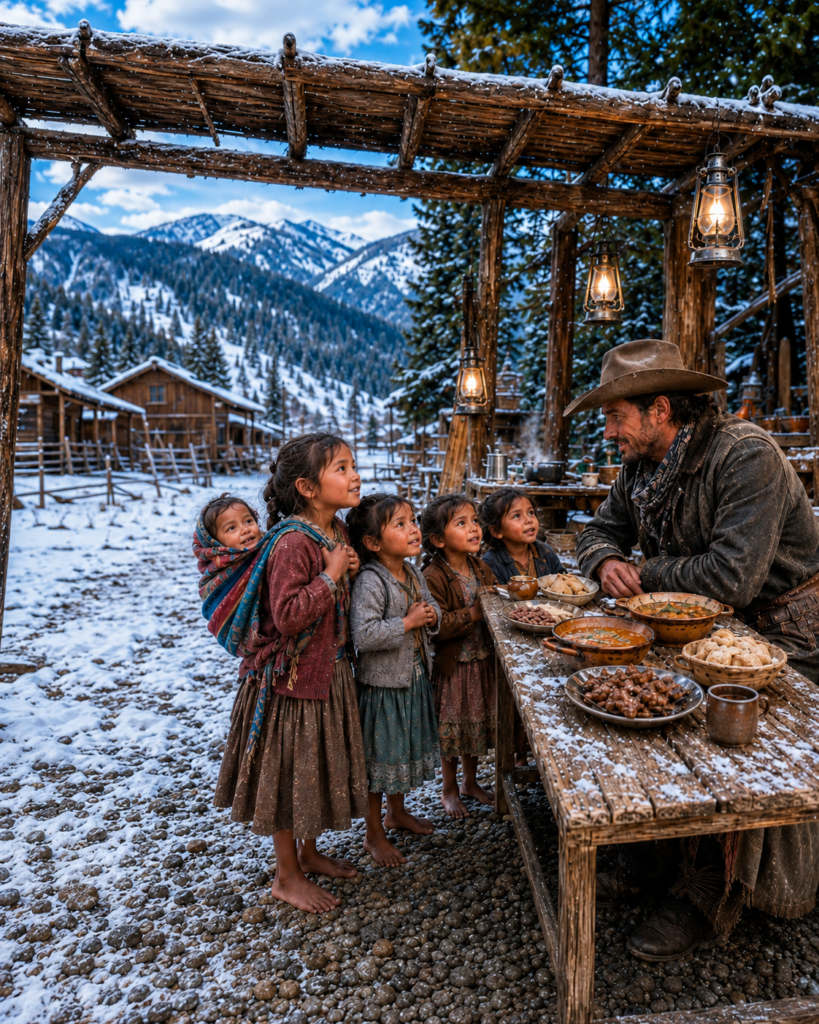
They were thin, dusty, with broken shoes and clothes clinging to their bodies from sweat. The smallest held an old bucket as if it were a treasure. A twelve-year-old girl stood protectively in front of her siblings, serious and tough, as if her childhood had abruptly ended.
Behind them was a young woman with a sleeping baby against her chest.
Her lips were cracked, and her eyes were sunken.
But she did not beg.
She simply lowered her gaze.
—I’m sorry. We’ll leave. We didn’t mean to bother you.
Aurelio looked at the bucket where they tossed hard tortillas for the dogs. Then he looked at the boy.
—No kid in this house eats animal leftovers —he said in a hoarse voice—. Come to the kitchen.
The woman tightened her hold on the baby.
—I don’t accept charity.
—Then help me clean the corral, and we’ll all eat like decent people.
She hesitated, swallowing her pride along with her hunger.
—I’m Mariana Solís. These are Lupita, Toño, Emiliano… and the baby is Rosita.
—I’m Aurelio Mendoza. And if you came here hungry, no one will humiliate you for it.
The kitchen smelled of hot tortillas again after a long time. Aurelio served beans, red rice, eggs in sauce, milk, and fresh cheese.
The children ate slowly, fearfully.
As if someone might snatch their plates away.
—Come on, kid —he said to Toño—. Eat slowly. Here, no one punishes for food.
Toño hugged his bucket against his chest, looking at the table in disbelief.
That night, Mariana cleaned the corral, washed dishes, swept the yard, and arranged sacks even though no one asked her to. When the children fell asleep in an empty room, she stepped out into the corridor with Rosita in her arms.
—I lied —she murmured.
Aurelio didn’t press her.
—It wasn’t just today. It’s been three days without eating well. I told the kids not to say anything because when people hear “hunger,” they think “laziness” or “filth.”
Aurelio felt a knot in his throat.
—People think pure nonsense when they’ve never missed a meal.
Mariana looked at the ground.
—And the worst part is they brag about it as if it were a virtue.
In the following days, Mariana worked with a strength that was painful to watch. She got up before the sun, made coffee, cleaned chicken coops, mended sacks, and never asked for anything.
Lupita took care of her siblings with an adult's seriousness. Toño hid the bucket under his blanket. Rosita began to smile whenever she saw the chickens.
Emiliano was different.
He hardly spoke.
He would stare at a honey-colored mare named Paloma, as if that animal understood things that people did not.
One afternoon, Aurelio placed a rope in his hands.
—Do you want to learn to rope?
Emiliano looked down.
—I don’t know.
—Well, that’s how it starts, kid.
The first attempt was terrible. The second worse. By the fifth, Emiliano braced himself for a scolding.
But Aurelio only said:
—Try again.
After many attempts, the rope fell near the post.
—That’s it, champ.
Mariana, from the door, covered her mouth to avoid crying.
That night she shared what she had buried.
—His dad threw him against a wall when he was six. Since then, he hardly speaks. As if each word cost him pain.
Aurelio clenched his fists.
He didn’t curse.
Not in front of that child.
Little by little, the hacienda stopped feeling like a tomb. There was laundry hanging, little laughter, the scent of broth, tasks scattered on the table, and children’s footsteps in the corridor.
But the poison began to seep into the town.
Doña Refugio Aranda, in charge of the parish committee, began to say that a young woman living in a widower’s house was a disgrace. That those children were in danger. That Mariana was surely hiding something.
And Don Evaristo Cárdenas, the most powerful rancher in the area, listened to the gossip with a twisted smile.
He had been wanting to buy the water well that crossed Aurelio’s lands for years.
One afternoon he sent his foreman.
—My boss says he can put an end to the scandal —the man said—. Just get that woman out and sell him the well.
Aurelio looked at him without blinking.
—Tell Evaristo that my water is not for sale. And that woman’s dignity, even less.
The foreman smiled.
—Just don’t say nobody warned you, Don Aurelio.
The next morning, a truck from the DIF arrived, along with a patrol and Doña Refugio with the face of an offended saint.
The official held a document in his hand.
And Mariana, upon seeing it, turned pale as if they had already ripped her four children away.
PART 2
The official read the report aloud, in front of the corridor.
It stated that Mariana Solís did not have a fixed address, lacked stable income, and lived in an “inappropriate” situation with an older man with no relation.
Doña Refugio slowly crossed herself.
—We’re not here to judge. We’re here to protect the children.
Lupita hugged Toño. Emiliano hid behind a post. Rosita woke up crying against Mariana’s chest.
Aurelio extended his hand.
—Let me see that paper.
The official hesitated.
—It’s a preventive review.
—Preventive, my boots. Who made the complaint?
No one answered.
But several eyes turned towards Doña Refugio.
Mariana stepped forward.
—You’re not taking my children.
—Ma’am, cooperate —said the official—. It will be easier this way.
—Easier for whom? For you, who sign without asking? Or for my children, who’ve already run from beatings, hunger, and nosy people who judge them for being poor?
Doña Refugio raised her chin.
—A decent mother doesn’t sleep in a widower’s hacienda.
Mariana looked her straight in the eye.
—A decent woman doesn’t invent sins to take another’s children.
The courtyard went cold.
Aurelio requested to make a call. Minutes later, attorney Teresa Pineda, who had been a friend of his late wife, arrived.
Aurelio pulled out a folder.
It contained a work contract, payment receipts, medical records, photos of how the children had arrived, and a document stating that Mariana occupied a separate room with her children.
The official reviewed everything and swallowed hard.
—This wasn’t in the file.
—Of course not —said Teresa—. Because that file didn’t aim to protect children. It aimed to fabricate an excuse.
Doña Refugio wanted to speak, but Emiliano stepped out from behind the post.
He held the rope in his hand.
He looked at the official and said softly:
—No one hits us here.
Mariana broke down.
Lupita cried silently. Toño hugged his bucket to his chest. Even one of the police lowered his gaze.
The official closed the folder.
—There’s no reason to remove the minors today. But tomorrow there will be a community meeting to review the complaint.
Doña Refugio stood up, furious.
—This town will not allow indecencies!
Aurelio responded without shouting:
—Then tomorrow we’ll talk about the real indecencies.
The meeting was held in the ejidal hall after mass. Half the town showed up. Some out of concern. Others out of morbid curiosity, because it’s known that some people run faster to gossip than to help.
Mariana entered with her four children.
She didn’t hide behind Aurelio.
She walked forward with Rosita in her arms, Lupita at her side, Toño clinging to her skirt, and Emiliano carrying his rope.
Doña Refugio took the microphone.
—Our duty is to protect the town's morals. We don’t know who this woman is or why she is living in the house of a single man.
Some nodded in agreement.
Mariana took a deep breath.
—You want to know who I am? I’m a mother who walked with four children because my husband stopped beating us only when he died.
The hall fell silent.
—I married at seventeen. He drank, gambled, and sold even the groceries. When he died, his brother tried to take my children to claim support and keep my mother-in-law’s little house. I left because if I stayed, I would lose them.
She looked at everyone.
—I didn’t come looking for a man. I came looking for food.
Lupita lowered her head.
Mariana caressed her hair.
—Look at my daughter. She’s twelve and knows how to sleep with one eye open. Look at Toño, who carried a bucket because it was the only thing he felt was his. Look at Emiliano, who stopped speaking because an adult broke him inside. And look at Rosita, who arrived so weak she could hardly cry.
An uncomfortable murmur swept through the hall.
Doña Refugio pressed her lips together.
—That’s what you say.
Then Doña Chela, the shopkeeper, stood up.
—I saw them that day. The girl asked how much a bolillo cost. She didn’t have enough, and left. I could have helped, and I didn’t. I was ashamed to get involved. And that shame is also a guilt.
Next spoke Beto, the mechanic.
—I heard Don Evaristo’s foreman say they were going to use the lady to pressure Don Aurelio for the well.
Everyone turned.
Don Evaristo was sitting at the front, wearing expensive boots and a fine hat.
—Pure lies from bitter people —he said.
Aurelio stood up.
—They are not lies.
He pulled out his cellphone.
The foreman had repeated the threat near the gate, right where Aurelio had a camera installed due to livestock thefts.
The voice rang clear:
“My boss says he can put an end to the scandal. Just get that woman out and sell him the well.”
The hall exploded in murmurs.
Doña Refugio lost her color.
Don Evaristo slammed the table.
—That doesn’t prove anything.
Attorney Teresa placed two folders in front of everyone.
—It proves quite a lot. And I also have something this town deserves to know.
She opened an old map of the ejido.
—The well of Hacienda El Mezquite has been registered as a community right for 38 years. If Evaristo bought that land, he could close access and sell water in tankers at triple the price.
Anger felt like fire.
Then everyone understood.
It wasn’t about morals.
It wasn’t about the children.
It was about money.
Evaristo had used a mother’s hunger to take control of the water for everyone.
Doña Refugio tried to defend herself.
—I was told it was for the children’s good.
Mariana interrupted her.
—No. You wanted to believe it because it felt good to feel better than a poor woman.
No one applauded.
But the truth fell heavily.
Toño pulled out his bucket and placed it on the table.
—We only wanted leftovers —he said—. We didn’t want to take anything from anyone.
People lowered their gazes.
The DIF official spoke in front of everyone.
—There’s no cause to remove the minors. There will be medical follow-ups, school enrollment, and food assistance. Mrs. Mariana has formal employment, a safe address, and a support network.
Lupita exhaled as if she had been holding her breath for years.
Emiliano took Aurelio’s hand.
Then Don Evaristo pointed at the old man.
—You’ll regret this.
Attorney Teresa raised the second folder.
—There is also a complaint for threats, attempted dispossession, and manipulation of testimonies. And your foreman has already testified this morning.
Evaristo turned toward the door.
His foreman didn’t look at him.
The same patrol that had arrived a day earlier for the children ended up taking the foreman to testify. Evaristo exited amid murmurs, but they were no longer of respect.
They were of rage.
Doña Refugio remained seated, small, with the rosary clenched between her fingers.
Mariana approached.
Everyone thought she would insult her.
But she didn’t.
—I hope you never hear a grandchild asking for dog food —she said—. Because that day, you’ll understand that hunger doesn’t ask if a woman is decent.
Doña Refugio didn’t respond.
She had nothing to say.
In the following weeks, the hacienda changed.
Lupita entered middle school with a new backpack that Aurelio bought in the square. Toño stopped carrying the bucket all day, though he still kept it under the bed. Rosita began to laugh every time she saw the chickens run.
Emiliano continued practicing with Paloma.
One afternoon, he managed to throw the rope at the post on the first try.
Aurelio applauded.
—That’s it, champ!
Emiliano smiled.
Then he said something that left everyone still:
—Can I call you grandpa?
Aurelio felt his knees weaken.
He had buried his wife thinking he had also buried his family. He had spent a year eating alone, talking to empty chairs, and listening to the wind as if it answered him.
He crouched in front of the boy.
—Of course you can, kid.
Mariana cried silently.
That night she stepped out into the corridor. Aurelio was gazing at the well under the moon.
—We’ll leave when you say —she murmured—. I don’t want anyone to think we’ve taken advantage.
Aurelio shook his head slowly.
—People have already thought too much. Now let them learn to see.
—I don’t know how to trust anymore.
—I’m not asking you to trust all at once. I’m asking you to stay with work, salary, papers, and dignity. If one day you feel this house is also yours, don’t be scared.
Mariana looked inside.
Lupita was doing homework with Toño. Emiliano was sleeping with his rope beside the bed. Rosita was breathing peacefully in a clean blanket.
—My children already feel it —she whispered.
—And what about you?
She took time to answer.
—I feel it too. That’s why I’m scared.
Aurelio didn’t promise great things or try to touch her.
He simply said:
—Sometimes fear appears just before peace.
Six months passed.
The case against Evaristo advanced. Several families joined to defend the well. Doña Refugio left the parish committee and began to deliver food packages to the DIF without putting her name down. She never publicly apologized, but in the town, everyone knew that shame also walks quietly.
One Sunday, Mariana crossed the plaza with her four children.
Some greeted her.
Others lowered their gaze.
She was no longer the woman from the gossip.
She was the mother who didn’t let anyone steal her children.
At the hacienda, Aurelio ordered a bigger table. There was no longer one lonely plate, but six places, hot milk, freshly made tortillas, laughter, and scattered homework.
One night, Toño left his bucket on a shelf.
Mariana saw him.
—Don’t you want it with you anymore?
The boy smiled.
—I don’t need it to ask for food anymore.
Aurelio stood in the doorway.
He felt something inside him break and heal at the same time.
Because that old bucket wasn’t trash.
It was proof that those children had survived a world that almost let them starve.
Later on, when someone asked how that such a strange family started, Emiliano always told the same thing:
That they arrived at a hacienda asking for leftovers.
That the town wanted to judge them.
That a rich man wanted to use them.
And that an old man simply opened the door, served beans on the table, and said that no child had to eat like an animal.
Some said Aurelio saved Mariana and her children.
But those who knew the whole story knew another truth.
They saved him too.
Because sometimes a family isn’t born of blood or surname.
Sometimes it starts with an open door, a plate served on time, and someone who dares to tell a hungry child:
—You belong here.





