PART 1
—Dad, get it out of me before it kills me!
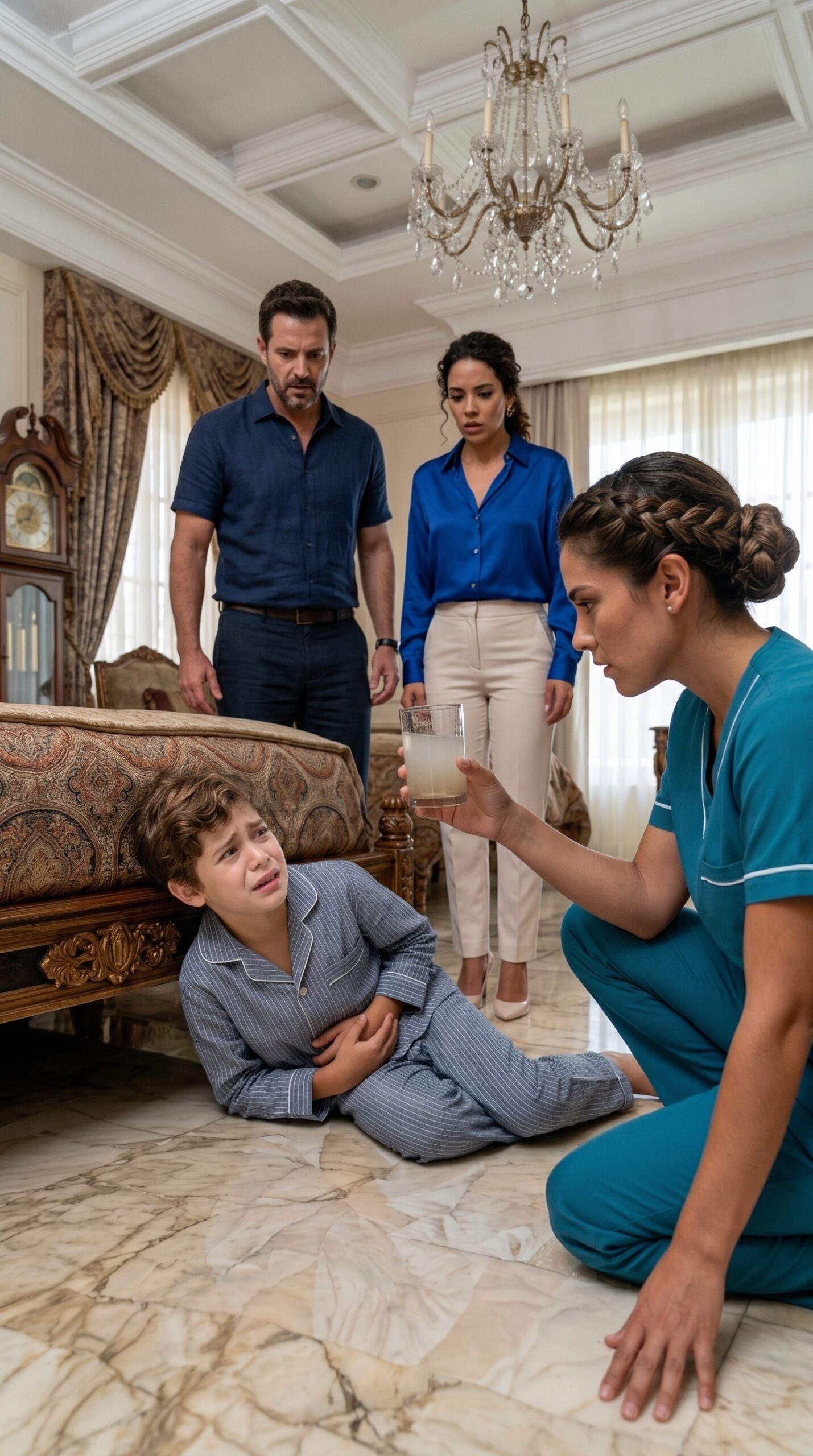
Mateo's scream echoed through the Las Lomas house like a plate crashing to the floor.
It was 3:17 AM.
In the residence of Rodrigo Santillán, owner of a construction chain in Mexico City, normally at this hour, only the hum of the air conditioner and the distant roar of the bodyguards could be heard.
But that night, a 9-year-old boy was pleading to have his stomach opened.
Mateo lay sprawled next to the bed, cold sweat clinging his pajamas to his body, his nails digging into his abdomen.
—It’s moving, Dad! I swear it’s moving! She put it in the atole!
Rodrigo lifted him as best as he could, his eyes red from exhaustion.
He hadn’t slept well in 5 nights.
They had been to the emergency room three times at a private hospital in Santa Fe. They had run tests, X-rays, analyses, abdominal examinations.
Everything came back normal.
Doctors talked about anxiety, grief, somatization.
Elegant words to say that nobody understood anything.
—Mateo, please —Rodrigo said, trying to sound firm—. The doctors said there’s nothing inside you.
The boy looked at him in terror.
—Then why does it hurt like something is biting me?
Before Rodrigo could answer, Valeria appeared in the doorway.
She wore a champagne-colored robe, her hair perfectly styled, and a look of sadness so well-practiced it seemed rehearsed in front of the mirror.
Valeria had married Rodrigo eight months ago.
Since then, she had spoken about “organizing the house,” “closing chapters,” and “helping Mateo let go of his mom.”
Mateo’s mother had died two years earlier in an accident on the way to Puebla.
And since Valeria arrived, her photos had vanished from the living room.
She also fired the old nanny.
She changed family dinners.
She began preparing a “special” atole for Mateo to sleep peacefully.
—Rodrigo, love —Valeria whispered—. We can’t keep going like this. This isn’t pain. It’s manipulation.
Mateo hid behind his dad.
—No! She gives me that! I saw her!
Valeria let out a shaky laugh.
—Now I’m poisoning children? For God’s sake. Listen to him. He needs serious help.
On the dresser lay the sheet.
An admission order for a private psychiatric clinic near Toluca.
Valeria had obtained it “for safety.”
It only needed Rodrigo’s signature.
In the hallway, Abril clutched a towel to her chest.
She was 23, from Oaxaca, and had only been working as a nanny for four weeks.
In that house, she had quickly learned that employees didn’t express opinions.
That the problems of the rich were viewed from a distance.
That a girl in an apron didn’t accuse the lady of the house.
But Abril had seen something.
The night before, at 11:48, she entered the kitchen for hot water.
Valeria was turned away, bent over a cup of atole.
She wasn’t adding cinnamon.
She wasn’t adding piloncillo.
She was counting drops from a brown vial.
1.
2.
3.
4.
5.
Then she stirred slowly, until the strange smell was hidden beneath the sweetness.
Abril said nothing.
She thought it might be medicine.
She thought maybe Rodrigo knew.
She thought perhaps a newly arrived girl couldn’t meddle where she wasn’t called.
But now Mateo was crying as if his body were a prison.
And Rodrigo had the pen in hand.
—Ramiro —Rodrigo ordered the driver over the phone—. Prepare the truck. We’re going to the clinic.
Mateo stopped crying.
That was worse.
He fell silent, staring at his father as if he understood he had already lost.
Abril saw the glass of atole on the nightstand.
She picked it up.
She brought it to her nose.
It didn’t smell like masa.
It didn’t smell like vanilla.
It smelled bitter, chemical, masked with too much sugar.
Then she stepped forward.
—Mr. Rodrigo, before you take him… smell it.
Valeria stopped breathing.
—What did you say?
Abril raised the glass with her trembling hand.
—I saw what the lady put in the atole last night.
Silence fell like a stone.
Rodrigo turned to Valeria.
She smiled with disdain.
—Are you really going to believe a nanny over your wife?
Abril reached into her apron pocket and pulled out a folded napkin.
She laid it open on the dresser.
Inside was the brown vial, with the label torn off and the lid poorly closed.
—I found it in the kitchen trash.
Rodrigo looked at the psychiatric order.
Then he looked at the glass.
Then he looked at his son, who was no longer asking for help.
He was just waiting.
And with the pen in one hand and the 5 drops in front of his eyes, Rodrigo still didn’t know whether to save his son or protect the lie of his wife.
PART 2
Valeria was the first to move.
—This is ridiculous —she said, regaining her sweet voice—. It’s probably some kitchen extract. Or something the staff uses. That girl can’t even read a label properly.
Abril pressed her lips together.
—I saw when she put it in the atole.
—Liar!
The shout made Mateo shrink against the bed.
Rodrigo saw it.
For the first time, he understood that his son didn’t hate Valeria out of jealousy.
He was afraid of her.
Ramiro appeared in the doorway with the keys to the truck.
—Sir, should we leave?
Rodrigo looked at the clinic sheet.
His name was printed there, waiting for his signature.
A signature to turn his son’s scream into madness.
Valeria approached slowly.
—Love, think. If we don’t admit him today, tomorrow he might harm himself. He could accuse me of something worse. He could destroy us.
Mateo murmured from the floor:
—I just wanted you to believe me.
It wasn’t a tantrum.
It was a surrender.
Rodrigo felt something break inside his chest.
For days, he had listened to his son cry, point, plead.
And for days, he had preferred to believe in doctors, papers, and pretty words because accepting that his wife might be hurting Mateo was too monstrous.
Abril spoke again.
—Don’t believe me, sir. Take the glass. Take the vial. Request a toxicology exam.
Valeria shot her a deadly look.
—You don’t give orders here.
—No —Abril replied, her voice breaking—. But the boy is telling the truth.
Rodrigo took a clean bag from the drawer.
He carefully stored the glass, the vial, and the napkin.
Then he called the pediatrician.
—Doctor, I’m going to emergency with my son. I want toxicology tests. Not psychiatry. Toxins.
Valeria lost color.
It was just one second.
But Rodrigo saw it.
And that second spoke more than all her fake cries.
—You’re overreacting —she whispered.
Rodrigo lowered the phone.
—Stay away from Mateo.
—I’m your wife.
—And he’s my son.
Ramiro carried the child.
Mateo clung to his father’s neck, but with his other hand, he grabbed Abril’s sleeve.
—Don’t leave me.
Abril swallowed hard.
—I won’t leave you, little one.
In the truck, Rodrigo sat in the back with Mateo.
Abril sat next to them, holding the bag with the evidence.
Valeria tried to get in.
Rodrigo slammed the door before she could touch the seat.
—You stay.
—Don’t make a scene, Rodrigo.
He didn’t shout.
—The scene started when my son had to scream to be heard.
In the emergency room, Mateo entered trembling.
They put him on an IV, took samples, and requested that no one touch the bag.
Abril told everything.
The time.
The kitchen.
The vial.
The 5 drops.
She didn’t exaggerate.
She didn’t cry to convince.
She just said what she saw.
Meanwhile, Rodrigo’s phone vibrated nonstop.
Valeria called 11 times.
Then sent a message:
“You’re destroying our family over a maid.”
Rodrigo read the phrase and felt nauseated.
It didn’t say “over a lie.”
It didn’t say “over a mistake.”
It said “over a maid.”
At 6:32 AM, the doctor returned, serious.
He didn’t name names.
He didn’t accuse anyone.
He just said there were enough indications to treat the case as possible poisoning and that everything needed to be documented.
Rodrigo felt the ground shift beneath him.
—Could it have worsened if I had taken him to the clinic?
The doctor paused for a second.
—If he continued to be exposed to the substance, yes. And if it was interpreted as a psychiatric crisis, the treatment would have been incorrect.
Mateo was sleeping, his hand closed over his father’s fingers.
He looked smaller than ever.
Rodrigo requested a copy of the report.
He also requested to attach the unsigned psychiatric order.
When he saw it under the hospital’s white light, he understood how close he had been to betraying his son.
That sheet wasn’t help.
It was an elegant tomb.
Then Abril received a message.
It was from Carmen, a cook who had worked in the house before quitting suddenly.
The message read:
“Did she also start giving him atole at night?”
Abril froze.
She showed the phone to Rodrigo.
He asked her to respond.
“I’m with Mateo at the hospital. Tell me what you know.”
The response came almost immediately.
“The lady would ask me to leave the atole ready, but she always added something afterward. One night I asked if it was medicine. She told me that if I wanted to keep my job, I should learn not to look.”
Rodrigo closed his eyes.
It hadn’t been one night.
It hadn’t been an accident.
It was a plan.
At 8:10, his lawyer, Licenciado Paredes, arrived.
He reviewed the report, the vial, the messages, and the admission order.
—We need to preserve everything. Cameras, trash, purchases, messages, kitchen. And she must not approach the child.
Rodrigo spoke with a calm that was terrifying.
—She won’t be getting close.
Later, he returned to the house with the lawyer, Ramiro, and two trusted employees.
The mansion was still impeccable.
The garden freshly watered.
The fountain running.
The windows shining.
As if nothing had rotted inside.
Valeria was in the living room, dressed in white, made up as if for dinner in Polanco.
Upon seeing them, she smiled.
—How dramatic.
Rodrigo placed the copy of the report, the photos of the vial, Carmen’s messages, and the psychiatric order on the table.
—you have 30 minutes to leave this house.
Valeria let out a dry laugh.
—Excuse me?
—Your cards are canceled. Your access as well. Any attempt to approach Mateo will be documented.
She looked at the lawyer.
Then looked at Rodrigo.
—Are you going to destroy your marriage over a child who hates me?
Paredes stopped writing.
That phrase didn’t sound like a defense.
It sounded like a motive.
—He’s 9 —Rodrigo said.
Valeria clenched her jaw.
—He has the same look as his mother. Since I arrived here, he judged me. He made me feel like an intruder.
—Because you were —Rodrigo replied—. I gave you a place in my home. Not in his food. Not in his fear.
Valeria stood up.
—You don’t know what it was like to live with the ghost of a dead woman. Everything was Sofía. Her photos, her songs, her memories. That child cried for her as if I were nothing.
Sofía was Mateo’s mother.
Rodrigo then understood every detail.
The photos removed.
The nanny fired.
The dinners changed.
The times Valeria said: “That child needs a firm hand.”
She wasn’t organizing the house.
She was erasing Sofía.
And when she couldn’t erase her memory, she tried to erase the boy’s voice.
—You made him sick —Rodrigo said.
Valeria crossed her arms.
—I just gave him a few drops to calm him down.
The silence was brutal.
Ramiro lowered his gaze.
An employee covered her mouth.
The lawyer raised his head.
Valeria understood too late that she had just confessed.
—It wasn’t poison —she added quickly—. It was something mild. To sleep. To make him stop throwing tantrums.
Rodrigo felt a chill run down his back.
—Who gave it to you?
—That doesn’t matter.
—It matters a lot.
Valeria exploded.
—You were never there! I had to endure his screams, his questions, his tantrums. You arrived late, kissed him out of guilt, and locked yourself in your study. Don’t come here now pretending to be the perfect father.
The phrase hurt because part of it was true.
Rodrigo had confused providing with caring.
He had paid doctors, school, therapy, drivers, security.
But he hadn’t listened.
Yet still, his guilt didn’t make Valeria innocent.
—I failed as a father —he said—. But you hurt him on purpose.
The lawyer requested to check the kitchen.
In a high cupboard, behind boxes of imported tea, they found two more unlabeled vials.
One almost empty.
They also found a small notebook.
“11:45 atole.”
“If he cries, don’t tell.”
“Talk to R. about clinic.”
“Insist on mental crisis.”
The handwriting was Valeria’s.
Rodrigo had to lean on the table.
These weren’t notes.
They were instructions.
A strategy disguised as care.
Ramiro, pale, finally spoke.
—Sir… once the lady asked me not to tell her when Mateo cried. She said you were tired and she would handle it.
Rodrigo closed his eyes.
Every adult had obeyed a small order.
Every silence had built a prison.
Abril looked at the notebook without touching it.
—That’s why he always felt sleepy after dinner… but he would wake up in pain.
Valeria turned toward her.
—You ruined everything.
Abril didn’t back down.
—No, ma’am. You ruined it when you thought a scared child was easier to confine than to believe.
Valeria raised her hand to slap her.
Rodrigo stepped in.
He didn’t touch her.
He just stood in front of her.
He arrived late, but he arrived.
—It’s over.
Valeria’s exit had no elegance.
She screamed that no one would believe a maid.
That her family had lawyers.
That Rodrigo would look like a ridiculous man manipulated by a service girl.
But she no longer commanded.
She left with a handbag, escorted by Ramiro.
Before crossing the door, she looked at Rodrigo.
—That child will always be weak.
Rodrigo responded without raising his voice:
—I was weak when I didn’t believe him.
Mateo returned home two days later.
He stepped inside slowly, holding his dad’s hand.
As they passed the kitchen, he stopped.
He looked at the counter where they prepared atole for him.
—I never want to drink that again.
—Never again —Rodrigo said.
For weeks, Mateo slept with the light on.
He asked three times who had prepared his dish.
He smelled the water before drinking.
If he heard heels in the hallway, he froze.
Rodrigo didn’t always know what to say.
He couldn’t erase the damage.
He couldn’t un-sign a paper he almost signed.
He couldn’t go back to that first night and choose wisely.
But he learned something that had once seemed small.
To listen without defending.
When Mateo woke up sweating and said:
—Dad, it’s in my belly.
Rodrigo turned on the light.
He sat next to him.
He placed his hand on his back.
—I believe you. I’m here. I believe you.
The first time he said it, Mateo cried for 20 minutes.
Not out of pain.
But out of exhaustion.
As if his body finally understood that he didn’t have to scream to exist anymore.
Abril stayed a bit longer in the house.
Rodrigo offered her a raise, benefits, and support to study nursing.
She accepted some things.
But asked for one in particular:
—Apologize to Mateo in front of me. Not for me. For him.
Rodrigo did it in the kitchen.
Without employees.
Without speeches.
Just him, Mateo, and Abril.
—I’m sorry for not believing you —he said—. I’m sorry for thinking your pain was a problem I could hand off to others. I should have protected you, and I arrived late.
Mateo lowered his gaze.
—Were you really going to take me?
Rodrigo could have lied.
He could have said no.
But no repair is born from another lie.
—Yes —he replied—. I was about to. And I will regret that for the rest of my life.
Mateo pressed his lips together.
—I thought you weren’t going to come back for me anymore.
Rodrigo couldn’t speak.
Abril cried silently.
That afternoon, Mateo didn’t hug his dad.
Not yet.
But when Rodrigo poured him water in a clean glass, the boy looked at him for a few seconds and then drank.
For them, that was a tiny miracle.
Months later, lawyers, reports, cameras, analyses, and people opining without knowing came.
Some said Valeria “didn’t seem capable.”
Others asked if Mateo might not have been “a difficult child.”
That was what angered Rodrigo the most.
Because he understood that the world always finds a pretty way not to believe a child.
One day someone suggested not mentioning Abril too much to avoid “a class scandal.”
Rodrigo slammed the table.
—The scandal was that we all believed him less because she wore an apron.
No one suggested it again.
Later, Mateo returned to school with a lunchbox made by his dad.
The sandwich was crooked.
The fruit was in a container too large.
But Mateo opened it, smelled it, and asked:
—Did you make this?
—I did.
—All by yourself?
—I burned two breads, but yes.
Mateo smiled for the first time in months.
Abril watched from the entrance and felt her heart loosen.
Before traveling to Oaxaca to see her mother, she received a letter from Mateo.
It had drawings of a crossed-out cup, a big house, and three people in a kitchen.
It read:
“When I screamed, you listened.”
Abril kept the letter and cried on the bus.
Rodrigo kept the case file in a safe.
Not to hide it.
To remind himself of what a house is capable of when everyone confuses silence with peace.
Because the worst part wasn’t that Valeria lied.
The worst part was that Mateo told the truth from the beginning and still needed a nanny to find a vial, a doctor to write a report, and a father to feel ashamed for someone to believe him.
Sometimes a child doesn’t need an explanation for their pain.
They need someone to listen before the world calls them crazy.