PART 1
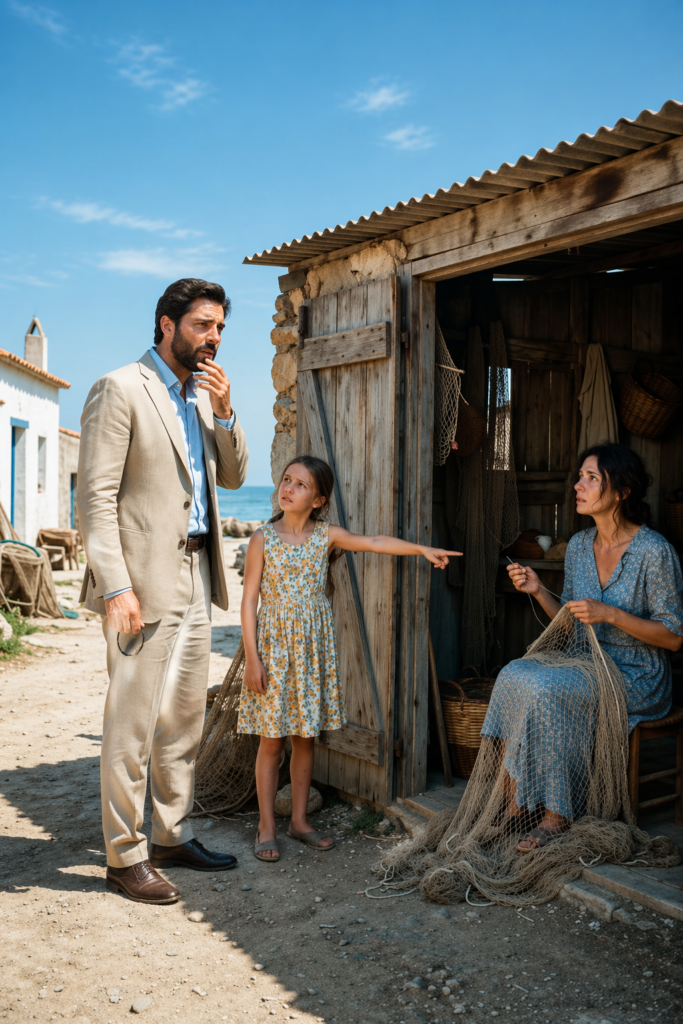
—Sir… that woman in the photo isn’t buried here. She lives with my grandmother in a little house by the beach.
The bouquet of gardenias fell from Damián Arriaga's hands, splattering onto the mud of the cemetery.
For three years, all of Veracruz had repeated the same story: Valeria Montes, the wife of the owner of one of the most powerful shipping companies in the Gulf, had died in a boat fire during a private dinner with investors.
No complete body was found.
Only a burned medal, a piece of white dress, and a hastily signed document.
Damián was never the same again.
Before that night, he was the businessman who negotiated million-dollar contracts without blinking. In the port, his name carried weight. In the newspapers, they called him “the elegant shark.”
But back at his home in Boca del Río, Valeria transformed him into another man.
—Have you eaten yet, my love? —she would ask, waiting for him with lime soup, coffee from the pot, and that calm smile that needed no diamonds.
Valeria didn’t flaunt trucks or expensive bags. She preferred to buy sweet bread for the caretaker, deliver medicine to the gardener's daughter, and sit in the kitchen chatting with the maids as if they were family.
That’s why Damián loved her with a stubbornness that many found ridiculous.
On the night of the fire, Valeria had boarded the Santa Lucía to accompany some partners from Campeche. Damián was supposed to arrive later, but an urgent meeting in Mexico City left him stranded.
At 12:17, he received a call filled with screams.
—It’s all burning! We can’t find Mrs. Valeria!
When he reached the dock, the sea was black, and the boat burned as if someone had ignited hell over the water.
Damián shouted her name until he lost his voice.
His half-brother, Esteban Arriaga, appeared at dawn with red eyes and a folder in hand.
—Brother, you have to accept reality. There’s nothing more to be done.
Esteban organized the funeral, spoke with experts, answered the press, and convinced Damián to sign papers he didn’t even read.
The coffin was closed.
The burial, swift.
The family, too quiet.
Since then, every Thursday, Damián visited Valeria's grave. He brought white flowers, cleaned her photo, and spoke softly, as if the marble could return something to him.
That afternoon, it drizzled. A skinny girl, 11 years old, swept leaves between the tombstones to earn some coins. Her name was Milagros.
As she passed by Damián, she stopped to stare at the photograph.
—What do you see? —he asked.
The girl pointed at the image with fear.
—That lady sings at night. My grandma says the sea spat her out alive, but she doesn’t remember her name.
Damián felt his hands grow cold.
—What does she sing?
Milagros hummed a soft, broken melody, almost like a prayer.
Damián paled.
It was the song Valeria sang when he came home late. The same one they danced barefoot the night he proposed to her by the boardwalk.
—Take me to her —he said, his voice cracking.
That afternoon, the man who had wept for three years in front of a tomb discovered that perhaps his wife breathed somewhere in the sea… and that someone had buried a lie with her name.
PART 2
Damián's truck left the cemetery as the rain pounded against the windshield.
Milagros sat in the back seat, hugging her old backpack, glancing at the leather seats as if afraid to dirty them. He didn’t ask her any further questions. He could barely breathe.
He drove towards a humble area near Antón Lizardo, where the scent of salt, frying food, and wet firewood mixed with the wind.
The houses were made of sheets, wood, and colorful tarps. Children played by puddles, skinny dogs lounged under tables, and women hung laundry even though the sky remained gray.
—It’s over there —said Milagros, pointing to a blue house next to some fishing nets.
Damián stepped out without looking at his Italian shoes sinking in the mud.
He walked behind the girl to an open door.
Inside, a woman was mending nets while sitting on a low bench.
Her hair was shorter, her skin marked by the sun, and her hands filled with small scars. She was thinner, almost fragile. She wore a simple top and a plain skirt, like any woman in the village.
But when she lifted her hand to push her hair back, Damián saw a mole on her right wrist.
That mole he had kissed a hundred times.
—Valeria… —he whispered.
The woman looked up.
It was her.
Damián's world stopped.
He took a step forward, but she recoiled in terror.
—Don’t come closer, sir. Please… don’t hurt me.
Damián stood frozen.
The woman for whom he had cried for three years looked at him as if he were a danger.
From the kitchen, an old woman with white hair emerged, holding a kitchen knife, positioning her body in front of Valeria.
—Who are you, and what do you want with Mar?
Damián took time to respond. His throat felt tight.
—I’m her husband.
The old woman didn’t lower the knife.
—Well, if that’s true, you’re too late, son.
Milagros hid behind her.
The grandmother, named Doña Chayo, explained that three years ago, after a terrible storm, they found the woman lying on the beach. She was beaten, burned on her back, with a fever and barely breathing.
She had no bag, no phone, no documents.
She only repeated one word in delirium:
—Fire.
Doña Chayo treated her with whatever little she had. Then she took her to the health center, but no one reported any missing person alive. The police asked two disinterested questions and left.
Since the woman couldn’t remember her name, they started calling her Mar.
—She doesn’t know who she was —said the old woman—. But she’s good. She helps clean fish, mends nets, takes care of the children. It’s just that when she hears fireworks or loud engines, she throws herself to the floor crying like a child.
Damián looked at Valeria.
She clutched a plastic rosary between her fingers and wouldn’t stop trembling.
In that moment, he understood something terrible.
While he left flowers at an empty grave, his wife had survived with a poor family that no one took seriously.
He hadn’t taken her by force.
He hadn’t called the press.
He hadn’t notified his family.
Damián knew that if Valeria was alive, then someone had orchestrated a perfect deception. And whoever could make her disappear for three years could try again.
That night, he discreetly set her up in an old house that his mother had left near Mandinga. He hired a trusted neurologist and two nurses who didn’t ask too many questions.
Valeria didn’t recognize him.
Sometimes she looked at him with curiosity. Other times, with fear.
Damián didn’t push her. He sat two meters away and talked to her about simple things: the weather, the mangoes from the yard, the fishermen passing by in their boats.
The doctor explained that her memory wasn’t lost but locked away by trauma.
—Don’t force her to remember. Memories will return through scents, sounds, songs, objects.
Damián began carefully.
He brought her a clay cup from Oaxaca that she used for coffee. Then he brought a burgundy scarf he had gifted her on their anniversary. After that, a small box with shells they had collected together in Tecolutla.
Valeria touched each item as if her hands knew something her mind could not yet accept.
One dawn, Damián heard her crying.
He entered the room and found her asleep, sweating, repeating:
—Don’t let go of me… Damián… please…
He knelt beside the bed without touching her.
—I’m here, Vale. I’m here.
When she awoke, she didn’t remember having said his name.
But from that day on, she stopped retreating when he entered.
Meanwhile, at the company, Damián pretended nothing had happened.
He returned to Grupo Arriaga in a dark suit, cold gaze, and the same silence everyone mistook for mourning.
Esteban welcomed him in the boardroom with a smile too comfortable.
—It’s good to see you getting back on your feet, brother. It was about time to let go of the dead.
Damián barely met his gaze for a second.
—Yes. It was about time.
Paola Cárdenas was also there, daughter of a rival shipping family. Since Valeria’s death, Paola had approached with a suspicious patience. First as a partner. Then as a friend. Later as “a woman who understood his pain.”
The press was already hinting at a wedding.
Esteban pushed it shamelessly.
—An alliance with the Cárdenas would save the division of the Caribbean —he repeated—. And you should rebuild your life, brother.
Damián listened.
He remained silent.
He took notes.
The first strong memory of Valeria came nine days later when Damián placed a photo of the Santa Lucía on the table.
She froze.
The cup fell from her hands.
—That hallway… —she murmured—. It smelled like gasoline.
Damián didn’t move.
—What else do you remember?
Valeria began to breathe quickly.
—I was given wine. Esteban said you sent it because you were delayed. I didn’t want to drink, but everyone looked at me strangely.
She hugged herself.
—Then the lights moved. My throat burned. I wanted to go out on deck, but I couldn’t walk well.
Damián felt his heart turn to stone.
—Who was with you?
Valeria closed her eyes.
—Paola.
The name fell like a blade.
—I asked her for help. I told her I felt unwell. She grabbed my face and said: “Oh, Valeria, you’re always so good… that’s why you’re in the way.”
Damián clenched his fists.
Valeria began to cry.
—Then I saw Esteban. He carried me with another man. He whispered in my ear: “It’s nothing personal, sister-in-law. Business doesn’t stop for a pretty wife.” Then I felt water… so cold… and fire behind.
The doctor had to sedate her gently.
Damián stepped outside and vomited in rage.
For three years, he had slept under the same roof as the man who tried to kill his wife. He had embraced his half-brother at the funeral. He had allowed him to manage contracts, accounts, and insurance.
And Paola, with her elegant dresses and sweet voice, had been waiting for the moment to take Valeria's place.
Damián didn’t go directly to the Prosecutor’s Office. Not yet.
Esteban had connections in the Captaincy, insurance companies, and the media. If he moved forward without proof, they would say Valeria was confused, that she was an imposter, that he was crazy with grief.
So he did what everyone expected.
He announced his engagement to Paola Cárdenas.
The news exploded on social media.
“Damián Arriaga believes in love again,” the society magazines wrote.
“A wedding that will unite two shipping empires,” said the TV hosts.
Esteban toasted with expensive tequila and hugged him in front of everyone.
—Now it’s time, brother. Valeria will rest in peace.
Damián smiled without showing his teeth.
—I hope so.
For five weeks, he prepared the trap.
A mechanic from the port confessed that he altered the alarms of the Santa Lucía on Esteban’s orders. A waitress admitted she swapped Valeria's glass for cash. A guard provided deleted videos showing a boat leaving the ship just as the fire started.
Transfers from the Cárdenas companies to accounts linked to Esteban also surfaced.
The motive was brutal and simple: remove Valeria, emotionally break Damián, push him into marrying Paola, and hand over part of Grupo Arriaga to the rival family.
But there was still the proof that nobody could deny.
And that proof was slowly walking, learning to call herself Valeria again.
The night of the engagement was celebrated in an elegant hotel by the Veracruz boardwalk. There were politicians, businessmen, local influencers, and journalists ready to capture the couple's kiss.
Paola wore a champagne-colored dress.
Esteban walked among the tables like the owner of the hall.
Doña Chayo and Milagros were hidden in a nearby room, protected by lawyers. Valeria waited there too, her hands cold and a black coat on her shoulders.
—You don’t have to do this —Damián told her before they went out.
Valeria looked at him.
She still didn’t remember all her life with him. She didn’t recall every trip, every breakfast, every Sunday in pajamas. But she did remember the icy sea. The bitter glass. Paola's hand letting her go.
—I do have to —she replied—. Because if I stay silent, they win again.
When the master of ceremonies asked for silence for the toast, Damián stepped onto the stage.
He took the microphone.
—Thank you for coming to celebrate a union that, according to many, would change the future of our families.
Paola smiled for the cameras.
Esteban raised his glass.
Damián continued:
—But tonight there will be no wedding. There will be truth.
The hall filled with murmurs.
Paola lost her color.
—Damián, what are you doing?
He made a signal.
The giant screen lit up.
The video of the guard appeared: the boat leaving the Santa Lucía. Then, the testimony of the waitress. After that, the transfers. Then, the mechanic recounting how they asked him to turn off the internal alarms.
Esteban shouted:
—That’s staged! My brother is sick! He never got over his wife’s death!
Damián lowered the microphone.
—You’re right about one thing. I never got over it.
The doors of the hall swung open.
Valeria entered.
She wasn’t wearing a gala dress. She wore no jewelry. Her hair was simply gathered, and a scar peeked out from her blouse.
But she walked tall.
Alive.
The entire hall froze.
Someone dropped a glass. A lady crossed herself. A reporter muttered a curse under his breath.
Paola recoiled as if she had seen a ghost.
Esteban turned pale.
Valeria walked until she stood before them.
—I remember —she said, her voice trembling—. You gave me the glass, Esteban. You carried me when I could no longer move. You said that business was worth more than my life.
Esteban opened his mouth, but only air escaped.
Valeria turned to Paola.
—And you saw me on the floor. I begged you to help me. You pulled my hand away and left me there.
Paola began to cry.
—I didn’t know they were going to throw you into the sea. They told me you were just going to disappear for a few days, that it was to scare Damián...
—And you thought that was normal? —Valeria asked.
The silence weighed more than any scream.
At that moment, the ministerial agents entered.
Esteban tried to run, but Damián’s guards stopped him. Paola fell to her knees, ruining her champagne dress on the shiny floor.
Her father tried to deny the transfers, but the documents were already in the hands of the authorities.
The engagement party turned into a scene of arrest.
The cameras that had arrived to capture luxury ended up recording shame.
Esteban, handcuffed, glared at Damián with hatred.
—You were given everything! The company, the name, the respect! I was your father’s child too!
Damián approached slowly.
—You could have asked for your place without trying to kill the only person who ever treated you as an equal.
That phrase broke him.
Because Valeria, even before the fire, had defended Esteban at family dinners. She sent him gifts on his birthday. She told Damián not to be hard on him.
And he had delivered her to the sea.
In the following days, Mexico spoke of the case non-stop.
The wife who returned from the dead. The empty grave. The girl from the cemetery. The ambitious half-brother. The fiancée who knew. The rival family that wanted to take over an empire.
But Damián didn’t let them turn Valeria into a spectacle.
There were no interviews.
There were no covers selling her suffering.
There were no programs using her face for ratings.
Doña Chayo and Milagros were protected. Damián bought them a decent little house near the lagoon. Milagros returned to school with new sneakers, crying because she had never had a decent zippered backpack.
—You saved my wife —Damián told the girl.
Milagros shook her head.
—No, sir. She stayed alive by herself.
Valeria’s recovery was slow.
There were nights when she would wake up screaming from the smell of smoke. At village parties, when fireworks exploded, she would cover her ears and hide in the bathroom. Some mornings she would stare at the water for hours, as if she didn’t know whether to love it or fear it.
Damián didn’t demand that she return to being the woman she once was.
He didn’t ask for kisses.
He didn’t reproach her for memories.
He was just there.
He made her coffee. He left her yellow flowers, not white ones. He walked with her along the shore without touching her until she took his hand first.
Months later, Valeria asked to go to the cemetery.
Damián took her without saying a word.
The grave was still there, with her name engraved in stone and a photo protected by glass.
Valeria gazed at it for a long time.
—Here you cried for me —she said.
Damián swallowed hard.
—Here they taught me to obey a lie.
She touched the cold marble.
—And I was alive, mending nets, not knowing who I was.
He took the photograph from the tombstone and held it against his chest.
—I don’t want to visit you as a dead woman. I want to know you again as a living one.
Valeria looked at him.
She didn’t smile as she used to. Not yet.
But she intertwined her fingers with his.
That afternoon, they didn’t leave flowers.
They didn’t pray for a corpse that had never been there.
They simply walked out of the cemetery, together, as the sky began to clear.
Because there are families capable of manufacturing funerals, buying signatures, burning boats, and raising graves to hide their greed.
But there are truths that breathe beneath fear.
And sometimes, justice doesn’t come with lawyers or police.
Sometimes it arrives with a poor girl sweeping leaves in a cemetery and saying the phrase that no powerful person wanted to hear:
—She’s not dead. She lives by the sea.





