PART 1
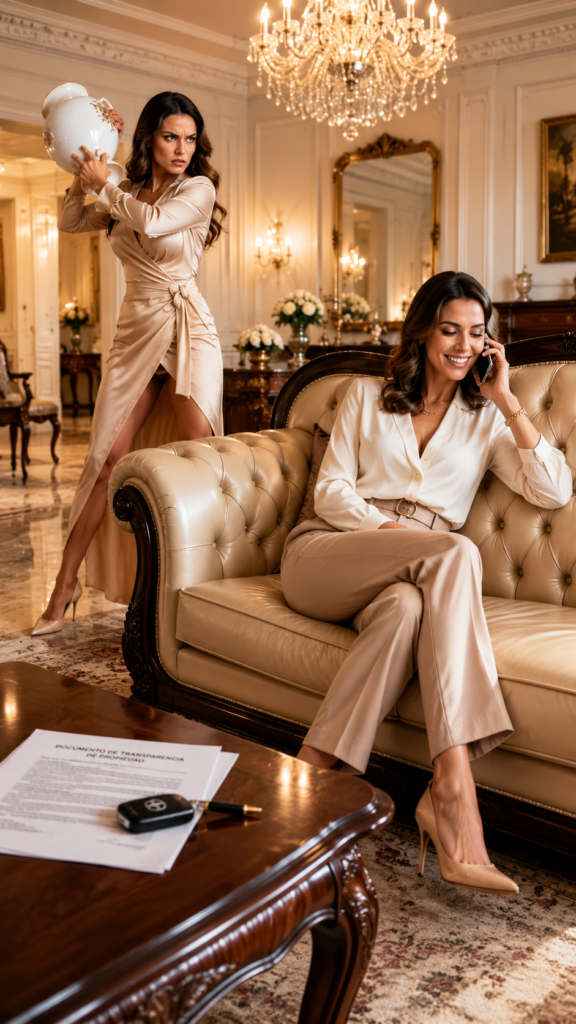
—If you don’t sign tomorrow, Valeria, everyone will know what kind of woman you really are.
Doña Amparo said this without raising her voice, setting a cup of walnut champurrado on the table. She wore the calm smile of a respectable lady, one who goes to church on Sundays and greets neighbors with blessings, even though inside she harbored poison.
Valeria Cárdenas was 34, five months pregnant, and owned a chain of fine bakeries in Guadalajara that her parents had built from the ground up. She also had a home in Puerta de Hierro, two warehouses, several storefronts, and a sadness she still didn’t know how to manage since her parents died in an accident on the way to Manzanillo.
Amidst that grief, Ivan Robles appeared.
He was an engineer, educated, patient. He accompanied her to the bank, the notary, the meetings where she broke down upon hearing her father’s last name. He opened doors for her, spoke softly, told her she wasn’t alone.
Valeria mistook that patience for love.
They married a year later.
Shortly after, Ivan asked if they could bring his mother, Doña Amparo, and his younger sister, Brenda, to live with them. He said it was temporary, that his mother had high blood pressure, that Brenda wanted to study design at a private university and needed support.
Valeria agreed because the house was large and deep down, she wanted to feel like she still had family.
But from the first month, it became clear that those women weren’t there to accompany her. They were there to occupy.
Brenda would invade her closet without permission, wear her perfumes, post stories with Valeria’s bags, and say in front of the employees:
—Come on, sister-in-law, we’re family now. Don’t be intense.
Doña Amparo corrected the cooks, rearranged furniture, rummaged through drawers, and spoke of the company as if it were her son’s inheritance.
—Ivan should have authority over everything —she said—. A man can’t live in the shadow of his wife.
Valeria remained silent.
Not out of stupidity. She stayed quiet because she was tired of fighting alone.
When they found out the baby would be a girl, Doña Amparo pursed her lips.
—Another rich girl in this house —she murmured—. God knows why He does what He does.
From that moment on, Ivan started insisting that Valeria grant him legal power over the company.
—It’s just for order, my love. Everyone thinks I’m just a freeloader. Give me a temporary signature. Until the girl is born.
Valeria refused.
Her father had always told her that love is shown through actions, not by signing blank papers.
That refusal changed everything.
On a rainy night, Ivan announced an urgent trip to Monterrey for a project. He kissed her on the forehead, touched her belly, and promised to return in two days.
At 9:30, Doña Amparo appeared in the dining room with a steaming cup.
—Drink this, daughter. It’ll relax you. It has walnut, cinnamon, and a few drops of natural sleep aid.
Valeria took a sip. The taste was sweet, but it left a strange bitterness on her tongue.
Brenda was watching her too intently.
—Come on, don’t be dramatic. My mom made it with love.
Half an hour later, the walls began to sway. Valeria tried to get up, but her legs wouldn’t respond. She wanted to call for help, but her tongue felt heavy.
She fell onto the bed, unable to scream.
She didn’t know how much time passed when she opened her eyes just a little. Her body was asleep, but her ears were still alive.
—Is it off yet? —Brenda asked.
—Like a log —Doña Amparo replied—. Ivan got something good.
Her husband’s name pierced through her chest.
—Leave the service door open —the mother-in-law ordered—. The men from El Chacal will arrive in 15 minutes. Let them record her, humiliate her, so tomorrow she won’t even be able to look in the mirror. With that, she’ll sign over the company, the house, and whatever else is needed.
Valeria felt her baby move.
—What if she loses the baby? —Brenda asked.
Doña Amparo let out a dry laugh.
—Better. That way, Ivan can start over with a woman who’ll give him a son.
Valeria wanted to get up, but her body wouldn’t obey.
Then Brenda said something that shattered her completely:
—Tomorrow, the fine lady will be begging on her knees.
Valeria bit her own tongue until she tasted blood. The pain sparked a flicker of awareness.
She dragged herself to the edge of the bed, her belly tight, her mouth dry, and her eyes filled with rage.
Downstairs, she heard a door open.
And in that second, she understood that if she didn’t move a single piece before dawn, her entire life would be left in the hands of those who had already decided to erase her.
PART 2
Valeria fell to the floor with a dull thud, but she didn’t scream. She stayed still for a few seconds, breathing as best she could, until the pain in her tongue jolted her awake again.
Her baby moved once more.
That was enough.
It wasn’t bravery. It was pure instinct. That dark and sacred instinct of a mother who understands that no one will come to save her daughter if she surrenders first.
The bedroom door was ajar. Valeria crawled down the hall. Each inch felt like it was made of broken glass. The drug pulled at her eyelids, bent her hands, turned her legs to jelly.
Downstairs, in the living room, Brenda lay sprawled on the couch, eating chips and texting on her phone.
—Hurry up, guys —she mumbled—. The key is under the mat. The master bedroom is at the back.
Valeria saw a heavy clay and metal sculpture that her father had bought in Tlaquepaque. A large, ancient piece shaped like a woman carrying corn.
She took it in both hands.
She stepped down one stair. Then another. Sweat ran down her back. She felt nausea, fear, pain, but more than anything, she felt rage.
Brenda didn’t hear her.
—When my brother gets the company, he’s going to buy me my truck —she said in a voice message—. Enough of living on borrowed time.
Valeria arrived behind the couch.
She didn’t think of forgiveness. She didn’t think of sin. She didn’t think of anything.
She delivered a sharp blow.
Brenda fell sideways, unconscious, with her phone lit up on the carpet. On the screen were messages from a contact saved as “Chacal.”
“Open door.”
“She can’t move.”
“Record everything.”
Valeria felt something inside her freeze.
She had no time to cry.
With a strength she didn’t know where it came from, she dragged Brenda through the living room, climbed the stairs slowly, and took her to the master bedroom. She laid her on the bed, covered her with blankets, arranged her hair over her face, and turned off almost all the lights.
In the closet, hidden among shoe boxes, she found a small camera aimed at the bed.
They had set it up themselves.
Valeria left it recording.
Then she took her phone, a long jacket, her truck keys, and left the room. She locked the exterior lock, one her father had installed years ago for security that almost no one knew about.
She didn’t go to the street. She wouldn’t have made it.
She went down to the basement and hid in the third row of her truck. From there, she opened the security camera app she had installed months earlier when she started noticing strange movements in the house.
Seven minutes later, the service door opened.
Four men in black raincoats entered. They didn’t check drawers. They didn’t touch watches. They didn’t look for money.
They headed straight upstairs.
—The old lady already paid half —one said—. The rest when we deliver the video.
Valeria pressed the phone against her chest.
The men found the key under the mat and entered the bedroom without paying much attention to the woman lying on the bed.
The door closed.
Valeria didn’t feel good that night. She didn’t feel clean either.
She felt alive.
And sometimes, when someone prepares your hell, surviving means letting in first the one who started the fire.
At 4:18 AM, the men left laughing. One said the lady would pay extra because the “job” had turned out worse than requested.
Valeria vomited in silence inside the truck.
At 6:55, Doña Amparo appeared on the hallway camera. She was dressed up, wearing a silk robe, her hair styled, and a look of triumph.
She climbed slowly, like someone coming to collect a debt.
—Let’s see, daughter-in-law —she said as she opened the door—. Now you’ll understand who’s in charge in this house.
She entered.
At first, there was silence.
Then a scream so horrible that the dogs in the neighborhood started barking.
—Brenda! No, my girl! My girl, no!
Doña Amparo fell to her knees by the bed. Her face contorted when she realized that the trap set for Valeria had closed around her own daughter.
Valeria called 911 from the basement.
Her voice came out broken, real, filled with terror.
—Please, help me. I’m pregnant. I hid in my truck. Men entered my house. I heard screams upstairs. I don’t know what happened.
Twenty minutes later, the neighborhood was filled with patrol cars, ambulances, and neighbors peeking through curtains.
The paramedics found Valeria trembling, barefoot, with a bloodied mouth and a hard belly. When she heard her baby’s heartbeat on the monitor, she cried as she hadn’t cried even at her parents’ funeral.
Her daughter was alive.
Upstairs, Doña Amparo repeated a phrase as if she had gone mad:
—I killed her. I killed my girl.
Brenda survived, but she was left destroyed inside and out. They took her out sedated, covered with a sheet, while Doña Amparo tried to run after the stretcher.
The forensic team found the hidden camera, the cup with traces of the sedative, Brenda’s phone, and the key under the mat. They also found audio messages, texts, and transfers.
It didn’t look like a robbery. No jewelry, money, or watches were missing.
The men had come for a specific woman.
When they called Ivan, he answered with a worried husband’s voice.
—Is Valeria alright? Is my baby alright?
The commander told him that Valeria was alive, but that his mother was detained and his sister had been taken to the hospital in critical condition.
Ivan’s silence stretched too long.
—I’m on my way —he finally said.
He arrived that afternoon saying he had come from Monterrey. His shirt was wrinkled, his eyes red, and his voice broken. He ran toward Valeria at the prosecutor's office and hugged her tightly.
—My love, forgive me. If I had been home...
Valeria felt disgust, but she let herself be hugged. She buried her face in his chest and cried like a broken woman.
—Your mom said horrible things, Ivan. She said it was all her fault. That you shouldn’t know yet.
Ivan’s body stiffened.
—What else did she say?
Valeria lifted her swollen eyes.
—I don’t know. I’m scared. I don’t understand anything.
But she did understand.
She understood that her husband wasn’t worried about her. He was calculating how much had been uncovered.
In the following days, Valeria moved to an apartment in Providencia that Ivan didn’t know existed. She said she couldn’t go back to the house. No one questioned her. No one easily returns to the place where they were almost buried alive.
Doña Amparo was detained. In her statement, she broke down several times. At times she blamed Brenda, at times she said it was all Ivan’s idea, and then she would hit her mouth as if trying to swallow her own words.
Brenda woke up in the hospital screaming. She couldn’t look at her mother. She couldn’t hear Valeria’s name without going into crisis. Ivan’s family murmured that Valeria brought bad luck, that she must have done something strange, that no pregnant woman could come out so calmly after a night like that.
But no one dared to say it in front of her.
At the symbolic wake they held for the “death in life” of the old Brenda, Ivan approached Valeria with a soft voice.
—You’re not in a position to run the company. You’re pregnant, traumatized. Give me temporary power. Just to help you until the girl is born.
There it was.
The real Ivan peeking through fake tears.
Valeria lowered her gaze.
—Do you really want to protect me?
He took her hand.
—I’m your husband. We’re family.
That word made her want to laugh.
But she didn’t.
The next day, Valeria signed a limited power of attorney in front of Julián Arriaga, the lawyer who had worked with her father for 20 years. Ivan saw the signature, the company seal, and the phrase “administrative powers.” He didn’t read more.
His ambition did the rest.
The document gave him an appearance of authority, but no real access to accounts, sales, credits, or properties. Every major move required double authorization from the board.
It was a bait.
Ivan swallowed it whole.
He entered the offices as the boss. He changed Valeria’s chair, demanded passwords, raised his voice at longtime employees, and ordered a review of the accounts.
Three hours later, he received a call.
—Pay the 48 million, engineer —a voice said—. Your mom messed up the job, but the debt remains.
Ivan tried to move money. He couldn’t.
He tried to sell one store. He couldn’t.
He tried to apply for a loan in Valeria’s name. The bank warned before finishing the application.
Then he started to sweat.
Valeria watched from afar.
Hector, her trusted assistant, had gathered everything: Ivan had been deep in underground betting for a year in Zapopan and illegal casinos on the border. He owed 48 million to a gang led by a man known as El Chacal.
To pay, he planned to destroy Valeria’s reputation, force her to sign, and hand over properties as collateral.
The data that changed everything came later.
Ivan had never been to Monterrey.
His phone connected that night to a tower near Tonalá, 25 minutes from home. He was hiding in a hotel, waiting for his mother to notify him when Valeria would be “ready” to sign.
Valeria brought everything to the prosecutor's office: messages, locations, transfers, recovered audios, and the recording from the hidden camera.
In one part of the audio, Brenda could be heard saying:
—Ivan said tomorrow she signs or sinks.
The arrest happened a week later.
Ivan was in the office, desperate, reviewing papers he didn’t understand, when two agents entered.
—This is a mistake —he said—. My wife is unwell. Someone is manipulating her.
Valeria walked out of the conference room in a black dress, her belly swollen, and her gaze clear.
—No, Ivan. The sick one isn’t me. The rotten one is you.
He froze.
—Valeria, listen to me. I didn’t want it to happen like this. I just needed money. My mom lost control. Brenda was to blame for not checking carefully.
Valeria felt the last shred of pity break inside her.
—Brenda was to blame? Your sister was destroyed by a trap you planned. Your mother is going to spend years in prison for obeying you. And my daughter almost didn’t make it because you decided to sell us to pay your gambling debts.
Ivan fell to his knees.
—Forgive me. I love you. We’re family.
Valeria stepped close enough for only he to hear.
—Family was my parents working for 30 years to leave me something clean. Family is this girl who will be born without learning to fear her own father. You weren’t family, Ivan. You were hunger disguised as love.
The agents took him away in handcuffs.
At the door, he shouted that she had ruined him, that she was cold, that a good wife would have helped him.
Valeria replied in front of everyone:
—A good wife helps a man who falls. Not one who pushes her into the abyss to save himself.
The case exploded in Guadalajara. On social media, some called her brave. Others said she should have forgiven him, that a marriage shouldn’t break over “one mistake,” that maybe Ivan acted out of desperation.
There are always people ready to ask for compassion for the perpetrator and silence for the victim.
Valeria didn’t respond.
She sold the house in Puerta de Hierro. She didn’t want to raise her daughter in walls that still smelled of fear. With part of the money, she opened a foundation for pregnant women facing economic violence and threats from their in-laws. She named it Casa Elena, after her mother.
Her daughter was born two months later, healthy, strong, with her fists closed as if she had come into the world ready to fight. Valeria named her Clara, because she understood that light doesn’t always enter softly. Sometimes it breaks windows.
Ivan was convicted of conspiracy, attempted extortion, fraud, and participation in planning the attack. El Chacal and his men also fell when they discovered that Ivan had no way to pay them.
Doña Amparo never looked Valeria in the eye again.
Brenda remained hospitalized for a long time. Valeria didn’t celebrate her pain, but neither did she carry it as guilt. Brenda had laughed by the door to hell without imagining that the first one in would be her.
Years later, when someone asked if she regretted surviving that way, Valeria would look at her daughter sleeping and think of the bitter cup, Brenda’s laughter, Ivan’s false voice, and Doña Amparo opening the door she should have never touched.
She didn’t regret being alive.
She regretted confusing patience with love, generosity with obligation, and marriage with total surrender.
Because a woman can love with all her heart, but she must never hand over the keys to her life to someone waiting to see her asleep to steal her soul.
And if that truth is uncomfortable, maybe it’s because many still believe that a wife should endure everything to keep a family together.
But a family held together by fear, blackmail, and betrayal is not a family.
It’s a prison with a nice dining room.
And when a woman manages to escape from such a prison, she doesn’t ask for permission.
She closes the door.
And lets the guilty hear from inside the noise of their own condemnation.





