PART 1
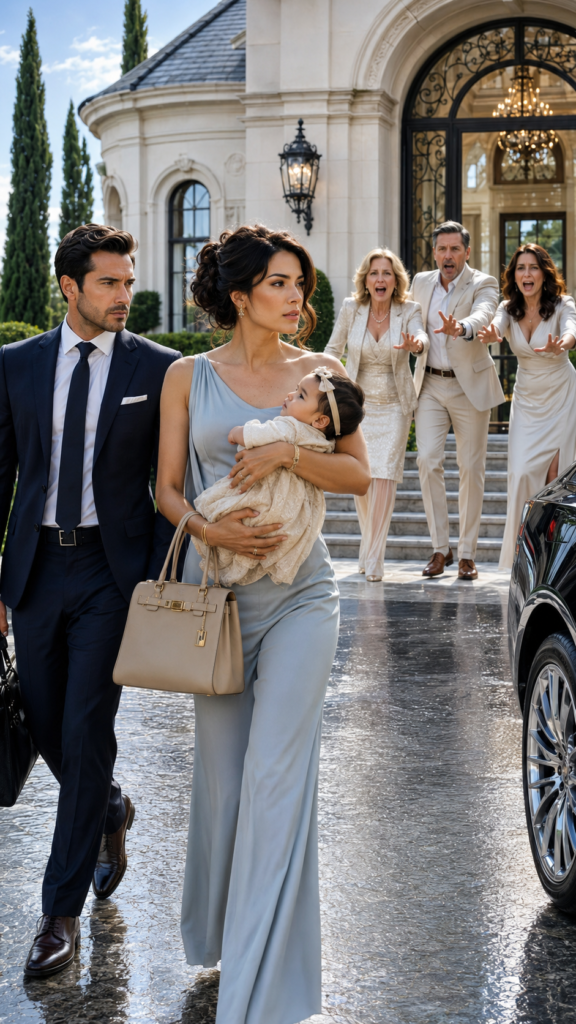
The rain fell hard over Lomas de Chapultepec as Teresa Villaseñor clutched her newborn baby to her chest.
Abril had only been in the world for three days. She slept, wrapped in a white blanket, her warm little face nestled against her mother's neck, unaware that her first night in their home had turned into a humiliation.
Teresa stood before the black gate of a residence she had purchased five years before meeting Bernardo.
That house was not a wedding gift.
It was not an inheritance from him.
It was not 'the family’s'.
It was hers.
She had paid for it with years of hard work, sleepless nights, impossible contracts, and an interior design business she had built from scratch while still living in a rented apartment in the Narvarte neighborhood.
But that night, the access keypad rejected her code four times.
Then seven.
Then twelve.
A dry phrase appeared on the screen:
ACCESS DENIED.
Teresa felt the wound from her cesarean throb with each breath. She was cold, weak, still bleeding a bit, and barely able to stand.
With a trembling hand, she took out her phone and called Bernardo.
He didn’t answer.
She sent a message.
“Beto, I’m outside with the baby. Why won’t you open the door?”
The two blue dots appeared almost immediately.
The reply came a minute later.
“You can’t just come and go as you please anymore. My mom and I decided to put things in order. We’ll talk tomorrow.”
Teresa read the message three times.
In the background, behind the enormous windows, she could see the lights on in the living room. The house was empty, but her husband had left the lamps on as if to mock her.
At the entrance, the camera slowly turned towards her face.
Then came another message.
“By the way, I changed the codes. The house is mine too. I’m your husband, not your employee.”
Teresa swallowed hard.
For months, Bernardo's mother, Doña Graciela, had repeated the same thing at every family meal.
“A married woman doesn’t need to have properties of her own.”
“That house looks so cold without pictures of the Hernández family.”
“When the baby is born, this house will finally feel like ours.”
Ours.
That word had always made Teresa feel nauseous.
Because Bernardo had never paid the property tax.
He had never contributed a single peso towards the mortgage.
He had never signed the deed.
Yet he paraded around the house, showing it off to his friends as if he had been born the owner of the marble, the garden, and even the air.
Teresa called her lawyer.
Licenciada Jimena Ríos answered on the second ring.
“Tere, is everything okay? You just came out of the hospital.”
Teresa looked at Abril. The baby sighed in her sleep.
“Sell it,” Teresa said quietly.
On the other end, there was silence.
“The house?” asked Jimena.
“Yes.”
“Tere, tell me exactly what happened.”
“Bernardo changed the access codes. He left me outside with Abril. His mom is involved in this. He thinks the house is now his.”
Jimena no longer sounded like a friend. She sounded like a lawyer.
“Confirm something for me. The deed is still only in your name.”
“Yes.”
“Separation of property.”
“Yes.”
“Prenuptial agreements signed before a notary.”
“Yes.”
“Bernardo was never added to the title.”
“Never.”
Jimena took a deep breath.
“Then that guy just made the most expensive mistake of his life.”
Teresa closed her eyes as the rain dripped down her forehead.
“There's an interested buyer, right?”
“The surgeon from Monterrey and his wife. They offered cash two weeks ago, but you didn’t want to sell because of the baby.”
Teresa looked back at the illuminated house.
The bedroom she prepared for Abril.
The kitchen where she imagined family breakfasts.
The garden where she had thought to see her walk for the first time.
All of that shattered in one night.
“Tell them I accept to review the offer today.”
“Tere, first get out of there. Who do I call?”
“My sister.”
Jimena lowered her voice.
“Don’t go back in alone. Save messages. Take a photo of the keypad. Record everything. This is no longer a couple dispute; it's property violence and abandonment.”
Teresa was about to respond when the gate opened just a few inches.
Through the intercom, Doña Graciela's voice came through.
“Don’t you dare make a scene, Teresa. A woman who just gave birth must learn to obey. If you want to enter, you’ll sign whatever my son asks tomorrow.”
Teresa froze.
And before she could respond, Doña Graciela unleashed the phrase that shattered her last hope:
“Besides, the baby stays with the Hernández… because a mother without a home has nothing to offer.”
PART 2
Teresa didn’t cry at that moment.
Not because it didn’t hurt.
Not because she was strong as stone.
But because Abril stirred in her arms and let out a tiny whimper that reminded her of something brutal: she couldn’t crumble like before.
Now someone depended on her.
The rain continued to pound the concrete as Teresa raised her phone and recorded the intercom camera, the closed gate, and the light on behind the windows.
Then she took screenshots of every message.
The one from Bernardo.
The one from Doña Graciela.
The one that said, “sign whatever my son asks.”
And the most poisonous of all: “the baby stays with the Hernández.”
When her sister Mariana arrived 18 minutes later, she got out of the truck wearing a huge jacket and a look of fury she didn’t try to hide.
“Are you kidding me, Tere?” she said, seeing her soaked. “Did this animal leave you outside with a newborn?”
Teresa could barely nod.
Mariana wrapped Abril up first. Then she hugged her sister gently, without pressing on the wound.
“Let’s go. You’re not begging anyone right now.”
On the way to Coyoacán, Teresa said almost nothing.
She just watched her daughter sleep in the special seat as the city lights faded behind the wet glass.
At 11:42 PM, Jimena called again.
“I spoke with the buyer. They’re still interested. They’ll pay cash, cover notary expenses, and want to close quickly.”
Mariana, who was driving, let out a bitter laugh.
“How nice. The guy wanted to play owner and tomorrow he could wake up as a squatter.”
Teresa didn’t smile.
“Can it be done that quickly?” she asked.
Jimena replied without hesitation.
“Legally, yes, because the house is free of liens, you are the sole owner, and the marriage contract is clear. What we can’t allow is for Bernardo to come back in, take things, or fabricate that he has possession. I need you to be in my office tomorrow at 8.”
“Make it 10,” Mariana interjected. “My sister just gave birth.”
Teresa took a deep breath.
“At 8.”
That night, Teresa slept for 47 minutes.
Abril woke up to eat every so often. Teresa had a slight fever, body aches, and a weight on her chest that wouldn’t go away.
But by 7:30 AM, she was sitting in front of Licenciada Jimena Ríos, with dark circles under her eyes, her hair tied back, and a folder full of papers.
The original deed.
The marriage contracts.
Five years of property tax receipts.
Maintenance payments.
Renovation invoices.
Account statements.
All in her name.
Jimena reviewed the file with sharp calm.
“Bernardo has nothing. No real rights, no co-ownership, no verifiable contribution. All he has is a lot of confidence to do stupid things.”
Teresa clenched the coffee cup she hadn’t touched.
“And my daughter?”
Jimena lifted her gaze.
“That’s the most serious part. Changing the code and leaving you outside with a three-day-old baby, after a cesarean, can be used for protective measures. And the message from his mother about taking the baby from you… that wasn’t just any threat.”
At 9:15, the first twist came.
The administrator of the private community called Teresa.
“Mrs. Villaseñor, sorry to bother you. Mr. Bernardo requested last night to register Doña Graciela as the primary resident.”
Jimena put the call on speaker.
“With what document?”
“He sent a letter signed by him. It says that you ceded the management of the house due to postpartum incapacity.”
Teresa felt her stomach drop.
“That’s a lie.”
The administrator cleared his throat.
“He also sent a copy of your ID.”
Jimena stood up.
“Send me everything right now. And do not authorize any further changes. If you do, you’ll get into serious legal trouble.”
The email arrived four minutes later.
The letter had a signature that looked like Teresa’s.
But it wasn’t her signature.
Bernardo hadn’t just left her outside.
He had tried to fabricate a permission slip to take control of the house while she was weak, freshly operated, and caring for her baby.
Mariana, who was sitting next to her, murmured:
“What a piece of work.”
Teresa stared at the forged document for several seconds.
Something died in her.
Not love, because that had been dying for a while.
Doubt died.
At 10:30, Jimena spoke with the notary.
At 12:05, the buyer sent an offer letter.
At 1:40, Teresa signed the conditional acceptance.
And at 3:00 PM, while Bernardo was posting pictures from a hotel in Cancún with his mom toasting by the sea, Teresa was signing the formal initiation of the sale of the house he thought he had conquered.
Bernardo’s post read:
“Finally making decisions for my family. Sometimes a man has to put things in order.”
Doña Graciela commented:
“Proud of you, son. It was about time.”
Mariana showed the screen to Teresa.
“Do you want me to reply?”
Teresa shook her head.
“No. Let him enjoy.”
But Jimena did something.
She sent three documents.
1 legal notification for property violence.
1 notice to the community administrator.
1 formal letter to Bernardo informing him that any attempt to access, dispose of assets, or manipulate documents would be reported.
Bernardo replied six minutes later.
“What are you doing, Teresa? Don’t be ridiculous.”
Then he called 14 times.
Teresa didn’t answer.
On the 15th call, Jimena took the phone.
“Mr. Hernández, all communication will be in writing.”
Bernardo’s voice sounded agitated.
“Who do you think you are, my wife? That’s also my house.”
Jimena barely smiled.
“No, sir. It’s Mrs. Villaseñor’s house. And if you say again that you presented a letter signed by her, I recommend you get a criminal lawyer.”
There was silence.
Then Bernardo lowered his voice.
“You don’t know who you’re messing with.”
Jimena replied calmly:
“I do know. I’m dealing with a man who left his freshly operated wife and a three-day-old baby out in the rain. Trust me, it doesn’t look good on paper.”
She hung up.
The sale progressed in nine days.
The doctors from Monterrey paid cash. A portion of the money went into a secured account for Abril. Another portion allowed Teresa to buy a smaller, safer, brighter apartment in the Del Valle neighborhood, close to Mariana.
It wasn’t a mansion.
But no one could change the code.
No one could stand at the door telling her to obey.
No one could threaten to take her daughter from her over an intercom.
The day Bernardo returned from Cancún, he arrived in a black truck with Doña Graciela, three suitcases, and an attitude of entitlement.
It was 6:18 PM.
He tried to open the gate with his new code.
It didn’t work.
He tried again.
Nothing.
He pounded on the keypad.
“What the hell?”
The guard stepped out of the booth.
“Good afternoon, sir. You are no longer authorized to enter.”
Bernardo burst out laughing.
“What do you mean? I live here.”
The guard grew nervous but maintained a firm voice.
“The property changed hands.”
Doña Graciela took off her sunglasses.
“What do you mean it changed hands? This is my son’s house.”
At that moment, a moving truck drove out through the gate. Behind it came a woman in scrubs, talking on the phone, and a tall man carrying a box of books.
The new owners.
Bernardo turned pale.
“No. No, no, no. This can’t be.”
The guard handed him an envelope.
“Licenciada Ríos left this for you.”
Bernardo opened it with clumsy hands.
Inside was a copy of the sales notification, the previous deed only in Teresa’s name, the marriage contracts, and a complaint for forgery of a private document.
There was also a printout of the message where he said:
“You can’t just come and go as you please anymore.”
And another from his mother:
“The baby stays with the Hernández.”
Doña Graciela snatched the papers.
“This is a trap. That woman manipulated everything.”
But then Teresa appeared.
She didn’t step out of the house because that was no longer her house.
She got out of a gray car parked in front of the private area. She held Abril in her arms, well-covered, calm, pressed against her chest. Mariana was beside her.
Bernardo saw her, and his expression changed.
First anger.
Then fear.
Then that false tenderness he used when he wanted to get his way.
“Tere, sweetheart, it’s enough. We all got worked up. Give me the baby, and let’s talk like family.”
Teresa didn’t step back.
“Don’t you dare say family to justify what you did.”
Doña Graciela stepped forward.
“You’re being overdramatic. We just wanted you to understand your place.”
Mariana let out a dry laugh.
“Well, she understood perfectly. Her place is far from you.”
Bernardo gritted his teeth.
“You sold my house.”
Teresa looked at him with a calmness that cost her tears, fever, and nine sleepless nights.
“No. I sold my house.”
He pointed at Abril.
“I’m the dad. I have rights.”
“And obligations,” Teresa replied. “The first was not to leave her in the rain three days after she was born.”
Bernardo lowered his voice.
“I never thought you’d be outside for so long.”
That phrase was the second blow.
He didn’t deny having done it.
He simply admitted he miscalculated the damage.
Jimena appeared behind Teresa, holding a folder in her hand.
“Mr. Hernández, there are protective measures requested. There is also a complaint for forgery. The administrator provided emails, cameras, and access records. The intercom camera recorded your mother’s voice.”
Doña Graciela paled.
“That doesn’t count.”
Jimena looked at her.
“It counts more than you think.”
Bernardo tried to approach Teresa, but the guard stepped in.
“Sir, I ask you to leave.”
“Are you kicking me out of my house?”
The guard looked at the papers.
“It’s not your house.”
The phrase fell like a sentence.
For years, Bernardo had confused marriage with ownership.
He had confused being a husband with being a master.
He had confused a crib in a bedroom with the right to control the woman who bought it.
And in front of the gate of that mansion, for the first time, he had no one to give orders to.
In the following months, Bernardo tried to present himself as a victim.
He told his friends that Teresa took everything from him.
He told his family that she left him on the street.
He posted online that some women used children to destroy men.
But the truth came out completely when, in the family hearing, Jimena presented the messages, the videos, the fake letter, and Teresa’s medical report, which stated she arrived with a fever, exhaustion, and signs of cold exposure.
The judge didn’t yell.
She didn’t make a scene.
She simply read everything and looked up.
“Mr. Hernández, you didn’t lose a house. You lost credibility.”
At first, Bernardo obtained supervised visits.
Doña Graciela was barred from any contact with Abril until further evaluation.
The forgery complaint continued its course.
And Teresa, though it took her time to sleep peacefully again, regained something more important than a mansion: the certainty that she didn’t have to stay where she was humiliated just for her daughter to grow up with 'a complete family'.
One afternoon, months later, Mariana visited the new apartment.
Abril was already smiling. Teresa sat by the window, with the baby sleeping on her chest.
Mariana looked around.
“It’s smaller.”
Teresa smiled.
“Yes.”
“But it feels more like a home.”
Teresa stroked her daughter’s back.
“Because here, no one enters with lies.”
Outside, the city continued to be noisy, intense, imperfect.
Inside, at last, there was peace.
And although many online debated whether Teresa was too harsh selling everything so quickly, other women understood something painful to admit:
Sometimes a huge house is not a home.
Sometimes the true home begins the day a woman stops asking for permission to save herself.





