PART 1
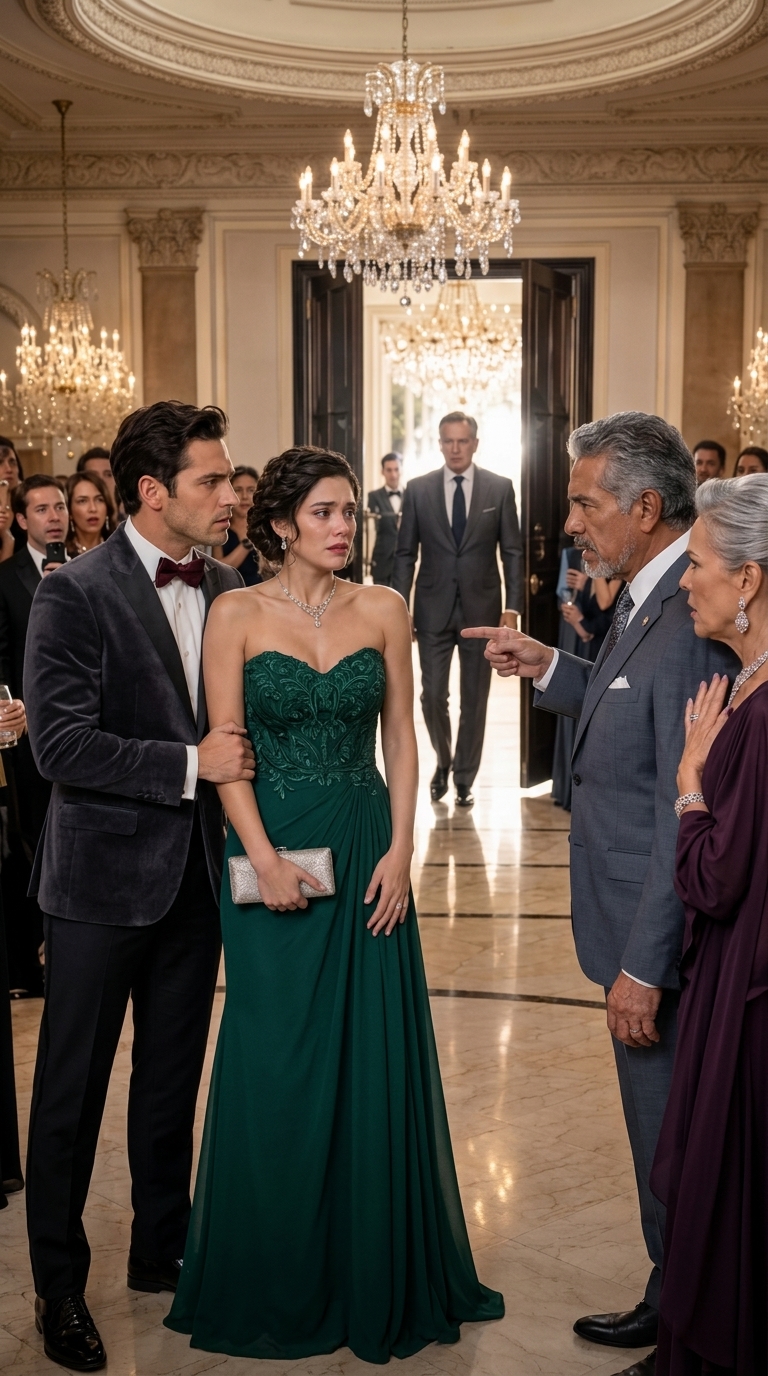
—Get out of my house. A woman like you will never be worthy of carrying the Montes de Oca name.
The words fell like a stone in the illuminated garden of a mansion in Lomas de Chapultepec.
There were businessmen, politicians, architects, journalists, and partners from Grupo Montes, one of the most influential construction companies in Mexico.
Camila Ríos stood frozen.
She wore a simple, dark green dress, without embellishments or visible logos. Her hair was tied up, makeup minimal, and small earrings that didn’t compete with the diamonds of the women who looked at her as if she had snuck in through the kitchen.
At her side, Diego Montes de Oca clenched his fists.
—Dad, enough already.
But Ernesto Montes de Oca didn’t even glance at him.
His eyes were fixed on Camila, as if he had been waiting two years for this night to break her in front of everyone.
The party celebrated the 40th anniversary of Grupo Montes.
Luxury towers in Santa Fe, residential areas in Querétaro, and boutique hotels in Tulum flashed on the screens. Everything sparkled. Everything smelled of money, power, and old family name.
But the real reason for the gathering was not the anniversary.
Everyone knew that Consorcio Arriaga was about to choose the construction company for the ecological corridor in the southeast, a contract worth billions of pesos.
And Ernesto needed to impress Julián Arriaga.
The problem was that no one had seen him arrive.
Julián was a reserved investor, almost a ghost. He didn’t attend galas, didn’t give interviews, and never signed with companies without first studying how they treated people when they thought no important eyes were watching.
Camila had heard his name several times that night.
She didn’t change her expression.
Before the scandal, she had greeted the waiters by name. She had asked Don Chuy, the gardener, about his wife’s surgery. She even helped a banquet girl when she dropped a tray of glasses.
—Thank you, Mrs. Camila— the girl said, embarrassed.
—Please don’t call me Mrs. Camila is just fine.
From the terrace, Ernesto watched her with contempt.
—Look at her, Beatriz. Always so comfortable with the help.
Beatriz, his wife, adjusted her pearl necklace.
—I never liked her. No one really knows where she came from.
Camila had met Diego during a reconstruction brigade after a landslide in Veracruz.
She arrived with muddy boots, carrying supplies and listening to families without taking photos.
When Diego asked her about her family, Camila simply said:
—They are discreet people.
She never flaunted surnames.
Never asked for money.
Never wanted to enter Grupo Montes.
And maybe that’s why Ernesto hated her so much.
To him, a woman without a visible lineage was dangerous. She could be poor, ambitious, or worse: someone who didn’t kneel before his world.
That night, after two drinks, Ernesto decided to humiliate her.
First, he asked why she never invited her parents.
Then he insinuated that she had trapped Diego for convenience.
Finally, in front of everyone, he unleashed the phrase that left the garden frozen.
—Get out of my house. I will not allow a gold digger to stain my family.
Camila swallowed hard, but she didn’t lower her gaze.
—Mr. Ernesto, I have never wanted your surname. I only want your son.
The silence was brutal.
Diego took her hand.
—Then we’re both leaving.
Ernesto let out a dry laugh.
—If you cross that door with her, forget about your position, your shares, and your inheritance.
Diego looked at Camila.
He saw the pain she was trying to swallow with dignity.
—I choose my wife.
Some guests lowered their gaze.
Others began recording with their phones, as if they were watching a live soap opera.
Camila and Diego walked toward the exit when Beatriz let out a scream.
—My brooch!
Everyone turned.
Beatriz clutched her chest in desperation.
—My grandmother’s gold hummingbird is gone.
She searched her shawl, her purse, the table.
Then she slowly looked at Camila.
—You were next to me a few minutes ago.
Camila understood the accusation before hearing it.
—Don’t you dare.
Beatriz pointed at her purse.
—Check her.
Diego stepped in front of her.
—Don’t you dare touch her.
Ernesto raised his hand and called the head of security.
—Ramiro, check my daughter-in-law’s purse. If she has nothing to hide, she won’t have a problem.
Camila looked around.
No one defended her.
Not the guests who had smiled at her, nor the ladies who had accepted her greeting, nor the partners who knew perfectly well that this was a vile act.
With her voice barely trembling, she placed her purse on the table.
—Check it here. In front of everyone. Since you decided to tarnish my name here.
Ramiro awkwardly opened the purse.
He pulled out a wallet, some keys, a phone, tissues, a small notebook, and a wooden rosary.
Nothing else.
The brooch didn’t appear.
Diego breathed with rage.
—Now apologize.
But Ernesto showed no shame.
He looked at Camila with even more contempt.
—The fact that it hasn’t appeared doesn’t mean you’re innocent. It only means you’re clever.
Then Beatriz stepped forward and unleashed the phrase that left Camila pale.
—They should also check her car. People like her always hide something.
At that moment, Camila’s phone vibrated.
The message read:
“I just arrived. I’m coming in.”
PART 2
The main doors of the mansion opened before Camila could respond.
A man nearing 60 crossed the foyer with a calm stride.
He had no visible escorts. He didn’t raise his voice. He didn’t need to.
He wore a dark gray suit, sober, perfectly tailored. His mere presence made conversations die one by one.
Ramiro, the head of security, was the first to recognize him.
—Mr. Arriaga...
The entire garden seemed to run out of air.
Ernesto Montes de Oca turned with a mix of surprise and anxiety.
He had spent eight months trying to secure a meeting with Julián Arriaga. He had sent proposals, invitations, reports, fine gifts, and even messages through acquaintances.
He never received more than cold replies from assistants.
And now Julián Arriaga was in his house.
At the worst possible moment.
Ernesto adjusted his jacket and walked toward him with a stiff smile.
—Mr. Julián, what an honor to have you. I’m sorry you arrived in such an uncomfortable family situation.
Julián didn’t shake his hand.
He looked at the open purse on the table.
He examined Camila’s personal belongings displayed as if they were evidence of a crime.
Then he looked at her face and Diego’s hand gripping hers.
—This doesn’t seem uncomfortable—he said calmly—. It seems unjust.
Beatriz paled.
Ernesto tried to take control of the scene.
—It was a misunderstanding. A family heirloom went missing, and it was my duty to protect my wife.
—Protect her from whom?—Julián asked.
No one answered.
Camila took a deep breath.
For the first time since the humiliation began, her eyes showed relief.
—You’re late—she murmured.
Julián looked at her tenderly.
—No. I arrived just in time to see what I needed to see.
The phrase ignited a murmur.
Diego turned to Camila, confused.
He knew she was reserved. He knew she didn’t talk much about her family. But he had never imagined she knew the country’s most sought-after investor.
Ernesto noticed it too.
—Do you two know each other?
Julián walked toward the table where Camila’s purse remained open.
He took the wooden rosary carefully, as if he recognized something more valuable than any jewel.
Then he placed it back.
—Before I answer, I want to know something. If the brooch didn’t appear in her purse, why didn’t anyone apologize?
Beatriz opened her mouth, but nothing came out.
At that moment, Lupita, an employee who had worked with the family for 15 years, entered from the hallway with a velvet box in her hands.
She looked nervous.
—Mrs. Beatriz... I’m sorry. I found this on your vanity. You took off the brooch when you went up to change your shawl. You asked me to keep it, but then they called me from the kitchen.
She opened the box.
The gold hummingbird shone under the lights.
The silence was savage.
Some stopped recording.
Others recorded from closer.
Beatriz covered her mouth with one hand.
Ernesto looked at the jewel as if it had just betrayed him.
Diego let out a bitter laugh.
—They accused her of being a thief for something that was always in her room. What a low blow, seriously.
Camila didn’t cry.
That made the scene even harsher.
—They weren’t looking for a brooch—she said—. They were looking for an excuse.
Julián closed his eyes for a second.
Like someone confirming an old suspicion.
Ernesto, cornered, chose pride once again.
—I admit there was a mistake, but that doesn’t change the core. This woman concealed her origin for two years. In a family like ours, that matters.
Julián looked him straight in the eye.
—You’re right. Origin matters. But not always for the reasons you think.
The murmur grew.
Julián pulled out a black envelope with the Consorcio Arriaga seal and placed it on the table.
—I didn’t come to celebrate your 40 years tonight. I came to observe.
Ernesto felt the blow to his chest.
—Observe?
—Before trusting a project worth billions of pesos, I need to know how a company treats people when it believes they have no power.
Ernesto hardened his face.
—Grupo Montes has 40 years of prestige.
—Prestige means nothing if it’s used to trample on an innocent.
Julián turned to Diego.
—and you, young man, were willing to lose everything without knowing who was about to walk through that door. That says a lot.
Diego still didn’t understand.
He looked at Camila.
—What’s happening?
Camila tightened her fingers.
For the first time, she seemed genuinely scared.
—I’m sorry. I wanted to be loved without my surname.
Julián positioned himself beside her.
His voice was calm, but impossible to ignore.
—Ladies and gentlemen, I believe you’ve heard enough lies tonight.
Ernesto took a step back.
Julián looked at Camila with pride.
—the woman who was accused of stealing a jewel, the woman who was called unworthy, the woman they wanted to throw out of this house as if she meant nothing...
He paused.
The entire garden hung in suspense.
—is my daughter.
The revelation fell like thunder.
No one spoke.
Not even Ernesto, accustomed to dominating rooms full of powerful men, found a phrase that could save him.
Beatriz looked at Camila as if she had just discovered that the woman she had despised for two years was not a shadow in her house but the daughter of the man who could decide the future of her empire.
Diego slowly released Camila’s hand.
Not out of rejection.
But out of surprise.
—Your dad is Julián Arriaga?
Camila lowered her gaze.
—Yes.
—Why didn’t you ever tell me?
The question didn’t sound furious.
It sounded hurt.
Camila struggled to breathe.
—Because since I was a child I saw how people changed when they heard my surname. They stopped talking to me and started talking to my dad’s money. When I met you among mud, destroyed houses, and families who had lost everything, you spoke to me as a person. I didn’t want to lose that.
Julián looked at her tenderly, but didn’t intervene.
That explanation belonged to her.
—I thought that if your family accepted me without knowing who I was, then it would be real—Camila continued—. I was wrong about them, but not about you.
Diego closed his eyes for a moment.
Then he took her hand again.
—You didn’t make a mistake with me.
That gesture finally sank Ernesto.
Julián opened the black envelope and pulled out several signed pages.
—Here’s the final evaluation of the ecological corridor. Grupo Montes was one of the three finalists.
Ernesto reacted like a castaway seeing a rope.
—Mr. Julián, I assure you this doesn’t reflect the quality of our company. We can discuss it privately.
Julián shook his head.
—What happened tonight reflects a culture. A way of looking at people based on their clothes, their car, or the surname they carry behind them.
One of the advisors lowered his gaze.
He had witnessed the humiliation in silence.
Now that silence weighed on him like fresh concrete.
Beatriz tried to approach.
—Camila, daughter, I...
Camila raised her hand.
—Don’t call me daughter. You never wanted to see me as part of this family.
Beatriz stood frozen.
—I was upset about the brooch.
—No—Camila replied, with a calm that hurt—. You were waiting for proof to justify what you already thought of me.
Ernesto looked at Diego.
—You know what’s at stake. Don’t let this destroy what we built.
Diego looked at him as if he finally saw the man he had tried to please all his life.
—What you built wasn’t destroyed by Camila. It was destroyed by you when you chose to humiliate her instead of getting to know her.
—I’m your father.
—and she is my wife.
Julián put away the documents.
—Consorcio Arriaga withdraws Grupo Montes from the selection process.
Ernesto paled.
—You can’t do that over a personal matter.
—I can do it for ethical reasons. And tonight that criterion became public.
The guests began to leave.
The phones had recorded enough.
Within hours, the video would circulate online with fierce headlines:
“Poor Daughter-in-Law Humiliated and Father Revealed as Julián Arriaga.”
But the real blow came the next day.
At 7:00 AM, Consorcio Arriaga released a statement:
“Human dignity and respect are not adornments. They are conditions for any alliance.”
It didn’t mention names.
It didn’t need to.
By 9:30, two clients requested to review contracts with Grupo Montes.
By 11:00, several investors demanded an urgent meeting.
By 1:00 PM, the board summoned Ernesto.
He arrived believing he could fix everything with an elegant apology.
He found everyone sitting in silence.
Clara Robles, the board chair, spoke plainly.
—Ernesto, a company that wants to build cities cannot destroy people within its own home.
—It was a family issue.
—It was a public, ethical, and reputational abuse.
After two hours, the board voted to temporarily remove him from leadership while they investigated the internal culture of the company.
They also demanded formal apologies to Camila and Diego.
Ernesto left without escorts, without photographers, without applause.
For the first time in 40 years, he walked alone.
Camila and Diego moved to a small apartment in Del Valle.
It had no garden for galas.
No marble fountain.
But one night they had tacos on mismatched plates, sitting at the kitchen counter, and finally they could breathe.
—I could have told you earlier—Camila said.
Diego took her hand.
—you could have. But my family could have treated you well without needing to know.
She smiled sadly.
—that was all I wanted to prove.
Six months went by.
The video stopped trending, but its consequences remained alive.
Grupo Montes survived, though no longer under Ernesto’s command. They implemented protocols against abuses of power, internal training, and channels for employees.
For the first time, several workers told how they had been treated over the years.
Beatriz called many times.
Camila only replied to one message:
“I wish you peace, but I cannot open a door you closed with such cruelty.”
Diego formally resigned from any inherited position.
Julián offered him a job in his consortium, but Diego set a condition.
—I don’t want to enter as a son-in-law. I want to start from the bottom.
Julián smiled.
—Then maybe you do deserve to be close to my daughter.
Diego started by reviewing minor files, visiting sites, and listening to engineers, construction workers, and families affected by poorly planned projects.
He learned that a company is not measured solely by the buildings it delivers but by the lives it touches while building them.
One Sunday, Camila invited Julián to lunch.
They prepared green enchiladas in a small kitchen, without waiters, cameras, or surnames weighing on the table.
When they finished, Julián asked her:
—Do you regret hiding who you were?
Camila looked at Diego, who was awkwardly washing dishes with his sleeves rolled up.
—No. It hurt, but it showed me the truth.
—What truth?
Camila smiled faintly.
—that there are people who only respect a fortune when it’s in front of them. And there are others who take your hand when they think you’re about to lose everything.
Weeks later, Ernesto sent a handwritten letter.
He didn’t ask to regain the company.
He didn’t speak of prestige.
For the first time, he didn’t justify himself.
“Camila, I was wrong. Not for not knowing who your father was, but for believing you needed to be the daughter of someone important to deserve respect.”
Camila read the letter in silence.
She didn’t cry.
She didn’t tear it up.
She kept it in a drawer.
Diego asked her:
—Are you going to respond?
She looked out the window, where the afternoon fell over the city.
—Maybe someday. Forgiving doesn’t always mean opening the door immediately.
That night they walked through a park filled with families, corn vendors, and children running after balloons.
Camila no longer needed to hide her surname.
But she also didn’t need to use it as a shield.
She had understood that true family is not the one that boasts blood, money, or tradition.
Sometimes it’s the one that stands firm by your side when everyone tries to make you fall.
And in a house where they wanted to humiliate her for seeming simple, Camila left a lesson that no one could erase: the respect that only appears when power is discovered is not respect… it’s fear disguised as education.





