PART 1
At 61, Laura Méndez thought she had survived the greatest pain of her life: burying Ricardo, her husband of nearly 40 years.
But that night, in her home in Las Lomas de Chapultepec, she understood that there were still words capable of shattering her soul.
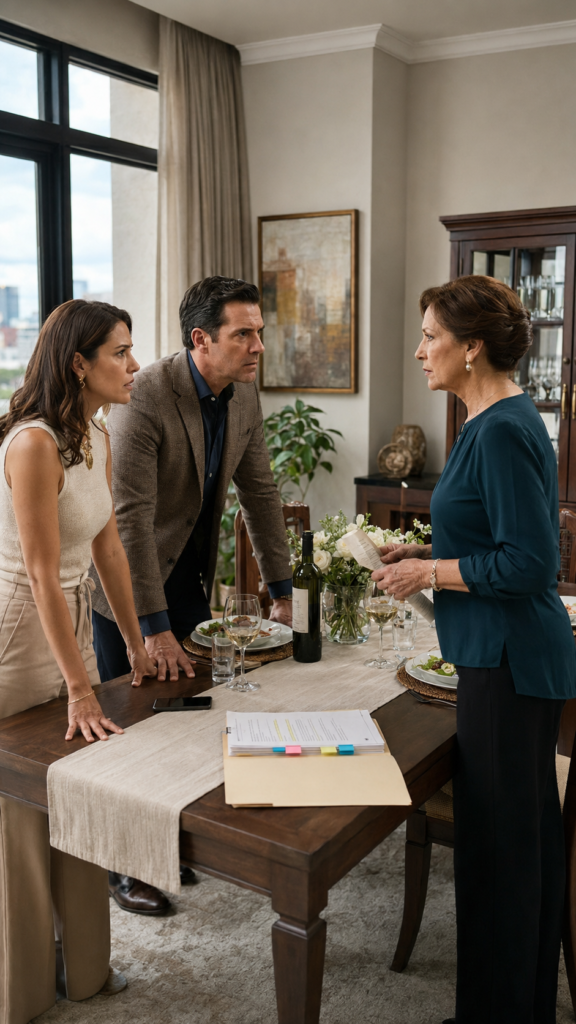
Her son Sebastián, 32, looked at her from across the dining room and said, without his voice trembling:
—Honestly, sometimes I wish I could have chosen another mother.
The mole Laura had prepared earlier sat untouched on the table. So did the red rice, the warm tortillas wrapped in a delicate napkin, and the flan she had made because it was Sebastián's favorite dessert since childhood.
Beside him, Regina, Sebastián's wife, lowered her gaze to her phone and smiled just a little.
It wasn’t a big smile. It was worse. It was that small smirk of someone who believes they have already won.
On the table was a cream-colored envelope. Inside were the papers Sebastián had brought under the pretext of "organizing the family assets."
But Laura understood perfectly what that meant.
They wanted her to sign over the house.
The house that Ricardo had left solely to her.
Not to the trust. Not to Sebastián. Not to some new company with an elegant name, an expensive office, and inflated numbers.
To her.
That house was not just property in an exclusive area. It was the place where Ricardo had worked on every wall, where they had celebrated birthdays, wakes, Christmases, fights, reconciliations, and silences.
It was the place where Sebastián's height was still marked on the doorframe of the pantry.
At 6 years old. At 8. At 12.
—Mom, don’t exaggerate —Sebastián said, pushing the envelope toward her—. No one is taking anything from you. We just need to use the house as collateral for the Santa Fe project.
—We need? —Laura asked, looking at Regina.
Regina adjusted her perfectly straightened hair.
—Mrs. Laura, it’s a strategy. The house is underutilized. You live alone in a huge property. Sebastián could turn that into something much bigger.
Underutilized.
The word burned her more than an insult.
Laura thought of Ricardo sipping coffee in the study. Of Sebastián sleeping as a child on the carpet. Of herself, after the funeral, standing in the kitchen not knowing how to keep breathing.
—It’s my house —she said.
Sebastián let out a dry laugh.
—Dad would have understood.
There it was, the dagger.
Because Sebastián knew that mentioning his father was the cruelest way to twist her heart.
For years, Laura had saved him from everything. When his first business failed, she paid off debts. When he crashed a luxury SUV, she covered the deductible. When he opened an "innovative" agency that lasted 9 months, she settled with the suppliers.
She said it was love.
Ricardo, before he died, had told her it was fear dressed up.
—Your dad wanted you to learn to stand on your own —Laura replied.
Sebastián slammed his palm on the table.
—Of course! You can say that because you’re sitting on everything he built.
At that moment, Regina's phone lit up.
Laura caught a glimpse of the message before Regina turned it over.
“Did the lady sign yet?”
Silence fell heavy.
Laura looked at her son and understood something that chilled her blood: that dinner was not a family conversation.
It was an ambush.
PART 2
Laura didn’t scream. Didn’t cry. Didn’t throw the papers.
She simply folded her cloth napkin, placed it beside her plate, and stood up with a calm that made Sebastián blink in confusion.
First, she picked up Regina's plate. Then Sebastián's. Then her own.
In the kitchen, she left everything by the sink and held onto the marble counter. Her hands trembled just a bit, barely enough to remind her that she was still human.
From the dining room, she could hear whispers.
—I told you to pressure her more —Regina whispered.
—Shut up, dude, she could still yield —Sebastián replied.
Laura closed her eyes.
That hurt more than the previous phrase.
When she returned, Sebastián was standing with his jacket over his arm. Regina had already tucked her phone into her bag.
—We’re going to give you a few days to think about it —Sebastián said, in a tone of executive and not of son.
—No —Laura replied.
He frowned.
—No what?
—I’m not signing the house. Not today, not tomorrow, not in 6 months.
Regina lost her smile.
Sebastián stared at her as if he didn’t recognize her.
—Are you going to choose a house over your son?
Laura looked around.
The portrait of Ricardo on the shelf. The out-of-tune piano nobody wanted to sell. The fine glasses he insisted on washing by hand. The table where her son had just humiliated her.
—No —she said—. I’m choosing to stop confusing love with surrender.
Sebastián clenched his jaw.
—Regina was right. You’ve always used money to control me.
Laura held his gaze.
—If I wanted to control you with money, I’d give you everything so you’d never learn to live without me.
He didn’t respond.
They left the house without saying goodbye. The door slammed so hard that the glasses in the foyer vibrated.
For 3 weeks, Laura didn’t call.
And for her, that was like learning to walk again.
Every morning she made coffee in a clay pot and left her phone on the counter, waiting for it to ring. In the afternoons, she watered the bougainvilleas in the yard. At night she entered Ricardo's study and sifted through the trust papers he had left organized with a patience that was almost painful.
On the fourth night, she found a letter.
It was behind an old folder, in an envelope with her name handwritten on it.
“Laura,” it said.
She recognized Ricardo's handwriting instantly.
She sat in her leather chair, turned on the lamp, and opened the envelope with trembling fingers.
The letter said:
“If you read this someday, I’m sure I’m no longer here and you’re carrying more than you should. I know your heart. You’ll want to protect Sebastián from everything, even from himself. But our son needs to feel the weight of his choices.
Don’t let guilt make you his bank. Don’t let sadness force you to shrink. The house is yours because you need a place where no one can negotiate your peace.
Love him. Guide him. But don’t rescue him from every consequence.
He’ll hate you at first.
Maybe afterward he’ll thank you.
And if he never does, you’ll still have to live with yourself.”
Laura cried in silence.
It wasn’t a loud cry. It was that old, deep cry that comes when a truth arrives late, but arrives.
The next day she received a call from Sebastián's lawyer.
The young man spoke with excessive courtesy. He said that his client wanted to review "the early distribution of the trust" for an urgent business opportunity.
Laura understood.
Sebastián hadn’t gotten the house, so now he wanted money ahead of time.
Previously, Laura would have asked how much. She would have transferred without a second thought. She would have called later to ask if he had eaten well.
This time she opened the trust folder.
—There are no early distributions without unanimous consent from the administrators —she said—. And I do not authorize.
The lawyer fell silent.
—Mrs. Méndez, I was informed that it’s an urgent matter.
—I’m sure it is.
Ten minutes later, the phone rang.
It was Sebastián.
—What are you doing, Mom?
—Chamomile tea.
—Don’t play dumb. You know I need that money. If I lose the Santa Fe location, it all collapses.
Laura walked to the window. Outside, the city continued to live, indifferent to the drama of a mother and a son.
—You structured a business with money you don’t have —she said—. That’s not my emergency.
There was silence.
Then Sebastián let out a bitter laugh.
—You’ve changed.
—No. I stopped paying the price for you not changing.
He hung up.
The following months were tough.
Sebastián lost the location. The architectural firm charged him 50,000 pesos for preliminary plans he never used. He sold the German SUV he used to flaunt in meetings and moved from an elegant office in Polanco to a small coworking space where the coffee tasted terrible.
Regina, of course, was not happy.
A friend of Laura's told her she had seen Regina at Antara complaining that "the lady had become unbearable."
Laura listened without defending herself.
It hurt, yes.
But she no longer rushed to extinguish fires that others lit with gasoline.
One Sunday, Sebastián came to the house alone.
He had dark circles under his eyes. Wrinkled shirt. Disheveled hair.
For the first time in a long time, he didn’t seem like a man trying to impress anyone. He looked like a tired son.
—Can we talk? —he asked.
Laura let him in.
In the living room, Sebastián didn’t accept coffee. That confirmed to her that he was in bad shape. He always accepted coffee when he wanted to soften her up.
—I owe 50,000 pesos —he said—. If you lend it to me, I’ll pay you back when the next distribution comes in.
Laura took a deep breath.
There was the old door.
The same as always.
She could write a check. She could spare him the anguish. She could buy a false peace for a few weeks.
But that peace always returned more expensive.
—No, Sebastián.
He looked up.
—What do you mean no?
—I’m not lending you 50,000 pesos.
—Are you going to let your son sink for a lesson?
—I’m going to pay for a serious financial advisor to review your contracts and help you negotiate. But I’m not paying your debt.
Sebastián stood up abruptly.
—I don’t need an advisor. I need money.
Laura looked at him with sadness.
—No. You need judgment. Money has only been replacing it.
He froze.
—You’re punishing me for what I said at dinner.
—What you said hurt. A lot. But this isn’t punishment. It’s the first honest boundary I’ve given you in years.
Sebastián took his jacket.
—You’re crueler than I thought.
—No, son. I’m stronger than you expected.
This time the door didn’t slam.
And somehow, that hurt more.
Time passed.
Sebastián had to negotiate alone. He sold watches, canceled memberships, cut expenses he once called “professional image.” Regina also started working with him, not taking photos for social media, but reviewing invoices, making uncomfortable calls, and collecting overdue clients.
One day, Sebastián called Laura.
She saw his name on the screen and braced herself.
—Mom —he said—, I’m not asking you for money.
Laura froze.
—Then tell me.
—I have a problem with a small location in Roma. A tenant left early and the bank can activate a clause if I don’t cover the payment. I have a letter of intent from another tenant, but it needs 60 days for permits.
—Have you talked to the bank?
—No.
—Why?
Sebastián took a while to respond.
—Because I wanted to know if you were going to help me first.
At least now he was telling the truth.
Laura closed her eyes.
—I’m not giving you money. But I can call Martín Arroyo, who knew your dad, to ask him to meet with you. It won’t be a favor. It won’t be a leg up. You’ll go alone, with clean numbers, real projections, and a payment plan.
There was a long pause.
—What if they destroy me?
—Then you’ll learn something before you try again.
Sebastián exhaled.
—Okay.
The meeting was on a Tuesday.
Laura spent the entire morning in the garden, cutting leaves that didn’t need cutting and checking her phone every 5 minutes.
At 3:17 PM, he called.
—They gave me the 60 days —he said, his voice shaky.
Laura sat on a bench.
—Yeah?
—Yeah. Martín made me redo the numbers in front of 2 executives. He said my dad would have thrown my Excel out the window.
Laura laughed while crying.
—Probably.
—My hands were trembling, Mom. But I did it.
It was the first time in years that Sebastián told her a problem without handing it over as if it were hers.
In spring, the new tenant moved into the location. Sebastián and Regina painted the walls themselves to save money. A friend sent Laura a photo: Sebastián in old jeans, blue tape stuck to his sleeve, and Regina sitting on the floor with a paint tray, laughing.
They looked exhausted.
They looked real.
Then another envelope arrived.
Laura found it one Thursday on the entrance table. This time it didn’t come from a lawyer. It came with Sebastián’s handwriting.
“Mom.”
Inside was an invitation to breakfast at his apartment.
No urgencies. No trusts. No “I need to talk to you about something important.”
Just breakfast.
Sebastián and Regina’s apartment was in a modest building in the Narvarte neighborhood. The staircase smelled of cheap cleaner and freshly baked bread. The mailbox lock was loose. At the entrance, there was a pot with half-alive basil.
Sebastián opened the door before Laura could knock a second time.
He hugged her.
Not like someone fulfilling an obligation. Not like someone negotiating.
Like a son.
Regina was in the kitchen, nervous, wearing an apron and with her hair tied back.
—I made chilaquiles —she said—. Well, Sebastián made them. I just made sure he didn’t burn them.
Sebastián rolled his eyes but smiled.
They had breakfast at a small round table by the window. They talked about the location, about Laura’s plants, about the unbearable traffic, and about a series Regina was watching about small businesses.
No one mentioned the house.
That, by itself, was already an apology.
After they cleared the plates, Regina stood up.
—I’ll leave you two for a bit —she said.
When she left, Sebastián took an envelope from the shelf.
Laura felt her chest tighten.
He noticed.
—It’s not that —he said quickly.
He placed the envelope before her.
Inside were copies of the papers he had wanted her to sign that night. On the first page, written in black marker, were the words:
“CANCELED.”
—I asked the lawyer to close any requests about the house —Sebastián said—. No new proposals. No shortcuts through the trust. No tricks.
Laura touched the paper.
—The house is yours, Mom. It always was. I convinced myself that, since my dad built a life there, I had the right to use it. But he left it to you because he trusted you. I should have trusted too.
Laura felt a lump in her throat.
—You already apologized.
Sebastián shook his head.
—I apologized for the phrase. But not for what was behind it.
He lowered his gaze.
—I thought that loving meant taking everything difficult off the path. And when you stopped doing it, I thought you stopped loving me. But the truth is you were the only one brave enough to tell me that I was living as if your money was my business plan.
His eyes filled with tears.
—I’m embarrassed to have said I wanted to choose another mother.
Laura took his hand.
—I felt embarrassed about something too.
Sebastián looked at her.
—Not about you —she clarified—. About what my fear helped to create.
Regina appeared at the door.
She had heard enough. Her eyes were red.
—I also need to apologize —she said—. I pushed him. I thought the house was the missing piece. That if we had collateral, everything would feel secure. But I was asking you to give up your peace so that we could pretend we had already built ours.
Laura nodded slowly.
That phrase was worth more than any elegant speech.
Months later, Sebastián spoke on a small financial education program that Laura funded through the family foundation. She didn’t put him in charge. She enrolled him as a participant.
The difference mattered.
In a simple room in Coyoacán, without luxuries, without surnames adorning the wall, Sebastián told young entrepreneurs how he had confused support with entitlement, pride with vision, and family money with strategy.
Laura listened from the back.
Regina was beside her.
—He’s nervous —Regina whispered.
—He should be —Laura replied.
On stage, Sebastián lifted his gaze and searched for his mother.
For a moment, he looked like that child who used to look for her in the crowd to feel safe.
But this time he didn’t look at her as someone waiting to be rescued.
He looked at her as someone wanting to be seen standing tall.
Then he said into the microphone:
—The best lesson my mother gave me was the one I hated the most when she put it in front of me.
The room fell silent.
Then the applause came.
Not for his surname. Not for his father’s fortune. Not because Laura had called someone powerful.
They applauded because, for the first time, Sebastián spoke the truth without dressing it up.
When it was over, he approached her and kissed her cheek.
—Thank you for not signing, Mom —he whispered.
Laura thought of the dinner. Of the cold mole. Of Regina’s smile. Of the envelope on the table. Of the phrase that split her in two.
Then she thought of Ricardo.
“Maybe afterward he’ll thank you.”
Laura looked at her son, no longer protected from every blow, no longer held up by someone else’s money, no longer confusing love with access.
—You’re welcome, son —she said.
And for the first time since Ricardo died, the house felt like a home again, not like a disputed property.
Because sometimes a mother loves more when she stops rescuing.
And that truth, though it hurts, divides families… or finally teaches them to grow.





