PART 1
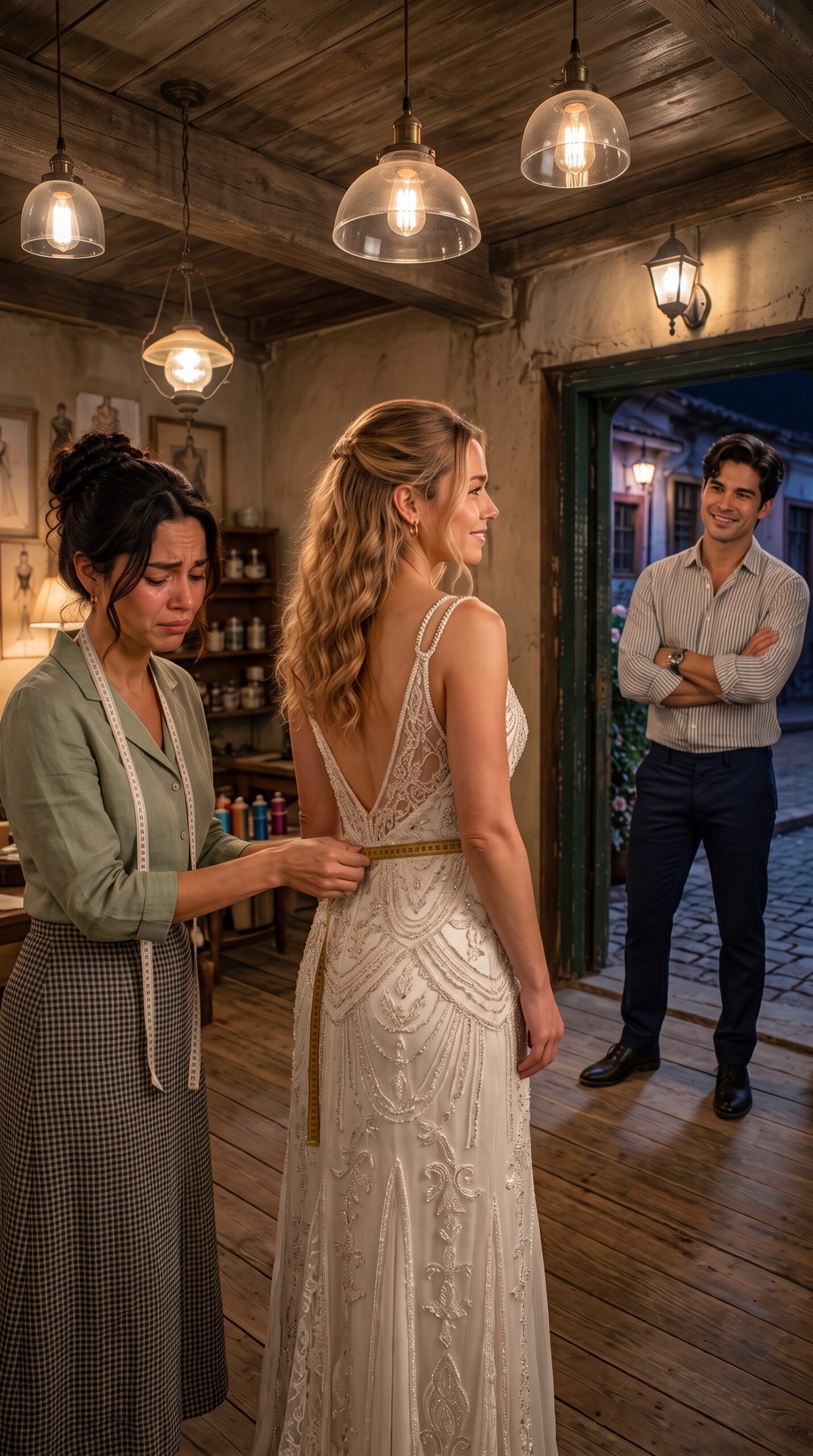
The bride arrived at the workshop with a huge smile and a folded magazine in her hands, searching for the perfect dress to marry in three months.
She had no idea that the woman who was about to take her measurements had waited for the groom for five years.
In Santa Rosalía de los Altos, a town in Jalisco where everyone knew who owed money at the store and who cried softly behind a curtain, no one had forgotten the story of Clara Medina and Mateo Arriaga.
Clara had been a seamstress since she was a girl, not because she chose it, but because in her home, everything was mended before thinking of buying something new.
Mateo was the boy who carried her backpack when they went to junior high, the one who saved her a seat in the van, and the one who swore, under the shade of a jacaranda, that one day he would return for her.
They grew up together among cobblestone streets, freshly made tortillas, church bells, and fair afternoons with banda music. Yes, they were poor, but they still had that kind of hope that didn’t know how much it could hurt.
At 17, everyone saw them as a couple even if no one said it out loud. Clara stitched his initials onto a handkerchief. Mateo gave her a red thread bracelet that he bought with what he earned unloading sacks at the market.
When Mateo turned 18, he made the decision that tore Clara apart inside.
“I’m going to Monterrey,” he said beside the old cemetery road. “I don’t want to stay here watching you struggle. I’m going to work, save money, and come back to ask for your hand the right way.”
Clara looked at him with eyes full of fear.
“What if you forget about me?”
Mateo took her face in his hands.
“Forget everything, except for you.”
He asked her to wait for him. He promised letters, visits, a future. Clara believed him because when you truly love, even a promise uttered with dusty shoes sounds like a contract before a notary.
For months, letters arrived every Friday.
“My Clarita…”
That’s how they always started.
Mateo told her about the noise of the city, the trucks, the huge warehouses, how strange it was to sleep without crickets. He said he was joining a transport company and that, if God helped him, he would soon return with more than just words.
Clara kept each letter in a wooden box, along with the red bracelet and a picture of the two of them in front of the elementary school.
But one Friday, the letter didn’t arrive.
Then the next one didn’t come either.
Nor the one after that.
In town, murmurs began.
“He got fancy.”
“Surely he found a girl with money.”
“Poor Clara, still waiting like a fool.”
She didn’t respond. She just sewed, prayed, and looked at the street every time she heard a bicycle.
What no one told her was that Mateo had tried to return.
In Monterrey, he caught the attention of Don Rodrigo Beltrán, owner of a powerful company. He made him a junior partner, gave him a suit, an office, and trust.
Mateo bought a simple yellow gold ring. He was going to drive to Jalisco to ask Clara’s parents for permission.
But that night, a trailer lost its brakes on a wet avenue.
When Mateo woke up, he didn’t remember the last years.
He didn’t remember the ring.
He didn’t remember the letters.
He didn’t remember Clara.
Don Rodrigo paid for the hospital and convinced the family not to tell him about it.
“If his head erased it, don’t revive it,” he said. “Sometimes God takes away memories to prevent suffering.”
Doña Teresa, Mateo’s mother, fell silent with tears.
And with that silence, Clara was buried alive in a story she didn’t understand.
Five years later, the bell in her workshop rang.
Doña Teresa entered with an elegant, perfumed young woman, with impeccable nails and a huge ring.
“Clarita,” she said, unable to look at her properly. “This is Renata Beltrán. She’s here for her wedding dress.”
The young woman smiled.
“I’m marrying Mateo Arriaga.”
And Clara felt the measuring tape slip from her hands, because the man she had waited for five years had just sent her to dress another woman.
PART 2
Clara didn’t scream.
She didn’t pull out the box of letters.
She didn’t throw in Doña Teresa’s face all the Fridays she had spent looking at the street as if the mailman could bring her life back.
She just took a deep breath, picked up the measuring tape from the floor, and said:
“Congratulations. Please, come in.”
Renata Beltrán entered the workshop, looking at the fabrics like someone entering a store of pretty but cheap handicrafts. She was beautiful, one of those women who seemed to never sweat. She came from Monterrey, daughter of Don Rodrigo, used to air-conditioned rooms, breakfasts in San Pedro, and weddings where the mariachi cost more than a house in town.
Clara measured her in silence.
Bust, waist, hips, sleeve length, veil fall.
Each number she noted felt like a stitch in an open wound.
Renata talked excitedly.
That the wedding would be at a hacienda near Tequila.
That there would be 300 guests.
That the menu would include gourmet birria, reserve tequila, and a dessert table with nata bread, jericallas, and a five-tiered cake.
“Mateo wants something simple,” she said laughing, “but my dad says a Beltrán wedding can’t look like a fair.”
Doña Teresa lowered her gaze.
Clara noticed her trembling hands on the bag. The woman who used to bring her corn tamales to her house now seemed an uncomfortable guest in her own lie.
When they left, Clara closed the workshop door and stood by the mannequin.
She didn’t cry right away.
First, she looked at the sketch of the dress: delicate neckline, wide skirt, lace on the sleeves, hand-covered buttons.
Then she imagined Mateo waiting at the altar while another woman walked towards him in a dress made by her hands.
Then she broke.
She fell sitting next to her grandmother’s Singer sewing machine and cried like she hadn’t cried even when she buried her parents. She cried with rage, with shame, with that horrible feeling of having been faithful to a ghost.
Her aunt Remedios, who had lived with her for two years, found her at dawn with the box of letters open.
“Mija, don’t kill yourself like this,” she said, sitting beside her. “That man doesn’t deserve you sewing your soul for him.”
Clara clutched a letter to her chest.
“I don’t understand what I did wrong.”
“Nothing.”
“Then why did he erase me so easily?”
Remedios didn’t know what to answer.
The next day, Clara opened the workshop at 8. She washed her face, tied her hair up, and started cutting the fabric. If she was going to sew that dress, she would make it perfect. Not for Renata. Not for Mateo. For herself.
Because her dignity was the only thing they couldn’t take from her.
For two weeks, the whole town talked about the commission.
Some women said Clara was a saint.
Others said she was a fool.
“I wouldn’t even stitch the other woman’s dress,” a client murmured while trying on a skirt.
“Well, good thing it’s not your workshop,” Clara replied without lifting her gaze.
But inside, every stitch hurt.
On the day of the first fitting, Renata arrived late. She entered the workshop talking on the phone, laughing, saying her dad was insisting on inviting half of Monterrey.
Behind her came Mateo.
Clara felt the air grow heavy.
It was him.
Taller, more serious, dressed in a light shirt and an expensive watch. He had a thin scar near his temple, like a poorly erased line. But he still had the same mole by his mouth, the same dark eyes that once looked at her under the jacaranda.
Mateo stood still as soon as he saw her.
“Good afternoon,” Clara said, struggling to sound normal.
He looked at her with a strange, almost painful confusion.
“Excuse me… do we know each other?”
The question pierced her chest.
Clara could have said everything.
She could have screamed that of course they knew each other, that he had written her 86 letters, that he promised to return, that he left her waiting until the town turned her into gossip.
But Renata let out a giggle.
“Oh, darling, with that again. Since your accident, you feel like you know people.”
Clara looked up.
“Accident?”
Mateo touched the scar on his temple.
“A few years ago. I don’t remember well a period of my life. The doctors said it was normal.”
Doña Teresa, who was entering at that moment, turned pale.
Clara understood that there was a piece of truth hidden beneath five years of silence.
While Renata tried on the dress, Mateo looked around the workshop as if something there called to him. He ran his fingers over the cutting table, over the spools of thread, over a piece of fabric embroidered with blue flowers.
“My grandmother had a machine just like this,” he murmured.
“Many grandmothers had it,” Clara replied.
He smiled faintly.
“Your voice… it sounds familiar.”
Renata tensed.
“Mateo, please. Don’t bother the lady.”
The lady.
Clara felt like laughing and crying at the same time.
She wasn’t just any lady. She was the girl who waited for him by the window. The one who read his letters until she knew them by heart. The one who let suitors pass because she still believed in a man who perhaps didn’t even know she existed.
The fitting ended in an awkward silence.
Renata went to the bathroom to touch up her makeup. Doña Teresa took the opportunity to approach Clara.
“Forgive me,” she whispered.
Clara didn’t look at her.
“Why didn’t you ever tell me?”
Mateo’s mother started to cry.
“Don Rodrigo said that if we pressured him it could get worse. He said you would suffer more if you saw him like this. I was a coward, Clarita. I have no defense.”
“No,” Clara replied with terrible calm. “It wasn’t cowardice. It was abandonment.”
Mateo heard the last word from the door.
“Abandonment of whom?”
Doña Teresa covered her mouth.
Clara lowered her gaze, but it was too late. Something in Mateo’s face changed. A shadow, a pang, a door barely opening.
That night, Mateo couldn’t sleep.
The name Clara hit him inside like a bell.
He searched in his mother’s room, in an old box of photographs. He found religious stamps, receipts, photos from elementary school, and, at the bottom, a folded image.
He was hugging Clara in front of the town’s jacaranda.
In the back, written in blue ink, it said:
“For when you return for me. Clara.”
Mateo felt the ground shift beneath him.
He went to find his younger brother, Daniel, who ran an auto parts store near the highway.
“Tell me who she is,” he demanded, showing him the photo.
Daniel froze.
“Do you really not remember?”
“Don’t answer me with questions.”
Daniel swallowed hard.
“She’s Clara Medina. You loved her, dude. Before you went to Monterrey, you promised her you would come back for her.”
Mateo felt a buzzing in his ears.
“Why didn’t anyone tell me?”
Daniel lowered his voice.
“Because Don Rodrigo got involved. Because mom was scared. Because when you woke up, you didn’t remember anything, and everyone decided it was easier to leave her out.”
“And Renata?”
“Renata showed up later. Her dad brought you to her, gave you a position, contracts, a house. Everything.”
Mateo left the auto parts store without saying more.
He drove to Clara’s workshop with the photo in hand. It was late, almost 10, and the square was half-empty. Only the sound of a taco stand closing and a dog barking next to the kiosk could be heard.
Clara opened the door with a tired face.
Upon seeing him, she knew the truth was already walking towards her.
Mateo raised the photo.
“I need you to tell me who I was to you.”
Clara didn’t answer immediately.
She entered the back room and returned with the wooden box.
She placed it on the table.
Mateo opened it.
There were dozens of letters, ordered by date, tied with ribbon. All written in his handwriting.
He took one at random.
“My Clarita, today I saw a ring in a showcase. I didn’t buy it because I want yours to be worthy of you, but I swear I’m almost back…”
His hands started to shake.
The memory didn’t return like a beautiful movie. It came back like breaking glass.
The patch of land.
The red bracelet.
The first kiss behind the church.
Clara laughing with flour on her cheek.
Him promising to return.
The ring.
The wet traffic light.
The trailer lights.
Mateo fell to his knees.
“Clara…”
She remained motionless, crying silently.
“I remembered,” he said, shattered. “My God… I remembered you.”
Clara gently closed the box.
“It’s too late, Mateo.”
He wanted to take her hand, but she backed away.
“I spent five years thinking I wasn’t enough. Thinking the city had made you ashamed of me. And while I was breaking here, everyone there decided my pain didn’t matter.”
Mateo cried without defending himself.
“I didn’t know.”
“But they did.”
At that moment, a black truck stopped in front of the workshop.
Renata got out first, her face pale. Behind her came Don Rodrigo Beltrán, furious, with his shirt unbuttoned at the collar and the look of a boss accustomed to buying silence.
“So it was true,” he said, entering without permission. “A village seamstress is about to ruin a wedding worth millions.”
Mateo stood up slowly.
“Don’t talk to her like that.”
Don Rodrigo let out a dry laugh.
“I picked you up from the hospital when you didn’t even remember your signature. I gave you a career, shares, a house, a last name. And now you’re throwing it all away for a girl who belongs to a miserable life.”
Clara pressed her lips together.
Renata looked at her father.
“Did you know about her?”
Don Rodrigo didn’t answer.
That silence confessed everything.
Renata took off her engagement ring and placed it on the table, next to the letters.
“You told me Mateo had no one.”
“I did it for your sake,” he said.
“No. You did it for your business.”
Renata’s voice trembled, but not from weakness. It trembled with anger.
“You wanted to unite him to the family because you trusted him for the company. And you used my wedding as a contract.”
Mateo looked at her with guilt.
“Renata, forgive me. I didn’t know.”
She took a deep breath.
“You didn’t deceive me on purpose. But you can’t marry me if your soul is still here.”
Don Rodrigo banged the table.
“If you cancel, Mateo, you lose your shares. You lose the house. You lose every client I opened up for you.”
Mateo looked at the letters, then at Clara.
“Then I’ll lose what my memory should never have cost me.”
The news exploded the next day.
The wedding at the hacienda was canceled.
Mateo resigned from the Beltrán company.
Don Rodrigo withdrew contracts and threatened with lawsuits.
The town became a boiling pot. Some said Clara had destroyed a commitment. Others defended that she was the real victim. There were ladies commenting in the tortilla shop as if they were judges.
“I wouldn’t accept a man who was already getting married to another.”
“Well, I wouldn’t forgive a family that hid my pain for five years.”
“But if he lost his memory, what fault does he have?”
And that was the question no one could answer easily.
Not even Clara.
For weeks, she didn’t allow Mateo to touch her. He went to the workshop every afternoon, not to pressure her, but to help her carry fabrics, sweep the entrance, or bring her coffee from the pot.
Sometimes she let him in.
Sometimes she closed the door.
One afternoon, Clara said:
“I don’t want you to stay with me out of guilt.”
Mateo replied without raising his voice:
“It’s not guilt.”
“You lost money, a house, a future.”
“No. I regained the truth.”
She looked at him with pain.
“I’m not the girl who waited for letters at the window anymore.”
Mateo smiled sadly.
“And I’m not the boy who left with a broken suitcase. But if you want, we can start without lies. From scratch. Day by day.”
Clara didn’t say yes.
But she didn’t say no either.
Months passed.
Mateo worked helping small merchants in town with routes, suppliers, and accounts. Don Rodrigo tried to sink him, but Renata did something no one expected: she declared before a notary that her father had hidden medical and personal information to manipulate a commitment.
She didn’t do it for love for Mateo.
She did it for dignity.
One day, Renata returned to the workshop with a white box.
Clara opened the door cautiously.
“I’m not here to reclaim anything from you,” Renata said. “I’m here to leave this.”
Inside was fine lace, the one she was going to use on her veil.
“I don’t want to keep it as shame. You make beautiful things with what is broken.”
Clara looked at her for a long time.
“You were hurt too.”
Renata swallowed hard.
“Yes. But they erased five years from you.”
They didn’t become novel friends. There was no dramatic hug. Just two women used by the same powerful man, understanding each other without having to say too much.
One year later, under the jacaranda in the square, Mateo proposed to Clara.
He didn’t bring a new ring.
He brought the same simple ring he had bought before the accident, kept by Doña Teresa all those years in a rosary box.
“I don’t promise you luxury,” Mateo said. “I promise you truth. I promise you presence. And if one day my head fails again, I want you to be the one who reminds me who I am.”
Clara cried.
“Then remember this first: don’t take another five years.”
They married without an expensive hacienda, without politicians, without 300 guests.
There was a mass in town, mole made by the neighbors, fresh hibiscus water, mariachi at sunset, and a dress that Clara sewed with her own hands.
On the lining, over the heart, she embroidered a phrase from the first letter:
“My Clarita, I’m going to return.”
And he returned.
Not as she imagined.
Not in time.
Not without wounds.
But he returned with the truth in his hands.





