PART 1
They said Alejandro Santillán never ran.
He didn’t run when he was summoned to testify before federal prosecutors in Mexico City. He didn’t run when the press surrounded him outside a restaurant in Polanco, shouting questions about shady business, missing partners, and frozen accounts. He didn’t run when armed men blocked an entire avenue in Guadalajara just to measure his fear.
Alejandro Santillán walked.
He always walked.
In a dark suit, with a cold gaze and that terrifying calm of men who don’t need to raise their voices for everyone to lower their heads.
But at 7:14 on a rainy night, Alejandro Santillán was running down the hallway of the fourth floor of San Gabriel Hospital.
His shoes slapped against the shiny floor like gunshots.
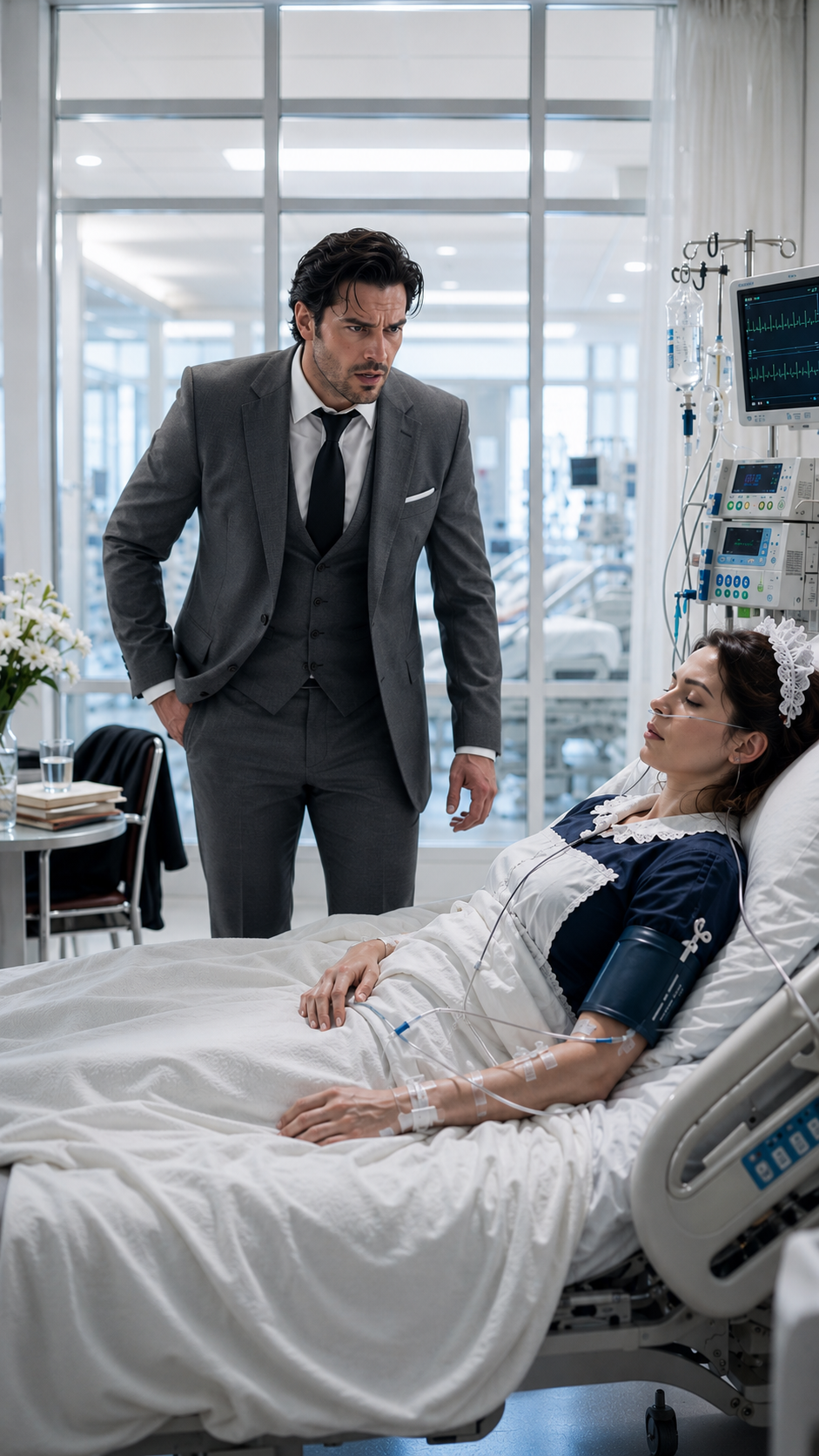
Nurses stepped aside. A guard tried to stop him, but upon seeing his face, he swallowed hard and stepped back. Behind some double doors of intensive care, a woman who had spent three years cleaning his house, washing his shirts, and serving coffee without anyone ever looking her in the eyes, was fighting to stay alive.
Her name was Elena Robles.
To Alejandro, until that morning, Elena was just “the girl from the house.”
That night, he understood she was the only reason he was still breathing.
Hours earlier, Alejandro was about to leave his residence in Las Lomas for a private meeting in Santa Fe. The rain pounded against the windows, and his bodyguards had the armored truck ready.
But Elena stopped him in the foyer.
She stood in front of him with her gray uniform soaked in sweat, hands trembling, and her face pale as if she had seen the devil himself.
—Don’t get into that truck, sir.
The silence fell heavy.
Bruno Salcedo, Alejandro’s head of security, took a step toward her.
—Get out of the way.
Alejandro raised a hand.
No one moved.
—Repeat that —he ordered.
Elena swallowed hard.
—There’s a bomb under the truck. I heard Don Bruno in the basement before 6:30. He was with one of the guards. They said it would explode after the second ignition. They said it would leave no trace.
Bruno let out a dry laugh.
—You’re crazy.
But Elena didn’t look away.
—I’m not crazy.
Alejandro watched her for three eternal seconds. Most people lied to him out of fear, ambition, or the desire to survive. Elena was afraid, yes. But she didn’t seem to be making anything up.
—Check the truck —he said.
The bomb appeared eleven minutes later.
Bruno Salcedo had already escaped.
By noon, Elena was taken to a safe house in Del Valle. She had two bodyguards, a clean phone, and strict orders not to call anyone. Not her mother, who was ill with a hip problem. Not her younger brother, who studied at a public university thanks to scholarships and weekend jobs.
At 6:42, she heard something heavy hit the wall of the hallway.
It wasn’t a knock.
It was a body.
The guard inside drew his weapon, but the door swung open before he could advance.
A man in a black coat entered.
He didn’t shout. He didn’t threaten. He moved with the calm of someone hired to erase problems.
Elena ran for the service exit. She descended stairs, crossed a rooftop, jumped into an alley, and managed to dial a number.
She didn’t get to speak.
The man caught up with her behind a closed bakery.
He struck her in the ribs. Then in the face. Elena fell on the wet floor, blood in her mouth and her phone lost next to a drain.
When he lifted her by the collar of her blouse, she managed to close her fingers around his tie.
Dark blue.
Expensive silk.
Familiar.
With her last strength, she tore off a piece.
Paramedics found her twenty minutes later, unconscious, bleeding, and with that piece of fabric clenched in her hand.
Before completely passing out, Elena parted her lips and said only two words:
—Santillán… Alejandro.
That’s why Alejandro was running.
And when he reached the door of intensive care and saw Elena connected to machines, her face swollen and her body filled with tubes, he felt something he hadn’t felt in years.
Fear.
In her right hand was still the piece of blue silk.
Alejandro barely touched it.
And then he recognized it.
That tie was only owned by six men in the world.
He had gifted it himself, a year earlier, during a private dinner with his most trusted men.
Bruno Salcedo had one.
Mauricio Vélez had one.
Gael Torres had one.
His younger brother, Ricardo Santillán, had one.
And Darío Montes had one too.
Darío, the man who knew all the safe houses.
Darío, who had suggested the gift.
Darío, who was now standing behind Alejandro, feigning concern.
Alejandro clenched his fist around the bloodstained fabric.
And without turning, he said with a calm that froze everyone:
—Seal the floor. The traitor is still here.
PART 2
In nine minutes, the elevators were blocked, the stairs guarded, and the intensive care hallway turned into an invisible border between life and death.
Doctors protested. Nurses demanded passage. A young resident tried to say that this was a hospital, not a private office.
Alejandro didn’t respond.
He stayed by Elena’s bedside, watching the monitor register every weak heartbeat of a woman nobody had considered important until that day.
Then the head nurse entered.
Her name was Pilar Castañeda, she was 58 years old, her hair hastily tied up, and she had a look capable of quieting even the most stubborn patient.
—In my floor, I’m in charge —she said—. Your men will not hinder my staff. If anyone blocks a medicine, a line, or an emergency, I’ll remove them with police, with press, or by screaming. I don’t care who you are.
The bodyguards looked at Alejandro, expecting an explosion.
But he just nodded.
—Alright.
Pilar observed him with distrust.
—What a miracle.
—Today I already had enough enemies —he replied.
At 8:40, Mauricio Vélez entered with a tablet and a tense expression.
Mauricio was his financial operator, one of those men who spoke little because they knew too much. He placed the tablet on a metal table.
—Darío Montes —he said.
Alejandro didn’t move.
—Speak.
Mauricio showed hidden transfers, unregistered calls, entries to safe houses, movements of Bruno Salcedo over 18 months, and encrypted emails sent from fake accounts. Darío had received automatic copies of every security protocol due to an old authorization that no one had updated.
Elena hadn’t been attacked by chance.
They found her because someone from the inside had betrayed her.
—Darío sent the man from the bakery —Alejandro said.
—Yes.
—And he knows she could wake up.
Mauricio lowered his gaze.
—That’s why he’ll try to finish the job.
At that moment, Alejandro's phone vibrated.
It was Darío.
Alejandro answered and walked toward the window. Outside, the rain turned the city into a smear of broken lights.
—I heard about the hospital —Darío said, his voice soft—. What a tragedy, boss. Poor girl.
Alejandro looked at Elena’s reflection in the glass.
—Where are you?
—I’m at the Reforma office. I thought you’d want the important men active tonight.
—How considerate.
Darío paused for a moment.
—Is she going to live?
Alejandro understood.
Darío wasn’t calling out of concern. He was calling to measure him.
—The doctors don’t know —he answered.
—What a shame —Darío said.
The same phrase. Too clean. Too rehearsed.
Alejandro hung up.
—He doesn’t know we have the fabric —Mauricio murmured.
—Then let’s let him think he’s still winning.
At 10:00, they identified the attacker.
His name was Iván Castañeda. Ex-military. Private contractor. Paid by two shell companies linked to Darío.
At 11:47, Gael Torres’s team checked the hotel where he was supposedly hiding.
The room was empty.
The bed untouched. An open suitcase as a decoy. The window unlocked leading to an emergency ladder.
—He didn’t flee —Gael said over the phone.
Alejandro understood before he finished.
—He repositioned.
He turned toward Elena’s room.
At 12:11, a photo arrived on Alejandro’s cell phone.
No message.
No sender.
It was the hallway in front of Elena’s room.
The image had a timestamp of eight minutes earlier.
Alejandro slammed the door open.
The window was open three centimeters.
In the frame was a folded strip of paper.
He took it.
“You have ten minutes left.”
Alejandro looked up at the IV bag.
There, next to the line port, was a second thin tube, almost invisible, taped with transparent tape.
His voice came out low.
—Doctor. Now. Your line is compromised.
The room exploded into movement.
Pilar shoved Alejandro with her arm.
—Get out of the way!
And he stepped back.
A doctor disconnected the line, closed the port, and began calling for antidotes. The monitors screamed. Elena’s body barely trembled under the sheets.
For four minutes, Alejandro Santillán discovered that there were still kinds of fear that no enemy had taught him.
In the end, the doctor looked up.
—She didn’t receive the full dose. It was slow. They wanted it to look like a complication.
—Is she going to live?
—I think so.
Alejandro closed his eyes for half a second.
When he opened them, the little humanity that had peeked out on his face was already buried under ice.
—We’re moving her.
—Where to? —Mauricio asked.
—To a place Darío doesn’t know exists.
Mauricio made one call.
His sister-in-law ran a private clinic in Toluca. Small, discreet, equipped for intensive care, with no ties to Santillán companies or internal protocols.
As Elena was taken out in an ambulance through the back, Alejandro headed to the office tower in Reforma.
The building looked like a glass knife stabbed into the night. The Santillán name gleamed on the lobby wall, cold, like power could also be written in golden letters.
Darío was on the 14th floor.
He waited for him in the conference room with four men.
He wore the dark blue tie.
Alejandro entered alone.
Darío smiled with false surprise.
—I wasn’t expecting you until tomorrow.
—Where is Bruno?
Darío sighed.
—I don’t know.
—He was always yours.
The room fell silent.
Alejandro walked to the table but didn’t sit down.
—The bomb, the safe house, Iván in the hospital, the money over 18 months. It all goes through you.
Darío stopped pretending.
—How much do you have?
—Enough.
Darío placed both hands on the table.
—You built something huge, Alejandro. But you’re no longer what this organization needs.
Alejandro didn’t say anything.
—You’ve become sentimental —Darío continued—. You shut down a hospital for a maid.
Alejandro’s eyes sharpened.
—She saved my life.
—She became a risk.
The word hung in the air.
Risk.
That’s how they talked about Elena. As if she had no mother, brother, fear, history, dignity. As if she were a stain that could be wiped clean with blood.
—Tell me where Bruno is —Alejandro ordered.
Darío made a minimal gesture.
One of the men lunged.
Alejandro had been watching for twenty seconds, gauging the weight on the left leg.
The fight lasted less than two minutes.
It wasn’t elegant. It was brutal. Chairs against the floor, glass breaking, breathless gasps, men understanding too late that Alejandro hadn’t survived all these years by letting others hit first.
When it ended, two men were on the floor.
The other two looked at Darío.
Alejandro, with blood on his brow, said to them:
—Get out.
They left.
Darío remained seated among the wreckage of the room, for the first time without theatrics.
—Bruno is in a warehouse in Naucalpan —he finally said—. Near the tracks. Unregistered.
—What about Iván?
—I don’t know. He was supposed to report at midnight.
Then Darío’s phone lit up on the table.
Alejandro saw the name on the screen.
Ricardo Santillán.
His brother.
Something shifted in the room.
Ricardo should have been in Monterrey, away from the business, away from the shadows, managing clean investments. Alejandro had spent years keeping him out to protect him.
Or so he told himself.
He looked at Darío.
—Since when?
Darío smiled faintly, his lips cracked.
—For four years.
Alejandro felt something freeze inside him.
He left Darío in the custody of his own men and went to the hotel where Ricardo was hiding.
Ricardo opened the door barefoot, wearing a wrinkled shirt with a laptop running behind him. He looked younger than his 34 years. Or maybe Alejandro was just seeing the boy who hid behind him when their father yelled.
Ricardo saw the blood on his face.
—What happened?
Alejandro stepped inside.
—Talk to me about Darío.
Ricardo paled.
For one terrible second, Alejandro thought he saw guilt.
Then he saw something worse.
Shame.
—I know already —Ricardo whispered.
—I know enough to ask you if you helped kill me.
—No.
The answer came too quickly to be a prepared lie.
Ricardo opened files, emails, contracts, transfers. Darío had approached him four years ago saying Alejandro wanted to modernize the financial structures without making noise. Ricardo believed him because he wanted to believe his brother finally trusted him.
There lay the wound.
—You never let me in —Ricardo said, his voice broken—. You said it was to protect me. Maybe it was. But when someone came and said you finally needed me, I wanted it to be true.
Alejandro didn’t respond.
—I moved money. I set up companies. I signed routes. I didn’t know what they were for. Eight months ago I started to suspect, but I was already in too deep.
—And you kept quiet.
Ricardo looked up.
—I went to the Prosecutor’s Office.
Alejandro stood still.
Ricardo turned the laptop around.
There were secure contacts, reports, names of agents, 14 months of evidence. Darío Montes had been under investigation for conspiracy, money laundering, extortion, and attempted homicide for over a year. Ricardo had made mistakes, yes. But upon realizing the magnitude of the monster he had helped build, he chose to cooperate.
—I should have told you —Ricardo said.
—Yes.
—I was scared.
Alejandro thought of Bruno. Of the eleven men Darío had blackmailed. Of Elena, alone by a washing machine, deciding whether saving the life of a feared man was worth losing her own.
Fear had built almost the entire night.
At 4:51, Alejandro returned to the tower with Ricardo’s files.
A man who had been with Darío before waited for him with a federal badge.
—Agent Morales —he said—. I’ve been infiltrated in Darío’s network for 14 months.
Darío was arrested at 6:15.
Bruno fell at 6:40 in the Naucalpan warehouse.
Iván was captured at 6:58 trying to leave the city with a fake passport and a broken doll.
By 8:00, the main traitors were in custody.
The eleven men who had cooperated out of fear received personal calls from Alejandro. He didn’t threaten them. He told them what he knew, what it meant to collaborate, and how much their silence had cost.
They all spoke.
At 9:00, Alejandro arrived at the clinic in Toluca.
He hadn’t slept. His suit was stained, his brow was cut, and he wore an expression that didn’t match any white hospital room.
The head doctor greeted him at the entrance.
—She woke up at 7:15 —she said—. She asked for water. She asked the time.
Alejandro waited.
—Then she asked if you knew.
He nodded and entered.
Elena was awake.
Pale, bruised, one eye swollen and the other open, clear, firm.
She looked at him as he sat by the bed.
—You look terrible —she said.
Alejandro almost smiled.
—I’ve been told that.
—Did you sleep?
—No.
—Is it over?
Alejandro thought of Darío in custody, Bruno confessing, Ricardo handing over files, and Elena breathing against all odds.
—Yes —he said—. It’s over.
Elena closed her eyes and let out a breath that seemed to have been held since that door in the basement.
Then she opened her good eye.
—There was laundry in the washing machine.
Alejandro looked at her, not understanding.
—I’m not serious —she murmured—. I think my head wants to think of normal things.
He lowered his gaze to her hand. The same one that had clutched the torn silk. Her knuckles were bruised.
—You’re not going back to the house —he said.
—I figured.
—Your medical expenses are covered. Your family is protected. Your mother’s rent, your brother’s university, your apartment, everything.
Elena's face tightened.
—Mr. Santillán.
—Alejandro.
She hesitated.
—Alejandro —she said carefully—. I didn’t stop him for money.
—I know.
—Then don’t turn it into a purchase.
He remained still.
No one spoke to him like that.
Maybe no one had ever dared.
Elena held his gaze, even with her broken face.
—I chose to do it. I would do it again. But that doesn’t mean you own what comes next.
Alejandro took time to respond.
—You’re right.
She seemed surprised.
—But I do owe you something better than going back to being invisible.
Elena looked out the window.
—I didn’t see you because it was easier not to see.
The phrase hit Alejandro harder than any blow from the night.
—Yes —he admitted.
Three weeks later, Elena left the clinic walking on her own.
Her mother cried as she hugged her. Her brother said almost nothing, only took her hand as if afraid she might disappear if he let go.
Alejandro visited her twice.
Never for long.
Never with speeches.
And never again as a man talking to a piece of furniture.
That morning, when Elena got into a simple car that would take her home, her phone rang.
It was Alejandro.
—How are you feeling?
—Functional.
—That’s not an answer.
—It’s the most accurate one I have.
There was a pause.
—There’s a position —he said—. Internal operations. It doesn’t exist yet. It would consist of seeing what others don’t see. Security flaws, abuses, ignored people, blind spots.
Elena looked at the city through the window.
—You want to pay me to notice things.
—I want to pay you what it’s worth to notice things.
She fell silent.
—I have conditions.
—Lay them out.
Elena stated them one by one.
Her mother and brother would be kept out of that world. Her salary would be clean, legal, and documented. She would never carry a weapon. And if she ever told him she wasn’t seeing someone, he would listen before it cost blood.
Alejandro took so long to respond that she thought the call had dropped.
—I accept.
—Just like that?
—You said you weren’t fragile —he replied—. I’m believing you.
Elena looked at the gray sky over the city.
For three years she had been invisible in a house full of powerful men.
Then she stood in a foyer, said one sentence, and changed the course of an empire.
Her life didn’t change because Alejandro Santillán decided to reward her.
It changed because, when the moment came to choose between silence and doing what was right, Elena decided not to stay still.
And that decision didn’t belong to him.
It belonged to her.





