PART 1
On her first afternoon at the Santa Lucía estate, just outside Tepatitlán, Rosario found no luxury, no order, no peace.
Instead, she discovered five children huddled by the cold hearth, eating cold beans with their fingers, as if in that vast house, no one remembered they were hungry too.
The estate was famous throughout Jalisco. It had endless pastures, stables, corn storage, a dry garden with a broken fountain, and a family chapel where wilted flowers still hung for doña Abril, the deceased wife of don Julián Montemayor.
Since doña Abril's accident, don Julián had ceased to be a man and had become a mere shadow.
He didn’t embrace. He didn’t ask. He didn’t listen.
He merely walked the corridors in heavy boots, a black shirt, and a rage that frightened even the dogs.
His children paid the price for the mourning he couldn’t bear.
Emilio, aged 11, looked after his siblings as if he were their father. Camila hid photos of their mother under her pillow. Nico stole tortillas out of habit. Darío broke things when he was scared. And the youngest, Sofi, just 4 years old, slept clutching an old sweater that still smelled like Abril.
The staff called them “the wild children.”
But Rosario understood something different from the very first minute: they weren’t wild; they were abandoned.
She came from a humble ranch near Arandas, with a canvas suitcase, two clean dresses, and a wooden box where she kept her knives, spices, and a notebook of her grandmother's recipes.
The foreman, Evaristo, greeted her in the yard with a crooked smile.
—Another cook. Let’s see if you can handle it, girl.
Rosario didn’t lower her gaze.
—I didn’t come to endure humiliation. I came to work.
Evaristo let out a dry laugh.
—Here the boss shouts, the kids bite, and the dead woman’s family calls the shots. So watch yourself.
Rosario entered the kitchen and felt a lump in her throat.
There were black pots, stale bread, locked sacks, and a nearly empty pantry. The keys belonged to Evaristo, according to a cleaning girl, because “the good food was only for important guests.”
Rosario found rice, nopal, tomatoes, guajillo peppers, dough, eggs, and a bit of dried meat.
She didn’t ask any more questions.
She lit the stove.
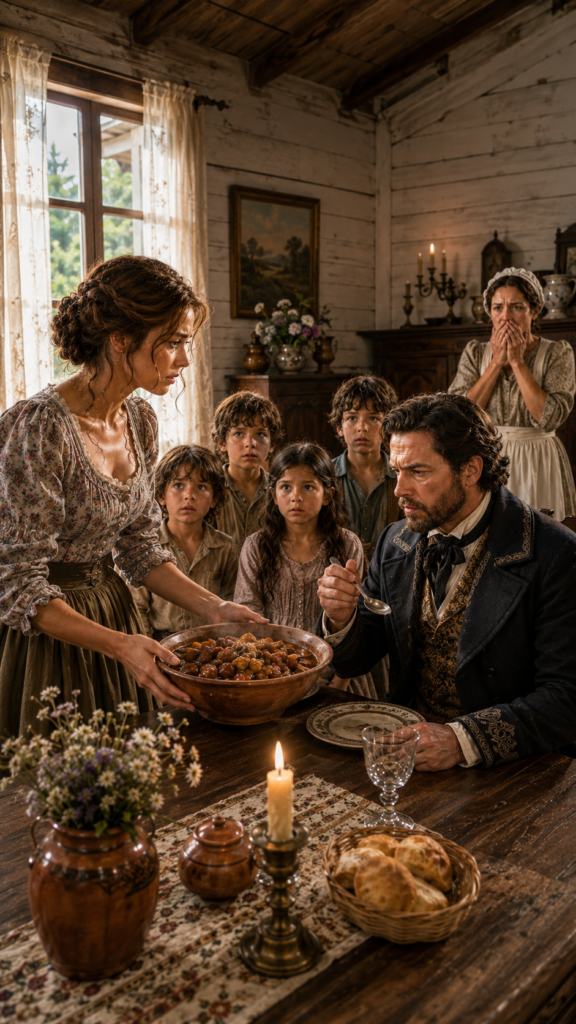
In less than an hour, the smell of freshly made tortillas, red rice, beans with epazote, and meat in sauce began to waft through the hallways like a living memory.
The five children appeared at the door.
Emilio had a slingshot. Camila clenched her jaw. Sofi stared at the pot with wide eyes.
Rosario set five plates on the table.
—You don’t have to like me. But you do have to eat.
Nobody moved.
Then Sofi stepped forward, tasted a spoonful, and burst into tears.
—It tastes like when my mom was alive.
At that moment, don Julián appeared in the doorway.
Everyone froze.
He looked at the plates, then at his children eating, and then he tasted a tortilla with sauce. His hand trembled.
Rosario thought he was going to throw her out.
But the boss turned pale and asked in a broken voice:
—Who taught you to make that sauce?
Rosario answered slowly:
—My grandmother. She said some foods awaken truths.
Don Julián dropped the napkin.
—Then this house has been lying for eight months.
PART 2
That phrase hung in the kitchen like the tolling of a church bell.
Evaristo, who had just entered with the pantry keys dangling from his belt, stopped dead. The cleaning girl crossed herself. The children ceased chewing.
Don Julián explained nothing.
He simply took the keys from the foreman's waist with a calmness that was terrifying and handed them to Rosario.
—From today, you run this kitchen. My children eat first. And if anyone denies them a plate again, they’re out of this estate with no severance and a complaint.
Evaristo clenched his teeth.
—Boss, I was just following orders.
—Whose?
The foreman didn’t answer.
Don Julián held him with his gaze, but didn’t insist. Not yet. His face showed that something had opened, an old wound he had kept closed out of cowardice.
From that night on, Rosario did more than just cook.
She rescued a house.
She had blankets washed, opened windows, pulled mattresses into the sun, and removed locks from cupboards. She prepared oatmeal with cinnamon in the mornings, noodle soup at noon, and hot dinners before bed.
At first, the children tested her like one tests a fence.
Nico hid rolls under the bed.
Darío threw a plate to see if Rosario would yell at him.
Camila told her that no cook could replace their mother.
Rosario wasn’t offended.
—Good that you know that, my girl. I didn’t come to replace anyone. I came to make sure you don’t lose your life.
That response disarmed Camila more than any scolding.
As days went by, Sofi started to follow Rosario around the kitchen. Emilio helped carry firewood while pretending it didn’t matter. Nico stopped hoarding food when he understood there would be breakfast the next day too.
Don Julián watched from afar.
He stood at the dining room door, watching his five children laugh with their mouths full of sweet bread, and left before any of them could see him. He was ashamed to step into a happiness he himself had abandoned.
One night, Rosario found him in the chapel, sitting in front of doña Abril’s photo.
—Your children are still waiting for you —she said.
He didn’t turn around.
—I don’t know how to talk to them without feeling like I’m betraying her.
—Betrayal is leaving them alone while you breathe.
Don Julián closed his eyes. No one in the estate dared to speak to him like that. But Rosario didn’t say it with arrogance, but with a clean sadness.
From that day on, the boss began to change.
He asked Emilio about school. He apologized to Camila for having thrown away her mother’s dried flowers. He picked up Sofi in his arms after months of seeing her only from afar.
The estate seemed to start breathing again.
But the peace didn’t last long.
One Saturday afternoon, a white truck arrived from Guadalajara. Doña Leonor Paredes, doña Abril’s aunt, alighted from it, a woman adorned with pearls, expensive perfume, and a snake-like gaze. She came with her daughter Valeria, 29 years old, elegant, cold, dressed as if she were attending a society luncheon rather than visiting orphaned children.
Doña Leonor embraced don Julián without tenderness.
—Oh, Julián, this house needs a real woman.
Valeria smiled with false pity.
—The children are so neglected. Poor things. Honestly, someone has to civilize them.
From the kitchen, Rosario heard every word.
It didn’t take long for her to understand the plan.
Doña Leonor wanted to marry Valeria off to don Julián. She said that this way, “doña Abril’s blood” would continue to be protected at Santa Lucía. But in reality, her questions always circled back to the same thing: deeds, accounts, cattle, trusts, inheritances.
During the meal, doña Leonor looked at Rosario as if she were a stain on the tablecloth.
—And who is this girl?
Sofi answered before anyone could:
—It’s Chayo. She feeds us.
The table fell silent.
Don Julián lowered his gaze, struck by the cruel innocence of that phrase.
Doña Leonor pressed her lips together.
—What a common remark. The children shouldn’t get attached to the help.
Emilio stood up abruptly.
—Don’t say that.
—Sit down, you spoiled brat.
Rosario took a step forward, but don Julián stopped her with a look. Not because he didn’t want to defend her, but because he was still measuring how far the poison of that family extended.
That afternoon, he had to go to town for an urgent call from the veterinarian. An outbreak was sickening several calves.
Doña Leonor waited barely for the truck to disappear down the dirt road.
Then she entered the kitchen with Valeria, Evaristo, and two unknown men.
—Get your things —she ordered.
Rosario left the knife on the table.
—Excuse me?
—you’re fired. This house doesn’t need a maid pretending to be the mother of five rich children.
Valeria laughed softly.
—Besides, you’re putting strange ideas in their heads. Sofi already talks like a country girl.
Rosario felt her face burn, but she didn’t move.
—Only the boss can fire me.
Doña Leonor clapped her hands, and the men took Rosario’s suitcase to the yard. Then Valeria picked up a yellow dress that Rosario was sewing for Sofi and threw it to the floor.
Sofi entered at that moment.
Seeing her dress trampled, she let out a scream.
Emilio rushed to defend her, but Evaristo pushed him against the table. A pot of hot broth spilled and splashed his arm.
The boy screamed in pain.
Rosario lunged at him, wrapped his arm in a damp cloth, and shouted for someone to bring clean water.
Doña Leonor didn’t flinch.
—That’s what happens when the brats think they have the right to voice opinions.
Then a deep voice sounded from the doorway:
—Who touched my son?
Don Julián was there.
With dust-covered boots, his hat in hand, and a leather folder under his arm.
Evaristo turned pale.
Valeria stepped back.
Doña Leonor tried to smile.
—Julián, it’s great you’re here. This employee caused a scandal. We were just trying to restore order.
Don Julián walked over to Emilio and saw the burn. Then he looked at Sofi crying, at Rosario kneeling, at the dress on the floor, and at his other three children pressed against the wall like frightened little animals.
His face changed.
It was no longer mourning.
It was justice.
—Today I didn’t go for the calves —he said.
Doña Leonor blinked.
—What?
—I went to the notary in Tepatitlán. He called me because he found a copy of Abril’s private will.
The silence became heavy.
Rosario lifted her gaze.
Don Julián opened the folder and pulled out several sheets.
—Abril knew you were moving money from the children’s accounts. She knew Evaristo was falsifying receipts for food, medicine, and clothing. She knew you, Leonor, wanted to declare me incapable due to mourning to manage the estate “in the name of the family.”
Doña Leonor lost color.
—That’s a lie.
—She also knew you wanted to marry Valeria to me to control Santa Lucía.
Valeria opened her mouth, indignant.
—I only wanted to help you.
Don Julián let out a bitter laugh.
—Help me? They found deposits of 740,000 pesos in an account in your name. Money that was supposed to be for my children.
Camila began to cry silently.
Emilio, with his injured arm, looked at Evaristo as if he finally understood why they had so often been told there was “no food.”
Don Julián showed another sheet.
—And there’s more. Abril didn’t die while shopping in Guadalajara, as you told me. She was going to report her own aunt.
Doña Leonor stepped back.
—Don’t you dare.
—The mechanic testified this morning. Someone had the brakes of the truck tampered with. He can’t prove who ordered it yet, but he did say who paid him to keep quiet.
Don Julián turned towards Evaristo.
The foreman collapsed into a chair.
—I didn’t want her to die, boss. Doña Leonor said it was just to scare her, that it was so she wouldn’t sign anything, I swear.
Sofi stopped crying.
No one breathed.
Doña Leonor screamed that it was slander, that a cook had bewitched everyone, that this family was degrading because of a starving woman.
Then Rosario stood up.
Her hands trembled, but her voice was firm.
—Not a starving woman. Starvation is what you inflicted on five children to seize what wasn’t yours.
The phrase hit harder than a slap.
Don Julián called the municipal police and the Public Ministry. Doña Leonor tried to leave, but the workers closed the gate. No one touched her. No one yelled at her. They simply allowed her to face, for the first time, a door she couldn’t buy.
Evaristo confessed that very night.
He told about the locks on the pantry, the fake receipts, the orders to reduce food so that the children appeared “ungovernable” and thus justify having a woman from the family take care of them.
Valeria denied everything until messages appeared on her cell phone talking about “holding out for three months” to convince don Julián to marry her.
The truth came out like dirty water.
And it hurt.
Don Julián gathered his children in the dining room. Not at the head of the table. He sat with them, at their level.
—I failed you —he said, his voice broken—. Your mother tried to protect you, and I hid behind my pain. Emilio, I made you carry a house that wasn’t yours. Camila, I let you cry alone. Nico, Darío, Sofi… forgive me for being a father while you felt orphaned.
Emilio tried to be strong, but his lip quivered.
Sofi got down from her chair and hugged his leg.
The others followed.
Rosario tried to step out to leave them that moment, but Camila took her hand.
—You’re part of it too.
Don Julián looked at Rosario with eyes full of shame and gratitude.
—I’m not going to ask you to take Abril’s place. That place is sacred. But I do want to ask you to stay in this house, not as a servant, but as the woman who taught us to live again.
Rosario took a deep breath.
—I’ll stay if this house changes for real. If your children become children again. If no one ever humiliates anyone for being poor, for cooking, or for not having a last name.
Don Julián nodded.
—I swear it by Abril.
Months later, Santa Lucía no longer seemed like a cursed estate.
There were laughs in the yard, clean clothes on the lines, the smell of coffee brewing in the mornings, and a table where six plates were always served: five for the children and one in front of their mother’s empty chair.
Rosario never erased Abril. On the contrary, she kept her alive in every recipe, in every fresh flower in the chapel, and in every night when Sofi asked about her without fear.
Don Julián understood too late that pain does not justify abandoning those who need us the most.
And the children learned something many adults never understand: family isn’t always who shares your blood, but who feeds you when the whole world decides to turn its back on you.





