PART 1
—If that diner doesn’t sign today, the machinery comes in tomorrow —Mauricio Rivas said, throwing a folder onto the table.
From the 39th floor of a tower in Reforma, Adrián Valcárcel stared at the model of the project that would make him a legend: Paseo Valcárcel.
Luxury apartments, office terraces, expensive restaurants, and a plaza with illuminated fountains. Everything perfect.
Except for one tiny establishment, marked in red, right in the middle of the lot.
The Diner of Doña Meche.
—It’s in the Santa María la Ribera neighborhood —Mauricio explained—. We’ve already bought 18 properties. We just need that stubborn girl.
Adrián didn’t even blink.
—Double the offer.
—We’ve already offered her four times its value. She says she won’t sell.
—Then she didn’t understand.
Mauricio smiled.
—We can pressure her with the debt issue. Her mom left poorly signed papers. That’ll be easy.
Adrián took the pen to authorize the eviction but hesitated.
It wasn’t pity.
It was pride.
He wanted to see for himself who dared to say no to Adrián Valcárcel.
That afternoon, he took off his Swiss watch, left his designer jacket in the office, and put on a gray hoodie, a cap, and old sneakers.
He walked through streets where the sidewalks were cracked, corn vendors puffed steam, and neighbors greeted one another as if the neighborhood still belonged to them.
The Diner of Doña Meche sat on a simple corner, with cream-colored walls, clay pots, and a hand-painted sign.
It smelled of noodle soup, coffee from a traditional pot, and tortillas fresh off the skillet.
As he entered, a little bell rang.
—Come in, young man, sit wherever you like —a female voice said from the counter—. Today we have mole de olla, and we don’t accept long faces.
Adrián turned.
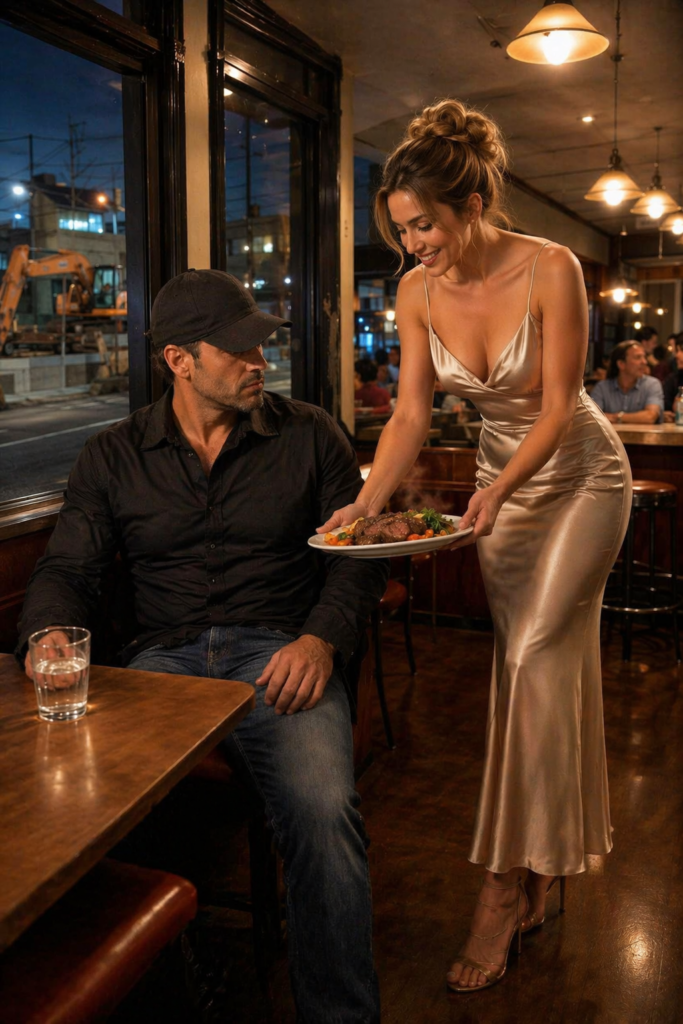
The waitress looked to be about 28 years old. Her name was Valeria, according to her apron. She had her hair tied back, deep dark circles under her eyes, and a tired smile, the kind people wear to avoid worrying anyone.
—I just want coffee —he said.
—I’ll bring you coffee and a bowl of soup. You look like you haven’t slept well in years.
Adrián almost laughed.
No one spoke to him like that.
He sat by a window with embroidered curtains. He watched Valeria serve food to a contractor on credit, give rice pudding to a little girl, and tell an elderly man:
—Don’t worry, Don Toño. You can pay me later. No one goes hungry here.
The phrase hit him like a stone in the chest.
No one goes hungry here.
When he tasted the soup, something broke inside him.
Guajillo chili, mint, zucchini, tender meat. A humble flavor. An ancient flavor.
A flavor his memory had buried beneath 20 years of money.
The diner closed after 10. Adrián pretended to read messages while Valeria turned off the lights.
Then he heard a muffled cry behind the counter.
—He’s here, Don Toño —she whispered—. The last warning. They’re giving us 15 days.
—Girl, let’s gather signatures.
—Signatures against Valcárcel? No one wins against those people.
Adrián stopped breathing.
—My mom died believing this place would save us —Valeria continued—. She used to say that one day that boy she fed when he was lying on the street would return. That if life made him big, he would come back to take care of the diner.
Don Toño fell silent.
—And what do I tell Emiliano? —she said, breaking—. That we’re left without a home, without work, and without the only memory of our mom?
Adrián stood up slowly.
Before leaving, he saw Valeria in front of a portrait with a candle lit. An older woman, with gray braids and a sweet gaze.
—Forgive me, Mom —Valeria cried—. You waited for that boy your whole life, but people forget who fed them when they rise.
The bell rang.
Adrián stood on the sidewalk, his throat dry.
Because the woman in the portrait was the same one who, 20 years ago, had found him hungry under a bridge.
PART 2
Adrián Valcárcel didn’t return to his penthouse that night.
He drove aimlessly down Insurgentes, turned through streets he no longer recognized, and ended up parked in front of a closed Oxxo, gripping the wheel tightly.
He was 16 when he arrived in Mexico City with no money, no family, and nothing but pride left over from hunger.
His name was Adrián Campos.
Not Valcárcel.
Campos, like his mother, who died in Veracruz. Campos, like the surname he later hid because it sounded like poverty.
He remembered the bridge near Buenavista, rain seeping through the cardboard, broken shoes, an empty stomach.
He remembered entering a diner to steal bread.
And he remembered a short woman, in a flowery apron, who grabbed him by the wrist.
He thought she would call the police.
But she simply said:
—Oh, son. To steal food, you have to be very hungry. Sit down.
She served him soup, tortillas, and rice. Then she gave him a coffee with cinnamon.
—No one goes hungry here —Doña Meche said—. Eat slowly. The world runs too fast out there.
That woman gave him a job washing dishes.
She let him sleep three nights in the storeroom.
She bought him a used jacket.
And when Adrián said he wanted to sell tacos to save money, she opened an old cookie tin and took out 8,700 pesos.
—It’s not much, but it’s honest —she told him—. When things go well for you, come back for coffee. Not to pay me. So I know you’re alive.
Adrián did come back once.
But he saw her serving customers, the apron stained, her hair filled with gray, and felt ashamed that someone from his past would recognize him.
He stayed on the other side of the street.
Then he left.
Then came the business, the contracts, the hotels, the land, the magazines, the awards.
And the surname Valcárcel.
At dawn, he returned to the diner disguised again.
Valeria was sweeping the entrance. She had puffy eyes, but when she saw him, she smiled.
—Look at that, the man from the sad soup has returned.
—I liked the food.
—That’s what everyone says once I’ve healed something inside.
Adrián didn’t know how to respond.
He sat at the same table. Valeria served him without asking.
—Today it has more lime. You look worse than yesterday.
In the back, a 9-year-old boy was doing homework at a table. He was thin, with straight hair and huge eyes. He had a red backpack and an inhaler next to his notebook.
—He’s Emiliano —Valeria said—. My little brother. He says he’s the diner’s manager.
The boy raised his hand.
—I collect the drinks, but my sister won’t let me touch the cash register.
—Because once you changed 200 pesos for World Cup stickers —Valeria replied.
—That was an investment —Emiliano said, very seriously.
Adrián smiled for the first time in days.
Then the boy looked at him curiously.
—Do you come alone because you have no family?
Valeria blushed.
—Emi, don’t ask that.
—It’s okay —Adrián said—. Yes. I come alone.
Emiliano lowered his voice.
—My mom used to say that lonely people need more soup. That’s why she opened late.
Adrián felt another stab.
—Did your mom talk a lot about the diner?
—A lot —the boy said—. She said she once helped a kid from the street. He had scared dog eyes. Then he got rich, I think. She said he would return.
Valeria stopped cleaning a table.
—Emiliano, enough.
—What? It’s true. My mom even kept a photo.
Adrián felt the air close around him.
—A photo?
Valeria hesitated.
—It’s in a box. My mom’s things.
—I’d like to see it.
She looked at him suspiciously.
—For what?
—I don’t know. Maybe I knew someone like that.
Valeria went for an old tin box. She placed it on the table and pulled out recipes, receipts, religious trinkets, and yellowed photographs.
In one of them, Doña Meche was hugging a skinny young man, disheveled, wearing an oversized jacket.
Adrián saw himself before he learned to pretend.
Valeria noticed his fingers tremble.
—Do you know him?
Adrián wanted to say it.
It’s me.
I’m the coward.
I’m the ungrateful one.
I’m the man who now wants to tear down your home.
But shame won out.
—No —he lied—. He just looks familiar.
Emiliano came closer, looked at the photo, and then looked at Adrián.
—How strange. You have the same eyes.
The silence became heavy.
Valeria carefully put the photo away.
—My mom used to say those eyes belonged to someone who wasn’t bad, just lost.
Adrián looked down.
That afternoon, he ordered an investigation into all the diner’s papers.
The report arrived at 5 in the morning.
The debt threatening Valeria hadn’t come by mistake. Mauricio Rivas, her partner, had bought the note through a shell company to force her to sell cheaply.
He’d also bribed a city official to declare the building “structural risk.”
The entire eviction was a trap.
And Adrián had signed it without reading, because to him that establishment was just a red stain on a model.
At 8, he called Mauricio.
—Cancel everything against the diner.
—What?
—The debt, the eviction, the machinery. Everything.
Mauricio let out a short laugh.
—Don’t tell me the waitress made you feel sorry for her.
—I told you to cancel.
—You can’t. The investors have already released funds. If you stop, they’ll impose penalties of 280 million. The project collapses.
—Let it collapse.
There was silence.
—Don’t be ridiculous, Adrián. That diner is worth less than the marble in your bathrooms.
—To me, it’s worth more.
—Then I’ll be clear with you. If you back down, I’ll continue. I have signed powers from you, permits, and agreements. The machinery enters on Monday.
Adrián hung up.
For the first time in years, he felt fear.
Not from losing money.
From being late again.
He returned to the diner wearing a white shirt, without a cap, without a disguise.
Valeria was arranging boxes. Don Toño was helping her take down pictures from the wall. Emiliano was wrapping cups in newspaper, trying not to cry.
She saw him enter and frowned.
—We’re not open yet.
—I need to talk to you.
—Today there’s no soup. We’re packing memories before they crush us.
Adrián took a deep breath.
—Valeria, I’m Adrián.
—I know what your name is.
—No. I’m Adrián Campos. The boy in the photo.
She froze.
The box she was holding slipped from her hands. The cups shattered on the floor.
Emiliano jumped up.
—Are you the one from my mom?
Adrián nodded, with wet eyes.
—Yes.
Valeria walked to the box, pulled out the photo, and held it in front of him.
—Look me in the face and tell me again that it’s you.
—It’s me.
—And are you also the owner of Grupo Valcárcel?
Adrián didn’t respond.
It wasn’t necessary.
Valeria let out a laugh without joy.
—What a beautiful story, right? My mom saved a hungry boy, and that boy grew up to tear us down from the diner.
—I didn’t know it was your diner.
—But you knew there were people here.
—I know.
—You slept here warm, ate from her hand, took her savings, and when you had money, you even changed your last name so no one would smell your poverty.
The words were precise blows.
Adrián didn’t defend himself.
—I’ll fix this.
—I don’t want you to fix anything.
—Valeria…
—My mom waited for you until the last month of her life. Every time the bell rang, she looked up. She said, “That boy will return, you’ll see.” And you returned. But not out of gratitude. You came back dressed as a poor man to spy on us.
Emiliano cried silently.
—I did believe you were good —the boy said.
That hurt more than any insult.
Adrián stepped toward him, but Valeria interposed.
—Don’t touch him.
—Sorry.
—Keep your apologies. There are people who arrive late and still want applause.
Adrián left the diner without saying more.
But this time he didn’t flee.
He headed straight for his offices.
Mauricio was meeting with investors. On the screen, the scheduled demolition appeared for Monday at 7:00.
Adrián entered without knocking.
—Paseo Valcárcel in Santa María la Ribera is canceled.
The men at the table laughed, thinking it was a joke.
Mauricio stood up furious.
—You don’t have the authority to do that without the board.
—I’m the majority shareholder.
—And I have documents where you approved everything.
Adrián threw another folder onto the table.
—And I have proof of your shell companies, the bribes, and the note bought to extort a family.
Mauricio paled.
—Watch what you say.
—No, Mauricio. Watch what you signed.
One of the investors took the papers and stopped smiling.
Adrián continued:
—I will deliver this to the Prosecutor’s Office. And I will declare that my company attempted to illegally dispossess a family.
—You’re going to sink too —Mauricio spat.
—Yes.
The word came out calm.
—But at least this time I won’t save my name by letting others lose their home.
The news exploded on social media the next day.
“Millionaire cancels megatower for neighborhood diner.”
“Grupo Valcárcel investigated for dispossession.”
“Partner accused of real estate fraud.”
But the machinery still appeared on Monday.
Mauricio had activated an emergency permit before the suspension arrived.
The neighbors rushed to the street. Valeria stood in front of the diner, holding Emiliano’s hand. Don Toño set up a table in the entrance.
—We’re not moving from here —she shouted.
The operator turned on the machine.
The noise made the windows shake.
Emiliano began to cough.
—It hurts… my chest...
Valeria bent down.
—Stay calm, my love. Breathe with me.
But the dust raised by the machine hit her directly. The boy doubled over, searching for air, his lips pale and hands trembling.
—His inhaler! —Don Toño shouted.
Valeria searched the backpack, but it was empty.
At that moment, Adrián arrived.
He leaped out of the truck, running, without bodyguards, without a jacket, without power.
—Shut off that machine!
No one obeyed.
Adrián pushed the foreman, took Emiliano in his arms, and looked at Valeria.
—You either hate me later or lose him now.
She, broken by fear, nodded.
—Save him.
Adrián drove to the emergency room as if the entire city were against him. At the nearest private hospital, he demanded a pulmonologist, oxygen, and immediate attention.
He didn’t ask for special treatment for himself.
He asked for it for the boy of the woman who believed in his goodness when he no longer believed in anything.
Valeria arrived minutes later, trembling.
—If anything happens...
—Nothing will happen.
—Don’t promise me things.
Adrián lowered his head.
—You’re right. I’ve promised too much and delivered too little.
Hours later, the doctor came out.
—He’s stable. It was a severe crisis, but we got here in time.
Valeria covered her face and cried as if she could finally let everything go.
Adrián didn’t approach.
He stayed back because he understood not all pain belonged to him.
That night, Emiliano woke up.
Valeria was by his side. Adrián remained at the door.
The boy looked at him tiredly.
—Was it true that my mom saved you?
—Yes —Adrián said.
—And why didn’t you come back?
Valeria closed her eyes.
Adrián swallowed hard.
—Because I was ashamed of being reminded of my poverty. And I ended up being poorer inside than when I didn’t have shoes.
Emiliano thought for a moment.
—My mom said shame heals by telling the truth.
Adrián smiled sadly.
—Your mom knew a lot.
—Are they going to tear down the diner?
—No. Never.
—Now do you promise it?
Adrián looked at Valeria before answering.
—I don’t promise it with words. I’ll show you by staying.
The following weeks were hell.
Mauricio was arrested for fraud, extortion, and bribery. Several officials fell with him. The investors sued Adrián. His accounts were frozen. He sold two apartments, one lot in Querétaro, and his shares in a hotel to cover fines and laid-off workers.
The press called him crazy.
His old friends stopped answering him.
But The Diner of Doña Meche stayed open.
Adrián didn’t arrive with a giant check or a camera filming him.
He arrived with paint, cement, new lights, and willing hands.
He fixed the plumbing.
Sanded tables.
Washed pots.
Carried bags of rice.
At first, the neighbors looked at him badly.
Don Toño took 18 days to speak to him.
Valeria took longer.
One afternoon, while Adrián was changing the doorframe, she came out with two coffees.
She handed one to him without smiling.
—Just because you’re having coffee here doesn’t mean I’ve forgiven you.
—I know.
—Helping doesn’t erase what you did.
—I know that too.
Valeria looked at the portrait of her mother, once again hung by the entrance.
—My mom would have said that everyone deserves another table.
Adrián looked down.
—Your mom gave me one when I didn’t deserve anything.
From the back, Emiliano raised a drawing. There was the diner, Valeria, Don Toño, Doña Meche with wings, and a man painting a wall.
—Look, Vale —the boy said—. I drew the man who arrived late.
Valeria took the paper.
—Is that what you call him now?
—Yes. Because he arrived late, but he didn’t leave again.
Adrián felt his eyes fill with tears.
That night, the diner reopened with more people than ever.
There were no luxury towers.
There was no plaza with an elegant name.
There was mole de olla, coffee from a pot, hot tortillas, and a line of neighbors leaving flowers under the portrait of Doña Meche.
Valeria served the last plate at Adrián’s table.
He received it in silence.
She stood for a moment, as if battling with her own heart.
Then she said:
—Eat slowly.
Adrián looked up.
Valeria took a deep breath and finished the phrase her mother had left alive in those walls:
—No one goes hungry here.
And Adrián understood that there are debts that can’t be paid with millions, but with the humility of staying where one day, someone fed you.





