PART 1
Santiago Arriaga arrived at his vacation home in Valle de Bravo with 4 empty boxes, a folder of documents, and a decision that hurt down to his bones.
He was going to sell it.
It had been nearly 2 years since Camila, his wife, died of cancer. Since then, that house by the lake had remained locked up, curtains still, furniture covered, and the children's room intact, like a broken promise.
Santiago owned boutique hotels in Mexico City, Querétaro, and San Miguel de Allende. He had a chauffeur, lawyers, accountants, and a family that always looked impeccable in society magazines.
But that Friday, as he stepped down from his gray SUV, he didn’t seem like a powerful businessman.
He seemed like a defeated man.
He held the rusty key in his hand when he heard a noise on the porch.
It wasn’t the wind.
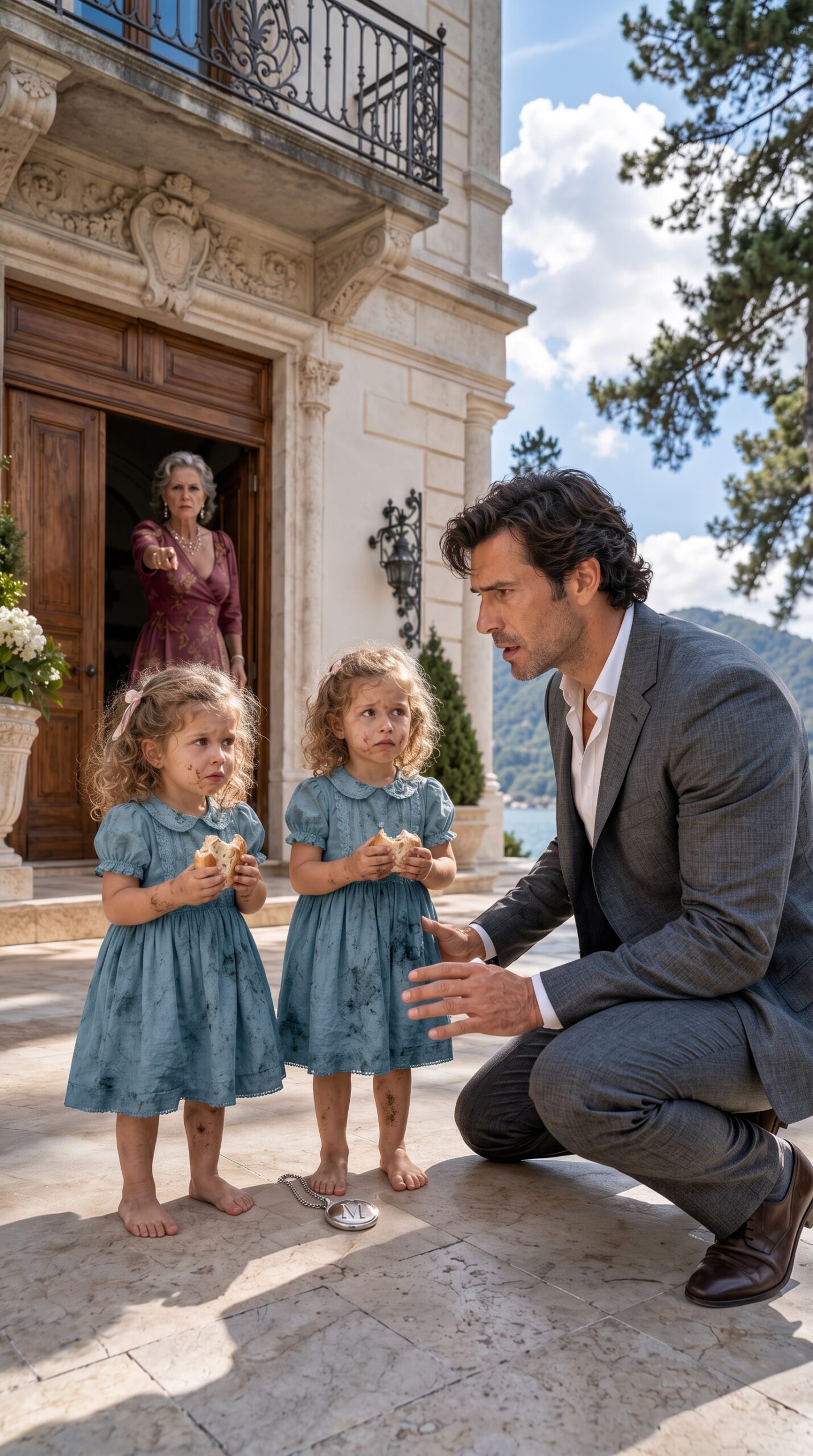
It was 2 little girls, identical, sitting on the wooden step. They were barefoot, dressed in dirt-stained dresses, hair plastered to their faces. One hugged a hard bread roll against her chest. The other had a scrape on her forehead and stared without blinking.
Santiago froze.
—Who are you?
The girl with the roll hid behind her sister.
The other swallowed and pointed to her chest.
—Luz.
Then she pointed to the little one.
—Estrella.
Santiago felt a strange knot in his throat. They had to be 3 years old. They weren’t crying. They weren’t asking for anything. That scared him more than any scream.
—Where is your mom?
Both girls looked down.
Estrella squeezed the roll as if it were the only thing left in the world.
—It’s from Mom Rosa —she murmured.
Santiago looked down the dirt road. There were no cars, no adults, no one. Just the lake in the background and those 2 hungry creatures.
He opened the door.
He gave them water, warm milk, rice with eggs, and banana. They ate slowly, saving little pieces in their hands, as if someone would take them away.
Santiago called the municipal police, the DIF, and Civil Protection.
They answered with cold phrases.
—We’ll check tomorrow, sir.
—We can send a social worker on Monday.
—If they aren’t hurt, just hold them for a bit.
It was Friday.
Monday was 3 days away.
Santiago looked at the girls dozing on the sofa, covered with an old blanket of Camila's, and felt something break inside him.
He couldn’t leave them there.
He bathed them gently. He gave them 2 of Camila's t-shirts that fit them like dresses. He prepared the guest room and turned on a lamp so they wouldn’t be afraid.
Before sleeping, Luz asked:
—Did you also lose your mom?
Santiago didn’t know how to answer.
He only thought of Camila, of her cold hands in the hospital, of the baby they never had, of the white crib he never dared to remove.
On Sunday at noon, his mother arrived unannounced.
Doña Rebeca Arriaga entered with Tomás, Santiago's younger brother, and Verónica, his sister-in-law. No one had invited them, but they walked through the living room as if the house were theirs.
—What are those girls doing here? —Verónica asked, wrinkling her nose.
—I found them outside —Santiago replied—. They were alone. The DIF is coming tomorrow.
Doña Rebeca let out a dry laugh.
—Oh, son, you’re still as naive as ever. In Mexico, no one leaves 2 girls at the door of a wealthy man by accident.
Tomás looked at the little ones with distrust.
—They might be trying to set you up. Or get money from you.
Luz hugged Estrella.
Santiago stood in front of them.
—They are girls. Not a threat.
Verónica pointed to the roll that Estrella was still guarding.
—Well, check that. No one carries old bread as treasure unless they have something hidden.
Before Santiago could stop her, Verónica snatched the roll from Estrella.
The girl screamed as if her mother was being ripped away again.
The bread fell to the floor, broke in two, and out rolled a silver medallion with a Virgin of Guadalupe and an engraved initial: C.
Doña Rebeca turned pale.
Tomás stopped breathing.
And Santiago understood that those girls hadn’t arrived at his door by chance, but because of a secret his own family had wanted to bury.
PART 2
Santiago picked up the medallion from the floor with trembling fingers.
He recognized it.
Camila had an identical one when they were dating. She always wore it under her blouse, pressed against her chest, even during chemotherapy. When he asked her where it came from, she just smiled sadly.
—A good woman gave it to me when I was very scared.
She never said more.
Now that same medallion was hidden inside a hard roll, in the hands of 2 girls abandoned in the house where Camila dreamed of raising children.
—Where did this come from? —Santiago asked, looking at his mother.
Doña Rebeca straightened her back.
—How would I know? Don’t start with your dramas.
But her voice didn’t sound confused.
It sounded scared.
Tomás wanted to reach for the medallion, but Luz stepped forward. She picked it up and pressed it against her chest.
—It’s from Mom Rosa —she said—. She said it was for the man of the pretty house.
Santiago felt a chill.
—Who is Mom Rosa?
Estrella looked at Luz, as if asking for permission.
—The one who took care of us —she whispered—. But she didn’t wake up anymore.
Verónica covered her mouth with her hand.
Doña Rebeca shot her a look.
—Imaginary girls. Who knows what they’ve been taught.
Santiago didn’t respond. He just carried Estrella, took Luz’s hand, and went upstairs with them. He locked the bedroom door and called his lawyer, Ramiro Fuentes.
That night, he didn’t sleep.
When the girls finally fell asleep, he went down to Camila’s study. He hadn’t entered since the funeral.
Everything was the same: her books, her blue ceramic mug, a scarf draped over the chair, the faint smell of vanilla that seemed to resist fading away.
Santiago opened drawers, boxes, medical folders, and hospital envelopes. He found receipts for treatments, letters from doctors, photographs from trips to Oaxaca, and notes from Camila written in increasingly shaky handwriting.
Nothing explained Luz and Estrella.
Until he found a notebook hidden behind a wedding album.
The first page read:
“If Santiago reads this, it means I could no longer protect the secret.”
Santiago’s hands went cold.
Before proceeding, he heard a thud in the kitchen.
He went down with the notebook pressed against his chest and found Tomás entering through the back door with a copy of the keys.
—What are you doing here at 2 in the morning?
Tomás froze.
—I came to talk to you. Mom is worried.
—Worried about me or about this?
Santiago lifted the notebook.
Tomás’s face changed. He was no longer the cheerful brother from family dinners. He was a trapped man.
—Give me that, Santiago.
—What is it?
—Something that’s going to destroy you.
—No. Something that’s got them scared to death.
Tomás clenched his jaw.
—For once in your life, don’t be stubborn. Let the DIF take those girls tomorrow. Sign whatever they ask and forget about it.
Santiago took a step back.
—Forget about 2 girls who came with a medallion of Camila?
Tomás didn’t answer.
Santiago rushed upstairs, checked that Luz and Estrella were still asleep, locked the door, and returned to the notebook.
The first pages spoke of Camila’s pain, her fear of dying, how she pretended to be strong so that Santiago wouldn’t break along with her.
Then words appeared that took his breath away:
“Santa Lucía Clinic.”
“Frozen embryos.”
“Private contract.”
“Rosa Elena Martínez.”
“My mother-in-law threatened me.”
Santiago read one phrase 5 times, unable to accept what he saw:
“If my daughters are born and I am no longer here, Santiago must know that they are his.”
The world came crashing down.
He looked at the sleeping girls. Luz had the medallion pressed in her hand. Estrella hugged the broken roll as if it still held something of her former life.
Santiago covered his mouth to keep from screaming.
At dawn, a social worker from the DIF and 2 municipal police officers arrived.
They were accompanied by Doña Rebeca.
—My son hasn’t been well since he became a widower —she said before greeting—. He found these girls and became obsessed. He can’t take care of other people’s children.
Santiago stood in front of Luz and Estrella.
—No one is taking them.
The social worker, Teresa Morales, spoke calmly.
—Mr. Arriaga, we received an anonymous report. We have to examine the case.
Ramiro, the lawyer, arrived just then.
—How curious that the anonymous report walks in right behind you.
Doña Rebeca lifted her chin.
—I’m their mother. I have the right to protect him.
—No —Santiago said—. You want to protect yourself.
Then Tomás appeared in the doorway. He had dark circles, a wrinkled shirt, and red eyes. Verónica came behind him, crying silently.
—Santiago —Tomás said—, I didn’t want it to end like this.
Doña Rebeca turned furious.
—Shut up.
But Tomás no longer obeyed her.
—Camila did want to be a mother. Before the chemo, they froze embryos. She didn’t tell you because she didn’t want to give you hope if the treatment failed.
Santiago felt a mix of love, guilt, and rage.
—And how did you know?
Tomás lowered his gaze.
—Mom reviewed her papers. Her appointments. Her accounts. She said Camila was draining you dry, that you were going to lose hotels, land, and stocks for a woman who was dying.
—She was my wife —Santiago said, his voice breaking.
Doña Rebeca smiled coldly.
—And she wanted to leave you with lab daughters. That wasn’t love. It was selfishness.
Teresa stopped writing.
The 2 police officers exchanged glances.
Tomás took a deep breath.
—Camila signed a contract with Rosa Elena Martínez, a woman from Toluca. Rosa agreed to carry the girls. At first, everything was legal, but then the clinic started falsifying documents and moving files. Camila wanted to tell you, but Mom threatened her.
Santiago looked at his mother.
—with what?
Verónica sobbed.
—with declaring that Camila was manipulating you for money. With hiring lawyers. With taking away all medical support. With destroying Rosa.
Doña Rebeca slammed her cane against the floor.
—I was taking care of my family.
—No —Santiago said—. You were protecting an inheritance.
The phrase left the room in silence.
Tomás nodded, defeated.
—If biological daughters appeared, everything changed. Trusts, shares, properties. Mom said you weren’t fit to raise anyone and that those girls would take away the future from my children.
Santiago felt disgust.
—Were my daughters a distribution problem for you?
Doña Rebeca didn’t answer.
It wasn’t necessary.
Tomás continued.
—When Camila died, Mom paid to erase the record. The Santa Lucía Clinic closed months later due to false adoption complaints and document trafficking. Rosa had the girls in a private home. There was no clear record. Mom sent money to keep them away.
Luz squeezed Santiago’s leg.
Estrella hid her face in his shirt.
—Rosa died 6 days ago —Tomás confessed—. She was sick. Before she died, she brought the girls to Valle. She knew this was the only house where Camila had been happy.
Santiago looked at his mother like she was a stranger.
—And you knew I was coming today?
Doña Rebeca pressed her lips together.
—Doctor Salinas informed me.
—My therapist?
—He said you finally accepted to return to the house. He thought your family should accompany you.
Santiago understood the cruelty of fate.
Rosa, sick and desperate, brought the girls to the only safe place. His therapist notified Doña Rebeca without bad intention. And he arrived just before his mother could make them disappear again.
Then Estrella spoke.
—The bad lady went to Mom Rosa’s house.
Everyone turned.
The girl pointed at Doña Rebeca.
—She said we were going to be taken far away.
Doña Rebeca stiffened.
—That girl doesn’t know what she’s saying.
Luz reached into the pocket of her shirt and pulled out a folded napkin.
—Mom Rosa said to give this to Mr. Santiago.
Santiago opened it carefully.
The handwriting was shaky:
“Mr. Santiago: forgive me. I was paid to stay quiet, but I can’t die with this. Luz and Estrella are your daughters and Camila’s. Your mom didn’t want you to know. If something happened to me, I had to bring them to the lake house. Don’t let them take them away.”
Teresa requested the napkin. She read it twice and fell silent.
Then she looked at the police officers.
—The minors will not be removed at this moment. They will remain temporarily in Mr. Arriaga’s custody while a formal investigation is opened.
Doña Rebeca exploded.
She threatened with judges, last names, contacts, money, and scandals. But the more she spoke, the clearer it became that she wasn’t a worried grandmother.
She was a woman desperate to not lose control.
Ramiro pulled out his cell phone.
—The conversation is recorded. We also have Camila's notebook, Rosa Elena's napkin, and we will request transfers, calls, and clinic files.
Tomás covered his face.
—I’m going to declare everything.
—Of course you’re going to declare —Santiago said—. But that doesn’t make you innocent.
The DNA test arrived 9 days later.
99.99%.
Luz and Estrella were biological daughters of Santiago Arriaga and Camila Montes.
Santiago received the result in the laboratory parking lot. The girls slept in the back seat, hugging 2 rabbit dolls he had bought for them.
He didn’t cry right away.
He stared at the numbers as if they were a miracle and a sentence at the same time.
Then he walked to a jacaranda, knelt down, and cried for Camila, for Rosa Elena, for the 3 lost years, for every birthday he didn’t celebrate, for every night he thought life had taken everything from him.
The legal process was tough.
Doña Rebeca tried to say she acted for her son’s emotional stability. But the transfers to Rosa, the deleted messages, the calls to the clinic, and Tomás’s declaration ultimately sank her.
She lost any right to approach the girls and was placed under investigation for concealment, forgery, and document manipulation.
Tomás declared everything. Santiago didn’t forgive him. Not that day. Maybe never completely. Because some guilt cannot be washed away with tears.
Verónica separated from him months later.
The Arriaga family, so perfect at gala dinners and charity photos, shattered in front of everyone. For the first time, Santiago didn’t lift a finger to maintain appearances.
He sold the mansion in Lomas.
He didn’t want to raise his daughters among walls filled with secrets.
He kept the house in Valle de Bravo. The same where Camila cooked barefoot. The same where she had imagined a garden filled with laughter. The same where Luz and Estrella arrived with hunger, fear, and a hard bread roll.
He fixed up the nursery.
On one wall, he had golden stars painted. On another, a sunrise over the lake. Luz chose dinosaur blankets. Estrella chose yellow flowers. They didn’t match anything, but Santiago thought it was the most beautiful room in the world.
One day he found a box of Camila’s.
Inside were letters.
One said: “For Santiago, if you ever know the truth.”
It took him 2 days to open it.
The letter read:
“Love, forgive me for being silent. I didn’t want to give you a hope that could break you more. But I needed to try to leave you life because you gave me the most beautiful life. If our daughters come to you, don’t think I arrived late. Think I found a way to come back home.”
Santiago read those words sitting on the porch, on the same step where he first saw the girls.
Luz and Estrella were running in the garden with a red ball. Estrella fell, Luz picked her up, and they continued laughing as if the world had never been cruel.
At the 1st birthday they celebrated together, it was in the garden. There were no businessmen, politicians, or relatives interested in being in the picture.
There was vanilla cake, a star piñata, kindergarten teachers, Teresa, Ramiro, and neighbors who helped rebuild Rosa’s life.
That night, Luz took Santiago’s hand.
—Dad, does Mom Camila see us?
He looked at the sky over the lake.
—I believe so, my love.
Estrella lifted the medallion, now clean, hanging from a new chain.
—And Mom Rosa too?
Santiago picked her up.
—Also.
Luz thought for a moment.
—Then we have 2 moms in heaven.
Santiago smiled with tears in his eyes.
—Yes. And both did everything for you to come to me.
After putting them to bed, he stood at the door listening to their calm breathing.
For years he believed that the greatest love of his life ended in a hospital, when Camila’s hand slipped from his.
But he was wrong.
Sometimes love doesn’t end. Sometimes it hides, crosses impossible paths, survives money, ambition, and the malice of those who claim to be family.
Sometimes it returns on a Friday afternoon, with 2 barefoot girls, 4 dirty little hands, and an old bread roll between their fingers.
Doña Rebeca lost her place in Santiago’s life.
Tomás lost his trust.
Camila lost the battle against illness, but she found a way to leave him the only thing that could restore his will to live.
And every time someone asked him if he believed in miracles, Santiago didn’t speak of lights or strange signs.
He spoke of a house closed for nearly 2 years.
Of a hidden napkin.
Of a medallion inside a bread roll.
And of 2 girls who didn’t cry when they saw him, because perhaps, in some way no one can explain, they knew they had finally come home.
Because there are secrets that destroy families.
But there are also truths that rebuild from the ruins.
Money can buy silence.
Papers can disappear.
Blood can hide for a time.
But what is destined to find you will, sooner or later, knock on your door.
For Santiago, it arrived with 2 small voices, 2 tired gazes, and a word that saved his life:
—Dad.





