PART 1
When Alejandro Cárdenas arrived at his office on the 42nd floor of a tower on Paseo de la Reforma, he thought the worst problem of the day would be closing a $15 million deal.
But when he opened the door to his office, he was frozen in shock.
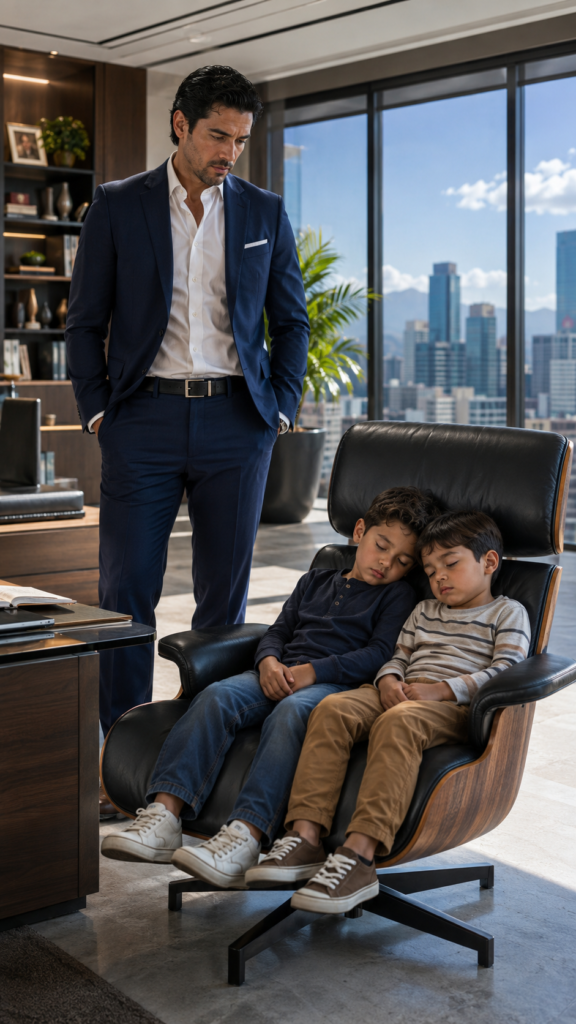
On his executive chair, where no one dared even lean back, two identical children were asleep. They were about four years old, their sneakers dirty, their jackets soaked from the rain, and their hands intertwined as if letting go would be dangerous.
Next to them was an old backpack, a stuffed dinosaur missing an eye, and a folded note on his desk.
Alejandro looked at his assistant, Clara, as if this were a cruel joke.
“Who put these kids here?”
Clara was pale.
“Security says they arrived with an elderly woman. The woman only said they were for you and left before we could stop her.”
Alejandro felt fury rise. He was the owner of Grupo Arista, an empire of hotels, construction companies, and investment funds. His life was made of meetings, contracts, and expensive silences. Not of sleeping children in his chair.
He picked up the note with annoyance.
But as he read the first line, the air left his lungs.
“They are named Emiliano and Mateo. They are your sons. If you are reading this, it’s because I could no longer protect them.”
The paper trembled between his fingers.
The signature at the end was unmistakable: Mariana Robles.
That name hit him like a slap.
Mariana had been the only woman Alejandro ever loved before he became a cold man. They met when he was still a nobody, living in a borrowed apartment in Narvarte, and she worked at a café near the Etiopía Metro.
Then he became rich.
And he left her.
He left her without explanation, convinced that love was a distraction for men who wanted to conquer the world.
Alejandro looked at the children again.
One of them opened his eyes.
“Are you our dad?” he asked in a tiny voice.
Clara covered her mouth.
Alejandro didn’t know how to respond.
Before he could say anything, David, his trusted lawyer, burst in, cell phone glued to his ear, his face a mask of distress.
“Alejandro... we found Mariana.”
“Where is she?”
David swallowed hard.
“At the General Hospital of Mexico. She’s been in a coma for almost three months after an accident on Viaducto.”
Alejandro leaned against the desk to avoid collapsing.
Then David added something worse:
“And there’s one more thing. Your mom knew about the kids for years.”
PART 2
Alejandro felt the office closing in on him.
For years, his mother, Doña Leonor Cárdenas, had been the elegant shadow behind his success. A woman of discreet jewelry, Sunday mass, and cruel phrases disguised as advice.
She always said that Mariana was not “up to her standards.”
That a café girl could not enter a family like the Cárdenas.
Alejandro had wanted to believe that his breakup with Mariana had been his decision. Cold, cowardly, but his.
Now David held a folder that looked like dynamite.
“We found old messages, transfers, and two letters that Mariana sent to your old house in Las Lomas. They never reached you. Someone received them, kept them, and then paid to make sure Mariana stopped looking for you.”
Alejandro could barely breathe.
At that moment, the child who had woken up got off the chair and approached.
“My mommy said that if Grandma Lupita got sick, we had to come to you. She said you might get mad, but you’re not bad.”
Alejandro knelt down.
“What's your name?”
“Emiliano. This is Mateo. But we call him Teo because he gets mad if you say his full name.”
The other child was still asleep, clutching the dinosaur as if it were a lifeline.
Alejandro felt shame. A shame that didn’t resemble losing money, or being featured unfavorably in a magazine, or failing in a business.
It was a deeper shame.
The shame of discovering that two children had survived without him while he pretended to be an invincible man.
They drove to the hospital in a black SUV.
Emiliano and Mateo sat in the back, in child seats Clara had bought in an emergency. Mateo woke up halfway there and asked if they were going to see their mom.
Alejandro glanced in the rearview mirror.
“Yes.”
“Is she going to wake up?” Mateo asked.
Alejandro gripped the steering wheel.
“The doctors are doing everything they can.”
“My mommy sleeps a lot,” Emiliano whispered. “But when we sing to her, sometimes she moves a little finger.”
That phrase shattered him completely.
At the hospital, Mariana looked like a different person.
She wasn’t the girl he remembered dancing barefoot in a small kitchen, laughing because her quesadillas were burning. She was pale, thin, connected to machines, with a scar near her temple.
The children ran to her.
“Mommy, we found you,” said Emiliano.
Mateo placed the dinosaur next to her arm.
“I brought Roco. He wanted to see you too.”
Alejandro stood frozen at the door, unable to move.
His whole life, he had paid for hospitals, donated equipment, appeared in photos cutting ribbons. But he had never stood in front of a bed feeling like all his money was worth nothing.
A doctor explained to him that Mariana had been hit by a delivery truck. That she arrived in critical condition. That she had no immediate family. That a neighbor, Mrs. Lupita, took care of the children for as long as she could until she fell ill.
“And why didn’t anyone call me?” Alejandro asked.
The doctor checked the file.
“You appear as the emergency contact, but the number was outdated. Mrs. Robles left a note in case something happened.”
Alejandro closed his eyes.
Mariana had trusted him even after he abandoned her.
That night, Alejandro didn’t return to his meeting.
He took the twins to his penthouse in Polanco, a place so immaculate it felt like a museum. The children entered hesitantly.
“Can we sit down?” Mateo asked.
The question tore him apart.
“Of course you can.”
In less than an hour, the perfect apartment became a home and chaos.
Wet sneakers by the door. Crumbs on the marble counter. A drawing taped to an expensive wall. Mateo spilled juice on a white rug worth more than a used car. Emiliano asked where “the mom of the dad” slept.
Alejandro didn’t know how to make cereal. He didn’t know how to comb children’s hair. He didn’t know what to do when two little ones cried at the same time.
But for the first time in his life, he didn’t want to run away.
The next day, the DNA results came in.
99.9998%.
There was no doubt.
Emiliano and Mateo were his sons.
Alejandro read the document alone in his study, while outside the city shone as if nothing had changed.
But everything had changed.
Later, he went to Mariana's apartment in Portales.
Mrs. Lupita, weak but lucid, received him with a blanket over her legs.
“She never wanted to ask you for money,” the woman said. “She said she wouldn’t beg a man for love.”
Alejandro looked down.
“She must have hated me.”
“Sometimes she cried. But hate you, no. Mariana said you were taught to be alone, not cruel.”
Lupita handed him a box.
Inside were pictures of the children, daycare receipts, unsent letters, and a chilling piece of evidence: screenshots of messages between Mariana and Doña Leonor.
“My son will not acknowledge bastards.”
“If you come looking for him again, you will lose more than you think.”
“I deposited 50,000. Disappear with dignity.”
Alejandro felt nauseous.
His mother hadn’t just hidden the truth.
She had bought silence.
And Mariana had refused the money. In the box was the proof of return.
That afternoon, Alejandro went to the family mansion in Las Lomas.
Doña Leonor was waiting for him, sipping tea, as if she already knew the storm was coming.
“I heard you made a scene in your office,” she said.
Alejandro placed the box on the table.
“Did you know they were my children?”
The woman didn’t blink.
“I knew that girl wanted to trap you.”
“They are children.”
“They are a mistake that could ruin your future.”
Alejandro let out a bitter laugh.
“No, Mom. The mistake was me for believing you for so many years.”
Doña Leonor stood up.
“All you have exists because I taught you not to let yourself be manipulated.”
“All I have is worth nothing if my children had to sleep in my office for me to know they existed.”
Then she said the phrase that buried her:
“You're still on time. Give them money, put them with a good family, and return to your life.”
Alejandro looked at her as if he didn’t recognize her.
“My life has just begun.”
The next day, the scandal exploded.
A journalist leaked that Mexico’s most powerful CEO had abandoned a multimillion-dollar acquisition for two children who appeared in his office. The Grupo Arista board demanded he return in 15 days or resign.
His partner, Bernardo, confronted him in the middle of a board meeting.
“Hire nannies, nurses, drivers. Solve the issue and come back. You’re not made for diapers, tantrums, and hospitals.”
The old Alejandro would have said yes.
The new Alejandro remembered Mateo asking if he could touch the couch. He remembered Emiliano saying that his mom moved a little finger when they sang to her.
“You're right,” he replied. “I wasn’t made for that. But my children are making me.”
Bernardo slammed the table.
“You’re going to lose power.”
Alejandro took out a sheet.
“Then I lose it.”
He signed his resignation as CEO that same afternoon.
It wasn’t a heroic act. It was barely the first payment of a debt he would never finish repaying.
That night he went to the hospital alone.
He sat next to Mariana and carefully took her hand.
“I don’t know if you can hear me,” he said. “But I need to ask you for forgiveness. Not to look good, not to feel less miserable. Forgive me for leaving you alone when you needed someone the most. Forgive me for every fever, every rent, every sleepless night, every question from the children you had to answer by inventing a less cowardly version of me.”
The machine continued to beep.
“My mother kept you away from me, yes. But I also let myself be kept away. I chose not to look for you. I chose to believe that money was easier than love.”
His voice trembled.
“The kids are with me. They are safe. And I’m not leaving.”
Then Mariana’s finger moved.
Once.
Alejandro froze.
“Mariana?”
The finger moved again.
He called the doctor. Nurses came in. The lights turned on. Mateo and Emiliano were not there, but Alejandro felt their voices filling the room.
Mariana’s eyelids trembled.
And opened.
At first, her gaze was lost. Then she saw him.
Her lips barely moved.
“Did the kids come?”
Alejandro cried without shame.
“They're fine. They’re with me.”
A tear rolled down Mariana’s cheek.
“Did you come?”
He nodded.
“Late. But I came.”
The recovery wasn’t like in the movies.
Mariana didn’t wake up forgiving everyone. She didn’t rush to hug her children. She didn’t smile as if three months in a coma and four years of abandonment hadn’t hurt.
She learned to speak slowly. To walk with a cane. To remember without breaking.
Alejandro learned something harder: not to buy solutions.
When she couldn’t button her blouse, he wanted to bring in the best therapist in Europe.
Mariana stopped him.
“I don’t need you to turn my pain into a project. I need you to ask before you help.”
And he learned to ask.
When Mateo had nightmares, Alejandro wanted to call an expensive specialist.
Mariana told him:
“Or you can sit with him.”
And he sat down.
When Emiliano cried because at school he was asked why his dad didn’t appear in baby photos, Alejandro didn’t invent excuses.
He knelt down and told him:
“Because I was a coward. But I’m learning to be your dad every day.”
The boy hugged him.
“Then keep trying.”
Justice arrived months later.
Doña Leonor was sued for threats, moral damage, and document manipulation. The press stopped calling her “the great lady of philanthropy” and began calling her what she was: a woman who preferred to protect a surname over two grandchildren.
Bernardo tried to take advantage of the chaos, but he also fell when it was discovered he helped hide payments made to a private investigator.
Alejandro sold part of his shares and created a trust for single mothers with small children. He didn’t announce it with spotlights. He did it because Mariana told him that guilt without action was just theater.
A year later, in the same building where the twins had appeared asleep, Alejandro took Mariana.
The chair was no longer in his office. He had reupholstered it and placed it in a playroom for the children.
Mariana touched the backrest.
“I thought you might reject them,” she confessed.
Alejandro lowered his head.
“I also fear who I would have been if I hadn’t seen them sleeping there.”
She looked at him for a long time.
“I didn’t forgive you because I woke up. I’m forgiving you because you stayed.”
He didn’t respond. He just accepted those words as one receives something sacred.
Months later, they married in a small garden in Coyoacán. There were no famous businessmen or society magazines. Just friends, doctors, Mrs. Lupita, two restless children, and a woman who walked slowly but standing.
In his vows, Alejandro said:
“I thought I had an empire. But it was empty. Then two children took my seat and gave me my place.”
Mateo shouted:
“Kiss my mom already!”
Everyone laughed.
Years later, people continued to tell the story of the millionaire who renounced everything for his children.
But Alejandro knew he hadn’t renounced everything.
He lost power, yes.
But he gained burnt breakfasts, taped drawings, tantrums at the supermarket, kindergarten homework, sleepless nights, laughter in the living room, and a word he once didn’t deserve.
Dad.
And perhaps that’s why the story went viral.
Because in Mexico, everyone knows someone who boasts surnames, money, or power.
But not everyone has the courage to admit that sometimes, to find your true place, someone first has to take away your chair.





