PART 1
The girl didn’t ask for money.
She didn’t cry loudly, didn’t make a scene, nor did she stretch out her hand as if she were used to begging.
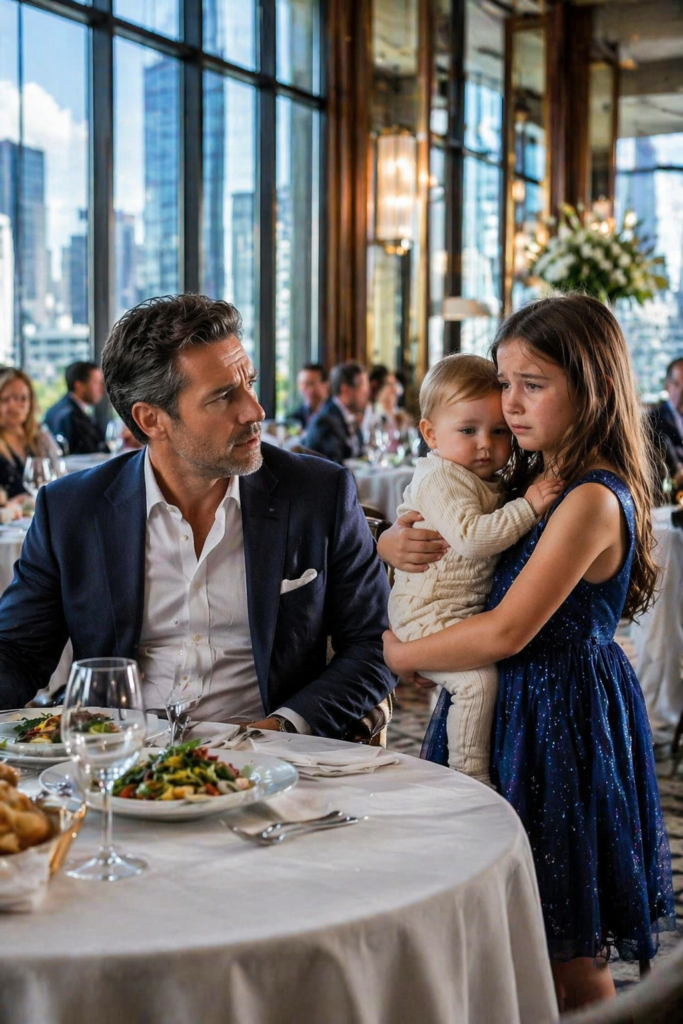
She simply walked into the most expensive restaurant in Polanco with a sleeping baby pressed against her chest and asked in a tiny but firm voice:
—Sir… when you’re finished, could you give us what’s left on your plate?
The whole place fell silent.
The waiters stopped moving.
A woman with a pearl necklace lowered her gaze to her untouched salmon.
And the man sitting by the window, in a dark suit and an expensive watch, raised his eyes as if he’d just been struck from within.
The girl’s name was Camila Ríos.
She was 11 years old, her shoes clean but worn at the tips, her black hair carefully styled, and dark circles under her eyes that didn’t belong to any 11-year-old.
The baby’s name was Mateo.
He wasn’t her blood brother.
But in Camila’s house, blood had long stopped meaning family.
They lived in an old tenement in the Doctores neighborhood, in a room where humidity climbed the walls as if it, too, were hungry. Her grandmother, Doña Mercedes, had been a primary school teacher for 34 years, but now spent her days in bed, her heart weary and her medications counted like gold coins.
The pension arrived every month.
But that week it was short.
Doña Mercedes had her card emptied at an ATM by a “very kind” man who pretended to help her when the machine jammed. By the time her grandmother realized, there was nothing left.
Not for medicine.
Not for milk.
Not for food.
Mateo had arrived four months earlier, in the arms of a neighbor who promised to come back for him in three days.
She never returned.
Camila learned to change diapers, warm bottles with lukewarm water, check for fever, and silence her own stomach when it growled with hunger.
That day she left with Mateo tied to her chest with an old rebozo.
She wasn’t going to beg.
She was going to look for food.
She walked from the Metro to Polanco, gazing at impossible shop windows: shiny pastries, chocolate cakes, perfect fruits, women stepping down from huge trucks as if life had never pushed them against the wall.
When she saw the restaurant, she hesitated.
Inside, there were white tablecloths, shiny glasses, and plates piled high that some barely touched.
Mateo hadn’t cried for hours.
That was what scared her the most.
Camila pushed the door open.
The hostess looked her up and down.
—Girl, you can’t be here.
—I just need one minute —Camila whispered.
—This is a private restaurant.
But Camila had already spotted the man sitting alone.
Alejandro Santillán, 42 years old, owner of one of the most powerful construction companies in Mexico, had come there to not talk to anyone. That morning he had lost a million-dollar contract, his board was pressuring him, and his girlfriend, Renata, had repeatedly told him that image was more important than feelings.
Then that girl appeared.
—Sir… when you’re finished, could you give us what’s left on your plate?
The manager rushed over.
—Excuse me, sir. We’ll have her removed right away.
Alejandro raised a hand.
—No one is going to remove her.
The manager froze.
—But, sir, the restaurant’s policy…
—I’ve heard the policy. Now listen to mine: she and the baby are my guests.
Camila took a step back.
—I didn’t come for you to buy me anything. I just thought that, if you had leftovers…
Alejandro looked at her closely.
The dignity of that girl shamed him.
—Please sit down.
Camila obeyed slowly, like someone who doesn’t trust kindness because she’s learned it almost always comes with a catch.
Alejandro ordered soup, chicken, rice, soft vegetables for the baby, and formula milk.
When the food arrived, Camila didn’t touch her plate.
First, she fed Mateo.
She tested each spoonful on her wrist, wiped his little mouth with a worn handkerchief, and spoke softly:
—Come on, my love, just a little more.
Only when Mateo fell asleep did she eat.
Slowly.
Carefully.
As if she feared someone would snatch the plate away.
Alejandro asked little.
Camila answered even less.
But each sentence was a stone:
Her mom had left.
Her dad never showed up.
Her grandmother was sick.
The milk was gone.
So was the medicine.
The neighbor who left the baby didn’t even open the door anymore.
Alejandro felt something he hadn’t felt in years.
Responsibility.
—Camila, I want to help you.
The girl jerked her face up.
—Why?
At first, Alejandro didn’t know how to respond.
In his world, everything had a price, a contract, a favor, or an advantage.
But that question had no place in his world.
—Because I can —he finally said—. And because you had more courage to ask for food than many adults do to tell the truth.
Camila studied him.
—My grandma says to be careful with strangers.
—She’s right.
—She also says there are still good people.
Alejandro swallowed hard.
—I hope she lets me show her that I am.
An hour later, Alejandro was climbing four flights in a Doctores tenement, his suit soaked with sweat and his heart tighter than ever.
Camila opened the door.
The room was clean.
Poor, yes.
But clean.
Doña Mercedes was sitting on the bed, pale, with hard eyes.
—Camila, who is this man?
—Grandma… he bought us food.
The elderly woman looked at Alejandro with suspicion.
—We don’t accept charity, sir.
Alejandro stayed by the door.
—Your granddaughter didn’t ask for charity. She asked for leftovers. I offered more.
Doña Mercedes tightened the blanket.
—And what do you want in return?
—Nothing.
The grandmother let out a sad laugh.
—Those who say “nothing” usually charge more.
Camila lowered her gaze.
Then Mateo woke up and began to cry.
A weak, dry, desperate cry.
Camila rushed to hold him, but at that moment Doña Mercedes clutched her chest and fell to the side of the bed.
—Grandma!
Alejandro didn’t have time to think.
He rushed to her, took her pulse, and shouted on the phone for an ambulance.
Camila, with Mateo crying in her arms, looked at the millionaire as if her whole life depended on what he did in the next few seconds.
And outside, from the dark hallway, someone pulled out a cellphone and took a photo.
PART 2
The ambulance took 18 minutes.
For Camila, it felt like 18 years.
Alejandro held Doña Mercedes upright, spoke to her with a calm he didn’t feel, and followed the doctor’s instructions on the phone. Camila, sitting on the floor with Mateo pressed against her chest, didn’t cry.
That was what hurt Alejandro the most.
A girl like that didn’t cry because she had already learned that crying didn’t cover the rent, didn’t fill a bottle, didn’t get pills for the heart.
When the paramedics finally arrived, Doña Mercedes could barely breathe.
—Decompensated heart failure —one of them said—. We need to transport her now.
Camila wanted to get in the ambulance with Mateo.
The paramedic shook his head.
—Only one family member.
—She’s my grandmother —Camila insisted.
—And he’s a baby. He can’t go like that.
Alejandro opened the door to his truck.
—They’re coming with me. I’ll catch up with you at the hospital.
Camila hesitated.
—I don’t have money to pay for a private hospital.
—That’s not for you to figure out today.
—But it will be tomorrow.
Alejandro looked at her seriously.
—Not tomorrow either.
At Hospital Ángeles, the doctors received Doña Mercedes immediately. Camila stayed in the waiting room, her clothes smelling of damp and baby, among people who looked at her as if she had made a mistake in the world.
Alejandro made calls.
Paid for tests.
Requested a cardiologist.
Bought diapers, formula, dry clothes, and something warm for Camila.
She only accepted the chocolate when he promised that her grandmother wouldn’t have to pay for it.
At 2 a.m., the doctor came out.
—She’s stable but needs continuous treatment, rest, proper nutrition, and a place without stairs. If she goes back to living like this, it could repeat itself.
Camila closed her eyes.
Alejandro understood the message.
It wasn’t enough to fill a refrigerator.
A life had to change.
Over the following weeks, Alejandro returned every day.
First with groceries.
Then with medicines.
Next with a nurse who checked on Doña Mercedes.
He got a crib for Mateo and a legal daycare.
And when he discovered that Camila was brilliant at math, he spoke with a private school in Coyoacán to offer her a full scholarship.
Camila didn’t want to accept at first.
—The kids are going to mock me.
—Why?
—Because I don’t talk like them. Because I live where I live. Because my backpack doesn’t cost what their sneakers do.
Alejandro knelt before her.
—Camila, you belong anywhere your intelligence takes you. And honestly, your intelligence will take you far.
She almost smiled.
Almost.
Doña Mercedes watched everything in silence.
One afternoon, while Camila was doing homework and Mateo was banging a spoon against the table, the grandmother called Alejandro.
—You’re getting attached.
—Yes.
—That can be dangerous.
—I know.
—Not for you. For them.
Alejandro didn’t respond.
—Rich people sometimes help when they feel guilty —she continued—. Then they get bored, leave, and create a bigger void.
Alejandro lowered his gaze.
—I’m not going to leave.
Doña Mercedes studied him for a long time.
—That is demonstrated by staying when it no longer looks nice.
And that day came soon.
Renata Valdés, Alejandro’s girlfriend and image director of his company, saw the photos before anyone.
Someone from the tenement had sold them to a gossip site: “Mexican Millionaire Supports Poor Girl and Abandoned Baby.”
Renata stormed into his office, furious.
—Do you realize the scandal?
—I see a girl who needed help.
—Don’t be naive. That family is playing you.
Alejandro raised his gaze.
—Watch your words.
—They’re not your blood, Alejandro. The girl isn’t your daughter. The baby isn’t even hers. Are you going to ruin your reputation over people you don’t even know?
—Now I know them.
Renata let out a dry laugh.
—Then the problem is worse.
The next day, several partners received anonymous emails: photos of Alejandro in the tenement, carrying Mateo, entering the hospital, taking Camila to school.
The message was clear: “Licenciado Santillán has lost his judgment. He is being manipulated by a marginalized family.”
The pressure mounted.
A client canceled a meeting.
A board member suggested “taking distance.”
Renata feigned concern.
—Make a statement. Say it was social support. Donate to a foundation and cut ties. No one will blame you.
Alejandro looked at her as if he had just met her.
—You sent those emails.
Renata froze.
—You have no proof.
—Not yet.
But the real blow came three days later.
Camila came out of school crying.
Two girls had shown her the post.
“Beggar Girl Gets Rich Daddy.”
Another said:
—My mom says you carry babies to elicit pity.
Camila didn’t respond.
She just got home, locked herself in the bathroom, and vomited.
That night, Doña Mercedes called Alejandro.
—If your help is going to destroy her, it’s better to stop here.
Alejandro felt something being ripped from him.
—I won’t let them decide who deserves love.
—Love isn’t enough, son. You have to have the backbone to carry what it provokes.
He did.
The next day he summoned his board of directors.
Renata was there, perfect, looking like a victim.
—Our priority must be the stability of the company —she said—. Alejandro needs to distance himself from this personal matter before it affects us further.
Alejandro entered with a folder.
—How curious that you say that.
He laid out screenshots of emails, transfers, and messages.
Renata had paid the gossip site.
She had also contacted the neighbor who left Mateo.
The revelation left the room frozen.
—This woman —Alejandro said— didn’t just leak photos. She also tried to locate Mateo’s biological mother to use against an 11-year-old girl.
Renata paled.
—I just investigated.
—No. You sought to destroy them.
Then Alejandro revealed the second truth.
The neighbor who left Mateo wasn’t just any stranger.
She was Renata’s cousin.
The baby had been abandoned because Mateo’s mother, addicted and without resources, didn’t want the Valdés family to find out. Renata knew from the beginning. She knew that baby existed. She knew he was in a tenement, in the arms of a sick old woman and a poor girl.
And did nothing.
Worse yet: when Alejandro found him, Renata tried to erase the problem so it wouldn’t stain her last name.
—That baby was also your family’s responsibility —Alejandro said—. But you cared more about a headline than his hunger.
Renata lost control.
—I’m not going to shoulder the mistakes of a drug addict!
The phrase fell like a sentence.
The board members heard.
So did the lawyers.
That same day, Renata was removed from the company and reported for harassment, leaking private information, and manipulating minors in digital media.
But social justice didn’t immediately heal Camila’s heart.
For weeks, she spoke little again.
Even though there was food, even though Doña Mercedes was improving, even though Mateo was gaining weight and laughing, Camila kept sleeping lightly, as if she feared waking up and losing everything.
Until one rainy night, the tenement flooded.
The drains burst, water rose through the entrance, and neighbors began to scream.
Doña Mercedes, still weak, couldn’t go down the stairs.
Camila prepared a backpack with medicines, formula, diapers, and documents.
Mateo cried in his rebozo.
The lights went out.
And just when Camila thought no one would come, Alejandro’s voice sounded from the hallway.
—Camila!
She opened the door.
He was soaked, his shoes filled with mud, breathing heavily.
—I came for you.
Doña Mercedes looked at him from the bed.
—I thought a man like you would send someone.
Alejandro carefully lifted her.
—Family isn’t sent for.
Camila broke then.
Not with screams.
Not with drama.
She simply leaned her forehead against Alejandro’s chest and cried like the girl who could finally stop being an adult.
After that night, there was no turning back.
Alejandro rented a single-story house in San Ángel, with a garden, light, space for Doña Mercedes’s nurse, and a room for Camila filled with books.
Doña Mercedes accepted with one condition:
—Don’t buy us dignity. We already have that.
Alejandro smiled.
—I just want you not to have to fight to survive.
Months later, he initiated the legal process to become Mateo’s guardian and legal support for Camila, without taking Doña Mercedes’s place.
One afternoon, in the garden, Alejandro gathered all three.
Mateo stumbled across the grass.
Camila wore her school uniform and a math contest medal.
Doña Mercedes knitted in a chair, pretending not to be excited.
—I want to ask you something —Alejandro said—. If you want, I’d like to be a part of this family legally. Not to command. Not to replace anyone. To stay.
Camila looked at him with eyes full of fear and hope.
—What if one day you get tired?
Alejandro took a deep breath.
—Then you remind me. Because I also need you to teach me not to become the man I was before.
Mateo, not understanding anything, walked over to him and tugged at his tie.
Camila let out a laugh through tears.
—I think Mateo has already decided.
Doña Mercedes wiped her eyes.
—That boy always had good instincts.
Camila approached Alejandro.
—Can I call you Dad?
Alejandro couldn’t answer immediately.
He just knelt and opened his arms.
She rushed into them with the strength of someone who had carried too much alone for too long.
Years later, when people told that story, they always said a millionaire had saved a poor girl.
But Camila knew that wasn’t true.
She had entered a restaurant hungry, afraid, and with a baby in her arms.
She had asked for leftovers.
And at that table, a rich man discovered that he had a life full of things but empty of meaning.
Doña Mercedes said that charity without respect is humiliation.
Camila learned that asking for help wasn’t losing dignity.
Mateo grew up knowing that family doesn’t always start with blood but with someone who chooses to stay when it would be easy to look the other way.
And Alejandro, who once measured his wealth in contracts, buildings, and bank accounts, finally understood that true luxury wasn’t dining in Polanco with white tablecloths.
It was coming home and hearing a little girl scream:
—Dad, come see my homework!
It was watching a baby who once slept in a drawer run through a sunlit garden.
It was hearing a grandmother who once distrusted everyone say to him:
—Come in, dear, dinner is ready.
Because sometimes, the smallest question can lay bare an entire society.
And sometimes, the one who asks for leftovers isn’t asking for pity.
They’re giving someone the chance to be human again.





