PART 1
—If my mom marries him, she’ll be sleeping next to the man who pushed my dad.
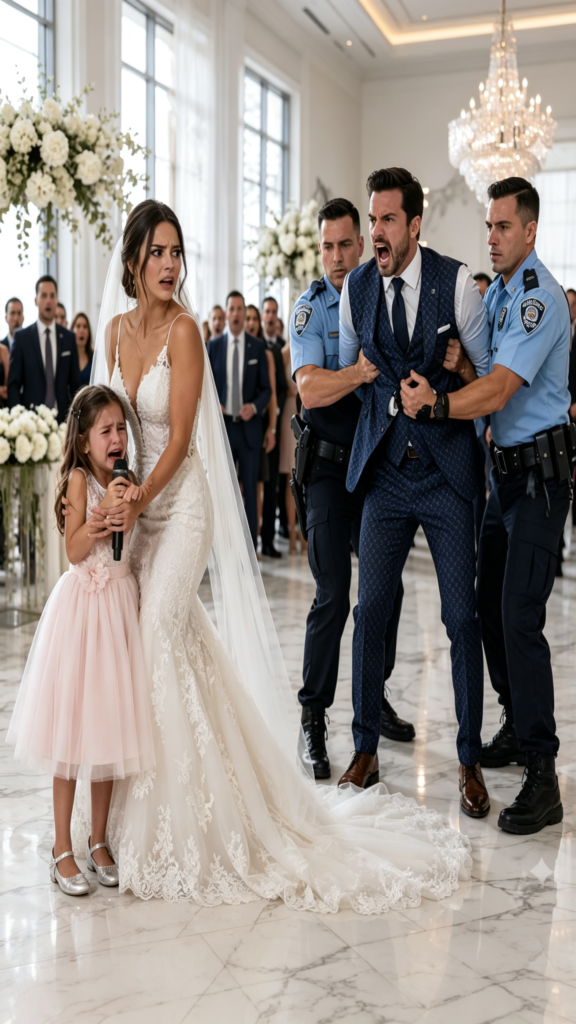
Camila's voice came out soft, trembling, almost lost among the speakers in the hall. But it was enough to split the wedding in two.
She was 5 years old, wearing a peach dress full of tulle, and her eyes were so watery she could barely see her mom among the tables decorated with white flowers.
Lucía, dressed as a bride in front of 60 guests at a hacienda in Tlaquepaque, felt the blood drain from her face.
—What did you say, my love? —she asked, walking toward the stage.
Before the girl could repeat it, Esteban shot up from the main table so quickly he knocked over his wine glass.
—Get down from there, Camila! —he shouted—. Right now!
The mariachi stopped playing. The waiters froze. Lucía's mother crossed herself, not understanding anything.
Until that moment, everyone believed Esteban was the ideal man.
The loyal friend. The compadre who didn’t abandon the widow. The man who, after two years of mourning, had helped Lucía get back on her feet.
Lucía had known him since college, when she was still Rodrigo's girlfriend. The three of them studied in Guadalajara, ate tortas ahogadas after classes, and dreamed of starting a construction company.
Rodrigo was the soul of any place. He laughed loudly, helped everyone, and always said that “life is fixed with hard work and faith.”
Esteban was different. Quiet, serious, attentive to everything. But Rodrigo loved him like a brother.
—This guy is family —he would say, hugging him.
When Lucía and Rodrigo got married, Esteban signed as a witness. When Camila was born, he showed up at the hospital with balloons, diapers, and an enormous teddy bear.
And when Rodrigo died after falling from a scaffold at a construction site in Zapopan, it was Esteban who knocked on Lucía’s apartment door to deliver the news.
That night, Lucía collapsed on the living room floor, clutching a denim jacket that still smelled like Rodrigo.
Camila was only 3 years old and didn’t understand why her mom screamed as if someone had ripped her chest open.
Esteban stayed.
He made calls, paid paperwork, brought food, accompanied her to the funeral, and held Lucía when she couldn't even walk.
Over time, he started showing up everywhere.
If Camila got sick, he drove her to the hospital. If money was tight, he left groceries at the door. If Lucía worked late at her salon downtown, Esteban watched the girl.
So, when two years later he invited her to Mazamitla for a weekend, Lucía accepted. She was tired of being strong. Tired of eating alone. Tired of pretending she didn’t miss a hug.
That night, in front of a fireplace, Esteban confessed he had loved her all along.
—I don’t want to erase Rodrigo —he said—. I just want to take care of what he left.
Lucía cried. She hesitated. She felt guilt.
But one month later, she agreed to marry him.
The move was quick. Too quick. Lucía left her apartment in the Americana neighborhood and moved into Esteban’s spacious apartment.
From day one, Camila changed.
She no longer called him “uncle.” She no longer wanted to be alone with him. She no longer slept with the light off.
—Mom, let’s go back to our little house —she whispered every night.
Lucía thought it was sadness.
Esteban said the same.
—It’s normal, honey. The girl is jealous. She’ll get over it.
But she didn’t.
On the wedding day, Camila walked down the aisle throwing petals without a single smile.
And when everyone toasted to “the new family,” the girl climbed the stage alone, took the microphone with her trembling little hands, and said:
—Mom, I’m sorry… but he told me that if I spoke, he would kill you like he did my dad.
Esteban rushed toward her, eyes filled with rage.
And Lucía understood she was about to discover something she had never imagined.
PART 2
Esteban’s scream made the entire hall shrink.
—Give me that microphone, Camila!
The girl stepped back, tripped over a speaker cable, and nearly fell. Lucía reached her before Esteban could touch her, hugging her against her wedding dress.
—No one gets near her —Lucía said, with a voice she didn’t even recognize.
Esteban raised his hands, trying to smile.
—My love, please. She’s confused. She’s just a girl. She doesn’t know what she’s saying.
—I do know —Camila sobbed—. I heard everything.
The murmurs grew among the guests. Aunt Rebeca covered her mouth. Lucía’s brother, Daniel, stood in front of Esteban.
—Not one more step, bastard.
Esteban clenched his jaw.
—Stay out of this, Daniel.
—I’ll get involved if you threaten my niece.
Lucía knelt in front of Camila, not caring if her dress got dirty.
—My love, look at me. What did you hear?
Camila breathed heavily. Her fingers were buried in her mom’s veil.
—A woman came to the apartment when you went with Aunt Rebeca to pick up the wedding souvenirs.
Lucía froze.
That visit had been four days before.
—What woman?
—A short woman, with short hair and a black jacket. She told Esteban she was tired of waiting. That if he didn’t pay what was owed, she was going to tell the police about the construction site.
Esteban let out a dry laugh.
—Seriously, Lucía, are you going to listen to a 5-year-old?
Camila closed her eyes.
—She said she saw him push my dad.
Silence fell like a slab.
Lucía felt the bouquet slip from her hands. The white roses lay scattered on the floor, next to the ring Esteban had just placed on her finger moments before.
—What did you just say? —she whispered.
Camila cried louder.
—He covered my mouth and said that if I said anything, you would fall too. Like dad.
Lucía lifted her gaze to Esteban.
For the first time in two years, she stopped seeing him as the man who had saved her.
And began to see him as the man who had been too close to everything.
Too close to the news.
Too close to the funeral.
Too close to her pain.
—Tell me it’s a lie —she begged.
Esteban opened his mouth, but nothing came out.
—Tell me my daughter is lying.
He swallowed hard.
—you have no proof.
The phrase was worse than a confession.
Several people turned at once. Daniel stepped toward him.
—Proof of what, Esteban? No one mentioned proof.
Esteban blinked. He realized too late.
—I meant that there’s no proof of that madness.
Rebeca was already calling 911. A cousin started recording. The music had stopped, and only Camila’s sobs were heard.
Lucía slowly removed the ring.
She didn’t throw it. She didn’t scream. She didn’t make a scene.
She simply left it on the main table, next to the toasting glasses, and took out her cell phone.
—Attorney Salas —she said when they answered—. This is Lucía Mendoza. I need you to come to the hacienda. Now. And I also need you to request a warrant to review Esteban Rivas’s payments.
Esteban went pale.
—What are you doing?
—Listening to my daughter.
—Lucía, don’t be ridiculous. All this over a tantrum…
Daniel shoved him against a chair.
—You call her that again, and I’ll break your face.
The police arrived 14 minutes later. By then, the wedding already resembled an impossible scene: the cake intact, flowers trampled, guests crying, and the groom restrained by three family members.
Esteban tried to hug Lucía as they took him away.
—I took care of you when no one could. I was with you. I lifted you off the floor.
Lucía looked at him with tear-filled eyes but didn’t move closer.
—Maybe you lifted me so I wouldn’t look down.
That night, Camila testified in front of a child psychologist from the prosecutor’s office.
She told about the woman. About the threat. About the exact phrase Esteban had whispered to her while he squeezed her arm:
—Your mom is going to be mine. And you’re going to learn to stay quiet.
Lucía vomited in the bathroom when she heard that.
Not out of disgust.
Out of guilt.
For all the nights Camila had asked to go home, and she thought it was nostalgia. For all the times Esteban had said, “I’ll take care of it,” and she rested. For confusing control with care.
That early morning, Lucía slept at Rebeca’s house with Camila clinging to her chest.
The wedding dress was wrinkled over a chair. The makeup ran down her face. Her phone wouldn’t stop ringing.
Esteban was calling from the precinct.
Lucía didn’t answer.
At 8:15 in the morning, Attorney Salas arrived with a folder. He had a tense face.
—Lucía, we reviewed the account statements you authorized me to request for the partnership you still had with Rodrigo.
She looked up.
—What did you find?
—An invoice for $180,000 pesos.
Lucía frowned.
—Invoice for what?
—Supposedly for “security consulting services on-site.” It was issued by a woman named Norma Aguilar.
Camila, who was eating cereal in silence, put the spoon down on the plate.
—The woman in the black jacket was named Norma —she said quietly.
Lucía’s body went cold.
The attorney opened another page.
—The strange thing is that this invoice was paid in three parts from an account linked to Esteban. And the last transfer was five days ago.
—The day before Camila heard her —Rebeca murmured.
Salas nodded.
—Exactly.
The police located Norma Aguilar two days later in Tonalá. At first, she denied everything. Said she had only done administrative work for construction companies.
But when they showed her the $180,000 pesos invoice, the deposits, and the video of Esteban’s building where she was seen entering in a black jacket, she broke down.
She asked for protection.
And she spoke.
Norma had worked as an administrative assistant on the site where Rodrigo died. That afternoon, according to the first report, everyone had left early for a safety inspection.
But she stayed behind to look for some documents.
From an improvised office, she heard shouting from the upper level.
When she went out, she saw Rodrigo arguing with Esteban.
—You can’t come to tell me that —Rodrigo said—. Lucía is my wife. You have to stay away from us.
Esteban was crying with rage.
—I loved her first. You always took everything from me.
Rodrigo tried to calm him down. Told him to leave, to seek help, not to ruin a years-long friendship.
But Esteban grabbed him by the shirt.
There was a tug.
Then a shove.
And then, the void.
Norma saw Rodrigo fall.
She didn’t scream. She didn’t run to help. She hid.
That was her guilt.
Esteban came down minutes later, trembling. He found her in the office. Looked at her as if he wanted to erase her.
—You didn’t see anything —he told her.
Norma stayed silent out of fear. Later, when she knew the case was closed as an accident, she kept quiet. But two years later, seeing Esteban was going to marry Lucía, she decided to ask for money.
—It wasn’t justice —she declared—. It was blackmail. I also did wrong. But that man killed Rodrigo.
Lucía listened to the statement sitting in front of Commander Ramiro Valdés.
At first, she didn’t cry.
She stayed still, hands on her knees, as if her body had decided to shut down to avoid falling apart.
Then she thought of Rodrigo.
Of his laughter filling the kitchen. Of his cement-stained boots by the door. Of the last time he carried Camila and promised to take her to the zoo on Sunday.
She thought of Esteban knocking on her door that night.
Thought of him hugging her while she cried for the man he had murdered himself.
Then she folded over the chair.
The commander offered her water.
—Mrs. Lucía, we know this is very hard.
She shook her head.
—No. It was hard that my daughter had to save me from a monster I let into her home.
In the following months, Lucía’s life became a mix of hearings, therapy, and sleepless nights.
She returned to the apartment in the Americana neighborhood. At first, it hurt to open the door. Rodrigo's mug still sat in the cupboard. His Charros cap was hanging on a nail. There were old drawings from Camila stuck on the refrigerator.
Everything seemed to ask her why she hadn’t seen the signs.
Camila began child therapy. At first, she drew houses without windows and big men without faces. Later, she drew her mom holding her hand. Then, she drew a star above the two of them.
—That’s dad —she explained—. Now he sees us without that man.
Lucía cried silently but didn’t correct her.
One morning, while they were making pancakes, Camila asked:
—Mom, did dad know Esteban was bad?
Lucía turned off the stove.
—No, my love. Your dad trusted him.
—Like you.
The phrase wasn’t an accusation. It was a simple truth spoken by a girl who had understood too early that adults also make mistakes.
Lucía sat beside her.
—Yes. Like me. And I was wrong.
Camila looked down.
—I was wrong too for not telling you before.
Lucía hugged her tightly.
—No, my love. You were a scared little girl. The adult who did harm was him. You were brave.
The trial began six months later.
Lucía arrived dressed in black, hair tied back, and wearing the medal of the Virgin that Rodrigo had given her when Camila was born.
She wasn’t looking for revenge.
She was looking for someone to say out loud what they had called an accident for two years.
Esteban entered handcuffed. He was thinner, with an unkempt beard, but his eyes still held that possessive intensity Lucía used to confuse with love.
Upon seeing her, he tried to smile.
She turned her gaze away.
The prosecution presented the invoice for $180,000 pesos, the deposits to Norma, the building videos, Camila’s protected statement, and the woman’s testimony.
Norma took the stand with trembling hands.
—I saw when Esteban pushed Rodrigo —she said—. I stayed quiet out of fear. Then I asked for money because I’m a coward. But I saw it. He pushed him.
Esteban’s lawyer tried to tear her apart.
—You’re an extortionist. Why should we believe you?
Norma lowered her head.
—Because a girl heard what I saw. And because I can’t sleep with that dead man on my conscience.
Then they played Camila’s statement.
Lucía couldn’t stay in the courtroom. The judge allowed her to leave to the hallway while her daughter’s voice told how Esteban had threatened her.
Rebeca held her hand.
—I can’t —Lucía whispered.
—Yes, you can. You’ve been doing it since you believed her.
When Esteban testified, he denied everything.
—I loved Lucía —he said—. Rodrigo didn’t deserve her. But I didn’t kill him. We argued, yes. He lost his balance.
The prosecutor walked slowly in front of him.
—If it was an accident, why did you pay $180,000 pesos to Norma Aguilar?
Esteban gritted his teeth.
—Because she was extorting me.
—With a lie?
—Yes.
—And why did she threaten Camila?
—I never threatened that girl.
Lucía, sitting in the front row, looked up.
Esteban saw her. For one second, the mask fell off.
—I was going to make you happy —he said, his voice breaking—. I loved you before he did. I was there when he couldn’t anymore.
Lucía stood.
—Don’t say his name as if you had the right to.
The judge called for order, but no one breathed.
—You didn’t love me —she continued—. You hunted me down. You waited until I was broken. You came in with flowers, favors, and hot food. You used my pain and my daughter’s fear to wedge yourself into our lives.
Esteban glared at her with hatred.
—If Rodrigo hadn’t gotten in the way…
—Rodrigo was my husband —Lucía interrupted—. And you were his friend.
That phrase weighed more than any shout.
The process lasted five days. In the end, Esteban was convicted of homicide and threats against a minor. The sentence was 30 years in prison.
Lucía didn’t feel joy.
She felt silence.
A strange silence, as if after living under a huge lie, she could finally breathe without asking for permission.
Upon leaving the courthouse, the sun in Guadalajara was strong. There were flower vendors, taxis honking, and children coming out of school as if the world hadn’t just shattered and pieced itself back together at the same time.
Rebeca hugged her.
—It’s over.
Lucía looked up at the sky.
—No. Now begins what Rodrigo would have wanted for us.
That afternoon, she went for Camila. The girl ran into her arms, and Lucía carried her even though she weighed more than before.
—Did dad win? —Camila asked.
Lucía smiled through tears.
—Yes, my love. Today your dad won. And you won too.
That night, they lit a candle next to Rodrigo’s photo. Camila placed a drawing beneath it: three figures holding hands and a big star above.
—It’s us —she said—. Only dad is higher.
Lucía kissed her forehead.
—He will always be.
Over time, they stopped living in fear. Lucía went back to work. Camila started laughing again. Rebeca continued to show up on Sundays with sweet bread, gossip, and advice no one asked for but everyone needed.
The wound didn’t disappear.
Because some betrayals can’t be erased. They’re learned to carry.
Lucía understood that sometimes danger doesn’t come with blows or threats at first. Sometimes it comes with groceries, timely hugs, favors, flowers, and promises of protection.
Sometimes the person who seems to save you is just waiting for you to be so broken that you no longer ask anything.
But she also learned something more powerful.
No lie is eternal when someone dares to speak.
And that time, the truth wasn’t dressed in a lawyer’s suit or had an adult’s voice.
It had the trembling voice of a 5-year-old girl in front of a microphone.





