PART 1
Clara married Daniel Rivera believing she was entering a sad house, not one rotting from a lie.
Daniel didn’t seem like a monster.
On the contrary, he spoke softly, cried when he mentioned his daughters, and always said that life had taken too much from him.
He was 38, had a spacious house in Coyoacán, and two girls who seemed to carry more silence than they should.
Lucía, 6, was serious, observant, the kind of girl who watches before she trusts.
Renata, 4, clung to Clara’s arm as if she had found a warm place to rest.
Daniel told her from the beginning that his wife, Mariana, had died three years earlier in a car accident on the way to Cuernavaca.
He said he didn’t like to talk about it.
He said it was quick.
He said that since then he had learned to make lunch boxes, braid crooked braids, and sleep with a girl on each side when the nightmares came.
Clara didn’t ask any more questions.
She thought that respecting someone’s pain was also a form of love.
For a year, Clara gradually entered the lives of those girls.
She made them soup when they had fevers.
She bought them little bows at the market.
She taught them to say “excuse me” without fear and to laugh when something went wrong.
She never wanted to replace Mariana.
That was crystal clear to her.
But without realizing it, she became that presence that checked sweaters, wiped away tears, and knew when a hug was urgent.
When Daniel proposed, there was no mariachi band or fancy restaurant.
Just a simple dinner, the girls in pajamas, and him saying that the four of them deserved a second chance.
Clara believed him.
The wedding was small, at a hacienda in Tepoztlán.
White flowers, family food, soft music.
Daniel cried during their vows.
Clara thought he cried for the woman he had lost.
Now she would understand that some tears clean nothing.
They only serve to cover the rot.
She moved in two days later.
The house seemed normal: drawings stuck to the fridge, toys in the living room, the smell of detergent, well-tended plants, and large windows letting in plenty of light.
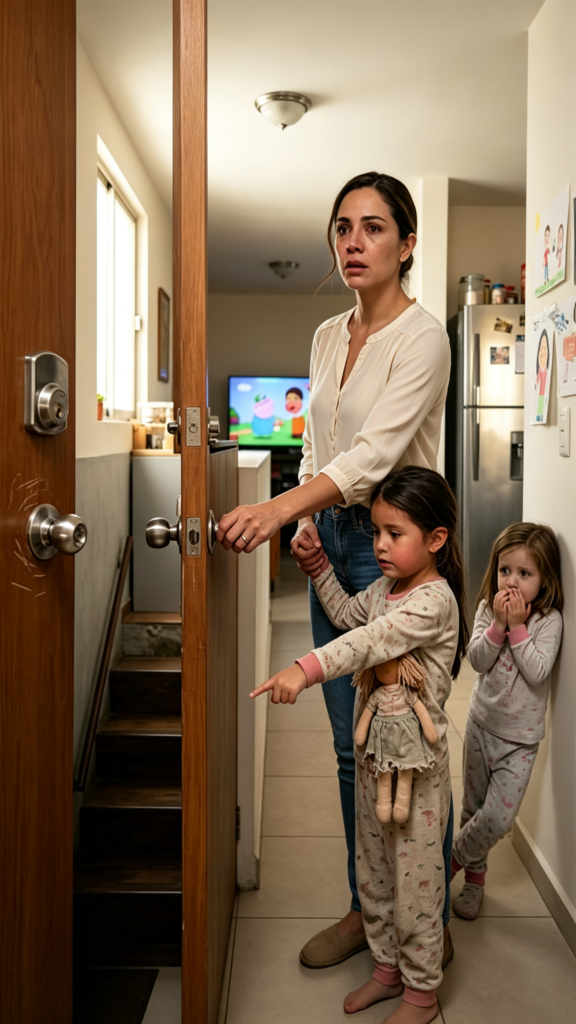
But at the end of the hallway was a different door.
It was dark wood.
It had a new, shiny lock, far too used for a forgotten storage room.
Daniel said it was the basement.
Tools, boxes, old furniture.
“I lock it for safety, love. The girls could fall,” he explained with a calmness that felt too perfect.
Clara wanted to believe him.
Because she had just married.
Because distrusting a widower seemed cruel.
Because Lucía and Renata needed peace, not a stepmother looking for ghosts where she shouldn’t.
But the house began to speak in other ways.
Sometimes Daniel would come down with a black bag and return without it.
Sometimes he would say he needed to check the heater and would shut the door from the inside.
Sometimes Lucía would stare at that door as if she were waiting for it to breathe.
And Renata, as soon as she heard her dad’s keys, would stop playing.
Kids don’t always say, “I’m scared.”
Sometimes they just learn to stay still.
On the Tuesday that everything changed, Daniel left early.
The girls were sick, with coughs and slight fevers.
Clara wrapped them in blankets in the living room, made chamomile tea, and put on cartoons.
Renata hid under the table.
Lucía appeared clutching her doll to her chest.
Her cheeks were flushed from the fever, but her gaze was too alert.
She took Clara’s hand and whispered:
“Do you want to meet my mom?”
Clara felt something freeze inside her.
She crouched down slowly.
“My girl, your mom is in heaven. Your dad told me about the accident.”
Lucía frowned, not like a sad child, but like someone correcting a wrong adult.
“No. My mom lives below.”
Renata stopped moving under the table.
The silence of the two was louder than a scream.
Lucía led Clara to the basement door.
She pointed at the lock.
“Dad says we shouldn’t open it. But mom cries when we take too long.”
Clara looked at the marks on the wood.
Small scratches.
Handprints at the height of the girls.
The hallway smelled of dampness, confinement, and something sour, human, impossible to confuse.
Daniel always carried the key.
Clara went to the bathroom, took a hairpin out of her hair, and came back.
She didn’t know how to open locks.
She wasn’t brave.
She just understood that a girl wasn’t making up a game.
She was asking for help.
Her hands trembled.
The hairpin scraped against the metal.
Renata began to cry silently.
Lucía didn’t let go of the doll.
When the latch gave way, the click sounded soft, but for Clara, it shattered her life in two.
She pushed the door.
The smell came out first.
Then she saw the steps.
Dust disturbed.
Large footprints.
Small footprints.
A metal tray with a blue cup and a piece of dry bread.
Clara stepped down one stair.
Then another.
At the back, behind an old curtain, she heard breathing.
Lucía whispered:
“Mommy.”
The curtain moved.
And a woman appeared in the shadows.
She was alive.
PART 2
The woman didn’t look like a ghost.
She looked like someone who had been forced to become one.
Her hair was long, tangled, her skin pale from lack of sun, and her eyes sunken as if she had been waiting for the door to truly open for years.
A gray blanket covered her shoulders.
Her hands trembled.
She first looked at Lucía.
Then at Renata.
And finally at Clara, as if she couldn’t understand what a stranger was doing there.
“Is Daniel in the house?” she asked, her voice broken.
Clara shook her head.
The woman closed her eyes.
It wasn’t relief.
It was terror with a little air.
Lucía took two steps down.
“Mommy…”
The woman raised her hand but didn’t move forward.
As if even hugging her daughters required permission.
That was what finally broke Clara’s heart.
There were no tools.
No old furniture.
No important boxes.
Daniel had locked Mariana, the mother of his daughters, in the basement of her own home.
Clara rushed upstairs with the girls.
Not because she wanted to separate them from Mariana.
But because she understood that Daniel could return at any moment.
She left the door open.
She took Lucía and Renata to the living room.
Renata trembled beneath the blanket.
Lucía kept staring at the hallway.
“Is Mommy being punished?” she asked.
Clara swallowed.
“No one should live locked away, my love. No one.”
She took her cell phone and called 911.
She spoke slowly, even though she was falling apart inside.
She gave the address.
She said there was a woman locked in the basement.
She said there were two minor girls.
She said the husband could come back.
The operator asked her not to confront Daniel and to keep the line open.
But life doesn’t always wait for the police.
Daniel arrived 8 minutes later.
He walked in with his keys, like any other afternoon.
He had his sleeves rolled up and a pharmacy bag in hand.
At first, he smiled.
Then he saw the open door.
His face changed without making a sound.
That was the most terrifying part.
He didn’t scream.
He didn’t ask about the girls.
He just looked at Clara with a coldness she had never seen before.
“What did you do?” he said.
Clara stepped in front of Lucía and Renata.
“Don’t come near.”
Daniel let out a dry laugh.
“Clara, you don’t understand anything.”
“I understand enough.”
He walked towards the hallway.
Renata hid behind the couch.
Lucía, at just 6 years old, stood in front of her little sister.
That gesture hurt more than any words.
A girl trying to protect another from their own father.
Daniel began to speak quickly.
He said Mariana had been messed up after the accident.
That she became aggressive.
That she screamed.
That she confused the girls.
That he just wanted to protect them.
“It was for them,” he repeated.
But at that moment, Mariana appeared at the top of the stairs.
She leaned against the wall.
She was breathing heavily.
And yet she spoke.
“There was no accident, Daniel.”
Silence fell over the house like a bucket of ice water.
Clara looked at him.
Daniel went pale.
Mariana stepped down another stair.
“You locked me up because I found out about the accounts. Because I was going to report that you were using my father’s money to pay your debts.”
Daniel clenched his jaw.
“Shut up.”
But it was too late.
Mariana kept talking, her voice weak but firm.
She recounted how three years ago there was no fatal accident.
There was an argument.
She discovered that Daniel had forged her signature to sell an inherited lot in Querétaro.
When she tried to take the girls and report him, he hit her, sedated her with pills, and told everyone she had died in a crash.
He sent false ashes to Mariana’s family.
He told the girls that mommy was in heaven.
But sometimes, when he got distracted or drank too much, he forced them to bring him food and water.
He told them their mom was sick.
That if they spoke, they would send her to a hospital “where they would never see her again.”
That’s why Lucía kept silent.
That’s why Renata cried without sound.
That’s why the house seemed clean, but smelled of fear.
Daniel advanced toward Mariana.
Clara raised the phone.
“The call is still open.”
He stopped.
Outside, sirens sounded.
That’s when Daniel began to cry.
Not when he saw his destroyed wife.
Not when his daughters trembled.
Not when Mariana told the truth.
He cried when he understood he could no longer hide.
The police entered first.
Then the paramedics.
Daniel tried to explain.
He said it was a family crisis.
He said Mariana was confused.
He said Clara was a jealous, new woman trying to take the house.
But Mariana raised a hand and pointed to a metal box behind the curtain.
There lay the twist that Daniel had never imagined.
For years, Mariana had hidden evidence in the same basement where he locked her up.
Receipts.
Photocopies.
A notebook with dates.
Names of notaries.
Account numbers.
And a USB drive that Daniel thought was lost.
Mariana had managed to hide it before he left her locked away.
On that USB were the recordings of Daniel speaking with a corrupt lawyer about the false ashes, the forged signature, and the accident story.
There was also a video of the last argument, recorded by the security camera in the living room.
Daniel was not a widower.
He was a man who had fabricated a death to steal, control, and erase a woman.
When the paramedics took Mariana out, Lucía ran to her.
This time, no one stopped her.
Mariana hugged her with a sad strength, as if she wanted to recover three years in three seconds.
Renata took longer.
She stayed glued to Clara, confused, scared.
Then Mariana, from the stretcher, didn’t ask about Daniel.
Didn’t ask about the house.
Didn’t ask what day it was.
She just looked at her youngest daughter and said:
“Have you eaten, my love?”
Clara broke.
Because there was the real mother.
Not dead.
Not crazy.
Not dangerous.
Just buried alive under a lie.
Daniel was arrested that afternoon.
The house filled with forensic experts, photographs, evidence bags, and neighbors peering in from the sidewalk.
The news spread quickly through the group of people.
Some couldn’t believe it.
Others said the usual phrase: “He seemed like such a good dad.”
As if monsters had an obligation to look like monsters.
In the following days, the truth came out fully.
Mariana’s family, living in Puebla, believed she had died for three years.
They had mourned a false urn.
Had prayed for a grave that held no body.
Mariana’s mother arrived at the hospital holding an old photo and fainted upon seeing her alive.
Daniel had isolated everyone.
Changed numbers.
Invented fights.
Said Mariana didn’t want contact before she died.
Each lie was another wall around the basement.
Clara requested an annulment before even completing a week of marriage.
She didn’t ask for money.
Didn’t ask for furniture.
Just declared everything she saw and handed over her phone with the complete 911 call.
Lucía and Renata remained under temporary protection while Mariana recovered.
Clara continued visiting them, but no longer as Daniel’s wife.
She went as the woman Lucía took by the hand when no one else was listening.
One afternoon, in the hospital, Lucía asked her if she had done wrong by opening the door.
Clara knelt in front of her.
She tucked a strand of hair behind her ear.
“No, my girl. You opened the truth.”
Lucía looked down.
“Dad said if we talked, everyone would hate mommy.”
Mariana, from the bed, cried silently.
Clara squeezed the little girl’s hand.
“Sometimes, bad adults make children carry burdens that aren’t theirs. But you did nothing wrong. On the contrary.”
The case went viral when a local journalist published the story without showing the girls’ faces.
People debated online.
Some asked how no one noticed anything.
Others blamed Clara for not suspecting sooner.
But the majority wrote the same:
“A 6-year-old girl showed more courage than all the adults.”
Months later, Mariana was able to leave the hospital.
She walked slowly, still thin, but with her face looking ahead.
She legally regained the house, as it had been bought with her family’s money.
The basement was sealed during the investigation.
Later, Mariana asked for it to be converted into a playroom full of light.
Many criticized her.
Said how she could let her daughters play in that place.
She responded with something no one could forget:
“Because my daughters will not inherit my prison. They will see how it transforms.”
Daniel lost custody and faced charges for illegal confinement, forgery, fraud, and domestic violence.
The corrupt lawyer fell as well.
The notary who helped move the papers ended up being investigated.
The lie didn’t just destroy Daniel.
It dragged everyone who benefited from it down with it.
Clara left that house with a small suitcase and the ring in an evidence bag.
She never believed in a man just because he cried beautifully again.
But she also didn’t regret entering that family.
Because if she hadn’t been there that Tuesday, maybe Lucía would have continued waiting for the right moment to tell a truth too big for a child.
Years later, when someone asked Clara what had been the scariest, she wouldn’t say “seeing Mariana in the basement.”
She wouldn’t say “looking at Daniel’s face.”
She would say that the worst was hearing Lucía say it calmly.
“My mom lives below.”
As if it were normal.
As if horror could also become routine when adults force children to survive silently.
That’s why this story hurts so much.
Because it didn’t start with screams.
It started with a pretty house, a model dad, two obedient girls, and a closed door at the end of the hall.
And sometimes, in Mexico and anywhere, the most dangerous doors aren’t the ones that make noise.
They are the ones everyone sees closed… and no one dares to ask why.





