PART 1
—The trash isn’t always outside, Doña Victoria. Sometimes it arrives in trucks, dressed for Sunday.
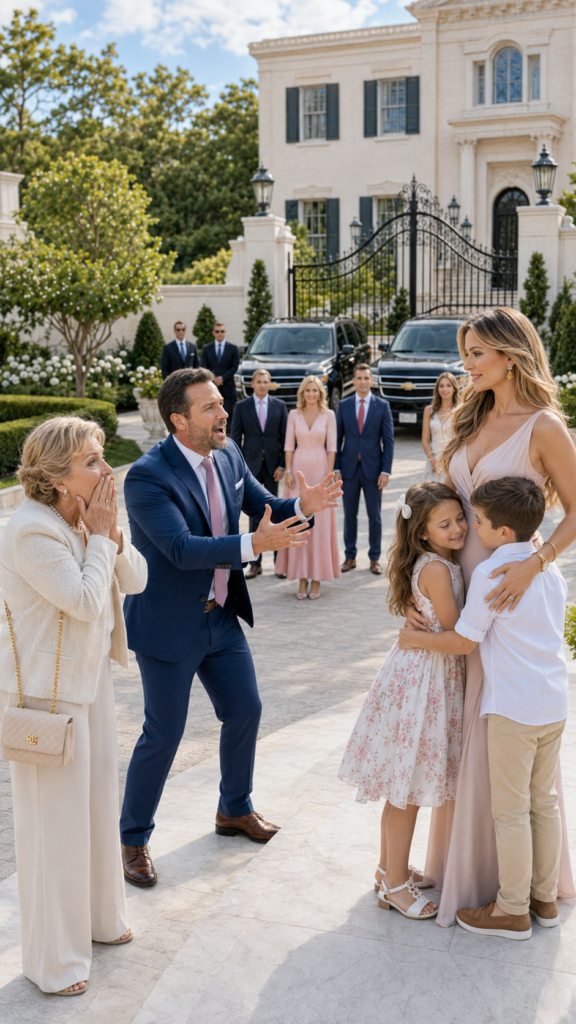
The Mendoza family stood in stunned silence before the black gate of a private residence in the hills of Tapalpa, Jalisco. Elena Varela was on the other side, serene, impeccable, in an emerald green dress that seemed made for a woman who owed no one explanations anymore.
But three weeks earlier, no one would have imagined this scene.
Outside the family court in Guadalajara, Elena had emerged with a small suitcase, dark sunglasses, and her divorce decree folded neatly in a beige folder. She didn’t cry. She didn’t shout. She walked away like someone who had just escaped a house on fire.
Alejandro Mendoza, her ex-husband, caught up to her on the pavement, wearing that smile of a man who believes he still holds the reins.
—Don’t act tough, Elena —he said, adjusting his expensive watch—. Without me, you won’t last two months.
Doña Victoria, her mother, stood behind him, surrounded by Paola, her sisters-in-law, and several cousins who had come to court as if it were a spectacle.
—Oh, sweetheart —the woman let slip with a venomous sweetness—. A woman like you can’t survive on her own. My son gave you a last name, a house, trips, a table. You came with a little suitcase, and that’s how you’re leaving.
Paola lifted her phone, waiting to capture the moment when Elena would break down.
For five years, Elena had endured worse phrases.
At every family meal, they reminded her she came “from the bottom.” At Christmas, they seated her far from the important guests. Doña Victoria rummaged through her bags when she left the house, claiming it was “for safety.” Alejandro joked, laughing, that he had married her because “she had a good heart, even if she was clueless.”
And Elena endured it all.
She endured because she believed love could educate arrogance.
But that day, she understood it couldn’t.
—You are right about one thing —Elena said, not removing her sunglasses—. A month is enough to know who falls first.
Alejandro burst out laughing.
—What, now you’re threatening?
—No. I’m inviting you.
Doña Victoria raised an eyebrow.
—Inviting us to what, child? To your rental room?
—to dinner. Easter Sunday. I want you to see how I live after your son.
The cousins laughed. Paola almost dropped her phone in excitement.
—No way, we’re going —she said—. This is going to be epic.
Doña Victoria smiled as if already imagining someone else’s failure.
—Of course we’ll go. The whole family. So you can lose that arrogance.
Elena didn’t respond.
She simply walked toward a black sedan parked half a block away. An older man in a dark suit immediately got out and opened the door for her with respect.
—Miss Elena —Julián said—. To the residence?
Elena took a deep breath.
—Yes. The experiment is over.
The car drove down Avenida Vallarta, while she stared at the city without blinking. For years, she had hidden her true world: her last name, her fortune, her place on the board of Varela Capital, a firm that financed real estate developments, logistics, and private funds throughout Mexico.
She wanted to know if Alejandro would love her without knowing anything.
The answer cost her five years.
On Easter Sunday, 32 Mendozas headed to the address Elena had sent in an ivory envelope with a golden seal. They were perfumed, elegant, mocking. Doña Victoria wore pearls. Paola was ready to record. Alejandro drove in silence, pretending to be confident.
—She probably rented some house —Paola said—. Poor thing, she really thinks she’ll impress us.
But when the GPS took them down a private road, among pines, stone walls, and security cameras, the laughter began to fade.
A guard approached the first vehicle.
—Good afternoon. Welcome to the Varela residence. Mendoza family?
Doña Victoria tensed up.
—Whose residence?
The guard looked at his list.
—Of Mrs. Elena Varela.
Alejandro rolled down the window, pale.
—Mrs. Elena what?
At that moment, the gate began to open slowly.
And what they saw in the background took their breath away.
PART 2
The trucks rolled down a stone driveway, surrounded by bougainvillea, jacarandas, and fountains illuminated by the sunset. At the end of the road stood a huge, modern residence, with floor-to-ceiling windows, fine wood, light stone, and terraces overlooking the forest.
Paola stopped recording.
—This can’t be Elena’s —she murmured.
Doña Victoria tightened her bag.
—It must belong to some friend. Or rented to humiliate us. That woman lacks the class to live here.
Alejandro said nothing. He gazed at the gardens, the uniformed staff, the sculptures, the cars parked near the entrance. Every detail struck his pride like a slow slap.
Upon getting out, Julián welcomed them with impeccable calm.
—Mendoza family, 32 guests. Mrs. Varela is waiting for you in the central patio.
—Mendoza —Doña Victoria corrected—. She was Mendoza until three weeks ago.
Julián looked directly at her.
—Here, she has never stopped being Varela, ma’am.
The words landed heavily.
They walked to the patio. There was a long table with white tablecloths, fine china, fresh flowers, artisanal bread, romeritos, cod, lamb, salads, and desserts. Everything was prepared with an elegance that didn’t need to show off.
But no one looked at the food.
Everyone looked at Elena.
She stood at the center of the patio, calm, with her hair down and a black folder in her hands. Beside her stood two lawyers, a notary, a bank representative, and Julián, firm as a loyal shadow.
Alejandro tried to smile.
—Elena, what is this show?
She looked at him as one observes someone who no longer hurts the same way.
—The show was my marriage, Alejandro. This is my home.
Doña Victoria let out a dry laugh.
—Don’t insult our intelligence. You came into my family with nothing.
—I came without showing anything —Elena replied—. That’s different.
Paola swallowed hard.
—Who are you?
The notary stepped forward.
—Mrs. Elena Varela Salvatierra is the majority shareholder of Grupo Varela and president of the asset committee for Varela Capital.
An icy silence swept over the table.
Alejandro blinked.
—No. That’s impossible.
—It was impossible to live with me for five years and never ask who I really was —Elena said—. You only asked how much I could obey.
Doña Victoria raised her voice.
—If that were true, you would have told us.
—Why? —Elena asked—. So you could respect me for money and not for dignity?
No one answered.
The bank representative opened a thick folder.
—Mr. Alejandro Mendoza, Mrs. Victoria Mendoza: you are hereby notified that the credit lines for Constructora Mendoza are frozen as of today due to financial inconsistencies, misuse of collateral, and formal withdrawal of support from Varela Capital.
Alejandro stepped back.
—Varela Capital was backing us?
Elena held his gaze.
—For four years. Without my signature, your projects in Zapopan, Chapala, and Puerto Vallarta wouldn’t have gone beyond blueprints.
Doña Victoria paled.
—You can’t do this. That company belongs to my family.
—No —Elena said—. Your company only learned to walk using other people's crutches.
Alejandro gritted his teeth.
—Elena, this is vengeance.
—No. Revenge would have been letting you fall without warning. This is an audit.
The word made several cousins lower their gazes.
Then Julián turned on a screen at the back of the patio.
Elena breathed slowly.
—Before anyone touches that table, you will see why this dinner was never a reconciliation.
The first image appeared.
It was Doña Victoria entering Elena’s old bedroom with a duplicate key. She opened drawers, searched documents, pulled out a blue box, and stuffed it into her bag.
Paola covered her mouth.
—Mom...
—It was my house —Doña Victoria said, trembling—. I could go wherever I wanted.
—It wasn’t your house —Elena replied—. It was a property paid for with resources from an account you never knew where it came from.
Alejandro edged closer.
—Enough, Elena. Don’t do this in front of everyone.
She looked at him sadly.
—In front of everyone? Like when you said you had pulled me out of poverty in front of your partners. Like when your mother called me a freeloader on Christmas Eve. Like when Paola recorded my crying after losing a pregnancy and sent it to the family chat saying: “the dramatic one again.”
Paola began to cry.
No one was laughing anymore.
The screen changed. An audio clip with subtitles appeared. It was Alejandro’s voice.
—As long as Elena keeps believing we need her for love, let her sign whatever.
Then Doña Victoria was heard:
—Make her feel guilty. Women like that bend when you tell them they will destroy a family.
A murmur erupted among the Mendozas.
Alejandro lost color.
—That’s edited.
One of the lawyers raised another folder.
—No. It’s backed by emails, altered contracts, bank requests, and three forged signatures.
Elena opened the black folder.
—This is the power you tried to register using my signature. This is the contract where you put my name as collateral without authorization. And this is the transfer with which you sold my grandmother’s necklace to cover Alejandro’s gambling debt.
Alejandro hung his head.
Doña Victoria looked at him, surprised for a second, but then she attacked again.
—You also enjoyed our life. Don’t come here pretending to be a saint.
Elena didn’t raise her voice.
—I enjoyed a lie believing I was family. That was the saddest part.
The notary intervened.
—Starting tomorrow, properties linked to irregular guarantees will undergo review. The accounts of Constructora Mendoza will be subject to investigation. Any attempt to move assets will be reported.
A cousin, who had been quiet until then, said:
—Alejandro, did you get us into this?
Alejandro did not respond.
The elegant table had turned into a courtroom.
Doña Victoria swayed, but she still had poison left.
—All this because my son no longer wanted you. You’re just bitter, girl.
Elena smiled faintly.
—No, Doña Victoria. I’m free. It’s different.
Alejandro approached with wet eyes.
—Elena, please. We can talk. I loved you.
She looked at him long.
—You loved me when I served coffee silently. You loved me when I signed without asking. You loved me when I looked down so your mother could feel like a queen. But when I needed you to defend me, you shrank.
He tried to take her hand.
Julián stepped in.
Alejandro lowered his voice.
—We’re family.
Elena shook her head slowly.
—Family was the word you used to train me to endure humiliation.
Paola stepped forward, crying.
—Elena, I didn’t know about the signatures.
—but you knew enough to mock —she replied—. And sometimes cruelty doesn’t need to know everything to cause harm.
Paola couldn’t respond.
Julián signaled. Four guards appeared discreetly near the hallway.
Doña Victoria looked around, indignant.
—Are you going to throw us out? After inviting us?
—I invited you to see the truth —Elena said—. Not to stay for dinner.
—That food is for us!
—No. That food is for people who know how to be grateful.
The silence hurt more than a scream.
Elena looked at the 32 Mendoza family members. Some were embarrassed. Others furious. Others calculating how much they would lose. None dared to defend her, not even now.
—You came hoping to see me broken, poor, and begging —Elena said—. You came to laugh at a woman you thought was trash. But the trash wasn’t the one who left the courthouse with a suitcase.
Doña Victoria pressed her lips together.
—You have no right to destroy us.
Elena stepped two steps closer.
—I didn’t destroy anything. I just stopped holding it up.
The phrase took the air out of the room.
Alejandro looked at the mansion, the lawyers, the dark screen, the untouched table. For the first time, he understood that the woman he had treated like an ornament was the only reason his last name continued to shine.
—Did you ever really love me? —he asked, broken.
Elena swallowed hard.
—Yes. That’s why I gave you the chance to love me without knowing how much I was worth. And you failed.
Julián opened the way to the gate.
One by one, the Mendozas walked back to their trucks. They no longer seemed a powerful family. They looked like guests expelled from a party they never deserved.
Doña Victoria was the last to leave.
Before climbing into her truck, she turned to Elena with hatred and shame.
—This isn’t over.
Elena looked at her without fear.
—You’re right. Tomorrow, the legal battle begins.
That night, the Mendozas returned to Guadalajara without tasting a single dish. On the way, the phone calls began: a bank summoned Alejandro, a partner canceled a contract, a supplier demanded payment, and a notary requested an urgent review of two properties.
In the family chat, where they used to share memes about Elena, no one wrote a thing.
Meanwhile, at the Varela residence, Elena ordered that the entire dinner be sent to a community kitchen in Tonalá. Entire families dined on romeritos, sweet bread, and lamb without knowing that meal had been prepared for people who never learned to value even a glass of water.
Later, Elena stepped out onto the terrace with a cup of coffee. Julián approached silently.
—Are you okay, miss?
She gazed at the distant lights.
—Not yet. But for the first time, I’m not afraid to be alone.
Julián nodded.
—Your father would be proud.
Elena closed her eyes. For five years, she wanted to prove she could be loved without a last name, without fortune, and without power. What she discovered was even harder: some people only respect what they can lose.
The next morning, Guadalajara began to murmur.
The Mendozas didn’t fall because Elena revealed her wealth. They fell because they confused patience with weakness, silence with ignorance, and love with permission to humiliate.
And Elena, for the first time in a long while, had breakfast alone in front of the forest, without feeling small.
Because sometimes justice doesn’t shout.
Sometimes it simply opens a gate, lets the arrogant pass… and then forces them to leave empty-handed.