PART 1
The day the DNA confirmed that Emiliano wasn’t Mariana’s son, she didn’t scream.
She didn’t tear apart the family album.
She didn’t call her husband in tears.
She opened her laptop, brewed a black coffee, and created an Excel sheet with a coldness she didn’t even recognize in herself.
Mariana Robles had been the perfect wife to Rodrigo Alcázar for seven years: quiet, proper, always ready to smile even when she was crumbling inside.
At family meals in a huge house in Lomas de Chapultepec, her mother-in-law, Doña Ofelia, would often say in front of everyone:
—Mariana may not be brilliant, but she knows how to obey. And that, in a wife, is worth gold.
The cousins laughed.
Rodrigo looked down.
Mariana smiled too.
Because for years she mistook endurance for love. She confused silence with peace. She mistook humiliation for “keeping the family together.”
Until a peanut butter almost killed Emiliano.
It all began on a Friday at the American School where the boy studied. They organized an event for Family Day, and a mother brought homemade cookies with peanut butter.
Emiliano ate only half.
Minutes later, his lips swelled, his face turned red, and he started breathing as if an invisible hand were choking him.
The teacher called an ambulance.
When Mariana received the call, she was at a supermarket in the Escandon neighborhood comparing milk prices. She ran out so fast she left her cart abandoned in the aisle.
She arrived at Hospital Angeles with one shoe on wrong and her heart in tatters.
Emiliano was in the emergency room.
She pressed against the glass, praying without words, until the doctor emerged.
—He’s out of danger —he said—. It was a severe allergic reaction to peanuts. From now on, he’ll need auto-injectable adrenaline and zero contact with this food.
Mariana cried tears of relief.
Then the doctor added:
—These allergies can have a familial component. Do you or your husband have any history?
Mariana froze.
—No.
She had eaten peanuts her whole life. So had Rodrigo. In the Alcázar house, they even had them in the Christmas snacks.
That night, while Emiliano slept pale, Mariana went through records, calls with her mother, old messages, family histories of grandparents, uncles, and cousins.
Nothing.
Then she checked the Alcázars.
Nothing.
At 11:43, she called Rodrigo.
He answered on the ninth ring.
In the background, a woman’s laughter echoed.
—What do you want now, Mariana?
—Emiliano almost died today.
There was a brief silence. Too brief.
—My mom already told me. I’m at a work dinner. If he’s stable, don’t make a scene.
Don’t make a scene.
Her son had stopped breathing, and to Rodrigo, that was just a scene.
—The doctor said the allergy could be familial.
—Well, it must have come from your side.
—There’s no one in my family.
—Then bad luck, right?
And he hung up.
Mariana stared at the dark screen.
That night she did something she never thought she would.
When Emiliano fell into a deep sleep, she stroked his hair, silently apologized, and saved a few strands in a bag. Then she pulled one of her own.
The next day, she took the samples to a private lab in Polanco.
She didn’t doubt the boy.
She doubted all the adults around her.
Three days later, the lab called.
—Mrs. Robles, the result excludes biological relationship between you and the minor.
Mariana didn’t cry.
She sat in front of the laptop.
Formula milk: 52,800 pesos.
Diapers and wipes: 38,400 pesos.
Daycare: 126,000 pesos.
School: 312,000 pesos.
Clothes, shoes, and uniforms: 74,300 pesos.
Doctors, vaccines, and emergencies: 59,700 pesos.
Toys, parties, books, and vacations: 83,950 pesos.
Total: 747,150 pesos.
She took a screenshot and sent it to Rodrigo:
“Raising another woman’s son for 6 years cost me 747,150 pesos. I have the receipts. Will you pay me by transfer, check, or cash?”
The response arrived in seconds.
“Have you gone crazy?”
Mariana smiled without joy.
“No. But if you don’t pay, I will start.”
Then the phone vibrated again.
It was an unknown number.
It brought an old video, recorded in the hallway of a private clinic in Santa Fe. The image was blurry, but Doña Ofelia could be seen entering the maternity area with a black bag.
Underneath was a single phrase:
“Your daughter is still alive.”
PART 2
Mariana read that phrase once.
Then again.
And again.
Your daughter is still alive.
It didn’t say “your son.” It didn’t say “the boy.” It didn’t say “the truth.”
It said daughter.
For a few seconds, the world was soundless.
Mariana walked to the bathroom with the phone in hand, turned on the cold water, and splashed her face. When she looked in the mirror, she didn’t see the submissive woman Doña Ofelia had boasted about as a family trophy.
She saw someone who had nothing left to lose.
She returned to the living room and wrote to the unknown number:
“Who are you?”
The response took 4 minutes.
“Someone who should have spoken up 6 years ago.”
Then came a photo.
It was a newborn bracelet.
Clínica Santa Lucía, Santa Fe.
Date: August 9.
Mother: Mariana Robles.
Gender: female.
Mariana felt her legs give way.
She didn’t remember seeing that bracelet. After giving birth, they told her she had a hemorrhage, that she was sedated, that everything had been complicated.
When she woke up, Doña Ofelia was by her bedside with Emiliano in her arms.
—You had a beautiful boy —she had said then—. Thank God. This family needed an heir.
Mariana had been weak, dizzy, happy.
How could she suspect they had stolen her own daughter?
The number wrote again.
“My name is Teresa Molina. I was a nurse at the clinic. Your mother-in-law paid to switch the bracelets. Rodrigo knew.”
Rodrigo knew.
It wasn’t an accident.
It wasn’t a hospital error.
It wasn’t a horrible confusion.
It was a plan.
That same afternoon, Mariana sought out a lawyer.
She didn’t call the Alcázar office. She didn’t call any lawyer who had dined with her father-in-law at Polanco restaurants.
She looked for a woman.
Her name was Valeria Nájera, a specialist in family law and medical negligence. She was known for speaking softly and destroying lies with documents.
When she saw the DNA, the receipts, the video, and the bracelet, she didn’t say “poor thing.”
She said:
—Keep everything. Don’t delete messages. Don’t talk alone with your husband. And above all, Mariana, don’t let them convince you that searching for your daughter is crazy.
That phrase held her chest.
That night, Rodrigo arrived furious.
He entered the house without greeting, slammed the door shut, and found Mariana sitting at the dining table. On the table were three folders.
One red.
One blue.
One black.
—Where’s Emiliano? —he asked.
—Asleep.
—What the hell does your message mean?
Mariana looked up.
—It means I want my money.
Rodrigo let out a cruel laugh.
—Your money? Mariana, you haven’t worked a day since we got married.
She placed her hand on the red folder.
—I’ve worked every day. It’s just that you never paid for it.
Rodrigo clenched his jaw.
—Don’t ever say that Emiliano isn’t your son again.
—I’m not the one saying it. The DNA says so.
Rodrigo’s face changed.
It was just a second.
But Mariana saw it.
She saw it because she had spent 7 years studying his little lies.
—What did you do? —he murmured.
Mariana opened the blue folder and placed the photo of the bracelet on the table.
Rodrigo turned pale.
—Where did you get that?
He didn’t ask what it was.
He didn’t ask why it said “female.”
He didn’t ask if it was fake.
He asked where she had gotten it.
And with that question, he sank further.
—Where is my daughter? —Mariana asked.
Rodrigo looked down.
—My mom thought it was best.
Mariana felt nauseous.
—Best for whom?
—For the family.
—I was family too.
He didn’t answer.
—Where is my daughter, Rodrigo?
He ran a hand through his hair, as if tired of an office problem.
—You don’t understand how a family like mine works.
—Explain it to me, come on.
Rodrigo swallowed hard.
—My dad was sick. My mom needed to secure the succession of the company. She needed a male grandchild. And Fernanda…
There was the name.
Fernanda Rivas.
Rodrigo’s ex-girlfriend.
The woman who always appeared at meals as “the family friend.” The same laughter Mariana had heard on the phone that night.
—Fernanda was pregnant with you —Mariana said.
Rodrigo didn’t respond.
It didn’t matter.
—She didn’t want the child —he continued—. My mom arranged everything. You gave birth that same night. The clinic was private. No one would question the Alcázars.
Mariana looked at him as if she were seeing a stranger.
That man had slept beside her.
That man had seen her cry from exhaustion.
That man allowed her to raise her lover’s son while her true daughter grew up far away.
—And my daughter?
Rodrigo spoke more quietly.
—She’s fine.
—Where?
—With Fernanda.
The air grew heavy.
—Fernanda raised my daughter?
—My mom bought her a house in Querétaro and deposited money every month. Fernanda agreed to keep her.
Mariana stood up so fast that the chair fell to the floor.
—You’re monsters.
Rodrigo raised his hands.
—Don’t make a scene, seriously.
—The scene started the day they stole my daughter from me.
At that moment, the doorbell rang.
Rodrigo tensed.
Mariana opened the door.
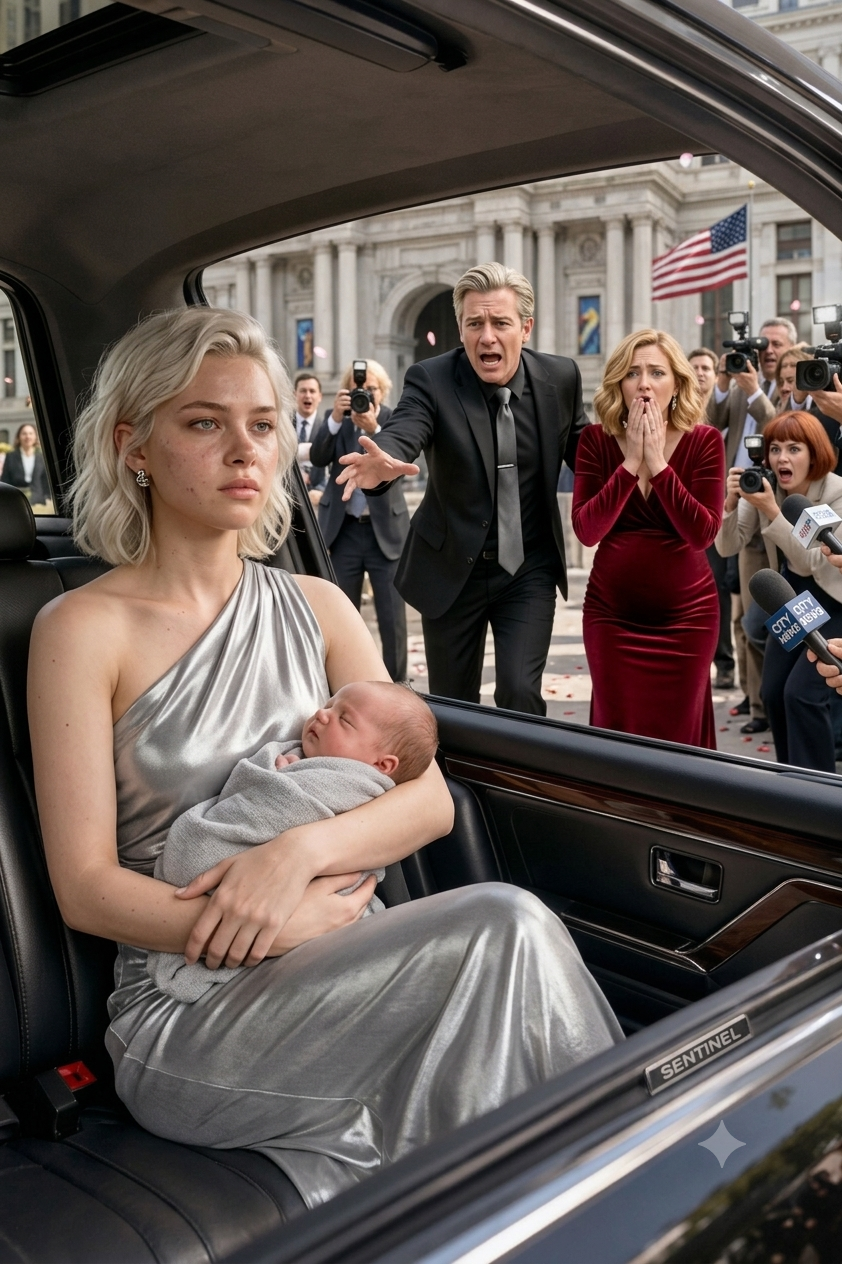
Doña Ofelia stood there, impeccable, in a beige coat, a pearl necklace, and that look of a woman who had always believed that money could buy even blood.
—We need to talk —she said.
—No —Mariana replied—. Now you’re going to listen.
She let her in.
Valeria, her lawyer, had told her something clear: “If they talk, record it.”
The phone was on, recording on a shelf.
Doña Ofelia saw the folders and lost color.
—Mariana, daughter…
—Don’t call me daughter.
The mother-in-law pressed her lips together.
—I did what was necessary to protect this family.
—You took my daughter from me.
—I gave you a healthy son, an important last name, and a comfortable life.
Mariana let out a dry laugh.
—I became a free nanny for my husband’s lover’s child.
Doña Ofelia slammed her hand on the table.
—That child is an Alcázar!
—And what was my daughter? Trash? A mistake?
Silence answered first.
Then Doña Ofelia said with a coldness that froze the house:
—She was a girl. Girls marry, leave, change their last names. A boy supports a household.
Something in Mariana died right there.
There was no longer a wife.
There was no longer a daughter-in-law.
Only a mother remained.
The next morning, Valeria filed a complaint against Rodrigo, Doña Ofelia, the clinic, and whoever was responsible. She also requested urgent measures to locate the minor.
Fernanda was not difficult to find.
She lived in Querétaro, in a nice house near Juriquilla, paid for with Alcázar money.
When Mariana arrived with her lawyer, a 6-year-old girl opened the door.
She had dark hair, huge eyes, and a small brown spot on her left wrist.
The same spot that Mariana had.
—My name is Camila —the girl said, hugging a doll.
Mariana felt her soul shatter.
Her daughter’s name was Camila.
Fernanda appeared behind her, pale, with deep circles under her eyes. She didn’t look like the arrogant woman Mariana had imagined. She looked exhausted.
—I didn’t know she was yours —she said before Mariana could speak—. Ofelia told me that my baby had been born wrong, that she died. Then they gave me Camila and said it was a discreet adoption. I was young, alone, needed money. I was cowardly, yes. But I didn’t know they had stolen her from you.
Mariana wanted to hate her.
A part of her did.
But Camila was there, looking innocently, not understanding that her life had just split in two.
The DNA test took 4 days.
It came back positive.
Camila was Mariana’s daughter.
This time, Mariana cried.
Not with elegant tears.
She cried, bent over the kitchen table, with the result in her hands, as if her body were expelling 6 years of silence.
Emiliano found her like that.
—Mom, does it hurt?
Mariana looked at him.
For days she had feared that moment.
Emiliano wasn’t to blame. He hadn’t asked to be born from a lie. He hadn’t asked to be used as the heir. He hadn’t asked for Mariana to love him.
She knelt in front of him.
—I’m not hurting, my love. I’m hurt by a truth.
—Did I do something wrong?
Mariana hugged him tightly.
—No. You didn’t do anything wrong. Never.
The scandal exploded in Mexico City.
Clínica Santa Lucía was investigated. Teresa testified. Doña Ofelia’s payments appeared in hidden accounts. Rodrigo tried to deny, then negotiate, then cry.
He even knelt in Valeria’s office.
—Mariana, I was also a victim of my mom.
She looked at him without blinking.
—No, Rodrigo. You were her accomplice.
The divorce was ruled in favor of Mariana.
Rodrigo lost part of his shares after the scandal. Doña Ofelia stopped showing up at social events. The woman who claimed that Mariana “knew how to obey” ended up testifying in front of a judge with a trembling voice.
Mariana received a huge compensation.
But no amount returned her daughter’s first steps.
No sentence brought back her first word.
No judge could erase the nights when another woman rocked her while Mariana slept next to the child of a lie.
And yet, life didn’t end.
It began differently.
Camila didn’t call her mom right away. Mariana didn’t demand it. For months, she was just “Mariana.” Then “Mom Mariana.” One afternoon, while they were making hot chocolate, Camila accidentally let out a “Mom.”
Mariana turned to the window so she wouldn’t see her tears.
Emiliano began therapy.
Camila did too.
Mariana did as well.
Because surviving isn’t pretending nothing hurts. It’s learning to live without letting pain dictate.
When someone asked her if she still loved Emiliano, Mariana told the truth:
Yes.
She loved him.
But no longer from the lie.
And when someone asked her if she could forgive Rodrigo, she told another truth:
Not everything deserves forgiveness.
Some things only deserve justice.
That day, when she opened Excel to charge for 6 years of diapers, school, and sleepless nights, Mariana thought she was putting a price on her pain.
She was wrong.
She was reclaiming her voice.
Because a woman doesn’t go crazy when she stops being silent.
Sometimes, she simply awakens.