PART 1
The backhoe rolled into Santa Lucía del Encino at 7:10 in the morning, kicking up a cloud of dust that made all the dogs along the main street bark wildly.
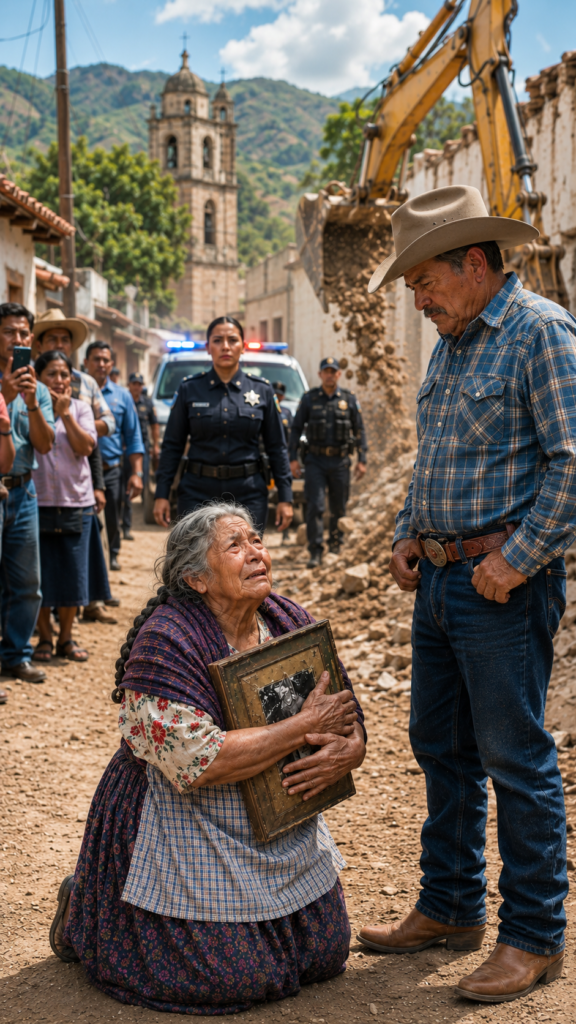
Doña Jacinta Rangel, 76 years old, was watering her geraniums when she saw two black trucks stop in front of her adobe house. From the first truck stepped Octavio Serrano, a former colonel, cattle rancher, and owner of nearly everything that moved in the municipality.
He wore new boots, a white shirt, and carried a burgundy folder under his arm.
"You have ten minutes to gather your things," he ordered. "Today, the expansion of my warehouse begins."
Jacinta stood her ground.
"This house isn't yours. I lived here for 48 years with Tomás. My three daughters were born here."
Octavio let out a short laugh.
"Your daughters left a long time ago. None of them has come back for you."
The neighbors listened from behind their curtains. No one dared step outside. In Santa Lucía, confronting Octavio meant losing a job, a plot of land, or ending up beaten in some ditch.
Jacinta knew that fear all too well.
Twenty-two years ago, her husband Tomás had disappeared after accusing the colonel of seizing communal lands. Octavio claimed Tomás had fled with stolen money and another woman.
Jacinta had never believed him.
Neither had her daughters.
Elena, Beatriz, and Marisol had left as children, not because they wanted to abandon their mother, but because Jacinta had begged them to escape before Octavio made them disappear too.
The former colonel opened the folder and displayed a document.
"Here’s your fingerprint. You sold it for 180,000 pesos."
"I never put that fingerprint down."
"Then claim it from the street."
The operator started up the machine. The metal arm swung toward the kitchen where coffee still simmered.
Nico, the young man from the stationery store, began recording with his cellphone.
Octavio saw him and swatted at him.
"Delete that, kid."
Jacinta stepped in front of him.
"Don’t touch him."
Octavio snatched her cane and threw it against a flower bed.
"Enough of playing the brave old woman."
Without support, Jacinta fell to her knees. Her palm opened against a stone, and blood stained the earth.
The backhoe struck the first wall.
Plates, tiles, and the portrait of Tomás with his palm hat fell.
Jacinta let out a scream she had been holding for 22 years.
Then, from the state road, three official vehicles and a press truck appeared.
A woman with a weapon stepped out of the first vehicle, walked through the dust, and aimed directly at Octavio's chest.
"Step away from her and shut down that machine."
The former colonel paled at the sight of her.
Jacinta looked up, but before she could pronounce her name, the woman showed a federal order.
"Octavio Serrano, you are under arrest for dispossession, forgery, and the disappearance of Tomás Rangel."
And when the doors of the other vehicles opened, the town realized that Jacinta's three daughters hadn’t returned to save a house but to unearth something that could destroy all of the colonel's accomplices.
PART 2
Elena Rangel did not lower her weapon until the operator shut down the backhoe and raised his hands.
She wore a vest from the Federal Ministerial Police. At 44, her face was serious, and she had the same piercing gaze as Tomás when someone tried to deceive him.
"My girl..." Jacinta whispered.
Elena pressed her lips together. She wanted to hug her, but armed men still surrounded Octavio.
From the second truck stepped Beatriz, dressed in a navy blue suit, holding several orders signed by a federal judge.
"Beatriz Rangel, agent of the Public Ministry. Everything will be secured as evidence."
Last was Marisol. She carried a camera over her shoulder and an old notebook that had belonged to her father.
"I came to tell what you turned into silence for 22 years."
Murmurs spread across the sidewalks. The three girls who left with a borrowed suitcase returned as women who knew the law and the value of well-kept evidence.
Octavio regained his composure.
"What a nice show. The police, the lawyer, and the reporter. Do you think you can come to my town and play justice?"
Beatriz held up the order.
"This is not your town. And we are not playing."
The agents searched his men. They found two unregistered guns, envelopes of cash, and copies of deeds in the names of deceased persons.
"I know generals, congressmen, and judges," Octavio threatened. "By afternoon they will be apologizing."
"Your calls are being monitored, and your accounts frozen," Elena replied.
For the first time, the former colonel's smile cracked.
Beatriz opened the burgundy folder. The false deed claimed that Jacinta sold the house for 180,000 pesos and went to a notary in Puebla six days earlier.
"My mother was in the clinic," Beatriz said.
Nico raised his voice:
"I took her because her hip was hurting."
A nurse confirmed the appointment.
"Also, the fingerprint is not hers," Beatriz added. "It belongs to Teresa Salgado, her former secretary."
The name dropped like a stone.
Teresa had worked for Octavio for 18 years and disappeared from town four months ago. Everyone thought she had gone to the United States.
Marisol lowered the camera.
"She is alive and under federal protection. She provided 11 boxes with altered documents, payments to officials, and a list of 34 dispossessed families."
Elena ordered the arrest of Darío Mena, the ejidal commissioner.
"I only signed what they showed me," he stammered.
"He certified assemblies that never occurred," Beatriz said. "There are signatures of 7 deceased and 12 farmers who couldn’t even read."
Darío looked at Octavio.
"Colonel, tell them you had authorization."
Octavio fell silent.
"He forced me," Darío blurted. "He said my son would show up in a ravine."
Neighbors started to emerge.
Doña Marta, the baker, spoke first:
"He took 5 hectares from my husband with a fake promissory note."
Don Hilario raised his hand.
"He closed the well until I agreed to sell to him."
A young woman showed a folder.
"My mom died believing she owed 600,000 pesos."
Octavio turned furiously.
"Get back in your houses!"
For decades, that phrase had been enough.
That day, no one obeyed.
Nico raised his cellphone again. His cheek was red from the blow.
"You no longer command, Don Octavio."
The former colonel tried to lunge at him, but Elena held him back and slammed him against the truck.
"Don’t you dare touch another kid."
"Is that how you treat a superior?"
"You stopped being a superior when you used your uniform to rob defenseless people."
When he was handcuffed, Elena ran to her mother. She knelt, raised her wounded hands, and kissed them.
"Forgive me for not coming back sooner."
"You came back when you could, mija."
Beatriz and Marisol knelt beside them. The four embraced in front of the broken wall, as the neighbors cried.
"I thought I’d never see you together again," Jacinta said.
"We never stopped looking for a way back," Marisol replied. "We just needed to do it without putting you in more danger."
From the patrol car, Octavio let out a bitter laugh.
"You don’t have anything on Tomás. Old papers don’t bring back the dead."
Marisol pulled out a recent photograph.
In it was an abandoned building. On a table lay a rusty buckle, a plaid shirt, and a San Judas medal with a crack.
Jacinta stopped breathing. She had given that medal to Tomás for their 25th anniversary.
"Where did you find that?"
"In a ranch that Octavio put in the name of a frontman three weeks after Dad disappeared," Elena explained.
Beatriz continued:
"Yesterday, forensic experts entered. They found human remains and objects belonging to four missing persons."
The town froze.
It wasn’t just Tomás.
There were other homes that had been putting out an extra plate out of habit for years.
"It’s all a lie!" Octavio shouted. "That property isn’t mine!"
Marisol played an audio from her phone.
Octavio's voice rang clear:
"Get rid of the Rangel stuff first. If they find his medal, the daughters will come for me."
Beatriz approached the patrol car.
"Thanks for confirming you knew what was in the pit."
The former colonel realized too late the trap.
The most painful revelation came afterward.
Teresa hadn’t just forged documents. She had also witnessed Tomás’s last night.
Octavio forced her to serve coffee during a meeting at the ranch. From another room, she heard the sounds of blows and Tomás refusing to sign the transfer of 80 communal hectares.
Then she heard a gunshot.
For 22 years she kept silent because Octavio threatened to make her son disappear. Guilt eventually overcame her, and she sought Marisol after seeing one of her reports on land dispossession.
She handed over recordings, payments, and the location of the pit.
Jacinta listened from a chair that Nico had brought. She held the broken portrait of Tomás.
"So, he never left."
"Never," Elena replied.
"He never left me for another woman."
"No, Mom."
For 22 years, Jacinta endured mockery and advice to forget him. The truth didn’t erase the pain, but it restored her husband’s name and dignity.
That afternoon, the forensic experts secured the house, the machine, and the offices of the commissioner. They searched two warehouses and Octavio's residence.
They found money, official seals, credentials of deceased elders, and documents to seize another 19 properties.
Then another secret emerged.
Beneath Jacinta’s yard lay the shortest access to an old irrigation tunnel connected to a warehouse where Octavio hid files and weapons.
The house had to disappear before the forensic experts arrived.
Octavio didn’t want another parcel.
He wanted to erase the path to his crimes.
As night fell, half the town remained in the square. The women brought beans, tortillas, coffee, and sweet bread. The men set up tables to receive complaints.
Beatriz took statements. Elena monitored the roads. Marisol broadcast the story without turning the pain into a spectacle.
In three hours, Nico’s video was shared thousands of times.
The image of Octavio throwing the cane of an elderly woman outraged all of Mexico. But what moved people most was watching neighbors step out one by one to tell what they had once whispered.
The next day, the sisters accompanied their mother to the ranch.
Jacinta waited outside the perimeter with Tomás’s rebozo over her legs.
The forensic experts took six hours.
When Elena returned, her eyes were swollen. She knelt and showed a transparent bag with the medal.
"It’s his," Jacinta said.
"Yes, Mom. We still need genetic proof, but everything indicates it is."
Jacinta looked toward the hill.
"Tomás, you can come home now."
Then she cried like a woman who had frozen her grief for 22 years because she didn’t even know where to leave flowers.
The three daughters embraced her.
None said everything would be alright.
Some pains don’t need pretty phrases.
They need companionship.
Twelve days later, the results confirmed that the remains belonged to Tomás Rangel. They also identified two farmers and continued searching for the fourth victim.
Octavio tried to leverage influence from prison. A former congressman called the prosecutor, and a local judge wanted to invalidate an order.
But Marisol had already published documents, audios, and testimonies. Every maneuver was exposed in minutes.
Darío handed over payment records. The operator confessed that Octavio had ordered him to destroy the kitchen first and then dig under the yard.
Teresa testified for nine hours. Her statement implicated seven officials, three municipal police officers, and two notaries.
The colonel’s empire fell due to hundreds of small pieces of evidence he believed were useless: copied signatures, purchased seals, transfers, threats, and receipts kept by widows.
Jacinta’s house became uninhabitable.
Octavio wanted to leave her homeless but instead got the whole town wanting to rebuild it.
Nico brought the first bucket of mix. Doña Marta donated a stove. Don Hilario gave wood. Several bricklayers worked for free on Sundays.
The daughters paid for the rest, though Jacinta refused a luxurious house.
"I want my corridor, my kitchen, and space for the bougainvilleas. I don’t need to show off anything to anyone."
She requested to mix a handful of dirt from the old wall with the new bricks.
"So the house remembers where it hurt."
Months later, the trial began.
Jacinta entered with a new cane, a purple rebozo, and Tomás’s medal around her neck.
Octavio looked small without a hat, without armed men, and without neighbors looking down.
The prosecution presented the video, the false deeds, the audio from the ranch, and Teresa's testimony.
The defense claimed that Octavio was a sick old man.
Jacinta asked to speak.
"I was the sick one when he ordered my house torn down. I was old when he threw me to the ground. I was alone when he made my husband disappear. None of that moved him."
She gazed at the man who had ruled her fear for 22 years.
"You thought my daughters left because they were cowards. You were wrong. They left to learn how to come back."
Octavio lowered his head.
Not out of remorse.
But out of defeat.
No sentence could return to Jacinta the lost years, but there was justice.
Octavio remained imprisoned for disappearance, homicide, dispossession, threats, forgery, and organized crime.
His assets were secured to compensate the victims. The lands began to return to their owners. Teresa and her son received protection.
One year later, Santa Lucía del Encino was no longer "the colonel’s town."
People said:
"That’s where an old woman and her three daughters brought down Octavio Serrano."
Jacinta always corrected them:
"We didn’t bring anyone down. He fell on all the lies he piled up."
In her new home, photos of Tomás, her daughters as children, Nico holding the cellphone, and the four women embracing in front of the broken wall hung on the walls.
Marisol restored the portrait of her father.
Beatriz opened a small office to provide free advice to farmers.
Elena returned whenever her work allowed.
None of them recovered lost time, but they learned that returning doesn’t always mean arriving early. Sometimes it means arriving with the strength necessary so that no one can expel you again.
One afternoon, under the bougainvilleas, Jacinta asked:
"Do you think I’ll ever be able to forgive Octavio?"
Her daughters fell silent.
"I don’t know either," she admitted. "Forgiving is a huge thing. I’m just learning to sleep without expecting someone to be taken away."
Elena took her hand.
"You don’t owe forgiveness to anyone, Mom."
"But I owe peace to this house."
That night, Jacinta left the window open for the first time in 22 years.
She didn’t fear hearing trucks.
She didn’t hide documents under the mattress.
Before sleeping, she paused in front of Tomás’s portrait.
"Your daughters have returned. And look at what women they’ve become."
Outside, the wind rustled the leaves of the oak tree.
The house still bore scars.
So did Jacinta.
But they were no longer signs of defeat.
Octavio thought that tearing down a wall would be enough to erase a family. He never understood that a house is not held up by adobe alone, but by memory, truth, and people willing to stop looking down.
And ever since, when someone in Santa Lucía felt fear of denouncing, they remembered Jacinta on her knees among the rubble.
Not as a defeated old woman.
But as a mother waiting for the truth to return with the faces of her three daughters.





