PART 1
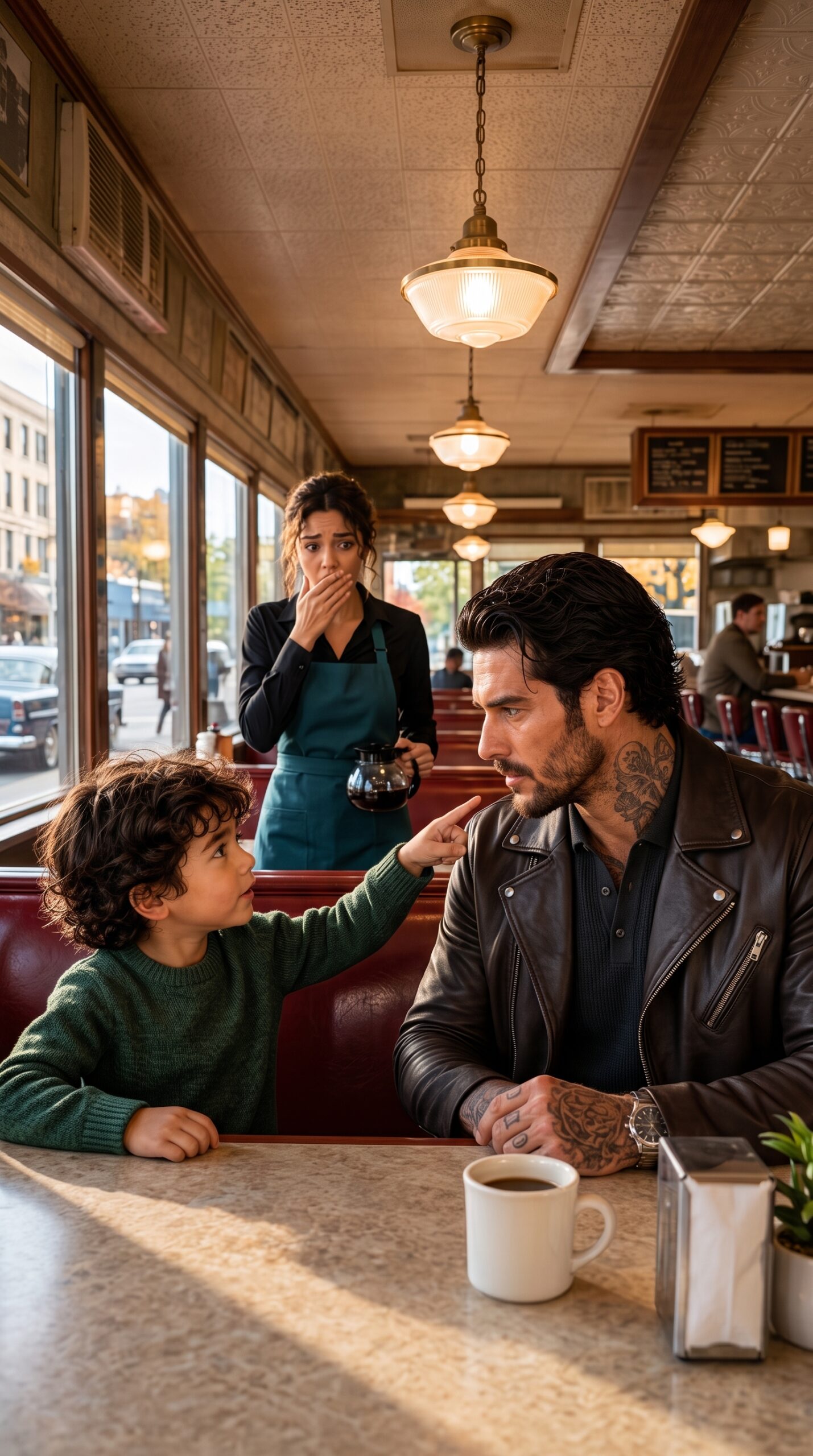
The restaurant El Comalito fell silent when the boy let the question escape his lips in front of everyone.
—Sir… why do you have the same eyes as me?
The sound of rain tapping against the tin roof filled the silence. At the bar, a driver dropped his taco halfway. The coffee pot kept sputtering steam as if nothing was amiss.
Marisol was emerging from the kitchen with two plates of green chilaquiles when she felt her body go limp.
Her son Mateo must have been at the back table, drawing little cars on a napkin, because once again the girl who was supposed to watch him had canceled. Doña Cuca, the owner, always told her that a mother shouldn’t apologize for working and raising her child at the same time.
That’s how nearly six years had gone by.
Tips counted out.
Uniforms washed at night.
A tiny room rented behind a tire shop.
A borrowed identity.
And a boy with black hair, a toothless smile, and smoke-colored eyes.
—Mateo —Marisol said, her voice breaking—. Don’t bother the man, sweetheart.
Then she turned.
Table 4.
White shirt soaked through. Gray jacket draped over the chair. Coffee untouched. Jaw set. Hands still. Eyes identical to her son’s.
Santiago Beltrán.
Her husband.
The man she had escaped from six years ago, pregnant, while they had sworn to him that he could never have a child.
The plate trembled. The salsa spilled onto the floor. Doña Cuca managed to grab the other plate before it shattered.
Santiago said nothing at first.
He just stared at the boy.
Mateo was watching him with a seriousness that didn’t match his five years.
—My mom says that eyes run in the family —he insisted—. So, are you one of mine?
Someone cleared their throat. No one laughed.
Santiago lifted his gaze to Marisol.
And in that moment, the restaurant disappeared.
There was no more smell of burnt tortillas, no more soaked patrons, no more old radio playing boleros. Only the two of them remained, with a massive lie breathing between them.
—Marisol —he said.
Her real name.
Not Rosa Méndez, the quiet waitress who served breakfast on the road to Celaya.
Marisol Aranda Beltrán.
Mateo’s eyes widened.
—Mom, the man knows your secret name.
The phrase crashed over the restaurant like a shattered glass.
Santiago stood up slowly.
He didn’t shout.
He didn’t threaten.
But everyone felt as if a storm had entered wearing expensive shoes.
—Mateo, go with Doña Cuca for a bit —Marisol asked.
—Are you going to scold me?
She swallowed hard.
—No, my love. You didn’t do anything wrong.
—Then why are you crying?
Marisol couldn’t answer.
Santiago breathed as if his chest hurt.
—Maybe because adults hide things that children find out by accident.
Marisol pointed to the hallway next to the kitchen.
—Not here.
They walked to the small storage room where they kept sacks of beans, soda boxes, and cheap napkins. When the door closed, the noise of the restaurant faded away.
—Is he your son? —Santiago asked.
—Yes.
—And his father?
Marisol clenched her fingers against her apron.
That question was the exact wound that the Beltrán family had used to break her apart.
—Santiago…
—Don’t say my name like that. I spent six years thinking you left with someone else. That you abandoned me as if I were some random guy.
She lowered her gaze.
—What happened was worse.
He stood still.
—Then tell me the truth.
Before Marisol could respond, four clumsy notes sounded from the old piano in the dining room.
It was the song Santiago had played the night he proposed to her.
The melody that his dead mother sang when he was a child.
Mateo was playing it with one finger, unaware that he had just opened the tomb where everyone had buried their story.
Santiago glanced toward the door.
Then looked back at Marisol.
And he understood, with a mix of fury and pain, that this boy had not only his eyes.
He had his blood.
PART 2
Before she became Rosa Méndez, Marisol had been a music teacher in Querétaro.
She had a small school above a bakery, with yellow walls, used chairs, and children who played out of tune but with fiery hearts.
She had no luxuries.
But she had peace.
She met Santiago Beltrán at a fundraising dinner in Juriquilla. She played the violin for businessmen, politicians, and women with necklaces worth more than a house.
In the middle of the piece, she swapped the elegant music for an old, sweet, and sad song.
When she finished, Santiago stood in front of the stage.
—Who taught you that melody?
—No one completely —she replied—. My grandmother hummed a little piece, and I made up the rest.
Santiago looked at her as if she had just returned a lost photograph.
—My mom sang it too.
The Beltrán surname loomed large over all of Querétaro.
Hotels, warehouses, construction companies, private security, restaurants, and businesses that people mentioned in hushed tones.
Santiago was not an ordinary man.
He was educated, elegant, and dangerous when someone crossed a line.
But with Marisol, it was different.
He never treated her like an ornament. He asked her about her students, remembered how she took her coffee, and had the roof of her school fixed without boasting about it.
When a drunken politician tried to grab her waist, Santiago calmly pushed his hand away.
—The teacher deserves respect.
That night, Marisol believed that a man raised in shadows could also protect without hurting.
She was wrong.
And she was right.
Santiago proposed five months later, in a library at his family’s home.
—My family wants to see me married —he said.
Marisol smiled.
—Then get an actress.
—They’ve tried. All of them fell in love with the surname first.
—And what did I fall in love with?
Santiago took a moment to respond.
—With the part that no one sees.
They married at a hacienda near Tequisquiapan, with white bougainvilleas, discreet mariachis, and armed men pretending to serve drinks.
That night, Santiago told her his secret.
—I can’t have kids. There was an accident when I was young. Doctors said the damage was permanent.
Marisol didn’t look at him with pity.
She sat across from him and took his hands.
—A child isn’t the only way to build a family.
He cried silently.
She didn’t embrace him to console him.
She embraced him to stay.
Love grew slowly.
In leisurely breakfasts.
In sheet music on the table.
In the way Santiago protected her without invading her.
Until, eight months later, Marisol saw two pink lines on a pregnancy test.
For one minute, she was happy.
Then fear crashed down upon her.
Everything in Santiago’s life said that this baby shouldn’t exist. Medical studies, family rumors, paid doctors, relatives hungry for power.
Marisol wanted to tell him that very night.
But first, she went to Dr. Gerardo Salinas, the Beltrán family doctor for over twenty years.
He looked at the test.
He smiled.
And that smile froze her blood.
—What a delicate surprise —he said.
When Marisol returned to the hacienda, Emilio Beltrán was waiting for her in the study.
Santiago’s uncle.
The man who managed the businesses when no one was watching.
On the desk lay a folder with her name on it.
—You’re not going to tell my nephew anything —he ordered.
—That baby is Santiago’s.
Emilio let out a dry laugh.
—That’s not your decision to make.
He showed her papers with elegant and cruel words.
Minor protection protocol.
Legitimacy assessment.
Preventive custody.
Asset protection.
Marisol understood the message without it needing explanation.
If the child was Santiago’s, they would take him away.
If he wasn’t Santiago’s, they would destroy her publicly.
In either case, she would lose her son.
—Why are you doing this? —she whispered.
Emilio stopped smiling.
—Because Santiago without children leaves the path clear for my son. Rodrigo was prepared to take his place. Your pregnancy ruins years of work.
Then he showed her fake photographs.
A man entering her school.
A hotel receipt.
A headline ready to leak: “Businessman’s Wife Pregnant by Lover.”
Marisol felt nauseous.
—Santiago would never believe them.
—You won’t have time to prove it.
That night, Marisol wrote the most painful lie of her life.
“If you ever loved me, don’t look for me. I left because I didn’t love you.”
She fled with a backpack, her violin, a fake birth certificate, and a little music box that had belonged to Santiago’s mother.
Inside, she hid a copy of the protocol.
She was scared, yes.
But she wasn’t stupid.
Mateo was born months later in a public hospital in Puebla, during a blackout from the storm.
When they laid him on her chest, Marisol saw Santiago’s eyes.
And she cried for the father who was alive but absent because of a lie.
For years, she never played that song again.
She only hummed it when Mateo had a fever or nightmares.
That’s why, when the boy played those four notes at El Comalito, Santiago understood that no coincidence could carry that much destiny.
In the storage room, he asked with a broken voice:
—Is he mine?
Marisol closed her eyes.
—Yes. He’s always been yours.
Santiago leaned a hand against the metal shelf, as if the truth had robbed him of strength in his legs.
He didn’t shout.
He didn’t break anything.
That silence was scarier than any threat.
She told him everything.
Emilio.
Dr. Salinas.
The fake photos.
The protocol.
The note.
The name Rosa.
The birthdays Mateo celebrated without his dad.
The times he asked why, at the kindergarten festival, everyone brought their dad except him.
Santiago listened without interrupting.
In the end, he looked through the crack in the door.
Mateo was sitting with Doña Cuca, dipping sweet bread in hot chocolate.
—I looked for you —Santiago said.
—I know.
—No. You don’t know the whole story. I searched until I had no pride left. Every clue led me to a different lie. They made me believe you had humiliated me.
Marisol cried silently.
—I died many times too.
Santiago swallowed hard.
—you didn’t steal my son from me. My family forced you to hide him so they wouldn’t take him away from you.
For two weeks, Santiago stayed close to the restaurant.
He didn’t demand hugs.
He didn’t touch Mateo without permission.
He didn’t say “my son” in front of him.
He sat at 8 AM, ordered coffee from the pot, and let the boy come to him on his own.
Mateo called him “the man with borrowed eyes” until Santiago taught him his name.
—It’s hard —the boy said—. I’d better call you Santi.
Santiago smiled for the first time in years.
—I think that’s fair.
On the third day, Mateo told him that his tie looked like a grumpy man’s.
On the fourth day, Santiago showed up without a tie.
Marisol had to go into the kitchen to cry.
Everything felt too natural.
As if Mateo had kept a place for his father without knowing he existed.
Meanwhile, Santiago investigated.
He found a retired nurse who remembered Dr. Salinas changing medical studies under Emilio’s pressure.
He found transfers from a children’s foundation.
He found the original studies that showed that his injury didn’t make him sterile, just reduced the chances.
It wasn’t impossible.
Just uncomfortable for his uncle’s plans.
Marisol handed him the music box.
Inside was the protocol.
Santiago held it like it was a knife between his hands.
—I kept it in case one day Mateo needed to know that his mom wasn’t crazy.
—you were never crazy —he said—. You were alone.
On day sixteen, Emilio showed up at El Comalito with two lawyers.
Mateo was eating pancakes cut into triangles. Santiago sat next to him, helping him create a river of honey.
Emilio’s eyes locked onto the boy.
There was no affection.
Only ambition.
—That minor carries Beltrán blood —one of the lawyers said—. The family has the right to intervene.
Marisol stepped in front of Mateo.
—The family already tried to take him away before he was born.
Santiago stood up.
The entire restaurant froze.
—Mention the blood in front of the boy again, and tomorrow all of Mexico will know how much you paid to rob me of six years of life.
For the first time, Emilio lost color.
That same afternoon, he leaked his version on social media.
“Fugitive wife reappears with hidden child. Doubts about paternity. Family prepares lawsuit.”
By nightfall, cameras were outside the restaurant.
Mateo cried because he thought it was all his fault for asking.
Marisol packed a backpack.
She wanted to run again.
Santiago caught up with her at the bus station before midnight but kept his distance.
—I could stop you —he said.
Marisol tensed.
—But I won’t.
He left a folder on the bench.
—Here’s a house in your name. No guards unless you ask for them. No keys you don’t control. No decisions about Mateo above you.
—Why would you do that?
—Because if I use power to keep you, Emilio wins even if I lose.
Marisol looked at Mateo sleeping in her arms.
She had spent six years running.
But she could no longer teach her son that love meant hiding.
—I’m not going to run —she said—. But you’ll keep my pace.
—Always.
The confrontation occurred three days later at the Beltrán hacienda.
Marisol entered wearing a simple blue dress and the wedding ring for the first time in six years.
Not because she returned defeated.
But because they had tried to erase her.
Mateo was holding her hand. Santiago walked close, protecting without possessing.
In the dining room were cousins, partners, lawyers, and old men who confused money with truth.
Emilio sat at the head of the table.
His son Rodrigo remained behind, pale.
Marisol placed the music box on the table.
—I kept the document Emilio showed me when he found out I was pregnant.
Santiago set the evidence one by one.
The doctor’s confession.
The original studies.
The transfers.
The nurse’s testimony.
Each sheet sounded like a door closing.
—My accident was real —Santiago said—. The lie was making me believe I could never be a father. My uncle needed my empty future to fill his son’s.
Rodrigo looked at Emilio with disgust.
—Did you do all this for me?
Emilio clenched his teeth.
—I did it for the family.
—No —Rodrigo replied—. You did it because you saw a baby as an obstacle.
Mateo squeezed Marisol’s hand.
—Mom, why is everyone talking ugly?
Marisol knelt in front of him.
This wasn’t the moment she dreamed of to tell him the truth.
But a truth hidden for too long also becomes another lie.
Santiago took one step and halted, waiting for permission.
Marisol nodded.
Mateo looked at a piano covered at the back of the room.
—Does that piano work?
He walked to it and played the four notes of the song.
Santiago sat beside him.
—Can I continue it?
Mateo nodded.
Santiago continued the melody.
The boy’s eyes widened.
—You know my mom’s song.
—Yes.
—So you come from that song?
Santiago knelt in front of him.
In that house, the Beltráns didn’t kneel before anyone.
But Santiago did in front of a boy with dried honey on his sleeve.
—I’m your dad —he said—. But I have no right to demand that you love me. I want to earn that, if you and your mom let me.
Mateo thought about it with the utmost seriousness.
—Do dads know how to make pancakes?
Santiago let out a broken laugh.
—I can learn.
—Triangles. Circles look weird.
—Triangles —he promised.
That’s how Emilio lost.
Not with gunfire.
Not with screams.
But because a boy set rules for love, and everyone understood that blood wasn’t a chain.
Before nightfall, Emilio was removed from the businesses. His accounts were frozen. Dr. Salinas was reported. The foundation was put under audit.
Rodrigo didn’t defend his father.
Sometimes the first form of justice is not standing beside the guilty.
Marisol didn’t move to the hacienda.
Love doesn’t erase a cage just because someone opens the door.
Santiago bought a small house near Querétaro and put it in her name.
—Without making decisions about Mateo without me —Marisol said.
—Never.
—Without buying forgiveness.
He lowered his gaze.
—I wouldn’t know how much it costs.
Santiago learned to be a father in small things.
He burned pancakes. He sent lunch with two juices and no food. He read stories as if he were giving a conference until Mateo told him that dragons needed more excitement, for real.
And Santiago learned.
At the kindergarten festival, he applauded late.
Mateo shouted from the stage:
—That’s my dad! He’s still practicing!
Marisol reopened her music school above a bakery.
The sign read:
Casa Aranda de Música.
Below, Mateo requested to add:
Songs for brave children and new dads.
At the first recital, Santiago arrived with a yellow tie because Mateo said that sad ties scared music away.
The boy played his grandmother’s song badly yet beautifully.
Santiago accompanied him on the piano, slowing the pace so he wouldn’t fall behind.
No one in that room knew all that melody had survived.
Maybe that’s why it sounded free.
That night, when Mateo fell asleep, Marisol and Santiago remained by the piano.
—Do you still need to stay away from me? —he asked.
She looked at the man from whom six years had been stolen.
The father who knelt before his son.
The husband who finally understood that protecting without allowing choice was also a form of confinement.
—No —Marisol said—. I need to be free with you.
Santiago didn’t embrace her until she took the first step.
And when his arms surrounded her, they didn’t feel like a prison.
They felt like an open door.
Because sometimes the past doesn’t return to destroy a life.
Sometimes it comes back with the eyes of a child, an old song, and an impossible question:
if there is still courage to return home.





