PART 1
When Alma Hernández reached the head of the table, Sebastián Valdés had been watching his mother die for nearly 20 minutes without realizing it.
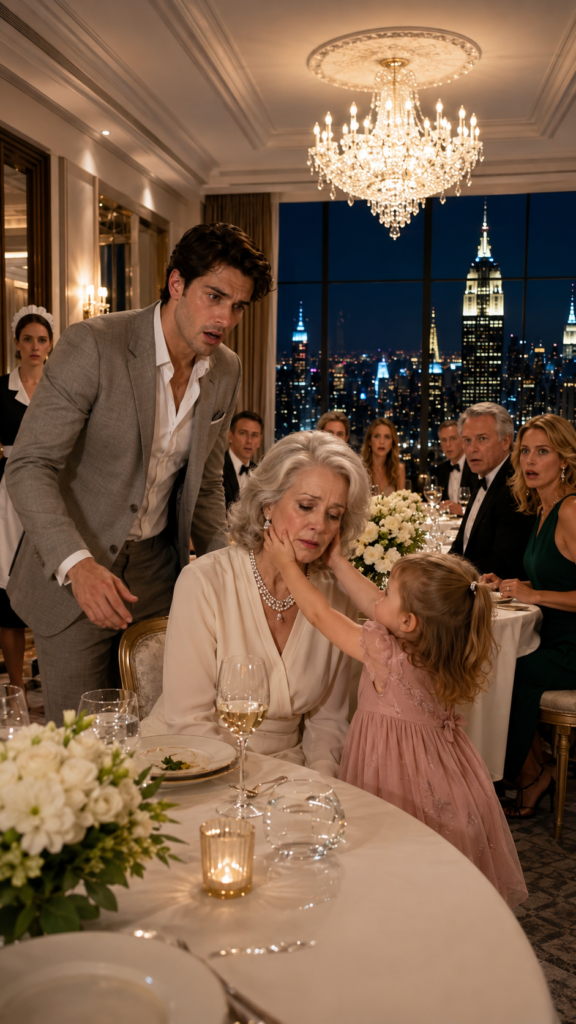
On the 38th floor of a restaurant overlooking Paseo de la Reforma, 30 guests were celebrating Elena Valdés's 67th birthday. Crystal chandeliers hung above, imported wine flowed, designer dresses sparkled, and a photographer captured perfect smiles.
No one saw Elena's mouth start to twist.
No one noticed her right hand trembling.
No one reacted as she tried to take a sip of water, missed by several inches, and knocked the glass over onto the tablecloth.
Sebastián sat two seats away, glued to his phone while negotiating with an investor from Monterrey.
—Are you okay, Mom? —he asked without looking up.
—Just… tired, son —Elena replied with difficulty.
—You can rest tomorrow.
And he went back to reading his messages.
At 35, Sebastián ran Valdés Tecnología, a company his father had started in a workshop in Azcapotzalco. He turned it into an empire, but he also became a man who always had one more important meeting than his own family.
Near the kitchen was Alma, a 4-year-old in a yellow daisy dress. The organizer had refused to seat her at the main table because, as she said, “it wouldn’t look good in the photographs.”
Alma was the daughter of Rosa, Elena's housekeeper.
Rosa had been working with her for 7 years. She knew Elena's medications, her knee pains, and the afternoons when she missed her late husband.
Elena also knew Rosa's life.
She knew that Rosa raised Alma alone, that she had come from Puebla with debts and sold quesadillas near the Metro to survive.
That's why, when Rosa called to say she had no one to leave the girl with, Elena replied:
—Bring her. It's my birthday, and I want to see my little sun.
Alma called her “Grandma Elena.”
No one taught her.
It just happened.
From her chair, the little girl noticed that one side of Elena's face smiled while the other seemed asleep.
Months earlier, she had seen the same thing in a vendor at the market. Rosa had called 911 and then explained:
—When one side of the face droops, an arm doesn’t respond, or the words come out strange, we don't wait. We run.
Adults forget how much children remember.
Alma got down from her chair.
—Alma, come here —Rosa whispered.
But the girl walked between waiters and elegant dresses.
She reached Elena, stood on tiptoes, and cupped her face with both hands.
The room fell silent.
—Grandma Elena… your face is asleep.
A few guests chuckled.
Not Sebastián.
For the first time that night, he looked truly at his mother.
He saw the drooping corner of her mouth, the weak eyelid, and the immobile right hand.
—Mom, raise your arms.
Elena lifted her left.
The right fell.
—Call 911! —he shouted.
Elena tried to stand, but she collapsed. Sebastián caught her before she hit the floor.
The paramedics arrived and asked when she had last been seen normal.
No one could answer.
Then Alma, clinging to Rosa's skirt, murmured:
—At home, her hand got sleepy too.
Rosa turned pale.
—It was before we left —she confessed, crying—. She dropped her lipstick. I wanted to call the doctor, but she made me promise not to ruin her birthday.
The paramedic closed the ambulance doors.
—Then the stroke could have started hours ago.
Sebastián stood frozen in the rain, realizing he may have spent the last hour conscious of his mother sitting next to him... without truly seeing her.
PART 2
In the emergency room, Sebastián discovered that all his millions were useless against a clock that had been ticking away for hours.
Metropolitan Hospital was lit with a harsh white light. Doctors rushed through the halls, families prayed in front of coffee machines, and stretchers appeared behind doors that opened and closed nonstop.
Dr. Lucía Herrera emerged with the CT scan images.
—Your mother has a blocked brain artery. An important part of her brain is no longer receiving blood.
Sebastián felt his legs give way.
—Can you save her?
—We will attempt to remove the clot through a thrombectomy. But we don’t know exactly when the stroke began. There may be irreversibly damaged tissue.
—Do whatever is necessary.
—I need you to understand the risks.
—Doctor, please. Do everything.
He signed the documents without reading them.
When they took Elena away, he checked his phone. He had 43 messages, 6 calls from the board, and one notification that took his breath away.
A missed call from his mother.
It had been at 6:18 PM.
There was also a voicemail.
“Sebastián, son… I know you’re busy. I just wanted to ask if you could arrive a little earlier today. There’s something I want to tell you…”
Her voice fell silent for a few seconds.
Then she added, weaker:
“Well. You can tell me when you get here.”
Sebastián remembered exactly where he was at 6:18.
Inside his truck, reviewing the purchase of a software company.
He had seen “Mom” on the screen.
He rejected the call.
“I’ll call her tomorrow,” he thought.
Now he sat against the wall, covering his face.
Rosa stood across the hall with Alma asleep in her arms. The girl no longer had the yellow bow. She had lost it during the chaos of the restaurant.
Beatriz, Sebastián's cousin, arrived with the company’s public relations head.
—This is already on social media —she said angrily—. There are videos of the ambulance, photographers outside, and employees talking. Why was that girl at the dinner?
Rosa lowered her gaze.
—I had no one to leave her with.
—You should have sorted it out. Now everyone says a girl discovered the stroke before the family did.
Sebastián slowly lifted his head.
—Because that’s exactly what happened.
Beatriz pressed her lips together.
—You don’t understand. The company’s image…
—My mother is fighting for her life, and you come to talk to me about the company.
—I’m being realistic, Sebastián. If the press starts asking why no one reacted…
—Let them ask.
Beatriz looked at Rosa with disdain.
—She knew your mom was sick before. Maybe it was negligence.
Rosa began to cry.
—Mrs. Elena forbade me to call. I insisted, I swear.
—Of course, how convenient —Beatriz replied.
Sebastián stood up.
—Enough.
—I’m just saying we need to protect ourselves.
—The only person who protected my mother was a 4-year-old girl. You were sitting across from her, taking photos.
Beatriz fell silent.
—And if you blame Rosa or Alma again to clean your reputation, you’re leaving here.
The operating room doors remained closed for nearly 3 hours.
At 2 AM, Dr. Herrera returned.
—We managed to remove a large part of the clot.
Rosa let out a sob of relief.
But the doctor did not smile.
—Elena is still critical. There is brain swelling and damage in several areas. The next 24 hours will be critical.
—Will she wake up?
—I can’t promise that.
Sebastián spent the night in front of the intensive care glass.
His mother looked tiny under the sheets. She had tubes, sensors, and machines doing for her what her body could no longer do alone.
At 8 AM, the swelling worsened.
At 11, the doctors talked about opening part of her skull to relieve pressure.
At 1 PM, Sebastián had to decide.
—Without the surgery, she could die —the doctor explained—. With the surgery, she might survive with severe sequelae. She may never walk, talk, or feed herself again.
Sebastián felt rage.
Not against the doctors.
Against himself.
For years, Elena had asked him if he was sleeping well, if he was eating on time, if he was happy or felt lonely.
He always answered:
—We’ll talk later, Mom.
He had bought her a huge apartment, hired a chauffeur, a private nurse, and planned trips they never took together.
He thought paying was the same as being there.
He entered to see her before the second surgery.
He took her left hand.
—Mom, it’s me.
Elena did not react.
—Forgive me.
The monitor kept the same rhythm.
—I sent you flowers when I could have visited you. I bought you things to avoid feeling guilty. And last night, I was two seats away from you… but I didn’t see you.
His voice broke.
—Don’t leave thinking that I don’t love you.
He rested his forehead on her hand.
—I was just an idiot. A true idiot.
When they took Elena to the operating room, Alma was awake in the hallway. A nurse had given her sheets and crayons.
The girl drew 3 figures: a gray-haired woman, a yellow girl, and a very tall man.
—This is you —she said, pointing to the man.
Sebastián crouched down.
—Why am I so far away?
Alma looked at the drawing.
—Because you’re always working.
The answer hurt more than any insult.
The second surgery ended at sunset.
Elena survived.
But she did not wake up.
Two days passed.
Then three.
Sebastián stopped going to the office. He slept in a chair, learned the names of the nurses, and ate cold tortas from the stand across the street.
The board began to pressure him.
His partner, Arturo Castañeda, arrived at the hospital with a folder.
—We need you to sign. The stocks have dropped, investors are nervous, and Beatriz says you’re making emotional decisions.
Sebastián closed the folder without opening it.
—My mother is in a coma.
—The company can’t stop.
—Then let them work.
—You’re the CEO.
—I’m also her son.
Arturo sighed.
—You can’t save her by sitting here.
Sebastián stared him down.
—Maybe not. But I can stop abandoning her.
That same afternoon, a nurse handed Sebastián a digital memory.
—The lady from public relations asked to delete the recordings from the restaurant —she explained—, but a waiter saved a copy. He thought you should see it.
Sebastián opened the file.
The video showed Elena's first symptoms.
Her trembling hand.
Her twisted mouth.
The glass falling.
It also showed something no one had mentioned.
Beatriz had seen Elena trying to get up and had held her shoulder.
—Aunt, don’t make a scene —she could be heard saying—. Wait until the toast is over.
Then, when Rosa approached worried, Beatriz blocked her way.
—Don’t get involved. The lady just had too much wine.
Sebastián felt his blood boil.
It hadn’t been simple distraction.
Someone had seen that Elena was unwell and preferred to protect a perfect party.
He called Beatriz.
She arrived 40 minutes later.
—What’s going on?
Sebastián put the video in front of her.
Beatriz lost color.
—I didn’t know it was a stroke.
—You knew she wasn’t well.
—I thought she was just tired.
—Rosa tried to approach, and you stopped her.
—There were important guests. I didn’t want a drama over nothing.
—My mother almost died because, for you, her health was “a drama.”
Beatriz crossed her arms.
—Don’t blame me for everything. You were right next to her.
The phrase hit where it hurt the most.
Sebastián didn’t try to defend himself.
—You’re right. I failed too.
Beatriz seemed surprised.
—But there’s a difference —he continued—. I’m going to carry what I did. You’re trying to blame an employee and her daughter.
—Sebastián…
—Effective immediately, you’re out of the family board and any position in my mother’s foundation.
—You can’t do this to me.
—I can. And I will.
Beatriz stormed out of the hospital, insulting him, but the video ended up leaking. The public opinion didn’t attack Rosa.
They attacked the Valdés family.
Thousands commented that a girl had shown more humanity than 30 adults surrounded by luxury.
On the fourth day, Dr. Herrera was direct:
—You need to prepare for the possibility that Elena may not regain consciousness.
That night, her blood pressure dropped.
An alarm began to sound. Doctors rushed in, and Sebastián was pushed aside as several people surrounded his mother’s body.
For the first time since he was a child, he prayed.
He didn’t ask for contracts.
He didn’t ask for money.
He only asked for 10 more minutes.
When Elena stabilized, a nurse allowed him to leave a phone by her pillow.
Rosa had recorded Alma’s voice.
“Grandma Elena, it’s Alma. Mom says the doctors are fixing your face. You have to wake up because you promised to teach me how to make hot chocolate without burning it.”
Sebastián watched his mother.
Nothing happened.
The recording continued.
“I saved my yellow dress. I love you so much. Wake up, okay?”
Elena’s left hand’s index finger moved.
Just 1 centimeter.
—Nurse! —Sebastián shouted—. She moved!
—It could be a reflex.
Sebastián played the recording again.
“Grandma Elena…”
The finger moved again.
Elena opened her eyes 9 days later.
There was no music or perfect miracle.
It was a rainy morning. Sebastián was sleeping with his head resting against the mattress when he felt a hand brushing his hair.
He looked up.
Elena's left hand was weakly resting on his head.
—Mom…
She tried to speak, but no sound came out.
Sebastián began to cry.
—I’m here.
Elena blinked.
—I’m here —he repeated—. This time, I’m really here.
The recovery was slow.
Elena had to learn to hold a spoon, sit up without falling, move her fingers, and form sounds.
There were days when she would get angry and throw the rehabilitation ball on the floor.
Sebastián would pick it up.
—5 more minutes.
She looked at him with annoyance.
—That’s what you used to say when I didn’t want to do my homework.
One afternoon, Elena let out a weak and uneven laugh.
It was the most beautiful sound Sebastián had ever heard.
Two weeks later, Alma was allowed to visit her.
She entered holding the yellow dress folded in her arms. Upon seeing Elena in a wheelchair, she stopped.
Rosa feared she might be scared.
But Alma walked toward her.
—Is your face still asleep?
Elena tried to smile.
First, one side lifted.
Then, with great effort, the other moved slightly.
Alma began to clap.
—She’s waking up!
Elena cried.
Her first recognizable word came 3 days later.
It wasn’t “water.”
It wasn’t “house.”
It wasn’t even “Sebastián.”
It was:
—Al… ma.
Rosa had to leave the hallway because her legs could no longer support her.
Sebastián remained next to the window, silently crying. He felt no jealousy.
He felt gratitude.
6 months later, Elena returned to her apartment in Polanco. One room was adapted for her therapies, and Rosa continued working with her, but with a better salary and reduced hours.
Sebastián wanted to gift her a house.
Rosa refused.
—Alma didn’t save the lady to receive a prize.
—I don’t want to buy what she did.
—Then do something that saves other people.
That phrase changed everything.
Sebastián created the Elena Valdés Fund to train workers from markets, schools, offices, and low-income neighborhoods in the early detection of a stroke.
The first campaign was in Iztapalapa.
There were no businessmen or financial magazines.
Drivers, merchants, young people, nurses, and entire families attended.
When a doctor explained that a drooping face, a weak arm, and confused words were emergency signs, Alma raised her hand.
—I already knew that.
Everyone laughed.
Elena did too.
Her smile was still crooked.
But she was alive.
1 year after the birthday that almost killed her, Elena requested to celebrate in the courtyard of a community clinic. There were mole, tamales, rice, hibiscus water, and papel picado.
Sebastián arrived early.
Without a phone in hand.
Alma appeared in a new yellow dress and ran towards Elena, who was already walking with a cane.
The girl raised her hands and held her face.
Everyone fell silent.
Alma examined one side.
Then the other.
—She’s not asleep anymore.
Elena let out an imperfect yet radiant laugh.
Later, Sebastián sat next to his mother.
—You never told me what you wanted to tell me in that message.
Elena took time to respond. Speaking still required patience.
—That… I was… proud… of you.
Sebastián lowered his head.
—I thought you wanted to scold me for being late.
Elena smiled.
—I did too.
The two laughed.
Then she took his hand.
—Look at me.
Sebastián lifted his eyes.
This time he didn’t check messages, contracts, or figures.
He looked at her for real.
A few meters away, Alma was running between the tables while Rosa tried to wipe chocolate from her cheek. The city continued to roar behind the walls, hurried and indifferent.
But here, no one was in a hurry.
For years, Sebastián kept a photograph of that afternoon. There were no buildings, luxury cars, or important people.
Just Elena smiling with her cane, Rosa by her side, and Alma holding her cheeks with her tiny hands.
Since then, every time Elena smiled, no one in that family looked away again.





