PART 1
The baby's cry cut through the cabin like an alarm blaring during a night flight from Tijuana to Mexico City.
Everyone turned.
Some with annoyance.
Others with pity.
And some with that ugly look of those who think a tired mother is intentionally ruining the world.
Valeria held her daughter tightly against her chest and murmured:
—It's okay, my girl… it's okay, Lupita… please.
The baby was six months old, her cheeks flushed, her tiny fists clenched, her cry caught in her throat as if she too were exhausted from existing.
Valeria had gone nearly 36 hours without sleep.
She had just come off a double shift at a diner in the Libertad neighborhood, sprinting to the airport with a torn diaper bag, a used stroller, and a suitcase that barely closed.
The ticket had cost nearly all she had left for rent.
But her older sister, Renata, was getting married in two days at a fancy hotel in Valle de Bravo.
And although they had been speaking to each other like strangers for years, Valeria decided to go.
Out of guilt.
Out of pride.
And because their mother, before she died, had asked them to never let go of each other.
Lupita cried louder.
An older woman across the aisle sighed as if she were suffering a national tragedy.
A young man with headphones murmured:
—Come on...
Valeria looked down.
—I'm sorry… I really am… I'm trying.
The flight attendant approached with a stiff smile.
—Ma'am, you need to calm your baby. There are passengers trying to sleep.
A knot formed in Valeria's throat.
She wanted to tell her that she too wanted to sleep.
That she too wanted to rest, even if just for ten minutes.
That she hadn't chosen to be alone, broke, and with a sick baby on a plane full of judgmental eyes.
But all she managed to say was:
—Yes… I'm sorry. She’s not usually like this.
An older man, wearing a white shirt and an expensive watch, leaned toward the aisle.
—Well, next time, think before bringing a baby on a plane.
The comment hit her like a slap.
Valeria held Lupita tighter.
Her eyes filled with tears, but she didn’t cry.
Not there.
Not in front of everyone.
Next to her, a tall man in a dark blue suit had said nothing.
He was tall, serious, with slicked-back hair and shoes so clean they seemed to have never touched a cracked sidewalk.
Valeria hadn’t even looked at him properly.
She only knew he smelled of expensive cologne and that since takeoff, he had remained calm, observing every cruel gesture, every low complaint, every heavy glance.
Fatigue finally got the better of her.
Her body relaxed for a second.
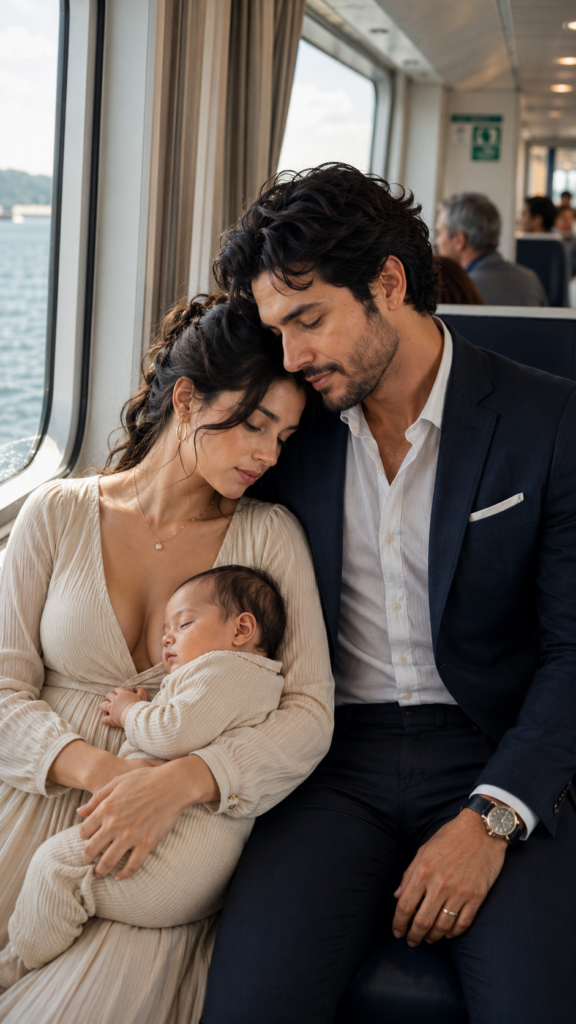
Valeria's head fell accidentally onto the shoulder of that stranger.
When she jolted awake, a horrible embarrassment washed over her.
—Oh, I’m sorry… I didn’t mean to...
But he didn’t flinch.
He didn’t look disgusted.
He didn’t complain.
He looked at Lupita, then at Valeria, and said in a low voice:
—You’re at your limit.
It wasn’t a question.
It was a truth.
The flight attendant returned.
—Sir, please remain in your seat.
Then the man stood up.
The entire cabin went silent.
He pulled out a black card from his jacket and discreetly showed it.
The flight attendant’s expression changed in seconds.
—Mr. Cárdenas… I’m sorry, I didn’t know you...
—You didn’t need to know —he replied—. But you should have noticed that this woman has been apologizing for a tired baby for the past twenty minutes while everyone here complains and no one lifts a finger.
Valeria felt her face burning.
Lupita continued to cry, though a little less now.
The man calmly extended his hands.
—May I?
Valeria hesitated.
Lupita was her responsibility.
Her entire world.
But her arms trembled.
And his gaze held no pity.
It was respect.
Valeria handed the baby over.
The man cradled her against his chest with unexpected steadiness and began to rock her slowly, following the hum of the airplane.
Lupita hiccupped.
Then cried more softly.
Then she was staring at the shiny button on his jacket.
And finally, amidst the silence of everyone, she stopped crying.
No one knew what to say.
The flight attendant swallowed.
—We have a free seat in first class. I could authorize a change.
Valeria immediately shook her head.
—No, I can’t afford that.
The man looked at her.
—You’ve already paid enough.
—There’s only one seat —the flight attendant warned.
—Then give it to her —he said—. I’ll stay here.
Valeria froze.
—You can’t do that.
He smiled just a little.
—Of course I can sit in an airplane seat.
Minutes later, Valeria walked toward the front with the diaper bag slung over her shoulder while the powerful stranger carried Lupita as if he had known her all his life.
The passengers who had been judging her no longer dared to look.
When Valeria settled into the spacious seat, with a soft blanket over her legs and warm water to prepare formula, her eyes filled with tears.
—Thank you —she whispered.
—What’s her name? —he asked.
—Guadalupe. I call her Lupita.
—And you?
—Valeria.
—Rest, Valeria.
She wanted to respond, but her body gave in.
She slept with Lupita pressed against her chest.
When they landed in Mexico City, she woke up with a tight heart.
She had messages from Renata.
“Did you arrive or not?”
Nothing more.
Not “how’s my niece?”
Not “I’m glad to see you.”
Valeria took a deep breath.
She took Lupita, stepped off the plane, and thought she would never see that man again.
But at the exit, a driver held a sign with her name.
VALERIA MORALES.
She stood frozen.
And then she heard a voice behind her:
—The road to Valle de Bravo is long. You shouldn’t do it alone with a baby.
Valeria turned.
The man from the plane was there.
And just as she was about to reject him out of pride, her cell phone vibrated with another message from Renata:
“I hope you found somewhere to stay. There are no rooms left here.”
Valeria felt the floor drop out from beneath her.
PART 2
Valeria looked at the message again and again.
There were no rooms.
No money.
No Plan B.
She only had 82 pesos on her card, a six-month-old baby asleep against her chest, and a sister who seemed to have invited her just to remind her that she was a burden.
The man from the plane, whom until that moment she only knew as Mr. Cárdenas, observed her face without intruding.
—I’m not going to decide for you —he said—. But the car is available. If you want to use it, go ahead. If not, I can also call you a safe taxi.
Valeria clenched the diaper bag.
—Why are you doing this?
He took a moment to answer.
—Because my mother crossed half the country with two children and thirty pesos in her pocket. She always said that the worst part of needing help wasn’t the need itself, but the gaze of others.
Valeria swallowed.
—My mother used to say something similar.
—Then maybe you both were right.
She wanted to say no.
That she could do it alone.
That she didn’t need favors from a rich man in a pristine suit.
But Lupita stirred, gave a tiny whimper, and Valeria felt that fatigue that seeps into your bones.
She got into the car.
On the way to Valle de Bravo, rain began to hit the windows.
The pine trees appeared through the fog like green shadows, and Valeria thought about her mother, that little tin house in Tijuana, about Renata and her washing dishes together when they were girls.
Before everything fell apart.
Before the illness.
Before Renata went to study in Toluca on a scholarship and Valeria stayed behind caring for their mother.
Before every call ended in a fight.
“I also sent money,” Renata would say.
“But I bathed her, I carried her, I watched her fade,” Valeria would reply.
And after the death, silence.
When they arrived at the hotel where the wedding would take place, Valeria felt like she didn’t belong there.
Everything was fine wood, white flowers, waiters in vests, women in fancy heels, and men in expensive suits.
She wore worn sneakers, her hair hastily tied up, and a milk stain on her blouse.
At the reception, she gave her name.
The young woman checked the computer.
Then she did that pause Valeria already knew.
The pause of bad news.
—I’m sorry, ma’am. There’s no room under your name.
—My sister made a reservation in the family block. Renata Morales. Or Renata Salinas, for her fiancé.
The receptionist checked again.
—The block is full.
Valeria felt heat rise in her face.
She moved aside with the stroller before breaking down right there.
She sat in an armchair next to a cold fireplace.
She wasn’t going to cry.
Not again in public.
—Valeria?
The voice made her lift her head.
Mr. Cárdenas was at the entrance, his jacket wet from the rain.
Valeria frowned.
—Are you following me?
—No —he replied, surprised—. I have a board meeting here. The hotel has private rooms.
—Of course. Because this place even has millionaire meetings.
He smiled faintly but then glanced toward the reception.
—What happened?
—Nothing.
He didn’t insist.
He just waited.
And that was worse.
—There’s no room —she admitted—. My sister thought I wasn’t coming.
—I can help look for another hotel.
—I don’t want you to rescue me again.
—That’s fine.
That response disarmed her.
She didn’t argue.
He didn’t make her feel ungrateful.
He just stayed there, calm.
—Accepting help doesn’t make you any less strong —he said—. Sometimes it just prevents the day from breaking you further.
Valeria looked down.
Her mother used to say things like that too.
Then a voice sounded from the staircase.
—Vale?
Valeria turned.
Renata was there.
Perfect.
Cream-colored coat, flawless makeup, hair up, shiny nails.
For a second, Valeria saw their young mother in her face.
Then she saw the woman who had been speaking to her like she was a debt owed for years.
Renata first looked at Lupita.
Something shifted on her face.
Then she looked at the man.
And went pale.
—What are you doing with him? —she asked.
Valeria stood up.
—I came to your wedding.
—I’m not talking about that. I’m talking about him.
The man extended his hand.
—Congratulations on your wedding, Miss Morales.
Renata didn’t take it.
Valeria looked at both of them.
—Do you know each other?
Renata clenched her jaw.
—Everyone knows Alejandro Cárdenas.
Alejandro.
Valeria didn’t even know his name.
—He helped me on the plane —she explained—. That’s all.
Renata didn’t seem to believe her.
—I need to talk to my sister.
Alejandro nodded.
—Of course. Valeria, my offer still stands. Only if you ask for it.
He walked toward the private rooms.
Renata watched him leave as if he carried a secret on his back.
—Why do you care so much? —Valeria asked.
Renata took a deep breath.
—My fiancé works for his company.
—And so what?
—Tomorrow morning, before the wedding, they’re going to vote on a huge project. Alejandro presides over the board.
Valeria crossed her arms.
—I still don’t understand.
Renata led her to her suite.
There, among flowers, suitcases, and a wedding dress hanging like a white ghost, the tension became unbearable.
Lupita woke up and smiled upon seeing Renata.
A tiny, innocent smile.
Renata covered her mouth.
—She’s huge.
—She’s six months old.
—I know.
But she said it as if she had just discovered it.
Valeria couldn’t hold back.
—Why did you invite me if you didn’t want me to come?
Renata closed her eyes.
—I did want to. But I didn’t know how to see you.
—Well, here I am.
Renata looked at the dress.
—I should have come back more when mom got sick.
The statement fell between them like a stone.
Valeria felt all her grievances get stuck in her throat.
She had waited years to hear that.
But it no longer sounded like victory.
It sounded late.
—I should have answered you after the funeral —Valeria said—. I wanted to hate you because it was easier than missing you.
Renata cried silently.
—Mom asked me to take care of you.
—I was asked to forgive you too.
Lupita babbled, as if she wanted to join the conversation.
Renata approached slowly.
—May I hold her?
Valeria hesitated.
Then nodded.
Renata took Lupita with clumsiness and tenderness.
The baby tugged at a loose strand of hair.
Renata let out a broken laugh.
—She looks like mom.
—Her name is Guadalupe Elena —Valeria said—. Just like her.
Renata stood still.
—You never told me.
—You never asked.
Renata lowered her head.
—You’re right.
For the first time in years, neither wanted to win.
But the calm didn’t last long.
The door opened without knocking.
Andrés Salinas, Renata’s fiancé, walked in.
Handsome, elegant, with a commercial smile.
The smile faded when he saw Valeria and then Lupita in Renata’s arms.
—I didn’t know you had arrived —he said.
—It shows —Valeria replied.
Renata tensed.
—Andrés, we need to talk about the project.
He looked at her warningly.
—Not now.
—Yes, now.
Valeria felt the air change.
—What project?
Renata went to her bag and pulled out a folder.
She handed it to Valeria with trembling hands.
Valeria read the cover.
“Cárdenas Foundation. Temporary housing for single mothers in vulnerable situations.”
The project sounded nice.
Too nice.
Until she saw the address.
Her building in Tijuana was marked for acquisition and demolition.
Valeria felt cold.
—Are you going to buy where I live?
Andrés shut the door.
—Don’t say it like that. It’s an unsafe area. The idea is to build better homes.
—And when were you going to tell us who live there?
—When it was approved.
—So, when we couldn’t do anything.
Renata looked at Andrés in horror.
—You told me the neighbors would be relocated from the start.
—That’s in the plan.
—In the plan? —Valeria repeated—. My daughter sleeps there.
Andrés removed the mask of the nice guy.
—Precisely why the case worked.
The room turned cold.
Renata took a step back.
—What did you say?
Andrés sighed, exasperated.
—I used a real profile to present the project. A young mother, a waitress, alone, with a baby, living in a deteriorating building. It was moving. We needed the board to understand.
Valeria felt nauseous.
—You used my life?
—I didn’t put your name.
—But you used my misery.
Andrés fell silent.
And that silence confessed everything.
Renata looked as if she were about to fall.
—You told me it was social research.
—It was.
—It was my sister, you jerk.
At that moment, Valeria's phone vibrated.
Unknown number.
“Mrs. Morales, I’m Alejandro Cárdenas. I need to speak with you before the rehearsal dinner. It’s about your daughter and the name Guadalupe Elena.”
Valeria read the message twice.
Andrés tried to move closer.
—Don’t answer.
Renata looked at him.
—Why not?
Andrés lost his color.
Valeria opened the door and stepped out with Lupita in her arms.
Alejandro was waiting for her at the end of the hallway.
He didn’t look surprised.
He looked sad.
—How do you know my daughter’s full name? —Valeria asked.
Alejandro took a deep breath.
—Because your mother, Elena Morales, worked for my family in Guadalajara for twelve years. She was the woman who took care of my younger sister when my father died. She was the person who taught me that money is useless if one doesn’t know how to look at the person in front of them.
Valeria felt the world bend.
—My mother never spoke of you.
—Because she left that job to return to you. And because my family didn’t treat her as she deserved in the end.
Alejandro opened a folder.
—Two months ago, I received an old letter from Elena. A notary found it among pending documents. She asked that if anything happened to her, we help her daughters not to lose each other.
Valeria covered her mouth with her hand.
Renata appeared behind her, crying.
Alejandro continued:
—When I saw your last name on the plane, I wasn’t sure. When I heard the name Guadalupe Elena, I understood.
Andrés came running.
—Mr. Cárdenas, this has nothing to do with the vote.
Alejandro looked at him with terrible calm.
—On the contrary. It has everything to do with it.
That night, at the rehearsal dinner, Andrés tried to act as if nothing was wrong.
But Alejandro requested the floor in front of family, partners, and board members.
He didn’t raise his voice.
He didn’t make a scene.
He just told the truth.
That a supposedly humanitarian project had used the real story of a woman without her consent.
That the relocation of neighbors was not guaranteed.
That Valeria’s poverty had been turned into a sales pitch.
The hall fell silent.
Renata took off her ring in front of everyone.
—I can’t marry someone who looked at my family as material for a presentation.
Andrés tried to defend himself.
No one believed him.
The wedding was canceled that same night.
The next day, the board rejected the project as it stood.
Alejandro announced a complete review, with participation from the neighbors, clear contracts, paid relocation, and priority for families to return if they wished to.
Valeria didn’t accept personal money.
She accepted something far more difficult.
She accepted to be heard.
Weeks later, she and Renata returned to Tijuana together.
Not as perfect sisters.
Not as if the pain had vanished.
But as two women tired of turning pride into a prison.
On the return flight, Lupita began to fidget.
Valeria grew anxious.
Renata looked at her, smiled, and extended her arms.
—Here, let me have her. Maybe now she’ll forgive me for coming late to her life.
Valeria handed her over.
And when Lupita calmed down on her aunt's shoulder, Valeria understood something her mother had tried to teach them all along:
Sometimes family isn’t saved with grand speeches.
Sometimes it’s saved when someone finally stops judging and dares to carry the weight with you.





