PART 1
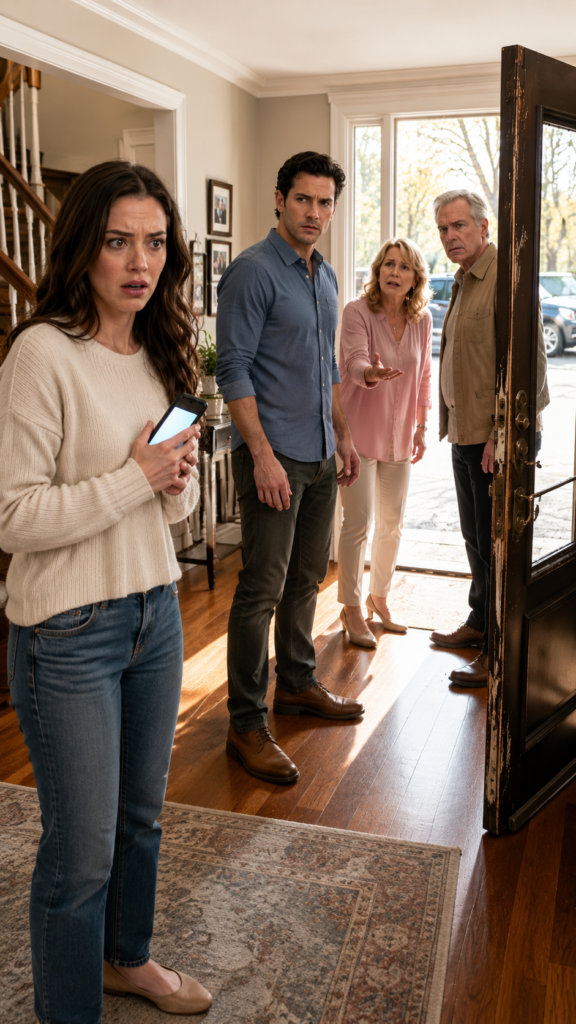
The pounding started at 6:12 in the morning.
These weren't normal knocks. They were hard fists striking against the front door, loud enough to rattle the windows in the foyer.
—Camila! —shouted Bárbara, her mother-in-law—. Open up right now! We know you're in there!
Camila descended the stairs in her robe, cellphone in hand, her heart tight. The house in Querétaro remained shrouded in darkness, with that blue light of dawn making everything feel like a dream.
But it wasn't a dream.
Arturo, her father-in-law, pounded once more.
—Don’t make this worse. We need to talk.
Need.
Not “we want to.”
Not “please.”
Need.
Camila glanced at her phone screen. Her mother's message was still there, sent just 4 minutes earlier.
Don’t open. No matter what, don’t open.
The night before, Camila had thought Doña Rebeca was exaggerating.
Her mom had always been like that: quiet, observant, the kind of woman who never raised her voice but could say one sentence that would keep you up all night.
Three days earlier, Camila had sold her financial software company for 15 million dollars.
Fifteen million.
A figure that still didn’t fit in her head. She had built NidoConta from a rented room in Roma, then from a coworking space in Del Valle, and finally from a small office in Santa Fe.
For years, she ate cookies in front of the computer, took out loans, cried in bank parking lots, and sold some of her grandmother's earrings to pay overdue salaries.
When she signed the sale, Daniel, her husband, hugged her in the elevator.
—We did it —he whispered.
Camila didn’t correct him.
She should have.
Because that very night, Daniel's family changed.
Bárbara sent hearts, blessings, and a picture of champagne. Arturo called her “daughter” for the first time in 5 years.
Before that, Camila had been “Daniel's wife” or “the one with the computers.” At family meals, Arturo talked business with his son, then would ask her:
—And how’s that app of yours?
Her “that app of hers” had just bought her freedom.
And apparently, it had also awakened a family that thought that freedom belonged to them.
Daniel came barreling down, barefoot, pale.
—Who is it?
Camila barely had time to respond.
—Daniel! —Bárbara shouted from outside—. Tell your wife to open up!
Your wife.
Not Camila.
Not daughter.
Your wife.
Daniel’s face barely changed, but she noticed. She knew him too well. That slight tightening of his jaw was guilt.
—Why are your parents here at 6 in the morning? —Camila asked.
He swallowed hard.
—Let me talk to them.
—No. Call the police.
Daniel didn’t move.
That silence froze her blood.
—Daniel —she repeated—. Call the police.
He opened his mouth but said nothing.
Outside, Arturo shouted:
—We don't have time for your tantrums!
Then Bárbara said something softer, but Camila caught it.
—She lied to us.
Twenty-four hours earlier, Doña Rebeca had been sitting in that very kitchen, a cup of tea in front of her.
—Tell them you’re broke —she said.
Camila laughed.
Her mother didn’t.
—Tell them the sale had legal issues, that the money is frozen, and you can’t touch a penny.
—Mom, why would I do that?
—Because people rebel when they think they can’t use you anymore.
Camila made the call with Daniel sitting next to her. She told her in-laws that the sale had hit a snag.
On the other end, there was an odd silence.
It wasn’t concern.
It was calculation.
Arturo hung up without a goodbye.
Doña Rebeca simply said:
—Now wait.
She didn’t have to wait long.
The door shook again. A crack appeared next to the frame.
Daniel stepped in front of Camila, but not looking toward the threat.
He was looking at her.
—Step aside —Camila said.
—Please, let me talk to them for 30 seconds.
—You had all night.
—I didn’t know they were coming.
—That doesn’t save you.
Camila answered her mother’s call without taking her eyes off him.
—Are they there? —Doña Rebeca asked.
—Yes.
—Is Daniel helping you?
Daniel listened.
Camila took a deep breath.
—No.
He turned pale.
—Go to the laundry room —her mother ordered—. I’ve already called 911. I’m on my way.
Camila took a step, but Daniel grabbed her arm.
Not hard.
Just enough.
She looked at his hand. He let go.
—There’s something you don’t know —Daniel said, his voice shaky.
—What a surprise.
—My dad is in trouble.
—And that’s why he’s here banging on my door?
—It’s money.
—How much?
—I don’t know everything.
—That’s not helpful.
Daniel ran his hands over his face.
—He took out loans against his company, against the house, and then with private lenders. Heavy people, Camila.
She felt the ground shifting beneath her.
—What does that have to do with me?
Daniel closed his eyes.
—My dad promised them you would pay.
The phrase hit like a stone.
—He promised them my money?
Daniel didn’t answer.
In that instant, the door burst open.
Bárbara entered first, disheveled, wearing a beige coat over her pajamas.
Arturo appeared behind her.
His eyes went straight to Camila.
—There she is —he said—. The little millionaire.
PART 2
Daniel stepped in front.
—Dad, get out of my house.
Arturo let out a dry laugh.
—Now you’re going to play husband?
Bárbara turned against her son.
—You told us you could convince her.
The foyer fell silent.
Camila looked at Daniel.
He closed his eyes.
There are phrases that hurt not just because they cut, but because they rearrange the past like pieces of a horrible puzzle.
You told us you could convince her.
Camila remembered when Daniel had asked her a year before to help his dad with a “temporary liquidity problem.” She had said no. Arturo had never given her confidence.
Daniel hadn’t insisted.
Now she understood why.
She also remembered Bárbara asking if they had separate accounts, if Daniel was listed in the company papers, and if Camila believed in “sharing everything in marriage.”
At that moment, every question stopped seeming casual.
—You knew they wanted my money —Camila said.
Daniel opened his mouth.
Arturo answered first.
—Of course I knew. He’s my son.
The phrase destroyed something in Daniel.
But it didn’t repair anything for Camila.
Bárbara approached, tears flowing quickly.
—Camila, this has spiraled out of control.
—You broke down my door.
—Arturo made mistakes, but he wanted to protect the family.
—No. He wanted to save himself.
Bárbara’s face changed.
There was the true her. Not the sweet lady who brought flan to gatherings. The other one, the cold one, hiding beneath “mijita.”
—Do you have any idea the embarrassment we’re going through? —she shot back.
Camila almost laughed.
—Your embarrassment is not the emergency here.
Arturo took a step toward her.
—Listen to me carefully. You’re going to call your bank. You’re going to authorize a transfer, and you’re going to stop playing coy.
—To whom? —Camila asked.
Arturo blinked.
—To a company.
—What name?
—Don’t be difficult.
—What amount?
Bárbara looked down.
Daniel turned.
—How much, Dad?
Arturo clenched his jaw.
—How much? —Daniel repeated.
Bárbara whispered:
—800 thousand dollars before noon.
The number filled the house.
800 thousand dollars.
Enough to buy a life. Enough to ruin another.
—No —Camila said.
Bárbara looked at her as if she had insulted a corpse.
—You don’t understand. These people don’t wait.
—Then they shouldn’t have borrowed money from them.
Arturo lost control. He lunged at her and grabbed her wrist.
Not enough to break anything.
Just enough for everyone to understand who he truly was.
—Give me the phone —he ordered.
Camila looked at his hand.
Then she looked at Bárbara.
Her mother-in-law said nothing.
That was the exact moment Camila stopped being confused.
They weren’t desperate because they cared about her.
They were desperate because they had lost access.
Daniel shoved his father.
—Don’t touch her.
Arturo stepped back, offended, as if the greatest betrayal was that his son defended his wife.
Then tires screeched outside.
A black truck slowly passed in front of the house. Then another.
The first parked next to the curb. The second stayed two houses down.
No one got out.
That was worse.
Bárbara started to cry for real.
Daniel grabbed Camila by the shoulders.
—Laundry room. Now.
This time she obeyed.
As they crossed the kitchen, Bárbara begged behind them:
—Arturo, fix this.
Fix this.
As if it were a water leak.
As if they hadn’t turned Camila into collateral for a debt that wasn’t hers.
Daniel closed the laundry room and moved the washing machine.
—What are you doing? —she asked.
—There’s a panel. It leads to the space under the house and exits near the garage.
—Since when do you know that?
—Since I found the first loan document and started checking for exits.
Camila looked at him with rage.
—You found documents and didn’t tell me.
He stopped.
—I thought I could contain it.
There it was.
The phrase of men who want credit for secrets that protected no one.
—You thought you could put out a fire by hiding the smoke.
Daniel didn’t argue.
A male voice came from outside, calm and horrible.
—Mr. Mendoza. Time is up.
Camila felt her legs buckle.
The voice returned.
—Open the door and bring Camila out.
It didn’t sound like a movie threat.
It sounded like someone collecting a debt.
Daniel opened the panel.
—Get in.
—I’m not going in there while you stay with your dad.
—I’m not choosing him.
—You already did.
The phrase hit her square in the face.
Then someone shouted from the street:
—Police! Hands up!
Another voice:
—Prosecutor’s office! On the ground!
Arturo shouted:
—No! Wait!
Bárbara screamed.
Daniel shoved the washing machine all the way.
—Go.
This time Camila entered.
She crawled through dust, cold concrete, and the smell of dampness. Daniel followed behind and closed the panel.
The passage ended in the garage. They emerged behind some Christmas boxes.
Through the little window, Camila saw patrol cars blocking the street. Three men from the black trucks had their hands up. One was on his knees. Neighbors watched from windows and cracked doors.
A gray car stopped crooked behind a patrol car.
Doña Rebeca got out before turning off the engine.
She looked small among the police and vests.
But to Camila, she was the only solid thing in the world.
The garage door went up.
—My daughter! —Doña Rebeca shouted.
A police officer tried to stop her, but Camila rushed out.
—Mom.
Doña Rebeca’s face broke. She didn’t make a scene. Just breathed as if fear was leaving her in a rush.
She hugged her tightly.
—You’re safe now, honey.
Camila didn’t faint.
It would have been easier.
Instead, she leaned against her mother in front of the house she had thought was safe, while Daniel stood behind, covered in dust and shame.
Arturo came out in handcuffs.
He didn’t look repentant.
He looked angry that someone had seen him fall.
As he passed by Camila, he muttered:
—You made this worse.
Doña Rebeca stepped forward.
—No. She just made it visible.
Hours later, Detective Morales explained everything in the kitchen.
Daniel had gone to the prosecutor’s office 8 weeks earlier. He found inflated invoices, ghost suppliers, a second mortgage, and strange withdrawals from his father’s company. Then they discovered lenders linked to an extortion network.
—Mr. Mendoza couldn’t offer you his money —Morales said—, but he assured that he could influence you through your husband.
Camila looked at Daniel.
—Did he give them my address?
Daniel looked down.
Morales replied:
—Yes. He provided it as leverage.
Doña Rebeca squeezed her daughter’s hand.
Daniel spoke, almost in a whisper.
—Last night I left a message for the detective. I told them something might happen.
—But you didn’t tell me —Camila replied.
He closed his eyes.
—No.
That was the truth that hurt the most.
Daniel had called the authority.
But he hadn’t trusted his wife.
Bárbara tried to approach later, wrapped in a blanket.
—Camila, I’m sorry. I didn’t know everything.
—No —Camila said—. But you knew enough to ask my mom if Daniel was on the papers of my company.
Bárbara turned red.
—I was worried about my family.
—You were worried about access.
The woman made a pained face.
That trick didn’t work anymore.
—You came at dawn, banged on my door, asked your son to convince me, and watched as Arturo grabbed me without saying a word.
Bárbara clutched a handkerchief.
—I was scared.
—I was too.
It was a short phrase.
And a closed door.
That afternoon, Camila went to her mother’s house. Daniel asked if he could come with her.
—No.
He accepted the word like one receives a sentence.
At the entrance, with the door covered by a makeshift board, Daniel said:
—I love you.
That hurt more than if he had stayed silent.
Because Camila believed him.
She believed he loved her. She believed he tried to protect her in his twisted way. She believed he had spent his life calming Arturo, covering Bárbara, and hiding family disasters before the neighbors found out.
She also believed he chose the secret over trust.
And those two truths didn’t cancel each other out.
—Maybe you love me —she said—. But you didn’t give me the truth. And I’m not something to be managed.
Daniel cried in silence.
—I know.
In the car, Camila asked:
—How did you know I had to lie?
Doña Rebeca took a moment to answer.
—Your uncle Roberto was just like Arturo. He asked for money for businesses, emergencies, debts. Once he wanted your dad to give him the savings from our house. I told him that if he did, I would still love him, but I wouldn’t build a life with someone who gave away our future to another’s emergency.
Camila had never heard that story.
—Was it worth it?
Doña Rebeca parked in front of her small house, with bougainvillea at the entrance.
—We bought this house.
Camila understood.
Her mother hadn’t taught her distrust.
She had taught her boundaries.
The following weeks weren’t like a movie.
They were lawyers, new passwords, cameras, statements, therapy, trusts, and separate accounts.
The sale closed without problems. The 15 million were legally protected solely in Camila’s name.
There was no champagne.
Just a bank confirmation on a screen.
Camila thought she would feel happiness.
She felt responsibility.
The money, she understood, didn’t just provide comfort. It also illuminated cracks. It showed who believed they deserved the key to your door. It attracted sudden relatives, opportunistic friends, and frightened family members who confused your effort with their salvation.
But it also built fences.
Legal fences.
Healthy fences.
Fences that allowed generosity to remain generosity and not obligation.
Arturo ended up charged with fraud, extortion, and association with an illegal lending network. In court, his lawyer spoke of stress and bad decisions.
Then the Public Ministry played the audio from Camila’s cellphone.
—You’re going to call your bank. You’re going to authorize a transfer and you’re going to stop playing coy.
The room went silent.
The judge looked at him over her glasses.
—You didn’t make a mistake, Mr. Mendoza. You made a series of decisions, and when they caught up with you, you tried to turn your daughter-in-law into payment collateral.
Bárbara closed her eyes.
Daniel stared ahead.
Camila breathed.
Arturo lost his company, his house, his reputation, and his freedom.
Daniel and Camila were separated for 6 months.
He went to therapy, testified against his father, and learned to tell his mother words he should have said years earlier.
No, Mom, Camila is not a financial topic.
No, Mom, I’m not going to ask her for anything.
No, Mom, Dad’s consequences are not my emergency.
That mattered.
It didn’t fix everything.
But it mattered.
When Camila bought another house, she didn’t choose a mansion. She chose a quieter home, with a strong door and a kitchen filled with light.
Daniel helped move boxes, but didn’t assume he would live there.
He asked before opening drawers.
He left his phone face up when calling his mom.
He said uncomfortable truths before they turned into fires.
Months later, Camila accepted to start over.
Not continue.
Start.
There’s a difference.
They signed a postnuptial agreement, maintained separate accounts, and let the old marriage die, the one where he hid and she trusted too much.
They built another one, slower and less pretty for photos, but more real.
Bárbara asked to see her three times.
Camila said no the first two times.
The third time, she accepted for a coffee.
Bárbara arrived older, less perfect.
—I thought being loyal meant staying by my husband no matter what —she said—. Now I know that sometimes loyalty to the wrong is just fear with good manners.
Camila looked at her.
—You used me because you were scared.
Bárbara dropped her head.
—Yes.
That was the only thing Camila respected: that she didn’t adorn it.
—Maybe one day I’ll forgive you —she said—. But I will never put my life where your fear can touch it.
Bárbara nodded.
She didn’t ask for a hug.
That also mattered.
Two years later, Camila was giving workshops to women entrepreneurs in Mexico City. A 63-year-old woman raised her hand and asked:
—How does one know whom to trust when things finally go well?
Camila thought of the broken door, her mother’s message, Daniel trembling, Bárbara silent, and Arturo handcuffed.
Then she answered:
—Trust those who respected your boundaries before knowing your worth.
That night, in her kitchen, she listened to an old audio from Doña Rebeca.
“Tell them you’re broke, honey. Don’t argue. Just say it and listen to what happens next.”
Camila played it one more time.
Before, she thought her mother had taught her to set a trap.
Now she understood that she had taught her to listen.
Because money doesn’t change people that much.
It gives them permission.
The greedy become urgent.
The fearful become dangerous.
The abusive take offense when they lose access.
The loyal protect.
And the wise tell you to close the door before the banging starts.





