PART 1
Eulalia Moreno was released from the Santa Martha prison with a signed apology, a government check, and six years of shattered life.
They told her it had all been "a mistake."
Just like that, as if a woman could reclaim six years of confinement, humiliation, sleepless nights, and an entire neighborhood calling her a murderer with a letterhead.
She refused to cash the check.
She tucked it away in an old box, along with the trial papers, the newspaper clippings, and the sentence that had condemned her for the death of a child.
Then she rented a small space in Iztapalapa, near a market where they still sold cactus in buckets and chicken in black bags.
She painted the walls white, set up six plastic tables, bought large pots, and hung a handmade sign:
"COMMUNITY DINING ROOM."
Eulalia didn’t smile much.
She was tall, strong, with arms built for carrying sacks of rice and a hard gaze that frightened even when she said good morning.
That's why people whispered as she passed.
—There goes the one from Santa Martha.
—They say she killed a child.
—Don't get too close, kid.
For three weeks, she cooked noodle soup, red rice, beans, zucchini with corn, and chicken stew.
No one came in.
The food grew cold on the trays while flies buzzed over the empty tables.
Eulalia closed up each night with a tight throat, but the next day, she would light the stove again.
She didn’t do it to be liked.
She did it because in prison, she swore that if she ever got out, no child would sleep hungry near her.
One Tuesday, when the heat made the sidewalk shimmer, a skinny girl stood in front of the door.
She wore broken sneakers, a backpack hanging from one shoulder, and scraped knees.
She looked at Eulalia without fear.
—My mom says you’re good —she blurted—. That you shouldn’t listen to the people. That you’d never close the door on a child.
Eulalia stood frozen, ladle in hand.
—What’s your name?
—Danna.
She served the girl a huge plate.
The child ate as if someone would snatch it away.
—Slow down, sweetie —Eulalia said.
—I haven’t had a hot meal in two days.
The next day, Danna returned with her little brother, Toñito.
On the third day, their mother appeared, a thin woman with deep dark circles and a shopping bag pressed against her chest.
—I’m Graciela… but everyone calls me Chela —she murmured from the entrance—. Forgive me.
Eulalia looked at her with suspicion.
—Are you going to eat or are you going to ask for forgiveness on an empty stomach?
Chela lowered her head and stepped inside.
From that day on, everything changed.
Danna began bringing other children.
Then came ladies with babies, elderly folks without pensions, construction workers without jobs.
The butcher from the market donated bones for broth on Fridays.
The baker brought day-old rolls.
A retired teacher started serving hibiscus water.
Eulalia’s once-empty dining room filled with voices, laughter, spoons clanking against plates, and children asking for more tortillas.
Chela was the first to arrive and the last to leave.
She peeled potatoes, washed dishes, swept the place, and arranged chairs without anyone asking her to.
But every time someone talked about “the one from the case,” Chela would slip into the kitchen and fall silent.
One midday, Danna hugged Eulalia around the waist and said something that left her frozen:
—You look like my brother Beto. He was big like you and took care of me. But he’s in heaven now.
The ladle fell to the floor.
That very afternoon, a neighbor brought old newspapers to wrap bread.
One featured a photo of Eulalia handcuffed, leaving the courthouse.
Chela saw it.
The plate she held shattered on the ground.
She turned pale, trembling in front of that photo.
And then Eulalia remembered that face.
Not from the neighborhood.
Not from the dining room.
She remembered it sitting in a courtroom, raising her hand, swearing to tell the truth… and pointing at her as guilty.
PART 2
That night, Eulalia couldn’t close her eyes.
She pulled the old box from the closet and set it on her bedroom table.
There lay everything she had wanted to bury: the sentence, the red notes, the statements, the witness list.
She read with trembling hands.
Graciela Hernández López.
Key witness.
The woman who claimed to have seen Eulalia near the room where the child died.
The one who said Eulalia had a “violent character.”
The one who repeated before the judge that a woman like her was capable of anything.
That woman was Chela.
The same one who had been washing dishes in her dining room for weeks.
The same one who sent Danna with that perfect line.
The same one who now ate from her hand.
Eulalia continued reading until she found the name of the dead child.
Roberto Hernández López.
Beto.
Chela’s son.
Danna’s brother.
The file said the child had drowned in a tub while his mother had stepped out for “a few minutes” to buy milk.
But the trial had ended up blaming Eulalia because she owned a little eatery nearby, because she was big, because she yelled when she got angry, because no one in the neighborhood dared to defend her.
The next day, Chela arrived early as always.
She brought her folded apron and a bag of poblano peppers.
Eulalia waited until the children were eating and took her to the back of the kitchen.
She placed the newspaper in front of her.
—Why? —she asked.
Chela didn’t pretend to be surprised.
She just closed her eyes.
—Because someone had to pay.
Eulalia felt the air leave her.
—And it had to be her?
Chela twisted the rag between her fingers.
—People were already afraid of you. You yelled a lot. You were strong. No one would doubt.
Eulalia felt the floor shift beneath her.
Six years.
Six years hearing doors slam shut.
Six years sleeping with one eye open.
Six years enduring being called a murderer for someone else’s carelessness.
—Get out —she said in a voice so low it was scarier than a scream.
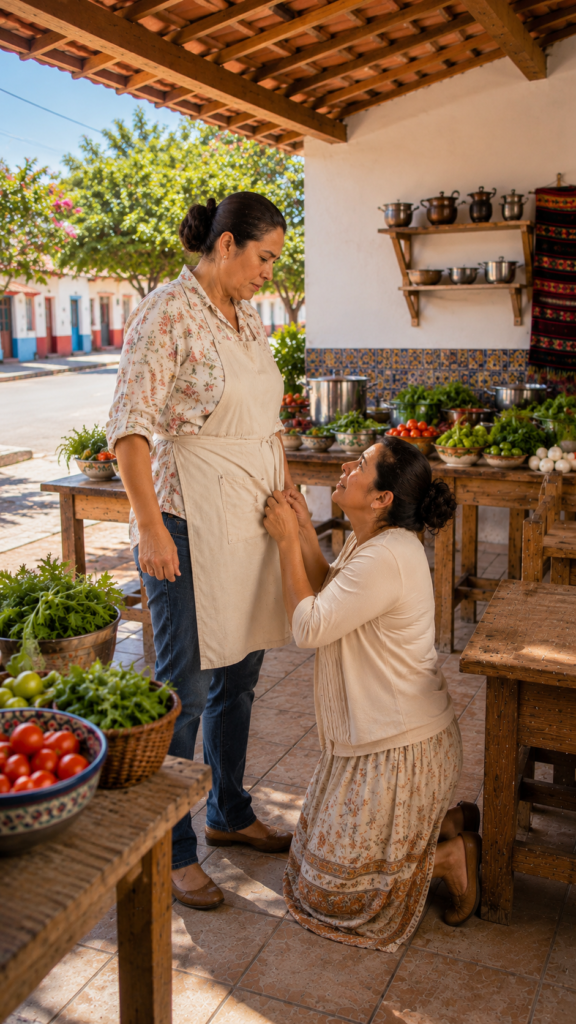
Chela fell to her knees.
—Blame me, report me, do what you want. But don’t close the door on my children. They are not to blame.
Eulalia looked toward the dining room.
Danna was sitting at the usual table, eating rice with mole, her cheeks finally plump.
The girl who had brought noise back to that place.
The little sister of the boy for whom she had lost six years.
Chela grasped Eulalia's apron.
—I knew you wouldn’t let her go hungry —she whispered—. That’s why I sent her to you.
That phrase pierced her like a knife.
Chela hadn’t come by chance.
She had used the only thing Eulalia still had clean: her inability to abandon a child.
What had turned her into a monster in the trial, now she was using as a key.
Eulalia raised her hand.
Chela closed her eyes, expecting the blow.
But before anything happened, the woman doubled over on the floor with a horrific cough.
She coughed once.
Then again.
When she pulled her hand away from her mouth, it was stained with blood.
Eulalia stood paralyzed.
—What’s wrong? —she asked, hating herself for sounding worried.
Chela tried to wipe herself with her sleeve.
—Nothing.
—Don’t say nonsense. That’s not nothing.
She sat her on a chair, brought her water, and closed the kitchen door.
Chela took time to speak.
—Stomach cancer. They found it late. The doctors say there’s not much to be done now.
Eulalia pressed her lips together.
The anger was still there, but it started breaking into strange, uncomfortable pieces.
—Is that why you came?
Chela looked toward Danna.
No words were needed.
Eulalia understood.
—You didn’t come for food.
Chela shook her head.
—I came because when I die, they have no one. Their father left years ago. My mom can’t even carry Toñito anymore. And in this whole neighborhood, the only person who gives a plate to a child without asking whose child they are… is you.
Eulalia remained still.
The woman who had sent her to prison was asking her to take care of her children.
The children of the lie.
The blood of Beto.
—Why me, Chela? —she finally asked—. Out of everyone in the neighborhood, why did you choose me to sink?
Chela covered her face.
And then she told what she had never said in the courtroom.
Beto wasn’t an easy child.
He was nine years old, big-bodied, clumsy hands, and had epileptic fits since he was little.
When he had one, he would go stiff, his eyes would roll back, and he would crash against anything nearby.
Before prison, Eulalia had a little eatery with three tables and a griddle.
Beto would come in every afternoon because Chela worked cleaning houses and had no one to leave him with.
Eulalia took care of him.
She gave him hot tortillas, served him beans before the customers, and when he had a seizure, she would lay him on his side, move the chairs away, and talk softly to him until he came back.
—He loved you —Chela said, her voice breaking—. He said you were his second mom.
Eulalia sat down because her legs wouldn’t hold her.
She remembered Beto laughing with his mouth full.
She remembered his big hands stealing tortillas.
She remembered a rainy afternoon when he fell asleep on a little bench, and she covered him with his own apron.
That boy had been the closest thing she had to a son.
And no one warned her that she had him on loan.
—I warned you —Eulalia murmured.
Chela nodded, crying.
—You told me never to leave him alone in the water. Not for a minute. That if he had a fit in the tub, he was gone.
—And you left him.
Chela let out a dry sob.
—I went to the store. I thought it was five minutes. Danna was asleep. Beto was bathing. When I came back, he wasn’t moving anymore.
The entire kitchen seemed to run out of air.
—I pulled him out as best I could —she continued—. I screamed. I asked for help. But when the ambulance arrived, it was too late.
Eulalia said nothing.
—The first thing I thought… —Chela swallowed hard— wasn’t about Beto. God forgive me. The first thing I thought was of Danna. If she said I left him alone, they’d take my daughter too. I’d lose both my children.
—So you made up that I was there.
—Yes.
The word fell like a stone.
—And when I saw you were condemned, I wanted to fix it. But everyone was saying you were guilty. The police, the neighbors, the judge. I was scared. I was a coward.
Eulalia looked at her with hatred, compassion, and a sorrow so old she no longer knew where it began.
Chela wasn’t a villain from a novel.
She was a mother who lost a child due to five minutes of carelessness, and then had destroyed another woman to not lose the daughter she had left.
That didn’t make her innocent.
But it made her human.
That night, when the dining room closed, Eulalia pulled out the box again.
She didn’t know if she wanted to report Chela, burn it all, take revenge, or disappear.
She lit the griddle.
She took the trial papers and began bringing them closer to the fire.
She wanted to let go of that life.
She wanted to stop being the woman from Santa Martha.
But at the bottom of the box, she found a thick envelope she had never opened.
It was the one they had given her upon leaving prison.
The one with the signed apology.
The one with the check she had rejected without looking.
She almost threw it into the fire.
But something stopped her.
She opened it.
Inside wasn’t just the check.
There were letters.
Many.
More than thirty.
All written in the same crooked, insecure handwriting, full of mistakes.
They were from Chela.
Letters to the judge.
To the prosecution.
To public defenders.
To journalists.
To anyone who would listen to her.
The first one was dated three months after the conviction.
It said she had lied.
That Eulalia was innocent.
That Beto died from a seizure in the tub.
That she, Graciela Hernández López, had accused an innocent woman out of fear of losing her daughter.
Eulalia read one letter.
Then another.
Then another.
Chela had written for six years.
She had gone to offices, begged for hearings, met with slammed doors, mockery, and threats.
No one believed her at first.
But she kept going.
Year after year.
Until someone reopened the case.
Until the "error of justice" came to light.
Eulalia then understood the whole truth.
Chela had put her in prison.
But she had also spent six years trying to get her out.
Without asking for forgiveness.
Without seeking recognition.
Without telling her anything.
Just writing, insisting, wearing herself down inside until her body broke too.
Eulalia ran to Chela’s room that same night.
A neighbor told her that they had taken her to the Seguro hospital.
When she arrived, Danna was asleep in a chair, her little hand holding on to her mother’s.
Chela could barely breathe.
Eulalia approached.
She wanted to tell her that she had read the letters.
She wanted to tell her that she didn’t hate her the same way.
She wanted to tell her that they had both loved Beto in their own way.
But Chela didn’t open her eyes anymore.
She died before dawn.
Danna cried without understanding why Eulalia was also crying as if she had lost someone of her own.
Months later, the dining room remained open.
Busier than ever.
People no longer crossed the street to avoid Eulalia.
Now they brought her vegetables, rice, used toys, and blankets.
But she didn’t become kind overnight.
She still had a face that scared most.
She still scolded the children who wasted food.
She still said, “Come on, kid, eat well,” as if it were a threat.
Danna and Toñito stayed with her under a legal agreement that a neighborhood lawyer helped process.
Eulalia never told them the whole truth.
She told them their mother had loved them until the last day.
And that was also true.
Every afternoon, Danna sat at the table next to the stove.
The same one where Beto stole tortillas years ago.
Eulalia always served her first.
Always.
Even if there was a line.
Even if others complained.
—Why do I always get served first? —Danna once asked, with her mouth full of soup.
Eulalia tucked a strand of hair behind her ear.
—Because your brother taught me that trick.
Danna smiled without understanding.
Eulalia turned toward the pots so no one would see her eyes.
She never used the indemnity check for herself.
With that money, she bought the place, fixed the kitchen, and put up a small plaque next to the door:
"Beto's Dining Room. Here, no child goes hungry."
The neighborhood buzzed with comments.
Some said Eulalia was a saint.
Others said she was a fool for raising the children of the woman who destroyed her.
But she didn’t argue.
Because there were things people would never understand.
Forgiving wasn’t forgetting.
Taking care of Danna didn’t erase the six years in Santa Martha.
Loving those children didn’t make Chela innocent.
But closing the door on them would have meant letting the lie win again.
And Eulalia had already lost too much because of the fear of others.
That’s why the dining room never closed early.
Not when it rained.
Not when the street was empty.
The door remained open, with the smell of freshly made beans and hot tortillas.
In case any child came in hungry.
In case Danna returned running from school.
In case, in some way that no one could explain, Beto still found his way home.





