PART 1
When Captain Emiliano Rivas returned to San Pedro Garza García that night, the fog descended from the mountains like a white sheet.
It wasn't a snowstorm like in the movies, but the cold bit just the same.
The road was wet, the windshield covered in a thin sheet of ice, and the wind hit with such force that the pines seemed to bend.
He had been driving from Saltillo after 18 hours of service, still in uniform and his heart racing to see his wife and newborn baby.
In the truck, he carried a pink teddy bear.
It was for Regina, his 12-day-old daughter.
He also had a bouquet of poinsettias for Mariana, his wife, because this would be their first Christmas as a family of three.
But when he arrived at the gate of the Rivas' massive house, something forced him to slam on the brakes.
First, he saw a suitcase lying by the sidewalk.
Then he spotted a soaked shawl.
And then he saw her.
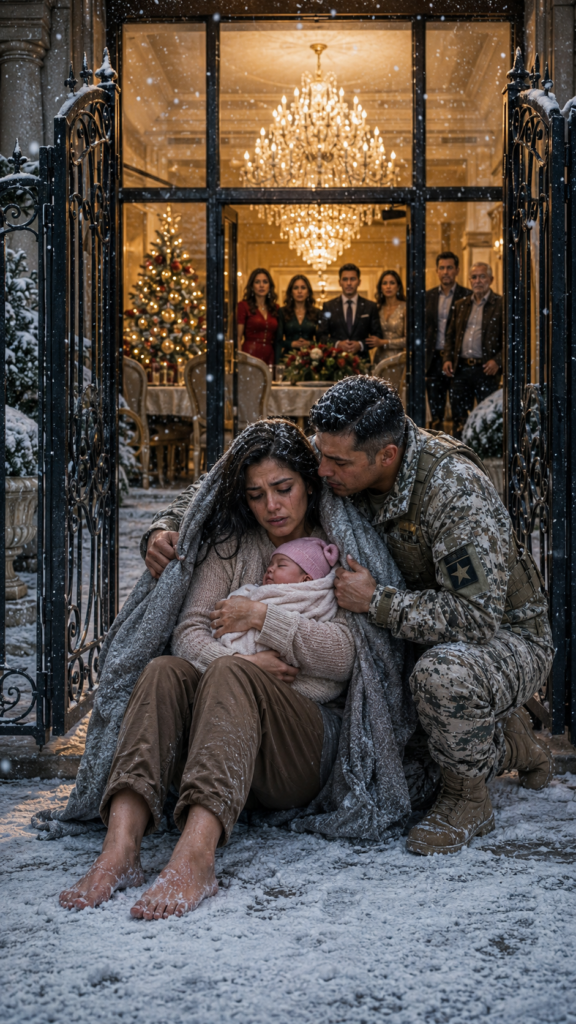
Mariana was barefoot on the frozen ground, pressed against the iron gate, cradling the baby to her chest. Her hair was wet, her hands purple, and her lips the shade of blue that no husband should ever see.
—Mariana! —Emiliano shouted.
He jumped out of the truck without turning off the engine and ran toward her.
Mariana barely lifted her gaze.
The baby let out a weak whimper beneath her mother's sweater.
—Emiliano… —Mariana whispered, as if even breathing hurt her.
He took off his military jacket and wrapped it around them both.
—Who did this to you?
Mariana trembled so much that her teeth chattered.
She looked toward the illuminated windows of the house. Inside, the table was set, the glasses were ready, the turkey was on display, candles lit, cousins, uncles, and the enormous Christmas wreath that Doña Amparo, Emiliano's mother, proudly displayed each December.
—Your mom said the DNA test proved Regina isn’t your daughter —Mariana murmured—. She called me all sorts of names. Said I had sullied the Rivas name.
Emiliano felt something break inside him.
—What test?
—She showed it in front of everyone. Your brother Darío took my suitcase. Your mom took my phone and said you already knew everything. That you had given permission to throw me out.
Emiliano looked up.
Above the gate, the security camera was still on.
The little red light blinked.
It had all been recorded.
He didn’t scream.
He didn’t bang on the door.
He didn’t make a scene.
He scooped Mariana into his arms, put her in the truck, cranked the heat up to maximum, and checked on Regina with trembling hands.
The baby was still breathing.
But barely.
Emiliano called the Military Hospital in Monterrey.
—I need neonatal emergency services. My wife is hypothermic, and my newborn daughter was exposed to the cold.
On the other end, Dr. Aldo Herrera responded immediately.
—Captain, bring them in now.
Before starting the engine, Emiliano looked one last time at the family home.
Inside, someone drew the curtains.
As if the problem was simply not looking.
Mariana, almost unconscious, grasped his sleeve.
—Please… don’t become like them.
Emiliano kissed her cold forehead.
—No, my love. This time, I won’t fight with words.
And as the truck pulled away, his phone vibrated.
It was a message from Darío.
“Don’t go back to that woman. The locks have already been changed.”
Emiliano read the message silently.
Then he replied with just three words:
“Understood. Merry Christmas.”
PART 2
At the Military Hospital, Mariana was admitted with moderate hypothermia, dehydration, and a severe nervous breakdown.
Regina ended up under heating lamps, wrapped in small blankets, with a nurse watching every movement of her chest.
Emiliano stood in front of the glass of the neonatal area.
He didn’t cry.
Not yet.
He only watched his daughter’s tiny hand open and close as if it were still fighting to hold onto life.
That’s when he understood something.
He was no longer just a soldier.
He was no longer just the eldest son of the Rivas family.
He was a father.
And someone had put his daughter in danger for pride, for a name, and for money.
At 3:17 AM, he called Colonel Víctor Salgado from the military legal unit.
—Colonel, I need to check if anyone used my personal data or identification to request a genetic test.
There was a short silence.
—Do you suspect fraud?
—I don’t suspect. I know.
—Do you have proof?
Emiliano looked at Mariana asleep, pale, her lips still cracked from the cold.
—I have cameras, messages, and a nearly frozen wife.
By 9 AM, the first report arrived.
The alleged DNA test came from a private lab in Guadalupe.
There was only one problem.
That lab had been closed for 2 years.
The signature of the responsible chemist belonged to a man who no longer worked in Mexico.
And the genetic sample number assigned to Emiliano never existed in any official system.
But that wasn’t even the worst part.
The worst part was the transfer.
$25,000 pesos sent 6 days earlier from Darío Rivas’ account to a former lab technician named Óscar Villalobos.
Emiliano read the document twice.
Darío.
His younger brother.
The kid he defended in high school when others bullied him.
The same one who hugged him crying when Emiliano left for his first mission.
The same one who had now helped fabricate a lie to remove Mariana and Regina from the house.
—What a piece of work —Colonel Salgado muttered on the phone—. Sorry, Captain, but this is no longer a family quarrel. This smells like a crime.
—Then let’s do it right.
—Are you going to confront them?
Emiliano looked at Regina’s heating crib.
—No. I’m going to let them sit alone at the table.
For 2 days, he didn’t answer calls.
Doña Amparo called him 14 times.
Darío sent voice messages.
His Aunt Leonor wrote in the family group:
“Emiliano, calm down. A woman cannot divide a decent family.”
He didn’t respond.
In the meantime, he gathered everything.
Mariana’s medical report.
Regina’s neonatal report.
The videos from the gate.
The messages.
The bank transactions.
The forgery.
And one document that no one in the family expected.
The title deeds to the house.
The Rivas mansion was not Doña Amparo’s, even though she treated it like her throne.
Legally, it belonged to Emiliano since his father, Don Ernesto Rivas, had died.
The will clearly stated that the property passed to the eldest son, with the moral condition of caring for his mother while she lived.
But caring didn’t mean obeying.
Much less allowing his wife and baby to be humiliated.
On the afternoon of December 24, Doña Amparo organized a family dinner “to patch things up.”
In reality, she wanted to showcase her victory.
She thought Emiliano would arrive alone.
She thought he would apologize.
She thought Mariana’s guilt would be buried under an elegant dinner and 20 poisonous comments.
At 7:00 PM, Emiliano arrived.
Dress uniform.
Impeccable shoes.
A serene face.
In one hand, he carried a black folder.
In the other, a sealed envelope.
When he crossed the threshold, everyone went silent.
Doña Amparo smiled as if she had just won a war.
—Son, you’ve finally come to your senses.
Darío raised his glass.
—It was about time, dude. That woman almost ruined your life.
Emiliano didn’t respond.
He sat at the head of the table, right where his father used to sit.
This made Doña Amparo harden her gaze.
—That place doesn’t belong to you.
—Legally, it does —he replied.
The dining room became tense.
Aunt Leonor let out a nervous laugh.
—Oh, Emiliano, don’t start. It’s Christmas.
He opened the folder.
—Precisely for that reason I came. Because at Christmas, no one should leave a new mother outside with her baby.
No one spoke.
Some lowered their gaze.
Others pretended to adjust their napkins.
Emiliano pulled out the first document.
—Genetic test performed at the Military Hospital in Monterrey, with federal chain of custody.
Doña Amparo crossed her arms.
—Mine already proved what’s necessary.
—No. Yours proved that someone in this family paid for a lie.
Emiliano read aloud:
—Genetic compatibility between Emiliano Rivas Salcedo and Regina Rivas Torres: 99.9999%. Paternity confirmed.
Darío’s glass clinked against the plate.
His face lost all color.
Doña Amparo pressed her lips together.
—That could have been arranged.
Emiliano nodded slowly.
—Funny you say that, Mom. Because one test was arranged. But not this one.
He pulled out the second document.
—The lab you presented closed 2 years ago. The signature is forged. The sample was never taken. And the payment came from Darío’s account.
Darío jumped up suddenly.
—No way, Emiliano! I just did what Mom asked.
The silence exploded.
Doña Amparo looked at him as if she wanted to silence him with her eyes.
But it was too late.
—What I asked you? —she said quietly.
Darío, sweating, pointed at his mother.
—You said Mariana was going to keep the house. That if the girl was recognized, everything would go to them. That we had to get her out of the way before it was too late.
Emiliano closed his eyes for a second.
There was the true motive.
It wasn’t about honor.
It wasn’t about the name.
It was about the house.
It was about money.
It was about a controlling mother’s fear of losing her kingdom.
—So Regina was indeed my daughter —Emiliano said—, but you needed me to stop her from looking like it.
Doña Amparo slammed her hand on the table.
—I only protected what your father built!
Emiliano stood up.
—My father would never have protected a house over a baby.
Aunt Leonor tried to intervene.
—Well, but Mariana shouldn’t have stayed outside. She could have gone to a hotel.
Emiliano looked at her.
—They took her phone. She was barefoot. With a newborn. At 4 degrees. Is that really your defense?
The aunt didn’t respond.
Then Emiliano pulled out a USB drive and connected it to the dining room screen.
The video from the gate appeared.
Mariana crying.
Darío leaving the suitcase.
Doña Amparo closing the door.
The baby crying beneath the shawl.
And everyone inside, dining.
The sound in the dining room faded.
Only Mariana’s voice could be heard on the recording:
“Please, my daughter is cold…”
Then Doña Amparo’s voice:
“Well, look for the real father.”
A cousin began to cry.
An uncle murmured:
—This really went too far.
Emiliano put away the USB.
—I didn’t come to ask for an apology. Apologies don’t warm up a baby.
He pulled out the sealed envelope.
—I came to inform you that the house has already been sold.
Doña Amparo stood frozen.
—What did you say?
—I sold it 48 hours ago. The contract is signed. The new owner takes possession in 30 days.
Darío put his hands on his head.
—You can’t do that!
—Yes, I can. It was mine.
Doña Amparo began to tremble.
—This is my house.
—No, Mom. It was Dad’s house. Then it was mine. And now it will be a foundation for mothers and newborns in risky situations.
No one breathed.
—A foundation? —someone whispered.
—Yes. Because if a woman ever shows up at a gate with her baby in her arms again, at least here, she will be let in.
Doña Amparo stood up crying.
—Emiliano, I’m your mother.
He looked at her with deep sadness.
—Mariana is also a mother. And you showed no mercy.
At that moment, there was a knock at the door.
Three people entered.
Two police officers and Colonel Salgado.
—Good evening —said the colonel—. We are here to notify a criminal investigation for document forgery, fraud, misuse of personal data, and failure to assist a minor.
Darío slumped in his chair.
Doña Amparo stepped back.
—Emiliano… please. We are family.
He took his coat.
—No. My family is at the hospital.
He walked toward the exit.
Before leaving, he turned one last time.
—And this time, I will truly protect her.
30 days later, the facade of the Rivas mansion no longer bore the family name in golden letters.
It had a new sign:
“Casa Regina: refuge for mothers and babies.”
Mariana entered for the first time with Regina in her arms.
She didn’t cry out of fear.
She cried out of relief.
Emiliano accompanied them in silence.
Outside, Doña Amparo watched from a car, her face aged and her hands empty.
No one kicked her out.
No one closed the gate on her.
But for the first time, she understood what it felt like to be outside a house she believed was hers.
And on social media, when the story came to light, people debated for days:
Does blood justify forgiving everything?
Or are there families that only learn when they lose what they used to destroy others?





