PART 1
"Invite her. I want her to see, sitting in the back, what she lost by not being up to our standards."
That was what Doña Dolores Mendoza said while inspecting the white flowers at her son Sebastián's wedding. She didn’t say it with open anger, but with that venomous elegance of women who smile while they stab you in the back.
The invitation arrived one week later at a modest home in Morelia, where Mariana Ríos was preparing breakfasts and uniforms for three children.
It wasn’t just any invitation. It was a message disguised as ivory paper: Sebastián Mendoza, heir to luxury hotels, was marrying Renata Pineda, daughter of real estate tycoons.
Mariana read the groom's name and froze.
Four years ago, she had left the Mendoza mansion with a small suitcase and a heart in pieces. She had loved Sebastián when he still seemed human, not just an extension of his mother's name.
They met in college. Mariana was studying pedagogy and dreaming of opening an adult education center. Sebastián was studying business management with his future already bought.
With her, he wasn’t “the young Mendoza.” He was the boy who promised bougainvilleas, Sunday breakfasts, and children running down the hallway.
But Doña Dolores never accepted her.
"You're lovely, dear," she told her one night in Lomas de Chapultepec. "But a family like ours needs more than good feelings."
Then came the medical tests demanded by Dolores before any commitment.
The result was a bombshell: Sebastián had fertility issues, and Mariana had a hormonal condition that could complicate pregnancy. Difficult, but not impossible.
Dolores heard only what suited her.
"A woman who can't guarantee children isn't fit for my son's future."
Mariana waited for Sebastián to defend her. He looked down.
That silence was the real breakup.
Two months later, Mariana discovered she was pregnant. At seven weeks, the ultrasound showed three heartbeats.
Triplets.
She never sought him out again. She wouldn’t allow her children to be born under the disdain of a family that measured love as if it were an investment.
She raised them alone, with help from Nora, a retired teacher who became family. Mateo, Diego, and Lucía grew up surrounded by warm soups, bedtime stories, and questions Mariana still didn’t know how to answer.
Until the invitation arrived.
The wedding would take place at a luxury estate in San Miguel de Allende. There would be businesspeople, politicians, social influencers, and cameras ready to sell the perfect story.
Sebastián waited at the altar, serious, elegant, empty.
Then a black truck appeared.
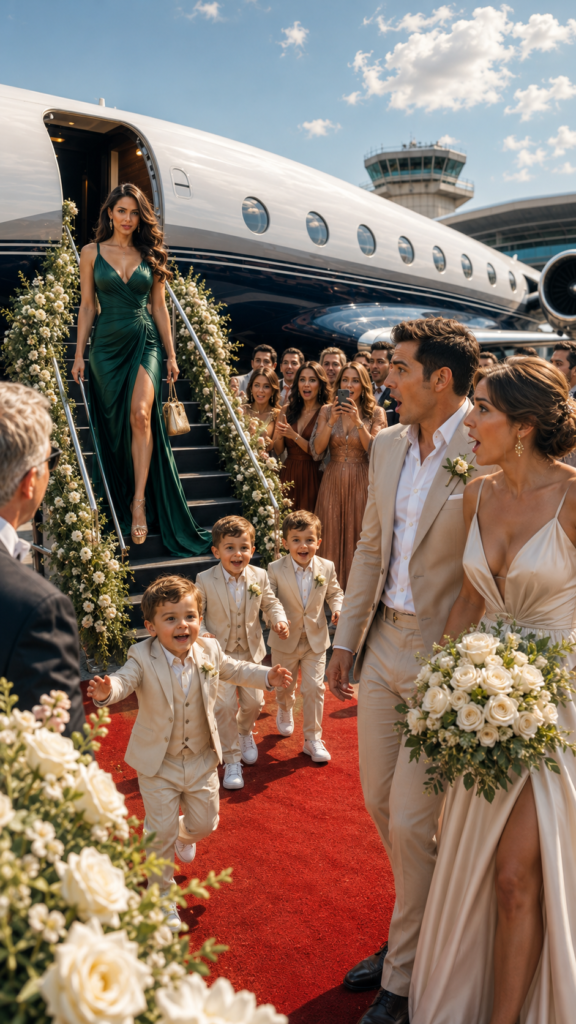
Mariana stepped out in a simple ivory dress. Then three four-year-olds got out: two boys and a girl, with Sebastián’s dimple and the serious eyes of the Mendoza childhood photos.
The music began to fade.
Doña Dolores paled.
Lucía took Mariana’s hand, looked at the groom, and asked:
"Mom... is that the dad we came to find?"
No one could believe what was about to explode in front of everyone.
PART 2
Silence fell over the estate as if someone had turned off the world.
Renata, dressed as a bride, first looked at the three children. Then she looked at Sebastián. She stood still, too calm, as if she understood that the lie didn’t start that day.
"Who are they?" she asked.
Sebastián opened his mouth but found no air.
Mariana didn’t move closer. She stayed at the edge of the garden, with the kids clinging to her dress. She didn’t come to steal a wedding. She came to respond to an invitation sent to humiliate her.
Doña Dolores reacted first.
"This is disrespectful," she spat, walking among the chairs. "Mariana, how dare you show up like this?"
Mariana pulled the golden invitation from her bag and held it up for everyone to see.
"You invited me, Doña Dolores. It says right here that my presence was important."
The guests began to murmur. One woman almost whispered, "Oh, no way." The photographer didn’t know whether to take pictures or hide.
Dolores pressed her lips together.
"I invited an ex-girlfriend, not a woman who shows up claiming children to ruin a wedding."
Mariana didn’t raise her voice.
"They’re not made up. They’re your grandchildren."
Sebastián took one step toward them. Lucía hid behind her mom. Diego hugged a red toy truck. Mateo, who had been born three minutes before his siblings, lifted his chin.
"Don’t come closer," he said.
Sebastián stopped as if faced with a wall.
"You’re right," he replied, broken. "They don’t know me."
Renata looked at him with shining eyes.
"Did you know about this?"
"No," he said. "I swear I didn’t."
"Maybe you didn’t know about them," she replied, slowly taking off her ring. "But you knew your heart was never with me."
Sebastián tried to step closer. Renata backed away.
"For two years, I asked if you were happy. You always said yes. But every time we talked about children, about a home, about the future, your eyes turned elsewhere. Now I understand where to."
The bride placed the ring on a table covered in white roses.
"I deserved a whole love. Mariana deserved respect. And those kids deserved a father from the beginning."
Dolores tried to stop her.
"Renata, think about your family. Think about the scandal."
Renata let out a bitter laugh.
"The scandal isn’t me. The scandal is marrying to save surnames."
And she left, the veil dragging fallen flowers behind her. The wedding ended without a wedding, but the real judgment was just beginning.
Hours later, in a private room at the estate, Sebastián asked to speak with Mariana. The kids were with Nora, oblivious to the fact that their existence had just toppled a million-dollar wedding.
"Why didn’t you tell me?" Sebastián asked.
Mariana looked at him as if that question had come four years too late.
"For what? So your mother could demand proof? So she could say they were from someone else? So you could look at the floor again?"
He looked down.
"I deserve it."
"I didn’t come back for you," she said. "I came for them. Lucía asked me in kindergarten why everyone had a dad except her. Diego said maybe his dad was lost. Mateo doesn’t ask, but he stopped drawing complete families."
Sebastián's face broke.
"I didn’t know."
"You didn’t know because you chose not to know."
Mariana placed a blue folder on the table. Inside were documents, ultrasounds, and a paternity test done months ago with a lawyer in Morelia.
Sebastián read with trembling hands.
Probability of paternity: 99.9%.
"They’re mine," he said, almost in a whisper.
Mariana corrected him:
"They belong to themselves. You are their biological father. Being their dad, you still have to earn."
At that moment, the door swung open. Doña Dolores entered with a lawyer in a dark suit.
"Then let’s talk custody," she said.
Mariana didn’t move.
"Custody?"
Dolores raised her chin.
"They are Mendozas. You can’t pretend that three children with that blood live hidden in Morelia."
Mariana smiled without joy.
"Four years ago, that blood didn’t matter. All that mattered was using my body as a requirement to enter your family."
The lawyer cleared his throat.
"Mrs. Mendoza just wants to guarantee the well-being of the minors."
"Sir," Mariana replied, "if you use the word well-being as a synonym for money again, this conversation ends."
Sebastián stepped in front of his mother.
"Mom, leave."
Dolores blinked, indignant.
"Excuse me?"
"Leave this room."
"She’s manipulating you."
"No. You manipulated me for years. Me, Renata, everyone. And today it’s over."
Dolores pointed at the folder.
"Are you going to accept that without a fight? Without protecting the surname?"
Sebastián took the DNA test.
"I’m not going to fight against the mother of my children so you can turn them into trophies."
For the first time, Doña Dolores couldn’t find an elegant phrase. The lawyer closed his briefcase and left behind her.
Sebastián stood before Mariana, small in his expensive suit.
"I’m not going to let her attack you again," he said.
"The problem," she replied, "is that you did before."
He nodded.
"I know."
"My children don’t need hotels, trucks, or magazine photos. They need stability. They need an adult to say ‘I will be there’ and actually be there. To arrive at the festival at 10 if they promised to arrive at 10. Not to use them to wash away guilt."
Sebastián took a deep breath.
"I’ll do whatever you decide. Legal agreement, supervised visits, family therapy, no press, no my mother. I don’t want to win. I want to repair."
Mariana looked at the folder. There were four years of fevers, diapers, debts, sleepless nights, and birthdays when she invented smiles so her children wouldn’t notice the absence.
"Honestly, Sebastián, I don’t know if you can," she finally said. "But they have the right to know who you are. We’ll start slow."
And so it was.
The news exploded on social media the next day. “Ex-girlfriend arrives with triplets at hotel heir’s wedding.” “Girl discovers her dad at the altar.” “Luxury wedding ends in total silence.”
Doña Dolores tried to filter that Mariana had come for money. She called journalists and club friends.
Sebastián stopped her with a simple statement:
"Mariana Ríos did not lie. My children exist because she had the courage to care for them alone. I failed by not searching for her and not defending her. I ask for respect for her, for Renata, and, above all, for the children."
Dolores screamed at him over the phone:
"You’ve just destroyed the family."
"No, Mom," he replied. "I just stopped lying."
The first visits were in Morelia. Sebastián learned that being a father wasn’t about crying beautifully in front of everyone, but sitting on the floor to piece together puzzles, remembering that Diego hated carrots, that Mateo got serious when he was scared, and that Lucía slept with a nightlight.
He also met Andrés, the widowed architect who had helped Mariana when the babies were born prematurely. He had driven her to the hospital in the early morning, bought medicine, and carried the newborn triplets.
The kids called him “Uncle Andrés” with a trust Sebastián couldn’t buy.
One afternoon, Diego fell in the yard and scraped his knee. Sebastián ran first.
"It’s okay, champ, I’m here."
Diego hugged him without thinking.
Sebastián froze. It was the first time one of his kids had sought him out.
Mariana watched from the door. She didn’t smile, but she didn’t look away either.
Six months passed.
Mariana opened “Casa Nueva” in Morelia, the center she had always dreamed of: a place for adults wanting to finish high school. Nora handed out fresh water. Andrés arranged chairs. The triplets ran among students and neighbors.
Sebastián arrived with simple flowers, without a photographer, without a fancy watch. Doña Dolores appeared behind him, without pearls and without her queenly posture.
Mariana stepped onto a small platform.
"This place is for those who were once told they weren’t enough," she said. "For those who were measured by their money, their surname, their background, their body, or someone else’s idea of what a family should be."
She looked at her children. Then at Sebastián. Then at Dolores.
"No one has the right to decide another person’s worth just because that person doesn’t fit into their version of the world."
The applause filled the yard.
Dolores cried silently.
Sebastián did too.
And Mariana, the woman invited to a wedding to be humiliated, stood before everyone, taller than ever.
Not because she had destroyed those who looked down on her, but because she built a life so dignified that those who once looked down had to lift their gaze to see her.
In the end, Lucía took one of Mariana’s hands and one of Sebastián’s. Mateo hugged Nora. Diego ran to Andrés.
And everyone understood something that hurt and healed at the same time: children don’t need perfect adults. They need honest adults who arrive, stay, and learn to love without turning them into trophies.





