PART 1
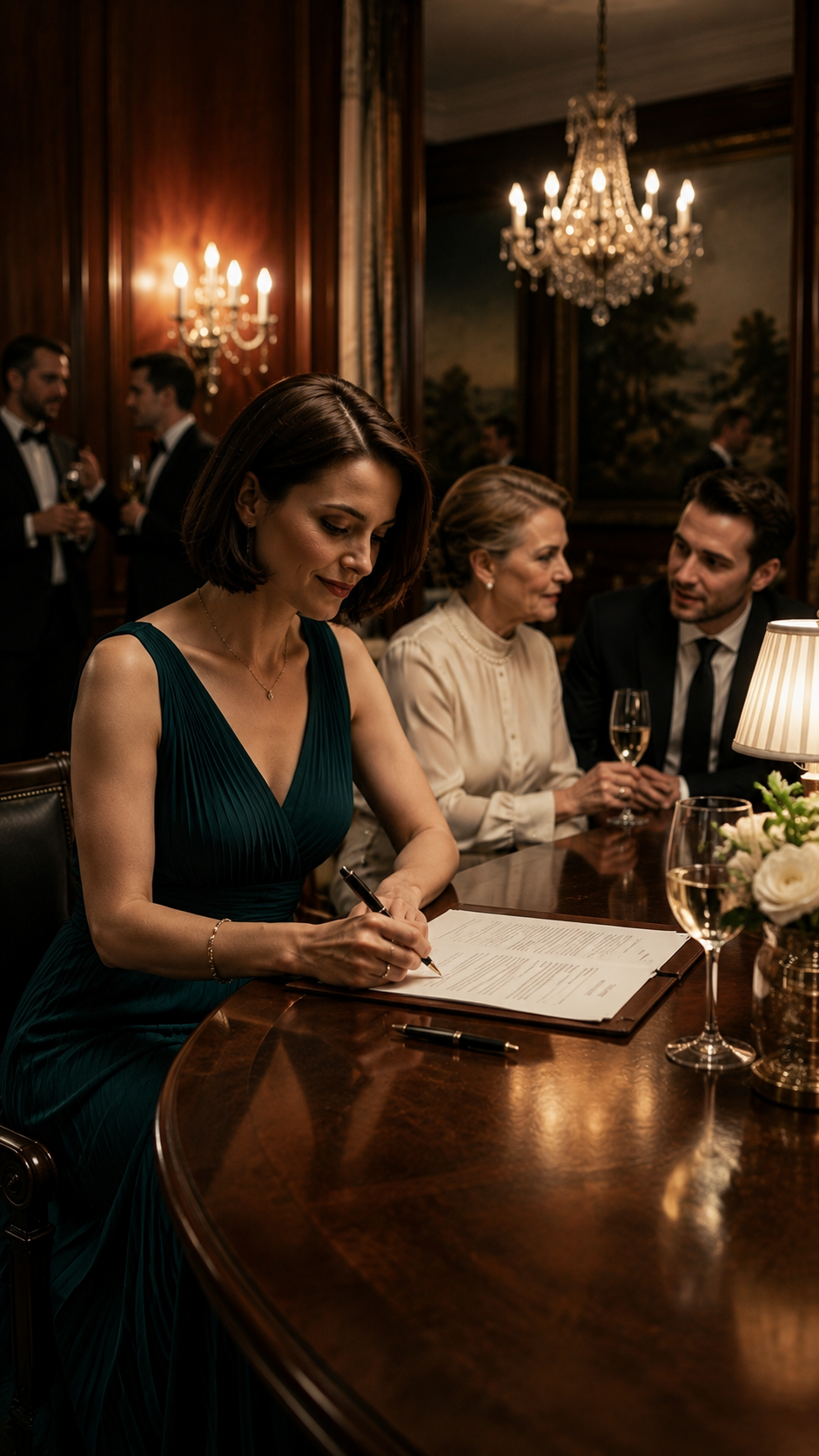
The toast began just as Valeria signed the last page of the divorce papers.
There was no awkward silence.
No apology.
There were clinking glasses, poorly concealed giggles, and applause as if the family had just freed themselves from a shame.
It all happened in an elegant hall of a hotel in Polanco, with arrangements of white flowers, waiters dressed in black, and a main table where it read "Welcome, baby" in golden letters.
But that party was never to celebrate the newborn.
It was a trap.
Valeria had just given birth three weeks prior. She walked slowly because the cesarean still burned, she had deep dark circles under her eyes, and her arms were tired from holding her son through the long nights.
The stroller was beside her.
The baby slept wrapped in a blue blanket, unaware of the poison filling that hall.
In front of Valeria was Beatriz Luján, her mother-in-law, a woman famous in Mexico City’s business circles for smiling sweetly while destroying reputations.
Beside her stood Andrés Luján, Valeria’s husband and heir to Luján Infrastructure, a conglomerate with construction companies, hotels, public permits, and plenty of friends in the government.
Andrés didn’t look at her.
That was the first stab.
Not the papers.
Not the money.
Not the cousins recording with their phones under the table.
What broke something inside her was seeing the man who had promised to take care of her for five years acting as if she were a burden they could finally escort out through the service door.
“It’s about time you understood,” Beatriz said, shoving a pen at her. “Sign without making a scene. You’re leaving with $2,000,000. For a girl like you, it’s a prize.”
A murmur swept across the table.
Someone let slip a “how generous.”
Valeria raised her gaze to Andrés.
“Do you want me to leave too?”
He pressed his lips together.
“It’s the healthiest thing for everyone.”
She felt her chest tightening, but she didn’t cry.
Beatriz seized that silence as if it were a victory.
“My son needs a woman from his world. Not someone who lived off our last name. Not even to give birth could you do it without nurses, medication, and scandals. Seriously, how tiring.”
The baby stirred slightly in the stroller.
Valeria placed a hand on the blanket.
Nobody in that hall knew the truth.
They didn’t know that before marrying, she had given up escorts, private jets, interviews, and meetings in Europe because she wanted to be loved without her last name weighing her down.
Andrés knew Valeria’s family had money.
But he could never have imagined how much.
He didn’t know that Valeria Santillán controlled, through a private trust, assets worth over $30,000,000,000.
He also didn’t know that several lines of credit from Luján Infrastructure remained alive thanks to silent guarantees authorized by her.
Valeria took the pen.
She signed.
The hall erupted in applause.
Beatriz lifted her glass with a cruel smile.
Andrés let out a sigh of relief.
Then Valeria closed the folder, looked at everyone, and said with a calmness that froze the champagne:
“Enjoy tonight, because tomorrow you’ll discover that you applauded with your accounts still open.”
PART 2
Silence fell heavy, as if someone had abruptly turned off the music.
It lasted barely 2 seconds.
Then Beatriz let out an elegant laugh, the kind rich ladies use when they want to humiliate without ruffling their hair.
“Oh, Valeria,” she said, adjusting her pearls. “Even when you leave, you want to feel important.”
Some relatives laughed.
Andrés didn’t.
For the first time all night, he seemed uncomfortable.
“Valeria, don’t start with threats,” he murmured.
She didn’t respond.
She carefully stood up, grabbed the diaper bag, adjusted her son’s blanket, and pushed the stroller toward the exit.
No one stopped her.
On the contrary, several guests stepped aside as if letting a dismissed employee pass.
An aunt of Andrés, with her glass in hand, said loudly enough for everyone to hear:
“Without the Luján name, that poor girl is nobody.”
Valeria paused for 1 second.
Then continued walking.
Outside the hotel, a black SUV waited for her with the engine running. It had no logos or flashy guards. Just a driver in a gray suit who immediately stepped down and opened the back door.
“Mrs. Santillán,” he said respectfully.
Valeria got in with her baby in her arms.
That same night, she didn’t return to the mansion in Las Lomas.
She requested that only her son’s clothes, personal documents, and a small box she had kept for years at the back of a closet be sent to her.
She didn’t touch jewelry.
She didn’t touch paintings.
She didn’t take cars.
She took nothing from the Lujáns because she never needed anything from them.
Meanwhile, in the mansion, Beatriz organized an impromptu dinner.
They served expensive wine, imported meat, and desserts that no one finished because everyone was too busy mocking.
“We got rid of a problem,” Beatriz toasted in front of her children, brothers-in-law, and 3 executives. “Now we can finally close the sale of the Riviera hotels without that girl meddling where she doesn’t belong.”
Andrés tried to smile, but Valeria’s words kept circling in his mind.
“With your accounts still open.”
“Mom,” he asked softly, “do you know exactly where the Santillán family’s money comes from?”
Beatriz rolled her eyes.
“Old lands, old stocks, old name. People who boast more than they have. Don’t get nervous on me, Andrés.”
But he had to get nervous.
Because Valeria hadn’t been a naive wife.
She had been a patient woman.
For 5 years, she watched Luján Infrastructure grow too fast. Public contracts won with no real competition. Suppliers who were born and disappeared in 6 months. Invoices for work that were never completed. Small transfers that, together, formed rivers of money to Panama, Houston, and Andorra.
At first, she thought Andrés was surrounded by corrupt people.
Then she discovered that Andrés wasn’t a victim.
He signed.
He authorized.
He kept quiet.
And Beatriz was the one ordering everything.
Valeria silently gathered evidence. Emails, audios, contracts, account statements, messages.
But what ultimately broke her wasn’t the fraud.
It was finding her newborn baby’s name in a fake trust created to move money without raising suspicions.
That day, she stopped feeling guilty.
The morning after the divorce, while the Luján family continued to comment that Valeria “would surely come back begging,” she entered a discreet building on Paseo de la Reforma.
There were no ostentatious signs.
Just a private elevator, silent security, and an entire floor where no one asked who she was.
In the conference room, 6 lawyers, 4 forensic auditors, and Clara Montoya, director of compliance for the Santillán estate, were waiting for her.
“Do you want to proceed today?” Clara asked.
Valeria looked at her sleeping son in the stroller.
His little hands were closed, his breathing calm, and that innocence that still doesn’t know adult malice.
“They used his name to hide money,” she replied. “Today.”
The first blow came 3 days later.
Three banks suspended the lines of credit for Luján Infrastructure due to inconsistencies in guarantees, legal risks, and unverifiable documents.
The second blow fell that same afternoon.
A foreign fund withdrew its offer to buy the hotel division.
The third blow was the one that shook everyone.
The Financial Intelligence Unit requested information about 21 accounts linked to executives, family members, and suppliers.
Andrés called Valeria 34 times.
She didn’t answer.
Beatriz sent messages first furious and then desperate.
“Common girl.”
“You’re going to regret this.”
“You don’t know who you’re messing with.”
Valeria read the last one, took a screenshot, and blocked the number.
On day 7, Andrés appeared at the Reforma building without an appointment.
He walked in with wrinkled shirt, two days of stubble, and the face of a man who finally understood that a last name doesn’t always suffice.
“I need to see Valeria Luján,” he demanded at reception.
The receptionist calmly looked up.
“There’s no Valeria Luján here.”
Andrés slammed the counter.
“She’s my wife.”
A voice behind him replied:
“Ex-wife.”
He turned around.
Valeria was next to the private elevator, dressed in a simple beige suit, her hair pulled back, and a serenity he had never seen in her.
She didn’t look shattered.
She looked free.
“What are you doing here?” Andrés asked, glancing around. “What is this place?”
“My office.”
“Your office?”
Valeria walked toward a conference room. Andrés followed her as if he had just entered a life he never bothered to know.
As they passed, several executives stood up.
“Mrs. Santillán.”
Andrés froze.
“Santillán?”
She sat at the head of the table.
“That was my last name before your family decided to treat it like trash.”
Andrés let out a nervous laugh.
“I don’t understand.”
“I know. That was the problem from the start.”
Contracts, transfers, financial routes, and digital signatures appeared on the screen.
Then two older men entered. Andrés recognized one immediately: he was the regional president of an international bank. The other headed an energy consortium with operations in 12 countries.
Both greeted Valeria with respect.
“Thank you for having us, Mrs. Santillán.”
Andrés went pale.
“It can’t be.”
Valeria crossed her hands.
“Yes, it can.”
“You had the lines closed?”
“No. The banks suspended them upon seeing the real information.”
“But you handed it over.”
“I turned on the light. The cockroaches were already there.”
Andrés clenched his jaw, trying to regain his confident businessman tone.
“Valeria, seriously, this has spiraled out of control. We have a son. We can work this out for him.”
Her gaze hardened.
“Don’t use my son now. Your mother used his name to launder money, and you signed documents without reading them because it suited you.”
“I didn’t know about the trust.”
Valeria slid a copy toward him.
“Here’s your signature.”
Andrés took the paper with trembling hands.
There it was.
His name.
His authorization.
His cowardice turned into evidence.
“My mom said it was a property protection procedure,” he whispered.
“Your mom also said I was useless, and you stayed silent.”
He lowered his gaze.
For the first time, he had no excuses.
Just fear.
But Beatriz still didn't know fear.
She learned it 2 days later when she called a press conference in Santa Fe.
She wanted to appear strong, elegant, targeted by “foreign interests” and “attacks against a hardworking Mexican family.”
She arrived dressed in black, with pearls, perfect makeup, and Rodrigo, the family lawyer, glued to her shoulder.
Behind her were Andrés, 2 uncles, 1 financial director, and several employees forced to smile.
“Luján Infrastructure categorically rejects these accusations,” she declared in front of the microphones. “We are an honorable family, of values, that has built Mexico for decades.”
Then, from the last row, a calm voice asked:
“Did you also build Mexico using the name of a newborn to move illegal money?”
Everyone turned.
Valeria was there.
Not shouting.
Not crying.
With a blue folder in her hands.
Beatriz lost her smile.
“Get that woman out of here.”
The reporters jumped up.
Some already knew the Santillán name. Others searched for it on their phones, the mockery wiped from their faces.
Valeria moved to the front.
“For 5 years, I was called a kept woman, useless, a freeloader, and worthless. I was humiliated at meals, meetings, birthdays, and even in the hospital, one day after my son was born.”
Beatriz gritted her teeth.
“This is a private matter.”
“Not when there are crimes.”
The room filled with murmurs.
Valeria opened the folder.
“There are simulated contracts, false invoices, transfers to shell companies, and documents where my baby’s name appears without legal authorization.”
The lawyer tried to intervene.
“You cannot disclose confidential information.”
Valeria stared at him without blinking.
“The authorities already have it.”
At that moment, 5 agents entered through a side door.
They didn’t shout.
They didn’t push.
They just walked directly toward Beatriz.
The woman who had toasted just a week prior for having kicked Valeria out took a step back.
“This is a setup,” she said, although her voice trembled.
One of the agents showed the warrant.
“Beatriz Luján Arriaga, you are under arrest for money laundering, document forgery, and organized crime.”
The flashes exploded.
Andrés closed his eyes.
Beatriz glared at Valeria with hatred.
“You destroyed this family.”
Valeria held her gaze.
“No. I just stopped protecting it.”
Then came the twist no one expected.
The financial director, a man named Samuel Ortega, raised his hand with a broken face.
“I want to testify.”
Beatriz turned furiously.
“Shut up, Samuel.”
But Samuel was already crying.
“Mrs. Beatriz ordered to use the baby’s name because she said no one would review accounts related to a minor. She also asked to prepare documents to take custody away from Mrs. Valeria if she refused the divorce.”
Andrés’s eyes widened.
“What did you say?”
Valeria felt the air leave her.
She didn’t know that.
She thought they only wanted to take her marriage.
She didn’t know they also planned to take her son.
Samuel continued speaking in front of the cameras.
“They were going to say she had severe postpartum depression. They already had a paid doctor, 2 family witnesses, and false reports about supposed neglect.”
The room turned chaotic.
Reporters shouting.
Cameras pushing.
Microphones approaching Valeria like knives.
Beatriz tried to advance toward Samuel, but the agents stopped her.
“Damn traitor,” she spat.
Andrés held his head in his hands.
He finally understood.
He hadn’t just allowed them to humiliate his wife.
He had let his mother prepare a cage to rip his son away from her.
Valeria didn’t cry there.
She didn’t give them that spectacle.
She closed the folder, took a deep breath, and walked out of the room with the dignity they tried to break.
Weeks later, all of Mexico was talking about the Lujáns.
The accounts were blocked. The hotels were intervened. Public concessions were suspended. Several officials denied knowing them, as always happens when the ship sinks.
Beatriz was linked to the process.
Samuel testified as a cooperating witness.
Andrés tried to negotiate, but his signature appeared too many times. He wasn’t arrested immediately, but he lost control of the company, the family house, the partners, and that image of a business prince he cared for so much.
He also lost the only thing he later understood was real.
Valeria.
Three months later, Andrés appeared outside the apartment where she was temporarily living in Roma Norte.
It wasn’t a mansion.
It was a warm place, with plants, baby toys, stacked books, and light streaming through the windows.
Andrés had grown a beard and had sunken eyes.
“I just want to see him,” he said.
Valeria looked at him from the door.
“You’ll see him as the judge determines.”
“Valeria, forgive me. I didn’t know how far my mom would go.”
“But you did know she was humiliating me.”
He didn’t answer.
“You did know she was breaking me in front of your family.”
Andrés lowered his head.
“I was a coward.”
Valeria shook her head slowly.
“You were comfortable. And comfort, Andrés, sometimes does more damage than malice.”
He cried silently.
“Can I still do something?”
Valeria looked inside. Her baby was sleeping in a crib by the window, calm, as if the world were finally far away.
“Yes. Don’t confuse my silence with permission again.”
And she gently closed the door.
No screams.
No insults.
No revenge.
Just boundaries.
Six months later, Valeria legally regained her last name, obtained primary custody of her son, and began living without asking for permission to breathe.
The Luján name, which once opened doors in restaurants, banks, and government offices, began to provoke uncomfortable glances.
Beatriz continued fighting from preventive prison, claiming it was all a conspiracy.
Andrés sold properties to pay lawyers.
The relatives who applauded that night disappeared like cockroaches when the light turns on.
Valeria bought a house in Valle de Bravo.
It wasn’t the biggest.
But it had a garden, bougainvilleas, a lake view, and a room full of sunlight for her son.
One morning, Clara arrived with investment documents.
“There are 3 important proposals,” she said. “They can wait.”
Valeria looked at her baby laughing on a blue blanket.
She remembered the applause.
Beatriz’s glass.
The pen on the table.
Andrés’s cowardly face.
And she understood something many women learn too late: sometimes you don’t lose a family, you escape from a decorated cage.
“Let them wait,” she responded.
She picked up her son and stepped out into the garden.
For the first time in years, no one measured her by a husband, a borrowed last name, or a venomous mother-in-law’s opinion.
They called her useless in front of everyone.
They cast her out as if she were worth nothing.
But those who thought they could buy her silence with $2,000,000 discovered too late that they weren’t dealing with a weak woman.
They were dealing with the only person who knew where all their secrets were buried.
And when a woman stops being afraid, even the most arrogant empire can fall in 7 days.





