PART 1
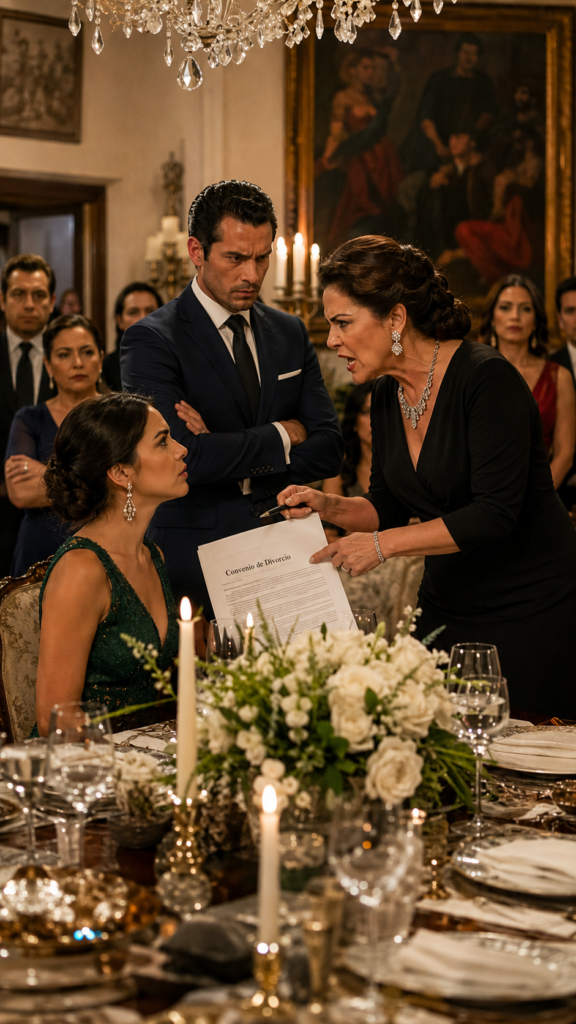
—Sign here, Mariana. It’s enough of pretending you’re part of this family.
Doña Beatriz Cárdenas’s voice struck the table like a slap.
She didn’t shout. She didn’t get agitated. She spoke calmly, in the midst of an anniversary dinner, in front of 38 guests, while the mariachi played softly in the garden of a massive mansion in Las Lomas.
The glasses hung suspended in the air.
A waiter paused with a tray of canapés. Aunt Gloria’s eyes widened, not in surprise, but out of sheer morbid curiosity. Cousin Renata smiled like someone finally witnessing the fall of a perpetual obstacle.
Mariana sat next to Andrés, her husband of three years.
He said nothing.
His gaze was fixed on the tablecloth, as if the white embroidery were more important than the woman he had promised to protect.
Doña Beatriz pushed a burgundy folder toward Mariana.
—The lawyer has prepared everything. Just sign and save us the theatrics.
Mariana looked at the first page.
Divorce petition.
Inside, she felt something shatter, but her face didn’t change. She had learned to breathe calmly while being humiliated.
Since she arrived at that house, doña Beatriz had treated her like a freeloader with a ring. She criticized her clothes, her accent, her job, even the way she took her coffee.
—A Cárdenas wife doesn’t act independent —she would say—. A Cárdenas wife knows her place.
And Andrés always replied the same:
—Don’t mind her, my love. You know how my mom is.
But knowing didn’t lessen the pain.
That night, doña Beatriz raised her glass.
—Mariana, you contributed nothing in three years. No prestige, no money, no children, no peace. Just strange silence and the pride of a woman who thinks too highly of herself.
Some chuckled softly.
Uncle Ramiro murmured:
—It was about time, honestly.
Andrés clenched his jaw.
—Mom, not here.
Doña Beatriz didn’t even glance at him.
—Of course here. Embarrassments are cleaned up in front of family.
Mariana turned to her husband.
She waited for one word.
Just one.
But Andrés looked down.
Then she understood everything.
It wasn’t that he couldn’t defend her. It was that he never wanted to pay the price for doing so.
Mariana picked up the pen.
Aunt Gloria leaned toward Renata, excited.
—Look, she’s going to sign.
Doña Beatriz smiled, confident in her victory.
—That’s how I like it. No scandals.
Mariana signed.
Her name was firm, elegant, without a tremor.
Then she closed the folder and set it in front of her mother-in-law.
—Done.
Doña Beatriz blinked.
—So easy?
Mariana stood up. The chair made a sharp noise against the marble floor.
—So easy.
She opened her black purse and pulled out another folder, thicker, with red dividers.
She placed it in the center of the table.
—Now you sign.
Doña Beatriz’s smile vanished.
—What is this?
Mariana looked toward the entrance.
—Mr. Salgado, please.
A man in a dark suit appeared by the door. No one had noticed him, although he had been there for most of the dinner.
—Good evening —he said—. I’m the legal representative of Mrs. Mariana Valdés.
Andrés raised his head, confused.
—Legal representative?
Mariana didn’t look at him.
—Proceed with the notification.
Mr. Salgado opened the folder.
—Effective tomorrow, the process of vacating this property will begin. The residence located in Las Lomas is legally registered in the name of Mrs. Mariana Valdés.
The silence was brutal.
Doña Beatriz let out a nervous laugh.
—What nonsense. This house belongs to my family.
—It belonged to a bank —Mariana replied— until I paid off the debt.
Don Ramiro stood up.
—This girl is crazy!
Mariana pulled out several receipts.
—Mortgage canceled. 18 transfers. 42 million pesos. All from my account.
Andrés paled.
—Mariana… what did you do?
She looked at him for the first time.
—Save your house, Andrés. While your mother called me a beggar at my own table.
Doña Beatriz grabbed the papers with trembling hands.
—This can’t be.
The lawyer left another folder.
—You will also be notified of the withdrawal of capital from Inmobiliaria Cárdenas. Mrs. Mariana’s private investment represents 71% of the current operation.
Don Ernesto, Andrés’s father, was left breathless.
—Without that capital, we go bankrupt.
Mariana nodded.
—I know.
Doña Beatriz stood up furiously.
—You can’t destroy us over a tantrum!
Mariana put the pen back in her purse.
—It’s not a tantrum. It’s a consequence.
Andrés took a step toward her.
—Mariana, wait. Let’s talk.
She shook her head slowly.
—You had three years to talk.
She walked toward the exit while everyone stared at her as if they had just discovered a stranger.
Before crossing the door, doña Beatriz shouted:
—You’re nobody without our last name!
Mariana stopped.
She smiled faintly.
—That last name was the only poor thing I had.
And she left.
No one in that family knew that the house, the company, and the money were just the beginning. Much less did they imagine that the woman they had just cast out was about to reveal the secret that could send the entire Cárdenas pride to prison.
PART 2
The truck waited outside under a fine drizzle, the kind that makes the streets of Mexico City shine.
Mariana climbed in unhurried. She sat in the back, removed her ring, and left it inside a white envelope.
Mr. Salgado took the front seat.
—To your apartment, ma’am?
Mariana looked at the lit residence. From the outside, it still looked like a perfect house.
But she knew how much rot could hide behind an elegant facade.
—No. Let’s go to Reforma.
Forty minutes later, the truck stopped in front of a glass tower. At the very top shone the logo of Grupo Valdés Arriaga, an investment firm that the Cárdenas had tried to contact for years without success.
The guard opened the door as soon as he saw her.
—Good evening, Ms. Valdés.
Mariana entered still in her dress, makeup intact, and her heart shattered.
On the 41st floor, several executives stood as they saw her.
She was not the quiet daughter-in-law.
She was not the kept wife.
She was Mariana Valdés Arriaga, executive director and heir to one of the strongest financial groups in the country.
She had only hidden her full last name because, after growing up surrounded by those interested, she wanted to know if Andrés loved her or the money.
Now she had the answer.
In her office, facing the windows, she finally took a deep breath. She didn’t cry. Not yet. There were things that hurt so much they got stuck first.
Her cell vibrated.
Andrés.
She didn’t answer.
It vibrated again.
This time she picked up.
—Mariana, where are you?
—Far from the table where you stayed silent.
He let out a broken sigh.
—I’m sorry. I didn’t know my mom was going to pull out those papers.
—But you did know she humiliated me.
Silence.
—Yes.
—And yet you let her.
—I was a coward.
Mariana closed her eyes.
—No, Andrés. A coward gets scared once. You chose to stay silent every day.
He didn’t answer.
—Let me fix it. Please.
—What do you want to fix? The divorce? The company? Your conscience?
—Us.
Mariana felt that phrase scrape at her chest.
—Before losing everything, did you ever fear losing me?
The silence was the answer.
She hung up.
The next morning, the Cárdenas arrived at Grupo Valdés Arriaga without an appointment.
Doña Beatriz entered first. She no longer wore the emerald necklace or the patroness smile. Her face was swollen, her eyes red, her hands clenched over a ridiculously expensive bag.
Andrés followed behind, looking worn out. Don Ernesto struggled to walk upright, but worry bent his back.
When they entered Mariana’s office, they froze upon seeing the golden plaque on the desk.
Mariana Valdés Arriaga
Executive Director
Doña Beatriz swallowed hard.
—You… work here?
Mariana looked up.
—No. I run this.
Don Ernesto leaned against a chair.
—My God.
Andrés looked at her as if seeing her for the first time.
And maybe that was how it was.
—Mariana —doña Beatriz said, in a voice she had never heard—, what happened last night was a mistake.
—It wasn’t a mistake. It was a habit that finally had witnesses.
The mother-in-law looked down.
—We didn’t know who you were.
Mariana leaned slightly toward her.
—That was the problem. You believed I needed to be someone important to deserve respect.
Mr. Salgado entered with a blue folder.
—Ma’am, the audit reports have arrived.
Don Ernesto turned pale.
—Audit?
Mariana opened the folder.
—When I invested in Inmobiliaria Cárdenas, I set three conditions: accounting transparency, complete tax payments, and zero family diversions.
Doña Beatriz looked at her husband.
—Ernesto…
The lawyer arranged several documents on the table.
—We found false invoices, resource triangulation, and personal payments charged to the company. There are transfers to family accounts totaling 9.8 million pesos.
Don Ernesto sank into the chair.
Andrés grabbed a sheet. His hands began to tremble.
—Dad… my signature is here.
—Don’t get involved —Ernesto growled.
Mariana looked at him coldly.
—That’s the part you didn’t know I had already seen.
Andrés lifted his head.
—What does that mean?
The lawyer placed a USB drive on the table.
—It means someone used your digital signature to authorize transactions while you were away in Monterrey.
Doña Beatriz covered her mouth.
—Ernesto, tell me no.
Don Ernesto exploded.
—I did it for the family!
Mariana didn’t move.
—No. You did it to sustain a life you couldn’t afford.
The twist left Andrés speechless.
For years he believed he was the heir to an empire. In reality, his father had used his name to cover debts, evade payments, and move Mariana's money without permission.
Doña Beatriz sat down slowly.
—I didn’t know.
Mariana looked at her.
—you may not have known the numbers. But you did know how to humiliate the woman who was supporting them.
The phrase fell heavily.
Doña Beatriz began to cry.
—I’m sorry. I was cruel. I treated you like nothing because I thought you were here to take from us. And you were saving us.
Mariana watched her for a long time.
She had dreamed of that apology many nights, after dinners where they told her her dress was “too plaza,” after birthdays where they placed her far from the main table, after hearing Andrés ask her for patience as if dignity could wait forever.
But upon receiving it, she felt no victory.
She felt exhausted.
—I accept your apology —she said—. But I won’t return.
Andrés closed his eyes.
—Not even with me?
Mariana breathed slowly.
—you didn’t lose me last night. You lost me every time you looked at the floor.
He cried silently.
—I can change.
—Maybe. But I’m not going to stay to supervise if you finally learn.
Don Ernesto was charged with fraud, breach of trust, and forgery. The audit revealed more than expected: cars purchased with company money, trips paid as “consulting,” and a secret account in Renata’s name, the cousin who mocked her at dinner.
The news spread quickly among the city’s money circles. The Cárdenas stopped receiving invitations. The mansion was vacated in 60 days. Designer furniture was wrapped in plastic while neighbors peeked behind curtains.
Doña Beatriz, for the first time in 30 years, rented an apartment without a garden, without a chauffeur, and without a table for 38 guests.
Andrés didn’t seek out Mariana for months.
That surprised her.
She expected flowers, calls, pleas. She anticipated the typical drama of a man confusing guilt with love.
But there was nothing.
Six months later, Mariana saw him by chance in a café in Colonia Roma. He sat with an old laptop, reviewing sustainable housing plans. He wore a simple shirt, days-old stubble, and real dark circles, not from partying.
When he saw her, he stood up.
—Hello, Mariana.
—Hello.
He didn’t approach too close.
—I didn’t come to bother you. I work here a few days.
She looked at the plans.
—Construction?
—I’m starting from scratch. Without a last name, without my dad’s money, without borrowed contacts.
Mariana remained silent.
—I also went to therapy —he added—. Not to get your forgiveness. To understand why I let my family decide for me while you were breaking beside me.
That phrase touched her.
—You should have done that sooner.
—Yes.
He didn’t justify himself. He didn’t blame his mother. He didn’t ask for another chance.
He just looked down.
—I wanted to thank you.
Mariana frowned.
—Thank you?
—For leaving. If you had stayed, I would have continued being a stylish loser.
She almost smiled.
—That’s strong.
—But true.
Mariana didn’t go back with him that day.
Nor the next month.
There was distance. Then short coffees. Then awkward conversations. She told him several times that she didn’t want to see him, and he respected it. That was new. Before, Andrés always wanted to resolve everything with a pretty phrase and a quick hug.
One year later, Grupo Valdés Arriaga received a partnership proposal from a small social construction company.
The project was solid: affordable housing, recycled materials, clear numbers, and zero smoke.
The founder entered the room in a simple suit.
It was Andrés.
But not the same.
He greeted the team, presented real risks, accepted tough questions, and never mentioned his past with Mariana. When he finished, she understood something that brought her peace: he was not coming to win back his ex-wife. He was coming to prove he could stand on his own.
The committee approved the partnership.
As everyone left, Andrés remained standing.
—Thank you for evaluating it fairly.
—It was a good project.
—Even so.
Mariana closed the folder.
—You’ve changed.
He shook his head gently.
—I’m changing. I’m still not someone finished.
That honesty weighed more than any promise.
Weeks later, doña Beatriz asked to see her. Mariana agreed in a café, not at a family house.
The ex-mother-in-law arrived in a simple dress and gray hair without so much fuss.
—I didn’t come to ask you for anything —she said—. I just wanted to tell you, face-to-face, that I’m sorry. Not for losing the house. Not for losing the money. I’m sorry because you were good to us, and I was despicable to you.
Mariana took a deep breath.
—Thank you.
Doña Beatriz cried.
—I wish someone had taught me earlier that class isn’t in names.
Mariana didn’t hug her. Some wounds don’t close with a pretty apology.
But she didn’t hate her either.
With Andrés, the return wasn’t like a novel. There was no surprise ring or serenade in Garibaldi. There were boundaries, patience, and a lot of uncomfortable truth.
They lived separately. They kept separate accounts. They learned not to use love as a pretext to endure humiliation.
Two years after that dinner, Mariana passed by the old mansion in Las Lomas. Another family lived there. There were kids' bicycles in the garden and a piñata hanging on the terrace.
Andrés, sitting next to her in the car, asked:
—Does it hurt to see it?
Mariana looked at the house without nostalgia.
—No. I didn’t lose anything there.
He understood.
—What you were looking for was never at that table.
—Exactly.
That night, on the balcony of Mariana's apartment, Andrés brought her coffee and sweet bread.
—Before, you would have sent someone for this —she said.
He smiled.
—Before I was a rich kid in an expensive suit.
Mariana chuckled softly.
—And now?
—Now I’m a man learning not to leave the person I love alone.
She looked at him in silence.
Not everything gets fixed. Not everything comes back. But sometimes life allows for a new beginning, not out of necessity, but out of respect.
Mariana never regretted signing that divorce.
Because that signature wasn’t the end of her story.
It was the day everyone understood that a quiet woman isn’t always defeated.
Sometimes she’s just waiting for the exact moment to rise, close the folder, and let the truth speak for her.





