PART 1
"Smile, Camila. That man is paying the debt your father couldn't pay."
Doña Patricia adjusted the veil with gentle hands and a hard gaze, as if she were preparing her daughter for a mass, not a surrender. Camila Rivera was 26, dressed in a rented white gown from Polanco, her stomach tight since dawn.
Before the altar of a private chapel in Las Lomas, Don Eusebio Moncada awaited her, a supposed businessman of 78, a widower, a millionaire, and a stranger.
Camila had only seen him for 15 minutes before the ceremony.
Her family called him opportunity. She called it a sentence.
Rivera and Associates was drowning. Her father, Ernesto Rivera, had signed impossible loans to sustain stalled projects in Santa Fe and Toluca. Her older brother, Rodrigo, had burned millions on bets, trucks, nightclubs, and “partners” who vanished with fake contracts.
But at the family table, the debt always bore the same name: Camila.
"If you hadn't rejected the banker’s son, none of this would be happening," Rodrigo told her before the wedding, as he placed a borrowed emerald necklace around her neck.
"I didn't love him," she replied.
Rodrigo let out a dry laugh.
"Nobody cares about that, little sister. We need money here, not poems."
Her father avoided looking at her. Her mother did look at her, with the poisonous tenderness of women who hurt while claiming it’s out of love.
During the ceremony, Don Eusebio spoke little. His voice was hoarse, old, almost broken. He walked with a silver cane and maintained a hunched back.
But when he took Camila's hand to place the ring, she felt something strange.
He didn't tremble.
The skin seemed wrinkled, yes, but the grip was strong. Too strong. His eyes, behind the drooping eyelids, weren’t those of a tired man. They were alert, black, sharp.
Camila signed.
Not out of obedience. She signed because she had known for years that her family was hiding something, and this wedding smelled more like a trap than salvation.
At the reception, her uncles toasted with expensive champagne, bought with the advance Don Eusebio had deposited. Her father smiled as if they had just returned his name. Rodrigo was already talking about new construction permits.
Doña Patricia kissed her daughter's cheek and whispered:
"Behave. Men with money forgive little, but they inherit a lot."
That phrase shattered something inside Camila.
Hours later, in the master suite of the Moncada mansion, the door locked behind her. The room smelled of old wood, gardenias, and confinement.
Camila backed up to a tall window. The dress weighed on her like a chain.
"Please," she said, her voice firm even though she was afraid. "Don't touch me."
The old man smiled.
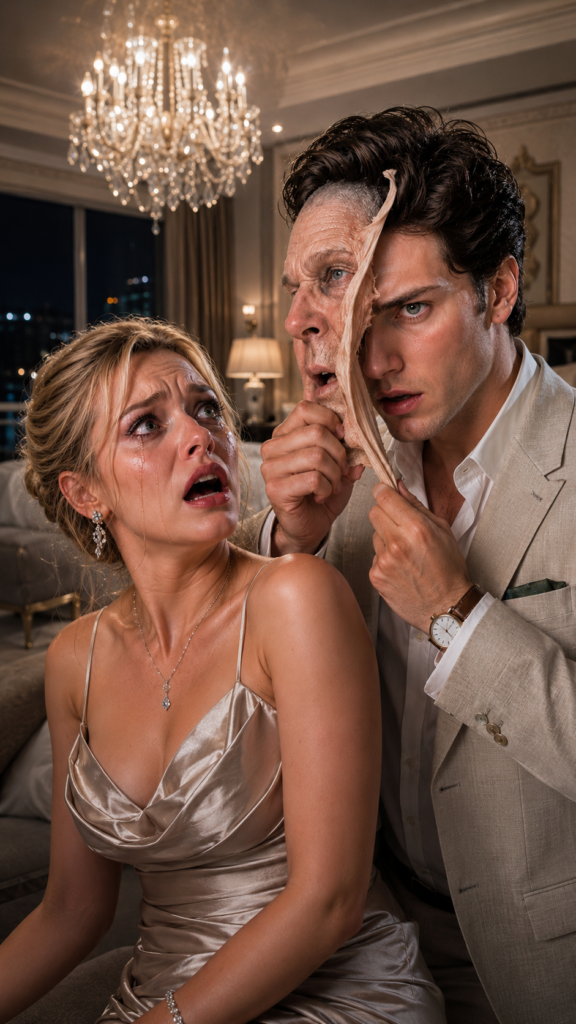
Then he lifted his fingers to her jaw, pulled the loose skin beneath her chin, and began to peel off his face.
Camila froze.
The wrinkles peeled away like a perfect lie. The gray hair fell along with a wig. The skin spots vanished. The twisted mouth transformed into a young, cold line.
There was no old man beneath.
There was a man in his 30s, tall, dark-skinned, with a defined jawline and a thin scar beside his left eye.
"I didn't come for you," he said. "I came for your family."
Camila felt the air leave her.
"Who are you?"
"Diego Moncada. Though your father knew me as Diego Aguilar."
That surname fell between them like a blow.
Aguilar.
A construction company that had disappeared 10 years earlier after a vehicular bridge collapsed in Morelos. Her father always said the Aguilars were irresponsible, ambitious, people who tried to grow beyond their means.
Diego opened a drawer and pulled out a thick folder.
"Your father forged safety reports. Your brother bribed an expert. They blamed my father to keep three contracts. He committed suicide. My mother lost her voice since then."
Camila swallowed hard.
"And that’s why you bought me as a wife?"
"I bought the front door. Your family sells everything when money is involved."
He showed her the contract. In exchange for 12 million pesos, her father had put up as collateral shares, properties, hidden accounts, and the family home.
If they broke just one clause, they would lose everything.
Diego expected to see her destroyed.
But Camila walked to the dresser, removed the emerald necklace, and left it beside the wrinkled mask.
"You mistook the daughter to scare," she said. "I have copies of the accounting books Rodrigo forced me to delete."
Diego stopped smiling.
Camila raised her phone. She had messages, transfers, fake invoices, and names her family thought were buried.
Then the screen vibrated.
It was Rodrigo:
"I hope the old man is satisfied. Tomorrow you get him the second payment or you know what happens to a useless wife."
Diego read the message.
Before he could say anything, another from her mother arrived:
"Don't cry. Remember your sacrifice saves our home."
Camila looked at the mask lying on the table and understood that her family hadn't sent her to a wedding.
They had pushed her into the center of a war, not imagining she carried weapons too.
And when Diego said, "Tomorrow we have breakfast with them," Camila knew no one in her family was prepared to see who had awakened that night.
PART 2
At 8 in the morning, the Riveras arrived at the Moncada mansion as if they were shareholders of the air they breathed. Ernesto stepped out of a black Suburban in a new suit. Doña Patricia brought white flowers. Rodrigo entered first, wearing dark glasses, a smug smile, and a folder under his arm.
Diego was again wearing the mask of Don Eusebio. Seeing him turned into an old man churned Camila's stomach, but it also reminded her of something important: dangerous people don’t always lie with words.
Sometimes they lie with a complete face.
"Camila, you look pale," her mother said, stroking her shoulder as if checking whether a package had arrived damaged.
Rodrigo laughed.
"You survived, see? So much drama for nothing. Seriously, you’ve always been so intense."
Camila looked down and poured coffee.
For years, that had been her best defense: to seem weak in front of people too arrogant to look closely.
Don Eusebio sat at the center of the table and spoke with his false, hoarse voice.
"Before the second deposit, I need to review updated financial statements."
Ernesto smiled immediately.
"Of course, of course. Everything is in order. It's just paperwork."
Rodrigo opened his folder but didn’t hand it over.
"The most practical thing would be to release the money today. There are suppliers breathing down our necks, licenses to pay, you know how this works in Mexico."
Diego tilted his head.
"I know perfectly how it moves."
Under the table, Camila activated a hidden recorder inside her bracelet.
Rodrigo didn’t take long to show his true face.
Later, in the library, believing Camila was alone, he locked her in and came so close she could smell the expensive perfume mixed with sleeplessness.
"Listen carefully," he said. "Convince the old man to release another 18 million or I’ll tell everyone you’re mentally unstable. Mom already has two psychologists ready to sign that you make things up."
"Why do you need so much money?"
Rodrigo smiled.
"To move it. Four suppliers from Mérida, two accounts in Panama, and some invoices for machinery that never existed. Then we declare a crisis, blame the market, and sell one piece of land. Dad comes out clean."
"And the employees?"
"Let them cope. Don’t be sentimental."
Camila let him speak.
He named banks, notaries, officials, phantom construction companies, and even the councilman who received watches in exchange for permits.
That night, Diego listened to the recording without interruption. His young face was still, but his eyes burned.
"With this, we can open the floor on them."
"It’s not enough," Camila said. "Rodrigo is going to say I was bragging. My dad will pretend he didn’t know. My mom will cry."
"So?"
"Then let them sign their own grave."
Camila prepared a fake spreadsheet where supposedly Don Eusebio would release 18 million more if Rivera and Associates presented new contracts with the municipality of Naucalpan. She left the tablet in a room, right where Rodrigo’s assistant used to poke around.
Before midnight, Rodrigo had already called three people.
By the next morning, there were two fake contracts, one copied digital signature, and six fabricated invoices.
The trap closed quickly.
Too quickly.
As they organized the documents, Camila reviewed the original file of the Aguilars. She was looking for dates, payments, matches. But she found something that froze her blood.
Her name.
She was 16 when the bridge in Morelos collapsed. Yet, in the file, there was a declaration signed by her, claiming she had seen the engineer Aguilar alter concrete tests.
Camila took the sheet to Diego's office.
"What is this?"
He stood still.
"That declaration destroyed my father’s appeal."
"I never signed this."
Diego lowered his gaze.
"At first, I thought so."
"At first?"
He pulled out another, old and marked copy.
"Your signature was one of the reasons I accepted to include you in the plan. I thought you were one of them."
Camila felt rage, but not against him. Or not just against him.
She looked at the signature stroke.
She recognized it.
It didn't come from a declaration. It came from a school permission slip her mother made her sign for a trip to Puebla when Camila still used colored pens and believed her family was a refuge.
Doña Patricia had stolen her own youngest daughter's signature to sink an innocent man.
The room seemed to shrink.
Camila understood why for years they called her exaggerated, useless, sensitive, difficult. They didn’t want her to grow up. They didn’t want her to ask. They didn’t want anyone to take her seriously.
She was the living proof of a forgery.
Diego reached for the document.
Camila didn’t give it to him.
"No more secrets."
He nodded, serious.
"No more."
She called her father.
"Dad, Don Eusebio agreed to release the remaining money. He wants a formal dinner tomorrow with the family, partners, and the board."
Ernesto let out a sigh of relief.
"I knew you’d finally be good for something."
Camila hung up without trembling.
On the other side of the office, Diego took off the mask and left it on the table.
"Are you sure?"
Camila looked at her stolen signature. She looked at the necklace Rodrigo had placed on her like a chain. She looked at the white dress hanging on a chair, still smelling of shame.
"No," she said. "I’m furious."
And that fury sat down to dinner with them.
The dinner was in the main hall of the mansion, under a huge chandelier, one of those that illuminates more sins than crystals. They served poblano chili cream, fillet, imported wine, and sweet bread that nobody touched.
Ernesto, Patricia, Rodrigo, three partners, one external accountant, and two board members arrived. They all believed that that night they would sign the definitive rescue of Rivera and Associates.
"Don Eusebio," Ernesto said, shaking the hand of the false old man. "You have no idea how much your trust means."
Diego responded in a hoarse old voice:
"Trust is expensive. That’s why I like to leave everything in writing."
Patricia looked at Camila from across the table.
"Sit up straight. Don’t go ruining anything tonight."
Before, that phrase would have made her shrink.
That night, it made her want to laugh.
At the end of the first course, Diego placed a folder in front of each executive.
"Last condition," he said. "Each one must confirm that these contracts, financial statements, and guarantees are authentic."
Rodrigo signed first, without reading.
"Duh."
Ernesto signed next with a gold pen. Patricia signed as corporate secretary. The partners hesitated, but seeing the Rivera family's confidence, they also signed.
Patricia leaned toward Camila.
"Good girl. You finally saved your own."
Camila stood up.
"No. I documented them."
Silence fell like a slab.
Diego raised his hands to his face. Rodrigo frowned.
"What the hell is the old man doing?"
The false skin peeled away from the jawline. The wrinkles vanished. The gray hair fell onto the table like a dead rat. Don Eusebio Moncada ceased to exist before everyone.
Patricia let out a short scream.
Ernesto turned pale.
Rodrigo threw his glass. The crystal shattered on the floor.
Diego straightened up, young, tall, with the scar next to his eye shining in the light.
"My name is Diego Aguilar Moncada," he said. "You destroyed my family, forged evidence, bribed officials, and stole millions hidden in phantom companies."
Patricia pointed at Camila as if she were the betrayal.
"Daughter, call security!"
"They’re already here," Camila replied.
The doors opened.
Agents from the Prosecutor's Office, financial investigators, two lawyers, and the councilman whose signature Rodrigo had used the night before entered.
Nobody screamed at first.
Fear took even the theater from them.
Rodrigo jumped up.
"This is a trap!"
"No," Camila said. "You were asked to confirm documents. You decided to sign new forgeries."
An agent took the folders before Rodrigo could touch them.
Ernesto tried to speak with authority, but his voice came out weak.
"My daughter is confused. She’s always been emotional. She doesn’t understand business."
One of the lawyers laid on the table Camila’s certification in forensic accounting, her expert report, and four notarized backup hard drives.
"She understands," Diego said. "That’s what scared you."
Camila connected her laptop to the hall's screen.
Transfers, duplicated invoices, payments to inspectors, phantom companies, properties in the names of straw men, and the exact route of the money that had left Aguilar Construcciones 10 years ago appeared.
Then Rodrigo's voice sounded, clear, arrogant:
"Four suppliers from Mérida, two accounts in Panama, and invoices for machinery that never existed."
Rodrigo lost color.
"It’s edited."
The councilman stepped forward.
"My signature was used without authorization. The complaint has already been filed."
Patricia started crying, but Camila already knew that trick.
"We did everything for you," her mother sobbed.
"No," Camila replied. "You sold one daughter. And when that daughter was 16, you stole her signature to blame an innocent man."
The false declaration appeared on the screen.
Then the school permission slip from Puebla appeared.
The same signature. The same stroke. The same lie.
Patricia stopped crying.
That was her true face.
The agents read the charges: fraud, criminal conspiracy, forgery, bribery, identity theft, obstruction of justice, and diversion of labor funds.
The guarantees signed before the wedding allowed freezing accounts, seizing properties, and recovering assets. The company would enter judicial administration to protect the workers, not the Riveras.
Rodrigo exploded.
"You owe us loyalty!"
Camila looked at him without blinking.
"I owed you silence. And it’s over."
Ernesto didn’t shout. He simply stared at the tablecloth, as if for the first time he understood that his last name no longer opened doors.
Patricia whispered:
"Where am I going to live?"
Camila felt no hatred. Hatred had already made enough noise.
"In a place where you can't sell anyone."
They first took Rodrigo, cursing everyone. Then Ernesto, with his head down. Patricia left escorted, with her pearls askew and a dry gaze.
When the hall was empty, Diego picked up the remnants of the mask and left them on the table.
"I’m sorry," he said.
Camila took a deep breath.
"Me too."
Not for them.
For the girl used as a signature. For the man who died believing nobody would defend him. For the woman who entered dressed as a bride as payment for a debt and left transformed into a witness.
Six months later, Rodrigo and Ernesto accepted sentences. Patricia received house arrest and a restitution order that stripped her of almost everything she had protected with fake tears.
The recovered money paid overdue pensions, compensated employees, and reopened the Aguilar case.
The house in Las Lomas was sold. The one in Cuernavaca too. Rivera and Associates survived, but without the Riveras. More than 200 workers kept their jobs under judicial supervision.
Diego annulled the marriage without a fight.
On the signing day, in a sober office near Reforma, he left the pen on the desk and looked at Camila without a mask.
"Was any of this real?"
Camila thought of the wedding night, the fear, the fury, and the truth they both had carried from different places.
"The deal wasn’t," she said. "The trust was."
He nodded, as if that answer both hurt and healed at the same time.
A year later, Camila opened her own forensic accounting firm in Mexico City. From her window, she saw towering buildings filled with people convinced that money erases traces.
She knew better.
Money always leaves a trail. You just have to look where the arrogant think nobody will search.
On the wall of her office, she hung a phrase written by her:
"Being underestimated isn’t a weakness. It’s time in your favor."
Every morning, looking at it, she remembered the night her family sacrificed her to save a debt.
They thought they were sending her to sacrifice.
But they sent her straight to the room where the truth was kept.





