PART 1
When the first contraction doubled Mariana Solís over the kitchen counter, she still had a glass of water in her hand.
The glass slipped from her fingers and shattered against the floor as if something inside the house had understood before anyone else that this night would break forever.
—Rodrigo... —she whispered, clutching her belly—. Something isn’t right.
Rodrigo Alcázar lifted his gaze from his phone with irritation.
He wasn’t working. He wasn’t resolving an emergency. He was scrolling through the family group chat where his mother, Doña Patricia, was flaunting pictures of the reserved room in San Ángel for her 65th birthday.
He was already dressed in a dark gray suit, freshly polished shoes, expensive cologne, and his hair slicked back as if he were going to a wedding.
To Rodrigo, missing his mother’s birthday was an unforgivable betrayal.
But leaving his 38-week pregnant wife alone seemed like just a domestic inconvenience.
Another contraction hit, stronger this time. Mariana gripped the sink, cold sweat pouring down her face, her legs trembling.
—Rodrigo, please... I think the baby is coming.
He let out a dry laugh.
—Oh, Mariana, don’t start with your drama.
The words landed colder than the pain.
Their doctor had warned them two weeks earlier that Mariana’s blood pressure was unstable. She had looked Rodrigo straight in the eye and told him that if there was severe pain, dizziness, bleeding, or sudden contractions, they had to go to the hospital immediately.
Rodrigo nodded like a responsible man.
But that night, all he thought about was not angering his mother.
Mariana breathed as best she could.
—I’m not exaggerating. It hurts horribly. I feel like something is wrong.
Rodrigo grabbed the car keys.
—You always do this. Just when my family needs me, you invent a crisis.
She looked at him in disbelief.
—Your daughter needs you.
He stopped at the door and smiled contemptuously.
—My mom turns 65 only once. You’ve been pregnant for nine months. You can wait a few hours.
Then he walked out.
The door slammed, shaking the hallway.
Mariana tried to call him five times. Rodrigo rejected each call. On the sixth attempt, her phone went straight to voicemail.
Then she saw the blood.
At first, it was just a little. A red spot on the white floor. Then another. And the air in the kitchen began to feel thin, as if the walls were closing in.
With trembling hands, she called 911.
—My husband left —she managed to say, crying—. I’m pregnant. I’m alone. Help me, please.
Crawling, she opened the front door, terrified she might faint and the paramedics wouldn’t be able to enter.
The ambulance arrived nine minutes later.
A paramedic named Luis knelt beside her.
—Ma'am, don’t sleep. Look at me. How many weeks are you?
—38... my baby...
Luis turned to his partner.
—Possible detachment. Fetal distress. Let’s go now.
Mariana remembered red lights bouncing off the ceiling. She remembered a stretcher. She remembered quick voices in the emergency room. She remembered a doctor shouting:
—Surgery now! Emergency cesarean!
And while Rodrigo toasted with tequila for his mother, Mariana entered a cold room alone, uncertain if she or her daughter would come out alive.
Two days later, Rodrigo came home smiling, a cake in a golden box in hand.
He opened the door expecting to find a tired wife and a newborn baby.
But when he looked at the floor, he lost his breath.
The dried blood was still there.
PART 2
Rodrigo Alcázar entered the house at 2:37 PM, whistling softly, with a loose tie and a smile of a man who believed he was right.
—Mariana? —he shouted from the entrance—. Enough with the tantrum, right?
No one answered.
He took two steps and then saw the broken glass near the kitchen. The glass was still in pieces. There was a dark mark in the hallway, as if someone had dragged themselves trying to survive.
The cake fell from his hands.
The box opened against the floor, and the frosting smeared across the tiles.
—What... what happened here?
From the living room appeared Andrés, Mariana's brother-in-law. He came in a police uniform, dark circles under his eyes, and a quiet rage that was scarier than a scream.
—What happened is what they warned you could happen.
Rodrigo took a step back.
—Where’s Mariana?
—At the hospital —Andrés replied—. Where you should have been two days ago.
Rodrigo put a hand to his chest.
—And the baby?
Then Clara, Mariana’s sister, came down with a hospital bag and eyes swollen from crying.
—Your daughter is alive —she said—. Not thanks to you, jerk.
Rodrigo seemed to lose strength in his legs. For the first time, he understood that the word “drama” hadn’t been a couple's argument but a cruel sentence.
While he was eating arrachera at Doña Patricia’s birthday, Mariana was being opened under bright surgical lights.
While he posed for pictures with golden balloons, his daughter was being born without a cry.
The girl, whom Mariana had already decided to name Lucía Renata, came into the world purple, tiny, with a silence that sent doctors and nurses running.
Mariana heard a nurse say:
—They’re working on her, Mom. Just hold on a little longer.
But Mariana couldn’t move. She was anesthetized from the chest down, staring at the ceiling, praying to God to take away anything but her daughter.
Rodrigo knew nothing because he didn’t want to know.
The hospital called from the emergency contact. He answered once, with music in the background.
—My wife exaggerates a lot —he said—. Call me when it’s something real.
It was real.
Lucía Renata ended up in neonatal therapy with tiny tubes stuck to her face. Mariana lost too much blood. Her pressure dropped twice. For 16 hours, the doctors watched over her like someone guarding a candle about to go out.
Clara arrived before dawn because she saw the missed calls.
She found the house open, the glass on the floor, and the trail of blood.
She was the one who ran to the hospital. She signed papers when Mariana could barely hold a pen. She stood in front of the incubator and cried softly.
—You do have family, my girl —she whispered to the baby—. Even if your dad is a coward.
On the morning of the second day, Mariana woke up to find Clara sitting next to her bed, holding her phone.
She had the pale face of anger.
—Mariana... Rodrigo posted pictures.
Mariana blinked, still dizzy from the medications.
—What pictures?
Clara showed her the screen.
Rodrigo was hugging Doña Patricia. They were both smiling, glasses in hand. Behind them were cousins, uncles, balloons, and a huge sign that read: “Happy 65, queen of the family.”
The post had one phrase:
“Family always comes first.”
Mariana didn’t cry.
Something inside her simply shut down.
It wasn’t anger. It wasn’t surprise. It was a deep silence, one of those that announce a woman is no longer asking for love but reclaiming dignity.
A nurse came in to check her vital signs and saw her staring at the screen.
—Mrs. Mariana —she asked carefully—, do you feel safe going home with your husband?
The question opened a door Mariana had been pretending for years didn’t exist.
She thought of every time Rodrigo minimized her pain. Of every time Doña Patricia called her “intense.” Of every Christmas where she apologized just to avoid ruining dinner. Of every slap on the table that Rodrigo later called “an accident.”
Then she thought of Lucía Renata breathing with the help of machines.
And she made a decision.
Clara didn’t clean the house. She said Rodrigo had to see what he had abandoned.
Andrés changed the locks, installed a security camera, and left a folder with documents on the entrance table.
Rodrigo saw it and approached with trembling hands.
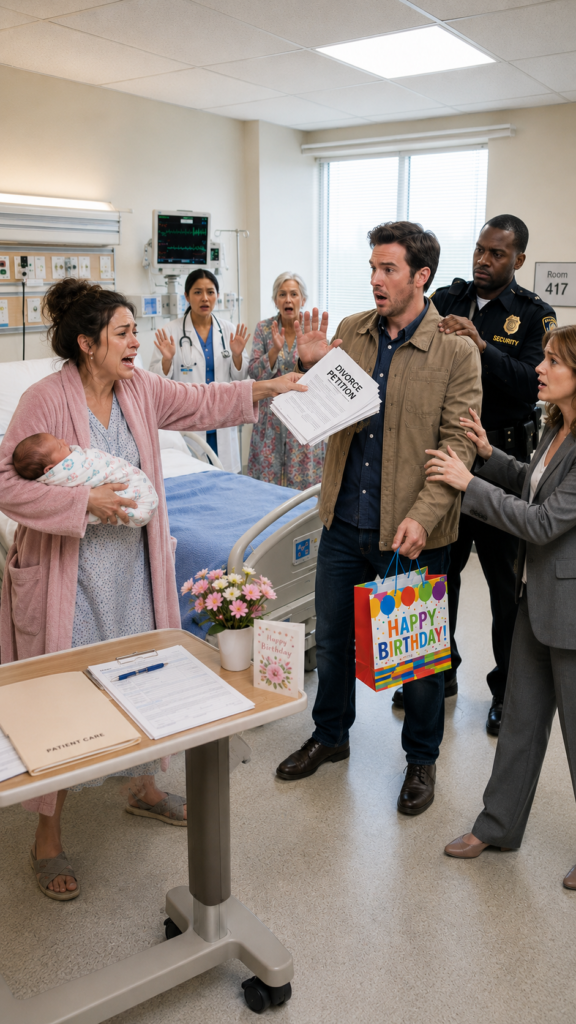
There were photographs of the stained floor. Screenshots of the five rejected calls. The medical report explaining that the delay could have endangered the lives of mother and daughter. The request for a protection order. The divorce papers.
And at the bottom, a note written by Mariana in shaky handwriting:
“Rodrigo, you were right. Family always comes first. That’s why you no longer belong to mine.”
Rodrigo sat on the stairs, shattered.
—No... you can’t do this to me.
Clara let out a dry laugh.
—Do this to you? Mariana almost died while you applauded for your mom.
Rodrigo pulled out his phone.
—I’m going to the hospital. I have the right to see my wife and daughter.
Andrés stepped forward.
—You won’t get past reception. Security has your name.
—It’s my daughter!
—You remembered too late.
Rodrigo tried to push, but Andrés didn’t budge.
At that moment, Clara’s phone rang. It was Mariana from the hospital, connected to the camera.
She had seen everything.
She didn’t want revenge. She needed to prove that the man she had feared for years only looked powerful when she was alone.
Rodrigo arrived at the hospital 40 minutes later, desperate and still smelling of expensive cologne and cake.
They wouldn’t let him in.
The reception nurse looked at him with professional coldness.
—The patient doesn’t authorize visits.
—I’m the husband.
—The patient doesn’t authorize visits —she repeated.
That night, he called her 26 times.
Mariana answered once.
—Forgive me —he sobbed—. I didn’t know.
She looked through the glass of neonatal therapy. Lucía Renata was moving her fingers inside the incubator, tiny but stubborn, fighting for every breath.
—You didn’t want to know —Mariana said.
—I thought you were exaggerating.
—You thought your comfort was worth more than my life.
Rodrigo cried ugly, without pride.
—Please, let me see my daughter.
Mariana took a deep breath.
—When a judge allows it.
The biggest twist came three weeks later.
During the legal process, Mariana’s lawyer requested the hospital’s call records. There appeared something Rodrigo never confessed.
The first emergency call wasn’t answered by him.
It was answered by Doña Patricia.
Rodrigo had left his phone on the table while he danced with his cousins. When the nurse explained that Mariana was in surgery and the baby was in serious condition, Patricia replied:
—My son is not going to leave my birthday for another tantrum from that girl. When the baby is born, send a message.
Then she hung up.
A cousin recorded part of the conversation without realizing it, because she was making a video of the toast. In the audio, Patricia could be heard clearly saying:
—Let her learn that in this family, tears don’t manipulate men.
That video changed everything.
Rodrigo tried to blame his mother. He said he didn’t know, that she hid the call from him.
But Clara presented another piece of evidence: minutes later, in the same video, Patricia whispered something in Rodrigo’s ear.
And he replied, laughing:
—I’ll go later. Just let her wait.
The court didn’t see a mistake. It saw abandonment.
The divorce lasted ten months. Rodrigo tried to sell himself as a confused husband who made one mistake. But the medical reports, the ignored calls, the Facebook post, the blood on the floor, the paramedics’ testimonies, and the birthday video told another story.
Mariana obtained primary custody. Rodrigo received supervised visits, mandatory therapy, a parenting course, and restrictions on direct contact with Mariana.
Doña Patricia sent flowers to the hospital.
Mariana didn’t even touch them.
Clara threw them in the trash in front of the reception.
Lucía Renata left the hospital after 23 days. The first night at home, Mariana sat by her crib until dawn, listening to every breath as if it were music.
Rodrigo came to see her months later in a supervised room at the DIF, with sunken eyes and a broken voice.
The baby didn’t recognize him.
And perhaps that was the most silent justice of all.
People later asked if Mariana hated Rodrigo.
The truth was simpler.
She stopped needing him.
The day he closed the door to go to a party, he showed her what kind of husband he was. The day Lucía Renata survived, he showed Mariana what kind of mother she had to become.
Because regret can come with flowers, tears, and promises.
But it doesn’t clean the blood from the floor.
And when a woman learns that protecting her daughter is worth more than saving a marriage, no birthday, mother-in-law, or last name will make her go back.





