PART 1
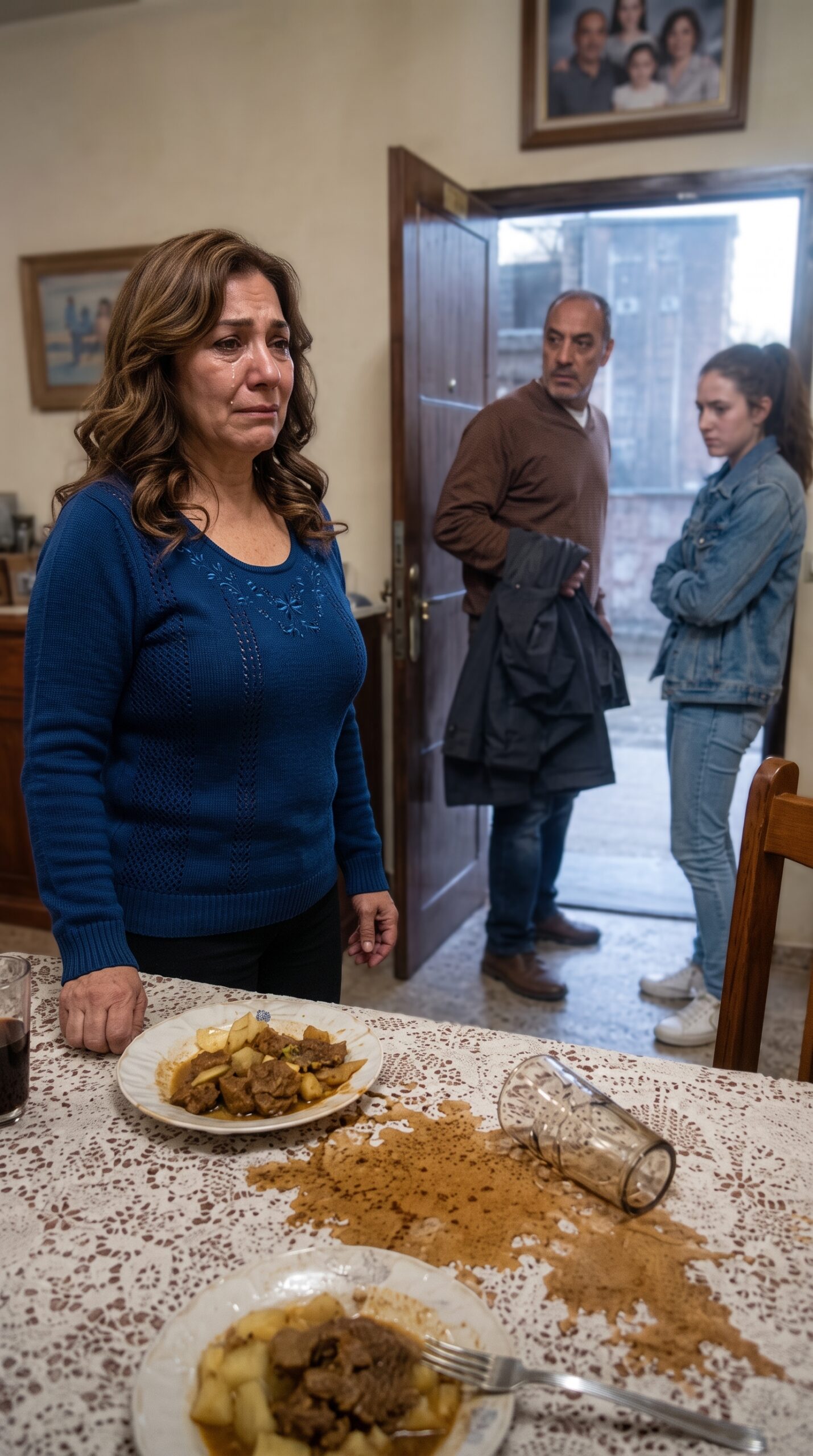
Carmen kicked Javier and his daughter out of the house on a rainy Sunday, right at lunchtime.
And though half the world would call her excessive, she knew one thing: it wasn’t just about a stain. She kicked them out because for four years, she had endured being treated as if she were invisible.
They lived in a small but lovely house in the Narvarte neighborhood of Mexico City. Carmen worked at a stationery store near the Etiopía metro station, Javier was an accountant, and Lucía, his 16-year-old daughter, was in high school with that dangerous mix of sadness, anger, and arrogance that nobody dared to name.
Since moving in with them, Carmen had promised not to become “the evil stepmother” of the stories. She cooked, washed uniforms, picked up medicine, listened to slammed doors, and pretended it didn’t hurt.
Lucía never called her mom. Carmen never asked her to. But there was a big difference between not demanding affection and accepting disdain.
Javier, on the other hand, was trapped in his guilt. Ever since his divorce, he said yes to everything his daughter wanted. If Lucía snapped back, he’d say it was just her age. If she left dirty dishes, he’d say she was tired. If she ignored Carmen, he’d look down and pour himself more water.
That Sunday, Carmen got up at 7 in the morning. She prepared a beef stew with potatoes, carrots, and ancho chili, the kind that smells like home from the sidewalk. She also took out the embroidered white tablecloth that had belonged to her grandmother Teresa.
That tablecloth was no ordinary item. Her grandmother used it only for birthdays, baptisms, and important meals. Carmen kept it like someone guards a part of their history.
At 2 PM, she set the table. Outside, the rain poured down. The steam from the stew fogged the windows. For a moment, Carmen believed that maybe, just maybe, they could eat as a family.
Lucía arrived, dragging her sneakers, cell phone in hand, and headphones on.
“Lucía, please put away your phone. We’re at the table,” Carmen said calmly.
The girl let out a long sigh, as if she had been asked to carry cement.
“Ugh, seriously, how intense. I’m not even hungry. Besides, that smells weird.”
Carmen looked at Javier. He pretended to adjust the napkin.
“Come on, sweetheart, just try a little. Carmen put in a lot of effort,” he murmured, lacking conviction.
Lucía didn’t even look at him. As she stretched her hand to take the salt without letting go of her phone, she knocked over her soda glass. The cola spilled directly onto the white tablecloth.
The dark stain opened like a wound.
Carmen froze. Javier did too. For three seconds, only the sound of the rain could be heard.
Lucía looked at the tablecloth, then at Carmen, and said with a horrible coldness:
“Well, you can clean it later. That’s what you’re here for, right?”
And she went back to staring at her screen.
Carmen felt something crack inside her. It wasn’t the tablecloth. It was her dignity.
She stood up slowly. She didn’t shout. She didn’t cry. She just walked to the front door and opened it.
“Out,” she said.
Javier looked up, pale.
“What?”
“Out. Both of you. Now.”
Lucía let out a nervous laugh.
“Are you crazy? Over a little stain?”
Carmen looked her straight in the eyes.
“It’s not about the stain. It’s because you didn’t say ‘sorry.’ It’s because you think the one who takes care of you is here to serve you. And it’s because your dad let you believe that.”
Javier opened his mouth, but Carmen didn’t let him speak.
“This is my house. My table. My food. My history. And my dignity isn’t kitchen slang for you to squeeze whenever you want.”
Lucía shot up, red with anger.
“Dad, say something!”
But Javier, for the first time, found no words.
Carmen pointed to the wet street.
“Go to your mom’s, your grandma’s, or a hotel. I don’t care. But you won’t come back until you understand the difference between a maid and a woman who loves you.”
Javier took his jacket. Lucía grabbed her backpack, trembling with rage.
When they stepped out into the rain, Carmen locked the door.
Click.
And behind that door, the food remained hot, the tablecloth remained stained, and Carmen understood she had just done something that would forever change that family.
PART 2
For a few minutes, Carmen didn’t move.
She stood in the hallway, hand still on the lock, listening to Javier and Lucía’s footsteps fade away in the rain. Then she returned to the dining room.
The stew was still on the table. The tortillas wrapped in an embroidered napkin. The tipped-over glass rolled barely next to Lucía’s plate. And her grandmother’s tablecloth had a brown stain in the center, as if someone had tried to wipe away four years of patience in one blow.
Carmen sat in front of her plate. She didn’t eat. She just poured herself water because the wine felt too elegant for such an ugly sadness.
She cried in silence.
Not because she regretted it. She cried because she loved Javier. Because, deep down, she also wanted Lucía to love her. Because kicking them out hurt like ripping out a rib.
But she knew that if she let them stay after that, something inside her would extinguish forever.
That night, Javier didn’t call. Nor did Lucía.
On Monday, there were no messages.
On Tuesday, Carmen received an audio message from Javier’s mom, Doña Consuelo.
“Sweetheart, Javier is here with the girl. I’m not going to get involved, but let me tell you something: sometimes men don’t understand until the roof falls on them. You did well not to let yourself be walked over.”
Carmen listened to the message three times.
She didn’t reply.
On Wednesday night, at 8:17, the doorbell rang. No one unlocked it. No one shouted from outside. No one sent a message saying “we’re home.” They knocked like visitors.
Carmen opened the door.
Javier was soaked even though it wasn’t raining anymore. He had dark circles under his eyes and a bag of sweet bread in his hand. Lucía stood beside him, with a box of pastries from the corner bakery. She didn’t have headphones. Her cell phone wasn’t visible anywhere.
Neither of them stepped inside.
“Carmen,” Javier said, his voice cracking, “I was wrong. Not just on Sunday. I’ve been wrong for years.”
Lucía lowered her head.
Carmen said nothing.
“I spoiled her because I was afraid of losing her,” Javier continued. “I thought saying no would hurt her. But I ended up hurting you. And her too.”
Lucía clutched the box to her chest. Her eyes were red.
“Sorry, Carmen,” she finally said. “Not just for the stain. For how I spoke to you. For acting like you had to serve me. I looked for a way to get soda out of an old fabric. I bought a special liquid. If you let me… I want to try and clean it myself.”
Carmen felt her throat tighten.
It wasn’t a perfect apology. It wasn’t a telenovela scene. It was a teenager swallowing her pride at a door, and that, for Carmen, was worth more than a hundred pretty speeches.
She stepped aside.
“Come in.”
That night, there was no stew. Carmen made ham and cheese sandwiches. They ate on simple plates, without a tablecloth. No one turned on the television.
When Carmen poured water for Lucía, the girl looked up.
“Thanks.”
One single word.
But in that house, it sounded like someone had opened a window.
The next day, Carmen set a rule.
“At this table, there are no cell phones. No headphones. No rudeness disguised as adolescence. Here we eat with respect, or we don’t eat.”
Javier nodded immediately.
Lucía grimaced, but she left her phone in the kitchen.
The first days were strange. They ate as if they were learning a new language. Javier made nervous jokes. Lucía responded little. Carmen watched everything, remaining on guard.
On Friday, while Carmen folded clothes in the living room, Javier sat next to her.
“I was scared to see you close the door,” he confessed. “But I was even more scared to realize you had been out of this house for a long time, even though you were here.”
Carmen placed a towel over her lap.
“I left little by little every time you justified rudeness. Every time you said, ‘Leave her, she’s a kid.’ Every time you left me alone being the bad adult.”
Javier closed his eyes.
“I know.”
“I don’t want to fight for your mom’s place,” Carmen said. “I’m not her competition. But I’m also not a punching bag for her anger.”
“I’m going to talk to her,” he replied.
“No. You’re going to talk to yourself first. Because Lucía learned from your silence.”
That phrase hit harder than any shout.
On Saturday morning, Lucía entered the kitchen while Carmen was chopping tomatoes for noodle soup.
She stood next to the refrigerator, restless.
“Can I help?”
Carmen looked at her. She didn’t smile much. Some things couldn’t be fixed with a kind afternoon.
“Wash the cilantro.”
Lucía obeyed.
The water ran. The silence did too.
After a while, the girl spoke without looking at her.
“I didn’t know the tablecloth was your grandmother’s.”
Carmen kept stirring the soup.
“You didn’t know because you never asked.”
Lucía bit her lip.
“I thought that if I liked you… it was like betraying my mom.”
Carmen turned down the heat a bit.
There it was. The root hidden beneath so much insolence.
“Loving someone doesn’t erase another person, Lucía.”
“My mom says you intruded into the family.”
Carmen took a deep breath. That phrase hurt her, but it didn’t surprise her.
“Your mom has the right to be angry about many things. But I didn’t destroy her marriage. When I met your dad, they were already separated.”
Lucía let out a bitter laugh.
“She says otherwise.”
At that moment, Javier appeared in the doorway. He had listened enough.
“Your mom and I hadn’t been a couple for a year before Carmen arrived,” he said seriously. “And I should have explained that to you, not left you to discover it through anger.”
Lucía froze.
“Then why didn’t you tell me?”
Javier looked down.
“Because I was a coward. Because I didn’t want you to be angry with me. It was easier to let you blame Carmen.”
Lucía’s face changed. There was no longer just anger. There was confusion. Pain. A new shame.
“Did you let her carry that?”
Carmen looked at Javier. That question finally didn’t come from her.
Javier nodded.
“Yes. And it was wrong.”
Lucía dropped the cilantro in the sink. Her eyes filled with tears, but she held them back as if crying was losing.
“I thought that if I treated her badly, I was defending my mom.”
Carmen approached slowly.
“You weren’t defending anyone. You were hurting someone who put a warm plate in front of you every day.”
Lucía didn’t respond. But this time, she didn’t storm out.
That afternoon, the three of them ate noodle soup with avocado and lime. It was a simple, almost awkward meal. But before getting up, Lucía collected her plate and Carmen’s.
“I’ll wash,” she said.
“I’ll dry,” Carmen replied.
There were no hugs. No sentimental music. Just hot water, soap, and two women by the sink, learning not to hurt each other.
The following week, Lucía tried to clean the tablecloth. She spread it over the table, placed a towel underneath the stain, and followed the instructions of the product she had bought. Carmen watched from afar, without intervening.
The stain faded a bit, but did not disappear.
Lucía grew frustrated.
“It won’t come out.”
“There are things that can’t be completely removed,” Carmen said. “But they can stop hurting just the same.”
Lucía looked at her as if that phrase were for her, not for the tablecloth.
Months passed.
Not everything was perfect. There were days when Lucía snapped back. Days when Javier almost said, “Don’t exaggerate.” Days when Carmen felt like locking herself in her room and giving up.
But something had changed: now, when someone crossed the line, someone spoke up.
On an April Sunday, Carmen decided to take out her grandmother’s tablecloth again. She ironed it carefully and laid it on the table. The shadow of the stain was still there, less intense but visible.
Lucía saw it and fell silent.
Then she went to her room and returned with a sewing box.
“At school, they taught us to embroider patches,” she said, nervously. “I made one. Not to cover it up as if nothing happened. More like… to make it look different.”
She opened the box.
Inside was a hand-stitched flower, crooked, with red petals and green leaves. It wasn’t perfect. That’s what made it seem alive.
Carmen took it carefully.
“You made this?”
Lucía nodded.
“It took me two weeks. I undid it like five times because it turned out horrible.”
Javier, from the doorway, wiped his eyes without anyone saying anything.
“If you let me,” Lucía continued, “I’ll sew it over the shadow. So it doesn’t look like a stain. So it looks like a story.”
Carmen felt a lump in her throat.
For years, she had wanted Lucía to love her. Then she wanted her to at least respect her. Now she understood that the latter had to come before the former.
“Do it,” she said. “But slowly. That tablecloth has endured enough.”
They sat together by the window. Outside, tamales were being sold, and the shout of the gas man could be heard faintly. Life continued, as always, mixing the sacred with the everyday.
Lucía carefully inserted the needle. Carmen held the fabric to keep it from wrinkling.
After several stitches, Lucía spoke very softly:
“Thank you for kicking us out that day.”
Carmen froze.
“How?”
Lucía lifted her gaze. She no longer had the face of an offended queen. She looked like a girl tired of fighting ghosts.
“If you hadn’t done it, I would have kept thinking it was normal to treat you like that. And you… you would have kept fading away.”
Carmen didn’t respond immediately.
She looked at the crooked flower. She looked at the shadow beneath it. She glanced at Javier, who finally seemed to understand that loving a daughter didn’t mean letting her destroy others.
“I love you too, Lucía,” Carmen finally said. “But I had to love myself first.”
Lucía lowered her head, and this time, she cried. Not with a tantrum. Not dramatically. She cried like someone who finally understands the damage they caused.
Javier approached and placed a hand on the back of her chair.
“Sorry for making you carry my guilt,” he said.
Carmen looked at him.
“Forgiveness isn’t a door that opens once. It’s a table that gets cared for every day.”
Nobody said anything else.
When they finished, the flower was a little crooked over the tablecloth. The stain still lingered, hidden beneath, but it no longer commanded. It was no longer a shame. It was a transformed memory.
That afternoon they ate baked chicken, red rice, and salad. Before sitting down, Lucía put her cell phone in the kitchen drawer, without anyone asking her to.
In the middle of the meal, she took the water pitcher and looked at Carmen.
“Can I serve you?”
Carmen nodded.
It was a small gesture. But there are small gestures that repair whole houses.
Years later, when someone in the family asked about the crooked flower on the tablecloth, Carmen didn’t say it was to hide a stain.
She said it was to remember the day a closed door saved a house.
Because respect isn’t begged for, bought, or bartered.
Respect is placed on the table.
And those who don’t know how to sit with dignity sometimes need to stay outside in the rain to understand the value of coming in.





