PART 1
—Tomorrow you sign, Alejandro. Or I swear your mother will end up in a place where no one will ever ask about her again.
That was the first thing Alejandro Salvatierra heard as he opened the door to his home in the Del Valle neighborhood of Mexico City.
He had come home exhausted, his shirt wrinkled, his mind swirling with responsibilities from the family business. But as he took two steps into the inner courtyard, all that fatigue turned to ice.
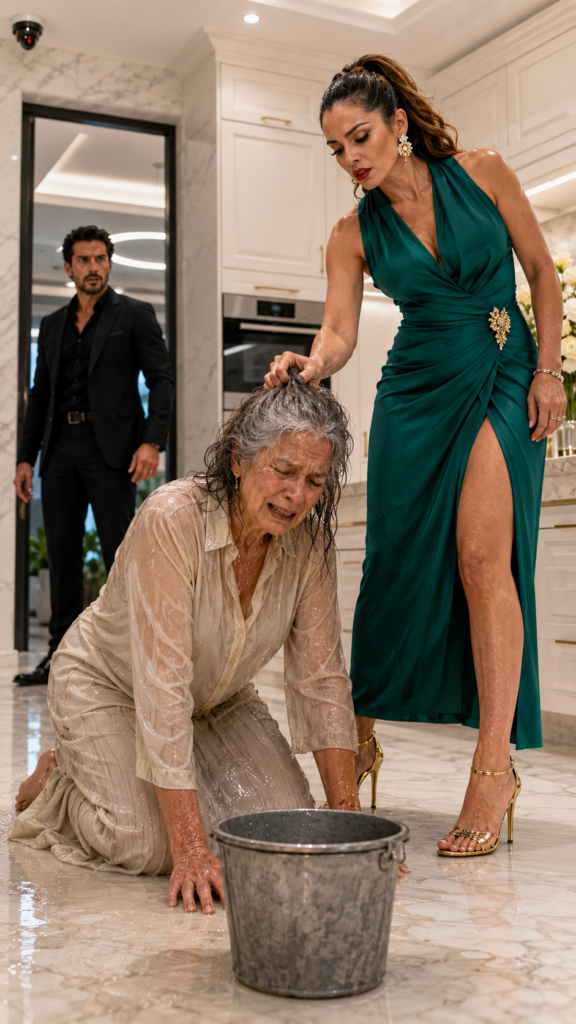
Doña Carmen, his mother, was on her knees by the sink.
Her rebozo was soaked, her hands red, her hair plastered to her face, and her eyes filled with a shame that did not belong to her. The floor was slick with dirty water, soap, and dirt.
In front of her stood Renata, his wife.
Dressed in white, immaculate, with perfect nails and a smile so serene it was terrifying.
—Let her go —Alejandro said, his voice low.
Renata turned slowly, as if he had interrupted some casual conversation.
—Oh, Alejandro… you’re early. What a bummer. Your mom was just starting to understand that everyone here needs to serve a purpose.
Doña Carmen tried to get up but slipped. Alejandro rushed over and caught her before she fell again.
—Don't make a scene, son —she whispered—. Please.
That phrase hurt more than seeing her on her knees.
Because Doña Carmen was not a weak woman. She had sold tamales outside the Metro Constitución to pay for his college. She had cared for her husband Julián during three years of illness. She had helped build Salvatierra Biotec when it was just a small shop in Querétaro.
And now she was begging for forgiveness for breathing in her own son’s house.
Renata crossed her arms.
—Tomorrow there’s an appointment with the notary in Polanco. You’re going to sign the power of attorney. The company goes under my management, the house is under my control, and your mother is going to a residence. I won’t put up with her drama of being a neglected old lady any longer.
Alejandro stared at her, unblinking.
For six years, Renata had been perfect in everyone’s eyes. At family dinners, she embraced Doña Carmen. At partner meetings, she called him “my love.” On social media, she posted pictures with phrases about family, loyalty, and blessings.
But privately, she had been slowly extinguishing him.
She called him useless. She called him a coward. She repeated that without her, he wouldn’t even know how to pay the electricity.
And he had stayed silent.
Not out of fear.
But because he was waiting for her to feel untouchable.
—Do you really think I’m going to sign that? —he asked.
Renata let out a dry laugh.
—Of course you are. Because if you don’t sign, tomorrow I’ll present medical reports to prove that your mother isn’t well anymore. I have witnesses, I have money, and I have Dr. Meza willing to help. Do you really think anyone will believe a confused old lady?
Doña Carmen lowered her gaze.
Alejandro felt something break inside him.
Then he lifted his eyes to the supposed smoke detector placed above the patio door.
A red light was blinking.
Renata didn’t know that wasn’t a detector.
She didn’t know it had been recording threats, insults, and humiliations for three weeks.
And she certainly didn’t know that, that very morning, a lawyer had already submitted the first evidence to a family judge.
Alejandro embraced his mother and led her out of the patio.
Renata screamed behind them:
—Tomorrow you sign, Alejandro! Or the old lady won’t sleep under this roof again!
He didn’t respond.
He just smiled for the first time in months.
Because no one could believe what was about to happen…
PART 2
That night, Alejandro didn’t sleep.
He made Doña Carmen a cinnamon tea, found her dry clothes, and sat by her bed until she stopped trembling. The house, which had once seemed elegant and tranquil from the outside, felt like a trap with beautiful walls that night.
Doña Carmen didn’t cry loudly.
She cried softly, like people who have learned not to disturb.
—Forgive me, son —she murmured—. I didn’t want to cause you problems.
Alejandro clenched his fists.
—You are not the problem, Mom.
—Renata said that if I spoke up, you would think I was making things up. That an old mother always wants to separate her son from his wife.
He fell silent for a few seconds.
It hurt to accept that, for months, he hadn’t seen everything. He had noticed silences, swollen eyes, lost objects, misplaced medicines. But Renata always had a ready explanation.
“Your mom is sensitive.”
“Your mom exaggerates.”
“Your mom wants attention.”
And he, exhausted from work and arguments, had often preferred to believe everything was under control.
At 2 a.m., Renata walked down the hallway talking on the phone.
Her voice sounded calm, almost happy.
—Tomorrow he signs. I’ve got him broken… Yes, my love, then we’ll move the shares to the company and sell before the Board gets involved.
Alejandro stood frozen.
—No, the old lady won’t be a bother —Renata continued—. Dr. Meza can make two reports. With that, we’ll get her into a private residence, and that’s it.
“My love.”
Alejandro didn’t need to hear the name.
Diego Armenta, an external lawyer from a competing company, had entered their lives a year ago. Renata said he was just a legal advisor. Alejandro had pretended to believe her, just as he had pretended not to notice her hidden calls, sudden trips, and deleted messages.
But Julián Salvatierra, his father, had never trusted appearances.
Before he died, Julián left Alejandro a wooden box with an encrypted USB drive and a note written in shaky handwriting:
“When someone wants you to sign in a hurry, open this.”
Alejandro opened that box six weeks earlier.
Inside, he found private audits, suspicious contracts, strange transfers, and emails where Renata and Diego discussed a shell company.
In one of those emails, Diego wrote:
“When Alejandro relinquishes control, we empty the assets and walk away clean.”
At 5 a.m., Alejandro sent three digital folders: one to his lawyer Mariana Ríos, another to the notary, and another to the Financial Crimes Prosecutor’s Office.
Then he sat by the window until dawn.
At 9, Renata came down to the dining room in an ivory dress, dark glasses, and expensive perfume.
She looked ready for a wedding, not to destroy a family.
—Let’s go —she commanded—. I don’t want to be late.
—My mother is coming —said Alejandro.
Renata took off her glasses.
—She has nothing to do there.
—Yes, she does. She’s coming as a witness.
Renata stared at him for several seconds. Then she smiled.
—Perfect. Let her see how her son finally learns to obey.
The notary’s office was in Polanco, in a modern building with huge glass windows, an elegant reception, and coffee served in small cups. Diego Armenta was already waiting for them inside, dressed in a blue suit, shiny watch, and that smile of a man who thinks the law is a toy for the rich.
—Alejandro —he said, extending his hand—. It’s great that you’re making a mature decision. Renata has vision.
Alejandro didn’t take his hand.
The notary placed the documents on the table.
It wasn’t a simple power of attorney.
It was a disguised assignment.
Shares, voting rights, administrative control, linked properties, banking authorizations. All wrapped in legal language to make it seem like a couple’s decision.
Renata placed a pen in front of him.
—Sign.
Doña Carmen was sitting beside him. She had her usual brown purse, the one where she kept little religious cards, handkerchiefs, and an old photo of Julián in front of the Basilica of Guadalupe. She was scared, but she didn’t lower her gaze.
Alejandro pulled out his phone.
—First, I want you to listen to something.
Renata’s voice filled the room.
“Tomorrow you sign, Alejandro. Or I swear your mother will end up in a place where no one will ever ask about her again.”
Diego paled.
Renata shot up abruptly.
—That’s edited. That’s illegal.
Alejandro pulled out a physical folder and opened it on the table.
There were emails, transfers, messages, screenshots, fake medical reports, and photographs of the supposed smoke detector installed in the patio.
—Then your emails, your deposits, and your messages with Dr. Meza were edited too, right?
The notary left the pen on the table.
Renata looked at the papers as if each sheet had stripped her of a layer of makeup.
—Where did you get this?
Alejandro leaned toward her.
—from my father. And from your arrogance.
At that moment, the door to the room opened.
But the police didn’t enter.
A woman walked in that Renata never imagined would be there.
It was Laura Armenta, Diego’s wife.
She didn’t scream. She didn’t cry. She didn’t put on a show. She walked to the table with a yellow envelope in hand and placed it next to the document they were trying to force him to sign.
—I brought evidence too —she said.
Diego stepped back.
—Laura, this isn’t the time.
She looked at him with an icy calm.
—Of course it is. Two weeks ago the bank called me about a transaction I never authorized. Since then, I know you used my signature to open a shell company.
Renata turned to Diego.
—A shell company?
Laura opened the envelope.
—The same company where they were going to move the shares of Salvatierra Biotec. The same one they planned to sell quickly and disappear with the money.
Diego tried to smile.
—You don’t know what you’re talking about.
Laura pulled out bank statements, notarized copies, and printed messages.
—I do know. I also know you planned to go to Cancún with Renata when it all blew over.
Renata froze.
—Cancún? You told me we were going to Miami.
That absurd detail shattered the mask of both.
Diego lost control.
—you contacted me! You said your husband was a poor fool and that the company was abandoned!
Renata slammed the table.
—you designed the plan!
—because you wanted to push her mother out of the picture!
Silence fell heavy.
Doña Carmen closed her eyes.
Alejandro felt a slow, deep rage, but he didn’t shout. He didn’t want to give them another spectacle. He wasn’t going to fight from pain anymore. He would respond from truth.
Mariana Ríos, his lawyer, walked in a few seconds later with a black folder.
—Sir —she said to the notary—, this document cannot be signed. There is a request for precautionary measures, an ongoing complaint, and evidence of financial coercion, document fraud, and psychological violence against an elderly person.
Renata let out a nervous laugh.
—Violence? Please. Carmen always exaggerates. She’s getting old.
Then Doña Carmen spoke.
Her voice came out low but firm.
—I don’t exaggerate.
Everyone turned.
She clutched her purse against her chest.
—for months I thought the blame was mine. I thought that maybe I was a nuisance. That maybe I was a burden. But you hid my medicines from me, Renata. You took away my phone. You told me my son would choose you because I was no good for anything anymore.
Alejandro felt the air leave him.
He didn’t know that.
—You took away her medicines? —he asked, staring at Renata.
Renata tried to respond, but Diego stepped in.
—I didn’t know that.
Laura let out a bitter laugh.
—Look at them. They’re sinking all by themselves.
Mariana placed a tablet in front of the notary.
The video started.
It didn’t show everything. It didn’t need to.
Just a few seconds were enough: Renata forcing Doña Carmen to scrub on her knees, calling her “useless old woman,” threatening to send her to a home, and mocking her prayers.
The notary took off his glasses.
Laura covered her mouth.
Diego stopped talking.
Renata screamed:
—Turn that off!
No one moved.
Then Doña Carmen lifted her face.
—No. Let it be.
Those two words changed the entire room.
She was no longer the old lady on her knees in the patio.
She was a mother reclaiming her voice.
The door opened again. This time, two investigative agents entered with a court official. There were no screams or movie-like scandals. Just papers, identifications, and an order.
They asked for Renata Pineda and Diego Armenta.
Mariana pointed calmly.
—Here they are.
The agent explained that both needed to appear to testify for threats, document fraud, possible fraudulent administration, and psychological family violence.
Renata tried to compose herself.
—My husband is being manipulated by his mother.
Alejandro looked at her like one looks at a crumbling house.
—Don’t ever use my mother again to hide who you are.
Diego wanted to speak as a lawyer, but the agent interrupted him.
—You will have the opportunity to testify.
They weren’t taken away in handcuffs in front of everyone. The reality was colder. They were asked to accompany them. Diego left first, sweating. Renata walked behind, still trying to appear untouchable.
Before crossing the threshold, she turned to Alejandro.
—Without me, you won’t manage the company.
He replied without raising his voice:
—It may cost me. But I’d rather learn alone than keep dying with you.
Renata couldn’t find a phrase that sounded victorious.
And she left.
The following days were a storm.
The judge issued protective measures. Renata couldn’t approach Doña Carmen or enter the house. Movements regarding the shares of Salvatierra Biotec were also frozen. Diego was reported to the Bar Association. Laura filed her own complaint for forgery.
But the hardest part for Alejandro wasn’t the paperwork.
It was watching the full recordings.
He saw Renata turn off his mother’s phone. He saw her hide her pills. He saw her tell her that Alejandro was tired of supporting her. He saw her break a cup and force her to clean the floor “if she wanted to keep eating there.”
Alejandro couldn’t finish the videos.
He cried in the bathroom like he hadn’t cried since Julián’s death.
Doña Carmen knocked on the door.
—Son.
He came out with red eyes.
—Forgive me, Mom.
She embraced him.
—Don’t apologize for what someone else did.
Three months later, Alejandro officially returned to the management of Salvatierra Biotec. He didn’t arrive shouting orders or flaunting revenge. He arrived with audits, new controls, and a clear decision: no signature would ever again depend on blind trust.
At the entrance of the building in Querétaro, he had a simple plaque placed:
“Carmen Salvatierra Program: legal and psychological support for elderly victims of family abuse.”
Doña Carmen didn’t want it.
—How embarrassing, son. Don’t put my name.
Alejandro took her hand.
—Those who hurt the people who cared for them should be the ones feeling embarrassed.
On the day of the inauguration, she arrived in a navy blue dress and a light rebozo. She walked slowly, leaning on her son. When she saw her name on the plaque, she began to cry.
—Your dad would be proud —she whispered.
Alejandro looked at the plaque.
—He always knew that one day we would need strength.
A year later, Doña Carmen returned to cooking mole in the Del Valle house. She invited neighbors, cousins, and former employees. The patio smelled of chocolate, roasted chili, and hot tortillas.
In the same place where she was once humiliated, there were now new flowerpots, clean light, and a long table full of people.
Doña Carmen sat at the head.
No one asked her to.
Everyone understood that this place belonged to her.
As she served coffee, she looked at Alejandro and said:
—The worst part wasn’t what they did to me. The worst part was believing for a moment that I deserved it.
His throat tightened.
—You never deserved it.
She squeezed his hand.
—Then promise me something. When you hear someone say “it’s family stuff,” don’t remain silent.
Alejandro looked around.
The house no longer seemed an elegant facade. It felt like a home.
—I promise.
That night, as he passed through the patio, he saw the clean sink and the dry floor. The fake detector was no longer there, but he still imagined the little red light blinking.
Renata thought power was humiliating without witnesses.
Diego thought the law was a paper he could bend.
Alejandro thought for years that silence was protection.
All three were wrong.
True power emerged when Doña Carmen said: “Let it be.”
When she stopped apologizing for existing.
When her pain stopped hiding.
Because that day Alejandro didn’t lose a marriage.
That day he regained his mother.
And with her, he regained his life.





