PART 1
On Tuesday, Renata buried her father in a cemetery in Iztapalapa.
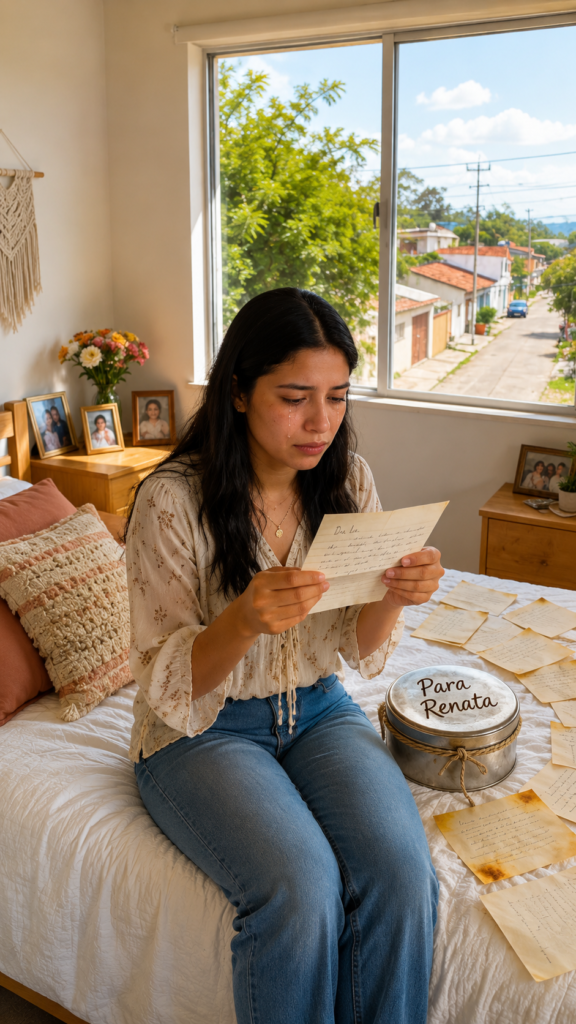
On Wednesday, while clearing out the small room where he had slept for 24 years, she found a cookie tin atop the closet. It was clean, dust-free, and tied with a red string that looked freshly bought.
Inside were dozens of letters.
All addressed to her.
Not Dr. Renata Salgado, as it was embroidered on her coat, but "Renatita," written in purple ink with a feminine script full of curves. Not a single letter had ever reached her hands.
Her father, Jesús, had Down syndrome. He had raised her alone since she was 2 years old.
When Renata asked about her mother, he repeated the same story:
—She left because she wasn’t ready, my girl. But you did nothing wrong.
Jesús cleaned offices in the mornings and arranged books in a library in the afternoons. He came home smelling of bleach, cheap coffee, and old paper. Sometimes he confused sugar with salt, read recipes three times, and called any burnt dish "gourmet cooking."
But he never forgot a school meeting, a vaccination, or a tuition payment.
Every peso for her medical degree had come from those two jobs.
Renata opened the oldest letter.
"My Renatita: today you turn 3 years old. They told me you asked for a strawberry cake and cried because one candle wouldn’t light."
The date matched.
She opened another.
It talked about the tooth she lost in elementary school. Another mentioned her pumpkin costume. Another celebrated her entrance to high school.
Someone had been following her life from afar.
All the letters were opened, soft from being folded, with coffee stains on the corners. The man who said he read slowly had poured over them until they were worn.
Beneath them was a photograph: a 19-year-old girl holding a baby wrapped in a yellow blanket.
The baby was Renata.
On the back was an address in Ciudad Nezahualcóyotl, less than 40 minutes away.
Renata tipped the tin onto the bed. Then documents, pay stubs, letters of recommendation, and a notebook filled with Jesús’s signature repeated hundreds of times spilled out.
In a custody petition, one phrase was underlined:
"Mr. Jesús Salgado, due to his condition, lacks the capacity to ensure the well-being of the minor."
Jesús had gathered only the evidence to prevent a wealthy family from taking his daughter away.
And he had won.
At the bottom was an envelope written in his large, shaky handwriting:
"For Renata, when I am no longer here."
Inside were three lines:
"I didn’t keep them out of jealousy. I kept them so that no one would ever teach you to feel ashamed of me."
Renata could barely breathe when she found another envelope, the only one sealed.
It didn’t say her name.
It said "Chuy."
The postmark was from the same week her father entered IMSS and never came out.
Renata opened it.
The first line read:
"Chuy, she’s a doctor now. No one can take her from us anymore. The time has come."
PART 2
Renata read that line three times.
Below, the woman had written in smaller letters:
"Open the box and tell her who I am. What we promised is over. Let me knock on her door before my time runs out."
The word "promised" changed everything.
Her mother hadn’t disappeared out of indifference. Jesús hadn’t kept the letters to punish her. They had both held a secret for over 20 years, and the truth had arrived just days after his death.
Renata spent the night sorting the envelopes by date.
There was one for each birthday. In some, her mother asked if she still sang in the shower. In another, she celebrated her entrance to medical school and wrote: "Chuy fulfilled his vow. Our girl will never have to ask for permission to exist."
At 6:20 in the morning, Renata tucked the photo, the last letter, and the address into her bag. She took the Metro, then a bus, and finally a van to Nezahualcóyotl.
The house was small, with a green facade and a bucket turned into a flower pot. Renata knocked twice.
A very thin woman with gray hair and eyes identical to those in the photograph opened the door.
She didn’t ask who Renata was.
—Renata —she whispered.
The woman held onto the door frame.
—Are you my mom?
—My name is Marisol —she replied—. And I have been waiting 24 years for you to ask me that question without anyone punishing you.
In the living room were medications and cut-out photographs of Renata from school newspapers. One showed her graduation; another, the ceremony where she received her diploma.
Marisol pointed to a photo of Jesús clapping in the audience.
—Doña Consuelo, the librarian, sent me news. She delivered my letters.
Renata placed the tin on the table.
—He never gave them to me.
Marisol lowered her gaze.
—Because that’s how we agreed.
Then she told the story that both families had buried.
Marisol was 19 when Renata was born. Jesús, 23, worked in a stationery store. They had fallen in love in a community workshop, but Marisol’s family considered that relationship a disgrace.
Her uncles had money, businesses, and lawyers. When the girl was born, they convinced Marisol that Jesús could never raise her.
—They told me I could forget to turn off the stove, lose you in the street, become the laughingstock of everyone —she confessed—. I was a scared girl. And I believed them.
Under pressure, she signed a document giving custody to some uncles from Monterrey.
Jesús was the only one who refused.
With Doña Consuelo's help, he learned what documents he needed. He kept receipts, got testimonies, and practiced his signature night after night so that in front of the judge, no one would confuse his nerves with incapacity.
—My family brought in specialists to say he couldn’t —Marisol continued—. But your dad brought half the neighborhood. Everyone testified that he knew how to care for you better than anyone.
—And he won —Renata said.
—Yes. The man they called incapable beat them.
But the victory came at a price.
The uncles threatened to appeal and use Marisol’s intermittent presence as evidence of an unstable home. They said that if she showed up, they would try to take the girl from Jesús.
Marisol, filled with guilt, agreed to stay away.
Jesús set a condition: she could write, but she must never repeat the insults of her family or suggest that Renata deserved a "normal" father.
—He feared I would return speaking like them —Marisol said—. That I would teach you to look at him with pity. That’s why he kept the letters until you could decide for yourself.
—I had been an adult for years.
—Legally, yes. But your uncle Armando was still looking for you. He wanted to pay for your education and give you a job, as long as you stopped using Jesús's last name.
Marisol pulled out printed emails. In the last one, sent eight months earlier, Armando said:
"When you’re a doctor, you’ll understand that man only delayed you."
That was the real reason for the wait.
Jesús didn’t fear losing custody of a girl. He feared that money would convince Renata to see him as a burden.
—He wanted to give you the letters when your degree, your salary, and your name were yours —Marisol explained.
Renata recalled the times she had corrected Jesús in front of others or had taken forms from him saying, "I’ll do it faster." She always thought she was protecting him.
Now she understood he had faced lawyers and humiliations without letting her carry that fear.
—Why did he write that his time was running out?
Marisol looked at the medications.
She had advanced renal failure. She had been in treatment for two years and was no longer a candidate for transplantation.
—I didn’t want you to know me out of pity. I wanted to tell you that I didn’t abandon you because I didn’t love you. I abandoned you because I was a coward… and I stayed away because he was brave.
Renata wanted to hug her and confront her at the same time.
—You could have looked for me when I turned 18.
—Yes —Marisol admitted—. At first, I obeyed out of fear. Later, out of shame. Each year seemed later than the last. Your dad would say: “Not yet, but keep writing.” I hid behind his decision because it was easier than facing yours.
That confession prevented a comfortable absolution.
Marisol had been a victim of her family, but she had also chosen to remain silent. Jesús had protected her, but in doing so, he denied Renata the right to know the truth for years.
Neither was perfect.
They were two scared and poor people who tried to save a girl with the tools they had.
—Did he know about your illness?
—For three months.
Marisol showed a voice message sent to Doña Consuelo. Jesús said:
"Tell her to hold on a bit longer. When Renata has a position, I’ll reveal the box. They won’t be able to buy her or scare her anymore."
The date was five days before the heart attack.
Her father hadn’t died clinging to the secret. He had begun to let it go.
Marisol pulled out another document.
It was a letter signed by Armando. He offered to pay for her treatment in exchange for not searching for Renata or revealing the trial.
—Did he accept? —Renata asked.
—For one year —Marisol confessed—. Then I rejected the money. I preferred to get sick than keep selling your story.
Renata photographed each page.
That Sunday, she returned with Doña Consuelo and a lawyer. Marisol recorded her testimony and provided messages, deposits, and threats.
Armando tried to get ahead.
He called Renata and offered a private clinic for Marisol, in addition to an office in Polanco.
—Your dad did what he could, but a person like him should never have stayed with you.
Renata activated the speakerphone.
—A person like him paid for every book that turned me into a doctor. You, with all your money, only learned to buy silence.
—You don’t know how things were.
—I have the file, your payments, and this recorded call.
Armando fell silent.
The complaint for coercion and extortion didn’t return the lost years, but it broke that family’s power. When the case reached local media, Armando denied everything until the proof appeared.
The most shared part was a photograph of Jesús holding Renata on her graduation day, alongside a phrase:
"They said he couldn’t guarantee my well-being. He guaranteed me a whole life."
Marisol began receiving treatment at the hospital where Renata worked. There were no miracles or instant reconciliations. Some afternoons they talked for hours; others, they could barely look at each other without anger surfacing.
Renata didn’t call her "mom" right away.
First, she called her Marisol.
Then she started bringing her bread on Sundays.
Months later, during a hospitalization, Marisol woke up to find Renata sleeping beside her bed.
—Your dad would be very proud.
Renata opened her eyes.
—He’d also be angry because I didn’t have dinner.
The two laughed through tears.
Marisol died 11 months later. She got to know Renata’s home, cook with her, and tell her what song Jesús sang when he carried her as a baby.
At her funeral, Renata placed the tin between two photographs: one of Marisol at 19 and another of Jesús practicing his signature.
She didn’t bury the letters.
She took them home.
While cleaning the lid, she discovered something she hadn’t seen the first night. On the side facing the wall, Jesús had written "For Renata" in shaky letters.
The red string was new.
Doña Consuelo confirmed that he bought it the week before entering IMSS. He had taken down the tin, organized the documents, and prepared everything to hand it to her.
He hadn’t hidden it for 20 years.
He had safeguarded it.
He had kept Marisol’s entire story intact to return it when Renata could meet her mother without anyone forcing her to feel ashamed of her father.
Renata cut out the piece of cardboard with her name written on it and kept it in her coat pocket.
From then on, when someone spoke in front of her as if a person with a disability wouldn’t understand, Renata touched those letters.
She remembered the man who confused salt with sugar, but never confused love with possession.
The judge wrote that Jesús could not guarantee the well-being of a girl.
Jesús guaranteed her a home, education, dignity, and the right to reclaim the mother he had to keep away.
He just couldn’t be there when Renata understood she had never been a burden to him.
She had been his victory.





