PART 1
Raquel Cárdenas had always believed the past could be buried if a person changed cities, surnames, and phone numbers.
For eight years, that idea had worked.
She lived with her seven-year-old twins, Sofía and Emma, in a small apartment in the Portales neighborhood of Mexico City. They had no luxuries, but they maintained a routine that brought them peace: backpacks by the door, borrowed books from the library, coupons stuck to the refrigerator, and transcription jobs Raquel finished in the early hours.
That Wednesday morning, Emma hugged a blue bowl as if it were treasure.
—Sofía says I stole it, but the cereal tastes better in here.
—It doesn’t taste better —Sofía protested—. You’re just being a brat.
Raquel chuckled as she poured milk. Then her phone vibrated on the table.
“Confirmation of flower girls.”
She opened the email without giving it much thought.
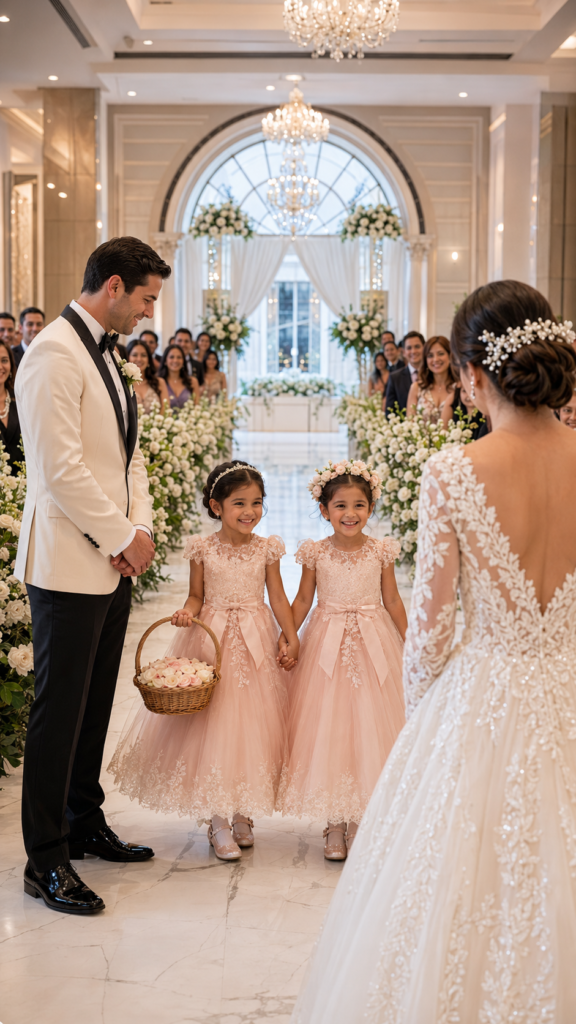
The girls’ school had enrolled several students in a program by the New Light Foundation, inviting children from working families to participate in charity events. Sofía and Emma had been selected to scatter petals at an exclusive wedding at the San Gabriel Estate, near Querétaro.
Dresses, transportation, accommodation, and meals would be covered.
Raquel was about to delete the message. It sounded like one of those rich campaigns that needed pretty pictures to show off their hearts.
But she opened the attached invitation.
The name of the bride, Valeria Luján, meant nothing.
The groom’s name stole the air from her lungs.
Daniel Haro.
Founder of Haro Technology.
One of the most powerful businessmen in Mexico.
The man who, eight years earlier, had promised her a life together.
The father of the two girls who were having breakfast in front of her, unaware they had just been invited to their own father’s wedding.
The milk carton slipped from her hands. It fell to the floor, the liquid spreading between her slippers.
—Mom? —Sofía whispered.
Raquel didn’t respond.
Sofía had the same blue eyes as Daniel. Emma, the same crooked smile he wore when he was about to make a joke. Every gesture of the girls had been, for years, a reminder of what Raquel chose to abandon.
When she met Daniel, she was still using her maiden name: Montero.
She was 26, drowning in student debt, and held an administrative position at his company. Daniel was 31, had millions in the bank, and a loneliness no one could see behind his expensive suits.
They fell in love amidst late-night meetings, awful coffee, and cold dinners over desks.
Then came the two pink lines on a pregnancy test.
Raquel bought two pairs of yellow baby shoes and practiced for days how to break the news.
But Daniel always had another crisis, another flight, another urgent business matter. When he promised to talk “tomorrow” and flew to Singapore, Raquel made a brutal decision: she vanished before forcing him to choose between his children and his empire.
She resigned by email, changed her phone number, adopted her mother’s surname, and never returned.
Three days after receiving the invitation, an organizer called to confirm the dress fittings.
—I’m sorry —Raquel said—. My daughters will not participate.
An odd silence followed.
Then, in the background of the call, a deeper male voice, unmistakable.
—Ask Raquel why she stopped using the surname Montero.
Raquel felt her legs give way.
And when Daniel took the phone and said he already knew Sofía and Emma had been born, she understood that this wedding had never been a random invitation.
PART 2
Raquel hung up without saying goodbye.
For several seconds, she stood frozen, her phone clenched between her fingers, the twins watching her from the hallway. Emma still wore a paper flower crown. Sofía, always more observant, sensed that something grave had just occurred.
—Who was that man? —she asked.
—Someone from a long time ago.
Before she could explain further, a black truck stopped in front of the building. Daniel got out alone.
Time had etched lines around his eyes, but he still walked with the same confidence that silenced entire rooms. In one hand, he held a transparent box. Inside were the two pairs of yellow shoes Raquel had bought during her pregnancy.
She opened the door just enough to see him.
—You have no right to come here.
—Probably not —he replied—. But I have the right to know why my daughters grew up thinking I didn’t exist.
—You knew nothing.
—That’s the problem. Someone made sure I didn’t know.
Raquel sent the girls to their room. They obeyed, though they left the door ajar.
Daniel sat on the worn-out couch and observed the school photographs, the drawings stuck to the wall, and the tiny shoes by the entrance. His face broke as he realized there were seven years of family life in that apartment, and he wasn’t in any of it.
—I found the shoes two months ago —he explained—. They were in a safety deposit box in my mother’s name.
Beatriz Haro had died three months earlier. She had always treated Raquel with icy courtesy, as if she were an employee who had mistaken a kind glance for the right to belong to the family.
Daniel opened a folder. There were copies of the resignation email, call logs, and a letter Raquel recognized immediately.
It was the letter she had written from a bus terminal after she fled. In it, she confessed to being pregnant, apologized, and said she was expecting two babies.
—I sent it to your apartment with the shoes —she murmured—. I thought it never arrived.
—It arrived.
Daniel showed her a receipt signed by Ofelia Vázquez, Beatriz’s personal assistant. Ofelia had received the package and delivered it directly to Daniel’s mother.
—My mom hid it. And it wasn’t the only thing.
After Beatriz’s death, lawyers reviewed documents from a family trust. There, they found payments for eight years to a private investigation agency.
The agency wasn’t looking for Raquel to reunite her with Daniel.
They were watching her.
They knew where she lived, in which hospital the girls were born, and what school they attended. Beatriz had tracked every step of the three while telling Daniel that Raquel had left the country with another man.
—Did your mother know about them all this time? —Raquel asked, pale.
Daniel nodded.
Beatriz had grown up cleaning other people’s houses and enduring humiliations from wealthy families. When her son built an empire, she became obsessed with preventing anyone from “taking advantage” of him. She thought Raquel, with her debts and humble origins, would use the babies to claim the fortune.
The woman who hated the privileged most ended up behaving like them.
—I left because I believed you would never choose us —Raquel admitted—. Not because your mother forced me to.
—But you tried to tell me. And I looked for you.
Daniel showed reports from investigators hired for nearly three years. All searches ended in false leads fabricated by the same agency paid for by Beatriz.
Raquel felt her anger blend with guilt. She had made the first choice; Beatriz had ensured it became irreversible.
—How did you find us now?
The New Light Foundation had been created by Valeria, Daniel’s fiancée. When he reviewed photographs of the girls selected for the wedding, he saw Sofía’s eyes and Emma’s crooked smile. An investigator took 48 hours to discover that Cárdenas was Raquel Montero’s maiden name.
—So you used the wedding to get closer.
—No. When they were chosen, I still didn’t know who they were. And there’s something worse: Valeria did know.
Raquel felt cold.
Ofelia had approached Valeria weeks earlier to sell her documents. The fiancée bought the file and ordered that Sofía and Emma be specifically selected.
Her plan was to have them appear at the ceremony, observe Daniel’s reaction, and then present Raquel as an opportunist who had sent her daughters to ruin the wedding. She already had a statement prepared and lawyers ready to accuse her of extortion.
—You were really going to use two little girls to protect your wedding?
—To protect a business merger. Our marriage would give her family control over billions.
At that moment, Sofía opened the door.
—Is that man our dad?
Emma appeared behind her, still wearing the paper crown. She looked at Daniel, then at the yellow shoes, and finally at her mother.
Raquel had imagined that conversation countless times, but never like this. She could no longer lie.
—Yes —she said, her voice breaking—. Daniel is your dad.
Emma approached first.
—And why didn’t he ever come?
Daniel looked down. He could buy buildings and manage thousands of employees, but he couldn’t find an answer that wouldn’t hurt a seven-year-old girl.
—Because I didn’t know you were born. And because adults make very big mistakes.
Sofía crossed her arms.
—not knowing something doesn’t erase the damage.
—You’re right —he replied.
The twins didn’t rush to hug him. They sat in front of him and began to ask questions: if he knew how to ride a bike, why he appeared on the internet, if he had a dog, and if he was really going to get married.
To the last question, Daniel said no.
That same afternoon, he canceled the wedding and the merger. Valeria reacted by leaking to the press that a hidden ex-employee was trying to snatch the businessman’s fortune.
But Daniel spoke first.
In a conference from his Santa Fe offices, he publicly acknowledged Sofía and Emma as his daughters and announced an investigation into illegal surveillance, concealment of information, and misuse of personal data.
He did not present Raquel as a saint. He told the whole truth: she left without waiting for a conversation; he allowed work to consume his life; Beatriz manipulated the silence; Valeria tried to turn two minors into pieces of a corporate war.
The scandal divided the country. Many attacked Raquel for hiding the girls. Others questioned why a pregnant woman felt she had to compete against her partner’s empire. Some even defended Beatriz because “she was just protecting her son.”
The definitive proof appeared four days later.
Ofelia delivered recordings to reduce her sentence. In one, Beatriz ordered falsifying reports to convince Daniel that Raquel lived in Spain with another man. In another, Valeria promised to pay her six million pesos for the birth certificates before the wedding.
Ofelia also confessed that she enrolled the twins in the foundation to force Valeria to pay more for her silence.
The police arrested Ofelia for extortion and forgery. Valeria faced charges for purchasing private information and threats. Her family withdrew financial support from Haro Technology, and Daniel lost millions.
For the first time, he didn’t rush to save his company.
He stayed, helping Emma with a project and listening to Sofía read. Raquel, however, made it clear that money couldn’t buy trust and that recognizing them legally didn’t erase seven birthdays or countless nights of fever.
Daniel accepted to start from scratch: supervised visits, afternoons in the park, and calls before bedtime. The girls discovered he made terrible pancakes, got dizzy on carnival rides, and couldn’t braid hair.
Raquel also faced her responsibility. In family therapy, she admitted she had confused independence with fleeing. She wanted to protect her daughters from potential rejection, but she also denied them the chance to know their father.
Months later, the San Gabriel Estate was filled with flowers again, though there was no wedding. The foundation organized a scholarship presentation for girls from public schools, this time without fake statements or bought cameras.
Sofía and Emma agreed to carry petals on one condition: Raquel would walk with them.
Daniel waited for them at the end of the garden, not as a groom or a tycoon, but as a father who still had to earn his place.
Emma handed him a flower. Sofía gave him another and warned:
—This doesn’t mean everything is forgiven now.
—I know —Daniel replied, with moist eyes—. It means you’ve given me the chance to do better.
Raquel watched the scene without imagining a romantic ending. She and Daniel might never be a couple again. What mattered was they had stopped building their lives around secrets dictated by others.
The yellow baby shoes remained in a display case in the apartment, not as a symbol of a perfect love, but as proof that a truth can take eight years to emerge and still compel everyone to pay the price for their decisions.
Beatriz wanted to control the future. Valeria wanted to buy it. Daniel believed success could wait for him. Raquel thought fleeing was the same as protecting.
The only innocents were two little girls invited to scatter flowers.
And in the end, it was they who forced all the adults to stop trampling the truth.





