PART 1
"We’ll be at your house tomorrow, Mariana. And don’t start with your weird boundaries. If you don’t like it, you can leave."
That’s what her mother told her over the phone, as if she were discussing rearranging furniture, not invading the home Mariana had just bought after twelve-hour shifts at a hospital in Guadalajara.
It had been barely four weeks since Mariana gave birth to Emilia.
She was still walking slowly. The scar was still burning. She was still waking up every two hours to nurse her baby, change diapers, and convince herself she wouldn’t break from exhaustion.
But her mother, Beatriz, didn’t ask about Emilia.
She didn’t ask if Mariana had slept. She didn’t ask if she had a fever. She didn’t ask if she needed soup, company, or silence.
She just said:
"Your sister Paola is coming with Arturo and the kids. We’ve seen pictures of the house. The big room will be for them. You and the baby can fit in the study. A single mother doesn’t need that much space, honey."
Mariana closed her eyes.
She was in the middle of the living room, surrounded by boxes. One said: “Emilia, blankets.” Another: “Newborn clothes.” She had bought that small house in Zapopan with every peso she didn’t spend on herself.
The kitchen smelled of fresh paint. The yard had a young lemon tree. There, she imagined Emilia taking her first steps.
And now her mother spoke as if everything was family property.
Mariana was thirty-five years old and an intensive care nurse. In her home, she had always been called "the calm one," "the helpful one," "the one who doesn’t complain."
Beatriz boasted about Paola because she had married Arturo, a financial advisor in a fancy suit, wearing a shiny watch and a commercial smile.
About Mariana, she said something else:
"She was born to care for the sick. She has the patience for that. Not everyone is born to aspire to more."
Arturo always laughed.
"To each their own, mother-in-law. Let me handle the assets and investments."
For almost a year now, Arturo had been managing the money of Doña Elvira, Mariana’s grandmother.
Doña Elvira was ninety years old. She lived in an old house near Santa Tere, paid for with decades of selling fabrics, mending uniforms, and saving like a little ant.
Beatriz repeated at every meal that her mother was already "gone." That she didn’t recognize anyone. That she signed anything. That taking care of an old lady like that was a burden.
They sat her in a wheelchair during gatherings. They gave her pills before visitors arrived. They displayed her as a burden so everyone would pity Beatriz.
But that night, there was something Beatriz didn’t know.
Doña Elvira was not lost.
She was in the back room of Mariana’s new house.
Lucid.
Protected.
And with enough memory to remember every signature, every pill, and every lie.
"Are you listening to me, Mariana?" Beatriz insisted. "We’ll arrive tomorrow at noon. I don’t want any drama."
Mariana looked down the hallway.
From Emilia’s room came the soft sound of the fan. From her grandmother’s room, barely the rustle of sheets.
On a box lay the card she had been saving for weeks: Licenciada Renata Cárdenas, asset protection and family law.
Mariana took it with firm fingers.
"Alright, Mom," she replied with a calmness she didn’t even recognize. "Come tomorrow."
Beatriz chuckled with satisfaction.
"That’s how I like it. You see, you do understand."
When she hung up, Mariana called the attorney.
"My mother is coming tomorrow to invade my house with everyone," she said.
On the other end, there was a brief silence.
Then Renata replied:
"So tomorrow we’ll finally have them all face to face."
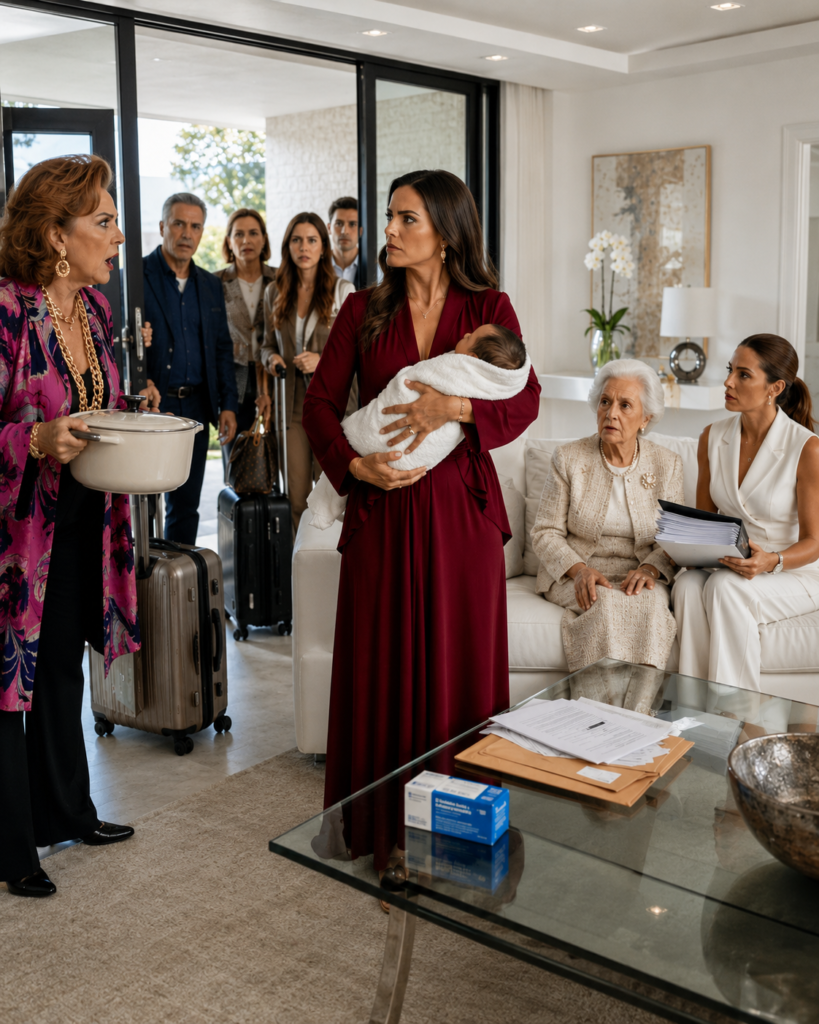
The next day, right at noon, Beatriz opened the door without knocking. She carried a pot of birria as if it were her entrance pass.
Behind her came Mariana’s father, Gustavo; Paola with an uncomfortable expression; Arturo talking on his cell phone; two kids and five suitcases.
"Well," Beatriz said, stepping in, "first we’re going to move your things from the master bedroom and then we’ll see where—"
She froze.
Everyone froze.
In the living room, next to the window, Doña Elvira sat upright, groomed, wearing a blue shawl, her eyes completely clear.
Next to her stood Licenciada Renata with an open folder.
Near the dining room, a social worker from the DIF had her badge on.
And by the door, a notary held a sealed envelope.
Doña Elvira lifted her chin and looked at Beatriz.
"Sit down, daughter," she said firmly. "Now you’re going to listen to me."
PART 2
Beatriz paled, but quickly sought to put on her mask of the sacrificial mother.
"Mom, you’re confused," she said, approaching with outstretched hands. "Mariana upset you. You probably didn’t take your medicine."
Doña Elvira didn’t move.
Licenciada Renata placed a sheet on the table.
"Geriatric evaluation conducted three weeks ago and reaffirmed five days ago," she said. "Mrs. Elvira Montes is fully in possession of her mental faculties."
Arturo put away his phone.
"Look, this is absurd. I have legal power to manage her assets. Everything was signed correctly."
"We’ll talk about that too," Renata replied.
Mariana held Emilia against her chest. The baby slept, oblivious to the tremor that had just split the living room in two.
It all began with a pill organizer.
Doña Elvira always arranged her medications in a green box, from Monday to Sunday. She was methodical, proud, distrustful of anything with small print.
When Beatriz started saying that "she wasn’t alright anymore," the family accepted it. They said she forgot names, that she slept all day, that she mixed up dates, that she couldn’t decide anymore.
But Mariana was a nurse.
She had seen bodies truly fade away.
And what was happening with her grandmother didn’t seem like old age.
It seemed like manufactured fog.
One night, after Doña Elvira had fallen in the bathroom, Beatriz asked Mariana to take care of her "for a few days." Mariana checked the pill organizer and felt a chill run down her back.
There were two medications that should never be mixed in a ninety-year-old woman: a strong sedative and another that could cause confusion, weakness, and memory loss.
It wasn’t natural forgetfulness.
It was manufactured silence.
Mariana called Dr. Julián Ponce, the geriatrician at the hospital where she worked. He reviewed dosages, tests, and prescriptions. Then he said a phrase Mariana would never forget:
"Your grandmother’s mind isn’t slipping away. They’re turning it off."
Reducing the medications took care and patience.
In two weeks, Doña Elvira came back.
First she asked for coffee with less sugar. Then she remembered the name of a neighbor who had died twenty years ago. After that, she looked at Mariana’s belly, still pregnant, and asked:
"Why didn’t anyone tell me my girl was going to have a girl?"
Mariana cried locked in the bathroom.
Then Teresa arrived, the caregiver Beatriz had fired for being "gossipy." Teresa brought a notebook where she had recorded dates, dosages, and orders.
On one page, it read: "Give her an extra pill if the notary comes."
On another: "Keep her calm to sign."
On another: "Don’t let Mariana review documents."
With that, they called Renata.
The attorney began to search.
She found a power of attorney in favor of Arturo. Strange transfers. Liquidated investments. Fake commissions. Cash withdrawals. And an attempted sale of the Santa Tere house.
The total was brutal: $412,000.
More than Mariana had imagined.
But something worse was still missing.
One day, Paola asked for help to pick up some things from Arturo’s office. As she moved a jacket, Mariana saw a cheap cell phone fall.
The screen lit up with a message:
"Did you deposit the rent money, love?"
There were photos, hotels in Puerto Vallarta, jewelry, rent payments, and transfers. Arturo had another life with another woman, funded by the stolen money from Doña Elvira.
Mariana wanted to run and tell Paola.
But Renata stopped her.
"Don’t explode before it’s time. First, let’s tie up the evidence. Then we let the truth walk in."
And that was exactly what happened that morning.
In Mariana’s living room, Beatriz still clung to her pot of birria as if she could still pretend it was a family visit.
"Documents?" she spat with contempt. "And who gathered all that? Mariana? The resentful daughter who always wanted to feel important?"
Mariana took a deep breath.
Those words would have made her lower her gaze.
Not that day.
Renata opened the folder.
"We have medical evaluations, medication logs, Teresa’s testimony, a request to revoke the power of attorney, a report of possible asset abuse against an elderly person, a bank report, and a preventive suspension of the sale of the property."
The notary lifted the envelope.
"You are formally notified of the suspension of the sale process for the house located in Santa Tere."
Beatriz opened her mouth.
She said nothing.
Arturo smiled, but he no longer looked confident.
"I’m a certified advisor. Every movement was for the good of Mrs. Elvira."
Paola looked at him.
"For her good? Were the hotels also for her good?"
Arturo froze.
Mariana turned to her sister. She didn’t know Renata had already handed her part of the evidence.
Paola’s eyes were red, but her voice was firm.
"Hotel Miramar, February 14. Hotel Aurora, March 22. Apartment in Providencia. Deposits in the name of Ximena Robles. Are you going to tell me all that was family investment?"
Arturo swallowed hard.
"This isn’t the time, Paola."
"Yes, it is, dude. Because you used my grandmother, you used me, and still came to want to sleep in my sister’s house."
Gustavo, Mariana’s father, took a clumsy step forward.
"Okay, calm down. There are kids here."
"The kids are in the yard," Mariana said. "And for the first time, the adults aren’t going to hide behind them."
The DIF worker jotted something down.
Beatriz saw that movement and exploded.
"Enough! I took care of my mother for years! I bathed her, I carried her, I listened to her nonsense! You don’t know what it’s like to live with someone who’s no longer worth anything!"
The room froze.
Doña Elvira slowly lifted her gaze.
"I was worth something, Beatriz."
The old woman’s voice didn’t tremble.
"I was worth something when I sewed uniforms. I was worth something when I sold my gold chain to pay for your surgery. I was worth something when I took care of your daughters so you could work. But when my mind started to cloud, you decided my life was no longer valuable."
Beatriz began to cry.
It wasn’t the cry of repentance.
It was the cry she always used to have everyone rush to console her.
"Mom, I just wanted to make things easier..."
"No," Doña Elvira cut her off. "You wanted my house. And you allowed that man to steal from me because you thought I wouldn’t wake up anymore."
Arturo stepped toward the door.
Renata looked at him without standing up.
"You can leave if you want. The Public Ministry already has a copy. Your company will also receive the report."
Arturo lost color.
Paola took off her ring and placed it on the table.
The sound was small, but it broke something enormous.
"It’s over," she said.
"Paola, think of the kids," he murmured.
"That’s what I’m doing," she replied. "For the first time."
Beatriz glared at Mariana with hatred.
"Are you happy? Is that what you wanted? To destroy your family four weeks after giving birth?"
Mariana tightened Emilia against her chest.
She didn’t remind her of all the times she was left alone. She didn’t mention the forgotten birthdays, the nights in the hospital, the times Paola received applause while she only bore responsibilities.
She didn’t give her mother a list of wounds for her to choose which one to deny.
She just said:
"You are not the owner of this house. And here you will not call family what you did."
Beatriz straightened up.
"I’m your mother."
"Not at this door," Mariana replied. "At this door, you are the woman who allowed her own mother to be drugged in order to take her estate. And you are leaving."
Gustavo looked down.
"Beatriz, let’s go."
"Is that all you’re going to say?" she challenged him.
He looked at Doña Elvira.
"I’m sorry, Elvira."
The old woman didn’t answer.
Some apologies arrive so late they find no place to sit.
Mariana opened the door.
The door she paid for with night shifts, cheap breakfasts, worn-out shoes, and tears swallowed in silence.
Arturo left first, talking on the phone. Gustavo followed after. Beatriz was the last.
Before crossing, she whispered:
"One day you will need me."
Mariana looked at her sleeping daughter. She looked at her grandmother. She looked at Paola, broken but awake.
"No," she said. "One day I will need peace. And it starts today."
She closed the door.
There were no shouts of triumph. No applause. Only the silence of a house that was finally truly hers.
Then the documents did their work.
The sale of Doña Elvira’s house was annulled. Arturo’s power was revoked. The bank had to review every transaction. The transfers were contested. Teresa testified. Dr. Julián confirmed the report.
Justice wasn’t quick or cinematic.
But it walked.
Arturo lost clients, position, and reputation. His expensive suit no longer saved him when the records spoke louder than his smile.
Beatriz lost something that hurt even more: the audience.
The neighbors stopped asking her for favors. At the parish, she was no longer invited to organize collections. The calls became shorter. The people who once said "poor thing" began to say "who would have thought."
Paola returned to Mariana’s house two weeks later.
She arrived with a bag of conchas and swollen eyes.
"I called you exaggerated many times," she said at the entrance. "I called you bitter. I called you jealous. And you were seeing what no one wanted to see."
Mariana didn’t hug her immediately.
It still hurt.
But she opened the door.
"We can start a little," she said.
Paola nodded.
"A little is okay."
From then on, it was like that.
A little.
Doña Elvira recovered her house in Santa Tere, but spent seasons with Mariana because she said the yard in Zapopan had better light for her plants.
One afternoon, while Emilia tried to pull a leaf from a pot, Doña Elvira scolded her as if the baby understood gardening.
Mariana watched them from the kitchen.
Three generations. Coffee. Sweet bread. Light filtering through the window.
Doña Elvira noticed she was watching. She approached and took her hand.
She squeezed it three times.
One. Two. Three.
It was their code since Mariana was a child.
It meant: I see you, I’m here, you’re not alone.
"You brought me back, Marianita," the grandmother said.
Mariana’s throat tightened.
"You brought me first, grandmother."
Doña Elvira looked at Emilia.
"Then it’s our turn to teach her that caring doesn’t mean letting oneself be trampled."
And that was the truth that remained in that house.
For years, Mariana thought being a good daughter meant obeying. That being noble meant staying silent. That being useful meant allowing others to decide how much her time, her exhaustion, and her life were worth.
She was wrong.
Boundless kindness becomes an open door for those without shame.
Her family believed Mariana was only good for caring for those who were fading away.
They forgot that a nurse observes.
Observes doses. Hands. Dates. Crooked signatures. False tears. Phrases that slip away when someone believes they’ve already won.
Mariana didn’t destroy her family.
She just stopped holding up the lie that kept her standing.
And if you were ever the quiet person, the useful one, the one everyone sought only when they needed something, remember this:
You don’t need permission to close your own door.
You don’t need to be believed to tell the truth.
And you don’t need an apology to stop obeying.





