PART 1
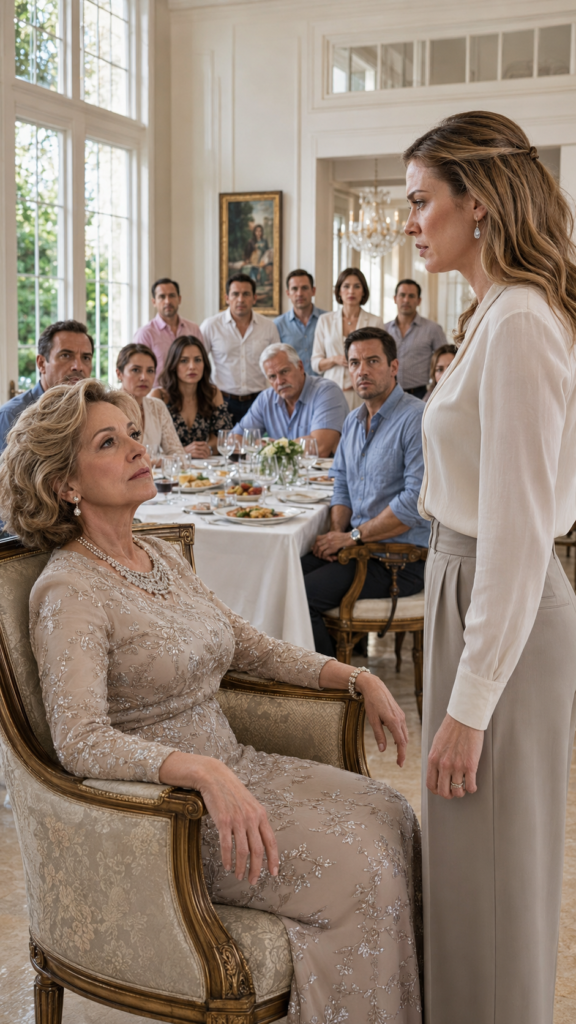
—What are you doing standing there? Get into the kitchen, girl. The family is already hungry.
That was the first thing Mariana heard as she opened the door to her own house in Coyoacán, a Friday at 9:17 PM, after an endless day at a marketing agency in Santa Fe.
Her makeup was tired, her feet burning from the heels, and a grocery bag in her hand because she still planned to prepare dinner for Esteban, her fiancé.
But upon entering, the smell of grilled meat, spilled beer, and cheap perfume hit her like a slap.
The living room was packed.
In her living room.
Children were racing down the hallway, a man was sleeping with his shoes on her beige armchair, two aunts were arranging plates on the coffee table, and three trucks were parked in the garden, crushing the bougainvilleas her father had planted.
Mariana froze.
That house wasn’t luxurious, but it was hers. Her parents had passed it down to her while they were still alive when she finished paying off half of her previous apartment.
Her mother had told her a phrase that stuck with her:
—A woman with her own roof doesn’t have to endure humiliation for fear of ending up on the street.
There were two months left until her wedding with Esteban.
She thought giving him a copy of the keys had been a gesture of trust.
He had asked for it fifteen days before, with a sweet voice, while they were having tacos al pastor in Narvarte.
—Love, it’s just for emergencies. We’re almost spouses. Your house will also be our home.
Mariana thought that was love.
She never imagined that this key would become the entrance to an invasion.
From the dining room, a woman in a floral dress and a hard gaze lifted her eyes.
It was Doña Lidia, Esteban’s mother.
She was seated at the head of the table, using the glasses Mariana kept for special occasions.
—Come on, Mariana —she said without smiling—. Heat up more tortillas. We’re not used to the daughter-in-law just standing there like a guest.
Mariana searched for Esteban with her gaze.
She found him by the window, checking his phone, calm, as if all of this was normal.
—Esteban —she said, trying not to raise her voice—. What’s happening in my house?
He sighed, annoyed.
—My family came to hang out. Don’t start with your dramas.
An aunt let out a chuckle.
—Oh, dear, what a nice house my nephew got. It’s clear God blessed him.
Mariana swallowed hard.
—This house isn’t Esteban’s —she replied—. This house is mine.
Silence lasted barely three seconds.
Then Doña Lidia let out a dry laugh.
—Oh, how heavy. You’re getting married soon, daughter. Stop talking like a distrustful single woman. The house is already family property.
Mariana felt a horrible chill down her spine.
Then she heard a voice from upstairs:
—Mom, is this room going to be ours when we come on the weekends?
Another voice replied:
—Yes, we’ll leave the one across for your uncle. We all fit here.
Mariana climbed the stairs without saying a word.
In the guest room, there were open suitcases, clothes on the bed, and a black bag full of shoes.
In the study, someone had moved her books to lay down blankets.
And from downstairs, Doña Lidia murmured, believing Mariana couldn’t hear her:
—When she gets married, she’ll stop being so conceited. Here she'll learn who’s in charge.
Mariana gripped the railing.
She couldn’t believe what she had just discovered… and even less what was about to happen.
PART 2
Mariana descended slowly, with a calm so rare that even the children stopped running.
She didn’t shout.
She didn’t cry.
She just looked at her invaded living room, her used plates, her cushions tossed around, the muddy footprints on the freshly polished floor, and Esteban standing like a statue, avoiding her eyes.
—I want everyone to get out of my house —she said.
Doña Lidia blinked, offended.
—Excuse me?
—I didn’t invite you. I didn’t authorize bringing suitcases. I didn’t give permission to use my rooms. And I’m not going to cook for anyone who entered here without my consent.
A cousin clicked her tongue.
—Oh, what a character. Poor Esteban, man.
Esteban quickly approached and spoke softly, clenching his teeth.
—Mariana, don’t do this in front of my family.
—What do you mean? —she asked—. Asking for respect in my own house?
—Don’t exaggerate. It’s a family gathering.
—A gathering doesn’t come with suitcases.
He didn’t respond.
That silence hurt more than any shout.
Doña Lidia slowly stood up, as if she were the real owner.
—Listen, girl, I’ll be clear. A woman who enters a family must learn to share. My son isn’t getting married to live isolated like an orphan.
—Sharing isn’t letting myself be invaded.
—My son has a key.
—I gave a key to Esteban. Not to you.
Esteban’s jaw tightened.
For the first time, Mariana noticed something strange about the front door.
Above the original lock, there was a shiny new deadbolt, recently installed.
—Who put that there? —she asked, pointing at it.
The living room fell silent.
Doña Lidia raised her chin.
—I had the entry reinforced. For security.
Mariana felt her heart slam against her ribs.
—You changed the lock on my house without asking me?
—Oh, don’t start with your tantrums. If family is going to come in and out, we need to get organized.
—In and out family? —Mariana repeated—. Who said this house would be publicly used?
An uncle laughed awkwardly.
—Well, once you’re married, dear, things change.
—I’m not married yet.
Doña Lidia looked at her with a venomous smile.
—But you will be. And when that happens, this house can’t be managed like your little whim. Esteban has responsibilities. His family also needs support.
Mariana slowly turned to him.
—What does that mean?
Esteban ran a hand through his hair.
—My mom just wants to help organize things.
—Organize what?
Doña Lidia spoke before he could.
—After the wedding, it would be wise to review the deeds. Maybe put the house in Esteban’s name or at least leave it as collateral for a family loan. That way, we all move forward.
Mariana felt nauseous.
There it was.
The naked truth.
They didn’t want to hang out.
They didn’t want to accept her.
They wanted her house.
—Did you know about this? —she asked Esteban.
He looked down.
—Don’t say it like that. No one wants to take anything from you.
But he didn’t deny anything.
At that moment, Mariana’s phone vibrated.
It was a message from an unknown number.
“I’m Rogelio, Esteban’s uncle. Don’t trust them. They owe a lot of money. Your house is the plan. I’m telling you because my conscience won’t let me sleep.”
Mariana looked up.
Esteban was pale.
Doña Lidia had also seen the name on the screen.
—That nosy old man doesn’t know anything —she spat.
Mariana put the phone in her bag.
Now she understood everything.
The rush for the wedding.
Esteban’s insistence on “merging assets.”
The way Doña Lidia kept asking how much the house was worth, how much property tax she owed, if she had a mortgage, if her parents still appeared on the deeds.
They weren’t innocent questions.
They were calculations.
—Get out —Mariana repeated, more firmly—. All of you.
No one moved.
Then she took out her phone and called the police.
Doña Lidia exploded.
—You’re crazy! Are you going to call the patrol on your own family?
—You are not my family —Mariana said—. You are people who entered my house without permission.
An aunt crossed herself as if Mariana had just committed a sin.
—How embarrassing. That’s not how you treat people.
—That’s not how you treat the owner of the house —she replied.
Esteban tried to take the phone from her.
Mariana stepped back.
—Don’t you dare.
He stood still.
For the first time, she saw him without the disguise of a loving boyfriend. She saw the man who preferred to leave her alone in front of a humiliation rather than contradict his mother.
When two police officers arrived, the noise dropped abruptly.
Cousins stopped laughing.
Uncles hid the beers.
Doña Lidia tried to speak first, as if authority would obey her too.
—Officer, it’s a family matter. This girl got upset.
The officer looked at Mariana.
—Do you live here?
—Yes. And the property is in my name.
She went up to her room, pulled a blue folder from the drawer, and came down with the deeds, her ID, and the property tax receipts.
The officer reviewed everything calmly.
Then he looked at the present company.
—The owner is Mrs. Mariana Ríos. If she requests that you leave, you must do so.
Doña Lidia pressed her lips together.
—My son is marrying her.
—That doesn’t give anyone the right to enter, settle, or change locks in someone else’s property —the officer replied.
That phrase fell like justice.
Mariana breathed for the first time in hours.
One by one, they began to gather their things.
The uncle in the armchair put his shoes on without looking at her.
The cousin who rummaged through her fridge carried a bag of food that Mariana snatched from her hands.
—That’s mine too.
The girl turned red and left the bag on the table.
The children walked out whining, the aunts murmuring “what an exaggeration,” and the cousins filming with their phones, perhaps expecting to make her look bad.
But Mariana was no longer afraid of what people would say.
Doña Lidia was the last to cross the threshold.
Before leaving, she turned back with eyes full of rage.
—You’re going to end up alone. No man wants a woman who humiliates his family.
Mariana didn’t drop her gaze.
—And no woman should marry a man who allows his family to humiliate her in her own home.
Doña Lidia had no response.
She just left with a slam of the door.
Esteban remained in the middle of the living room.
The house was a wreck: sauce on the table, glasses tossed around, a blanket in the study, dirt on the floor, and the heavy smell of a party that should never have existed.
—I’m sorry —he murmured—. I didn’t think it would get out of hand.
Mariana looked at him with a dry sadness.
—Yes, you did. You just thought I would endure it.
He sat down, defeated.
Then Mariana’s phone rang again.
It was Rogelio.
She answered and put it on speaker.
—Mariana, I’m sorry for getting involved —the man said—. But you need to know the whole story. Esteban owes more than 900,000 pesos. Loans, bets, fake businesses. Lidia signed as a guarantor. They’re desperate.
Esteban closed his eyes.
Mariana felt all the air leaving the room.
—Say the rest —she asked.
Rogelio took a deep breath.
—The plan was to pressure you after the wedding. They wanted you to agree to put the house as collateral. If not, they were going to say you were selfish, that you didn’t support your husband, that you didn’t understand the Mexican family. Lidia told everyone that they would gradually get you used to obeying.
Mariana looked at Esteban.
—Is that true?
He didn’t speak.
He just covered his face with his hands.
That gesture was the confession.
—I was going to fix it —he finally said—. I swear I didn’t want to hurt you.
—You wanted to use me.
—No. I love you.
—No, Esteban. You loved my house, my stability, and my silence.
He lifted his face, teary-eyed.
—We can get through this. It won’t happen again. I promise.
Mariana remembered the chosen invitations, the reserved hall, the dress hanging at her mom's house, the songs they had picked for the waltz.
For a second, it pained her to think of the life she thought she would have.
But it hurt more to imagine herself married, in debt, obeying orders in a house her parents had left her to be free.
—The wedding is canceled —she said.
Esteban stood up.
—Mariana, don’t do this. Please. What am I going to tell everyone?
—Tell them the truth. That a key is not permission to invade. That a bride is not a loan. That a house is not a prize.
He tried to approach.
—I love you.
—Then go.
Esteban stood still.
He waited a few seconds, perhaps hoping she would crack.
But Mariana didn’t move.
When he left, he softly closed the door.
The silence that remained was not empty.
It was peace.
That night, her parents arrived at midnight. Her mom didn’t ask anything upon seeing her. She just hugged her in the midst of the messy living room.
Mariana cried.
Not for Esteban.
Not for the lost wedding.
She cried for almost confusing love with sacrifice, patience with submission, and family with abuse.
In the following weeks, she canceled the venue, returned the dress, notified her guests, and changed all the locks.
Some said she was exaggerating.
Others said that in Mexico families are like that, meddling, intense, that one must endure a bit for a marriage to work.
Mariana stopped explaining.
Because no one who opines from the outside was about to lose their property.
No one had seen strangers dividing her rooms.
No one had heard a mother-in-law planning the future of a house she didn’t buy.
Months later, she painted the living room olive green, put new plants in the garden, and returned to calmly drink coffee on Sunday mornings.
She didn’t lose a husband.
She saved herself before signing.
And she understood something many women learn too late: when someone turns your trust into an open door to control you, closing it is not a lack of love.
It’s dignity.





