PART 1
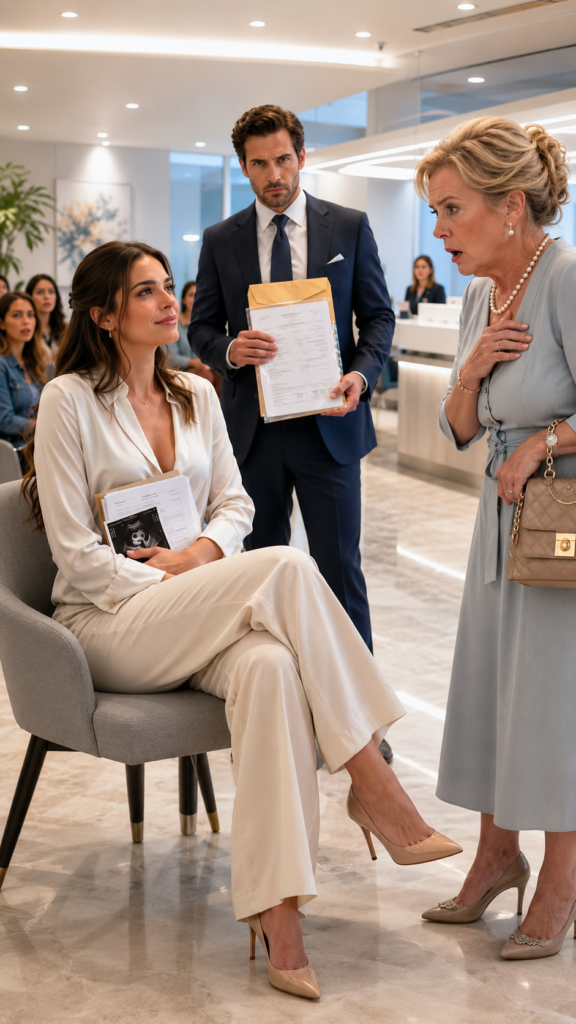
"How wonderful that my son left you, Lucía. Now he has a real daughter."
Doña Graciela Luján's voice rang clear, strong, and venomous in the waiting room of the Vida Nueva Clinic in Santa Fe.
Several people turned to look.
Lucía Robles tightened the folder in her lap but didn’t respond right away. It had been a year since she last saw her ex-mother-in-law, and yet it took just five seconds for her body to remember everything: the awkward dinners, the comments disguised as advice, the pitying glances every time she failed another treatment.
Doña Graciela was impeccable, as always.
Pearls around her neck, an expensive handbag, red nails, and that smug smile of a Las Lomas lady who believes that humiliation is an elegant way to speak.
"Aren’t you going to greet me?" she asked, moving closer. "Oh, Lucía, how life turns, doesn’t it? Here you are again... and my Andrés is happy with Fernanda and their little girl."
Lucía lifted her gaze.
Fernanda.
The name still scraped.
She had been her best friend for twelve years. The one who accompanied her to buy pregnancy tests. The one who brought her soup when she lost her second baby. The one who sat in her living room saying, “Don’t worry, my friend, Andrés loves you.”
And while she said that, she was already messaging Andrés.
First, it was coffee.
Then “work” calls.
A trip to Monterrey.
And finally, a divorce notice that arrived two weeks after Lucía left the hospital with her soul in tatters.
For six years, Lucía and Andrés tried to become parents.
Treatments, injections, tests, empty accounts, sleepless nights, and two losses that no one in the Luján family respected. For Graciela, Lucía was not a wounded woman. She was a defective woman.
"Camila is beautiful," Doña Graciela continued. "She has Andrés’ eyes. Fernanda was meant to be a mom. As for you... God knows why He does things."
Lucía took a deep breath.
Months ago, that phrase would have destroyed her.
But not this morning.
Because Lucía wasn’t at the clinic to start another treatment.
She was there to meet with the medical director, her lawyer, and the Prosecutor’s Office.
It all began four months after the divorce when she accidentally received a collection email. Her account was still tied to the fertility file.
At first, she thought it was about embryo storage.
Then she saw the date.
“Authorized embryo transfer.”
Two weeks after Andrés filed for divorce.
The embryo wasn’t Fernanda’s.
It was Lucía’s.
Lucía and Andrés’.
A frozen embryo that could never be used without the consent of both.
And Lucía never signed anything.
Doña Graciela leaned in, relishing her final blow.
"My granddaughter is proof that my son made the right choice."
Lucía calmly closed the folder and smiled slightly.
"Is that what you think?"
The automatic door opened.
A tall man in a dark suit entered, holding a sealed folder under his arm. He didn’t look like a patient. He didn’t look like a doctor. He looked like someone coming to extinguish a lie with a single document.
Doña Graciela saw him and turned pale.
It was Commander Javier Ocampo from the Prosecutor’s Office.
The man stopped next to Lucía and looked directly at her ex-mother-in-law.
"Mrs. Luján, it’s good we found you here."
Graciela swallowed hard.
"I don’t understand."
The commander raised the folder.
"We are talking about the minor Camila Luján Rivas. Everything indicates she was conceived with an embryo belonging to Mrs. Lucía Robles... and that her consent was falsified."
The room froze.
Lucía stared at her ex-mother-in-law without blinking.
"Do you still think Andrés made the right choice?"
And just as the receptionist called for the clinic director, Doña Graciela realized that what was coming wasn’t a scandal... it was an unstoppable truth.
PART 2
Doña Graciela fell into a chair as if the strings had been cut.
For the first time, she didn’t have a cruel phrase ready. She didn’t say, “You’re exaggerating,” she didn’t say, “You’re bitter,” she didn’t say, “My son wouldn’t do that.” She only clutched her bag against her chest as Commander Ocampo placed the folder on the low table in the room.
Inside were copies of the medical consent, the lab record, the de-thaw authorization, and a preliminary handwriting analysis report.
The signature read:
Lucía M. Robles.
Lucía felt a knot in her throat, but not out of fear. It was pure rage.
"That’s not my signature," she said.
"We know," the commander replied. "It’s similar, but it has errors."
Lucía’s lawyer, Licenciada Valeria Mena, arrived at that moment with a blue folder and greeted them briefly. She wore a calm expression but had hard eyes.
"The clinic had a specific rule," she explained. "From the first procedure, my client signed all documents with both her full last names: Lucía Marcela Robles Aranda. The fake document omitted the second last name."
Doña Graciela tried to get up.
"This is a family matter."
Lucía turned slowly.
"No, ma’am. It stopped being family when someone used my embryo as if it were a forgotten object."
That word hit the room.
My.
For a year, Graciela had boasted about Camila on Facebook. Photos with pink bows, expensive dresses, captions like “God rewards good families” and “finally, the granddaughter we deserved.”
She referred to Fernanda as “the daughter-in-law I’ve always dreamed of.”
Lucía was never named, but everyone understood when Graciela posted: “Some women only bring sadness to a home.”
Now the perfect story began to rot from the roots.
The commander pulled out a photograph.
"Mrs. Luján, did you accompany Fernanda Rivas on the day of the transfer?"
"No," she answered too quickly.
Ocampo slid the image across the table.
It was a capture from the parking lot camera. Graciela’s silver Lexus was parked two spots from the entrance.
Date. Time. License plates.
Everything.
Graciela froze.
"I only brought her," she murmured.
"Did you know they were going to use an embryo from your son’s previous relationship?"
"I knew Andrés had embryos stored here."
As soon as she said it, she regretted it.
Lucía closed her eyes for a second.
There it was.
The confirmation.
Andrés hadn’t acted alone. He was cowardly, selfish, and an expert at blaming others, yes. But Graciela was the hand behind the plan. The same one who once told her at a meal: "A broken woman can’t give a future to a man like my son."
Dr. Raúl Medina, the clinic director, appeared pale in the hallway.
"Let’s go to my office. We’ve suspended the file and notified the legal department."
Graciela approached Lucía with a false, almost pleading voice.
"Lucía, think carefully about what you’re doing. That girl is Andrés’ daughter."
Lucía looked at her with a calmness that hurt.
"She’s also mine."
Andrés Luján arrived thirty minutes later.
He entered with his jacket open, phone in hand, and that look of a man accustomed to having money resolve what shame could not. Behind him came Fernanda, with dark glasses and a pink diaper bag slung over her shoulder.
When she saw the commander, she stopped.
Lucía needed no more.
Guilt always knows the door through which justice enters.
"What the hell is going on?" Andrés demanded.
Graciela whispered something in his ear. His face changed in three seconds: anger, disbelief, and fear.
In the conference room, Licenciada Valeria arranged the documents in front of everyone.
"Mr. Luján, I recommend you don’t make a statement without a lawyer."
Andrés let out a dry laugh.
"This is absurd. Lucía abandoned those embryos."
"She didn’t abandon them," Valeria replied. "The contract requires written authorization from both parties for any transfer."
"She didn’t want to try anymore," Andrés said, pointing at her. "She spent her time crying. She was devastated."
Lucía felt cold in her hands.
"I lost two pregnancies, Andrés. Of course, I was devastated. But I never gave you permission to give our embryo to my best friend."
Fernanda took off her glasses.
Her eyes were swollen.
"He told me you had agreed."
Lucía looked at her as one looks at someone who was once home and then became a fire.
"You were with me when I bled in the bathroom. You kept my medications in the fridge. You held me when the doctor said there was no longer a heartbeat. You knew what those embryos meant to me."
Fernanda lowered her head.
"I thought that if Andrés wanted..."
"You didn’t think," Lucía interrupted. "It was convenient for you to believe him."
The commander opened another folder.
There were call records between Andrés and a clinic administrative assistant. Altered internal emails. A payment from a family Luján business account. And a message sent from Graciela’s phone to Fernanda the night before the procedure:
"Sign as Andrés explained. No one will check. When the girl is born, everything will be irreversible."
No one spoke.
Not the doctor.
Not Fernanda.
Not Andrés.
The lie lay naked in the middle of the table.
Graciela began to cry, but her tears weren’t of regret. They were of fear.
"I just wanted a granddaughter," she whispered.
Lucía felt something break inside her.
"I didn’t want a granddaughter. I wanted to erase my pain and give it another name."
Andrés slammed the table.
"Camila is my daughter!"
"Yes," Lucía replied. "And she’s also my genetic daughter. But the most important thing is that she’s an innocent girl whom you dragged into a disgusting lie."
That was the part that hurt the most.
Not Andrés.
Not Fernanda.
Not Graciela.
Camila.
A nine-month-old baby who hadn’t asked to be born this way. A girl who perhaps had Lucía’s mother’s smile, the dimple of the Robles women, or the same serious gaze she had in her childhood photos.
Lucía didn’t want to rip her from other arms as if she were a recovered thing.
She wanted the truth to exist.
That’s why she didn’t arrive screaming.
That’s why she didn’t make a video for social media.
That’s why she waited, gathered evidence, hired a lawyer, and filed a complaint.
Valeria explained the legal path: an investigation file for forgery, misuse of genetic material, and possible complicity; a civil lawsuit against Andrés, Fernanda, and the clinic; a request for genetic maternity recognition; and gradually supervised visitation, always safeguarding the minor.
"Camila has the right to know where she comes from," the lawyer said. "And Lucía has the right not to be erased from her own story."
Two weeks later, Lucía was summoned to a family visitation center in Coyoacán.
The room had light blue walls, clean rugs, and fabric toys. Lucía arrived without gifts. She didn’t want to buy affection. She only brought a handkerchief in her bag and an old photo of her mother, for if one day Camila asked where her eyes came from.
Fernanda entered first with the baby in her arms.
They didn’t greet each other.
The social worker placed Camila on the rug.
The girl had round cheeks, dark hair, and a serious look, as if she were trying to understand a world too big.
Lucía sat on the floor, at a distance.
She didn’t call her.
She didn’t extend her arms.
She just waited.
Camila crawled towards a yellow cube, hit it twice, and then turned to look at Lucía. She stared for a long time. Then she slowly moved forward until she was right in front of her.
Lucía laid her palm open on the rug.
The baby touched her hand with two fingers.
Then she closed her tiny hand around Lucía’s index finger.
And Lucía cried.
She cried for the lost years, for the injections, for the cribs she never set up, for the friend who stole her trust, for the man who confused desire with right, and for that girl who had been born from a crime without being guilty of anything.
Months later, the judge authorized supervised visits while the parentage trial progressed. Andrés was linked to the process for forgery and use of private documents. Fernanda had to testify how much she really knew. Doña Graciela deleted her posts and stopped sharing phrases about her “blessed family.”
The clinic was also investigated.
The administrative assistant confessed that she received money to "expedite" documents. The twist that finally sank Andrés was that the payment didn’t come from his personal account but from an account Graciela had managed for years for family expenses.
The grand lady not only knew.
She had financed the theft.
Lucía did not celebrate.
Justice didn’t give back the pregnancy they took from her. It didn’t give her back the first ultrasound, nor the first cry, nor the nights that others lived in her place.
But it returned something stronger than any imposed surname: the truth.
One year after the divorce, Doña Graciela thought she found Lucía alone in a clinic.
She thought she would humiliate her once more.
But she didn’t find a defeated woman.
She found a mother from whom her story had been stolen.
And when the lie finally fell, everyone understood the cruelest truth: Andrés hadn’t formed a new family after leaving Lucía.
He had used the last piece of the family he himself destroyed.





