PART 1
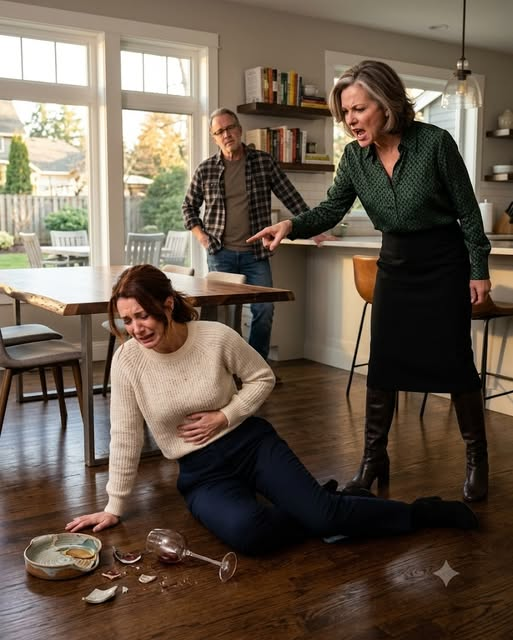
—Here’s where your mom will sleep, Andrés. After all, she’s grown up and doesn’t need that much space.
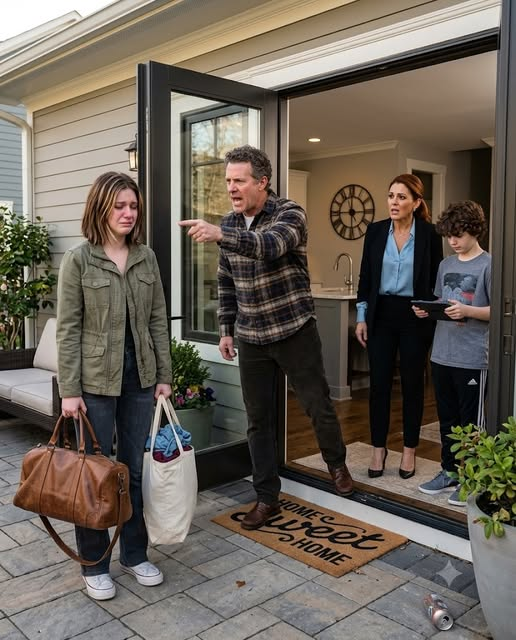
Doña Mercedes heard that phrase from the entrance of the apartment, holding a bag of clothes, her heart knotted in despair.
Her daughter-in-law Karla opened the door to the laundry room as if she were showing a storage closet. There was a single bed pressed against the wall, two boxes of detergent, a broken bucket, and a window so small it barely let in any light.
At 72, Mercedes never thought she would end up here, in her only son’s home, after they had taken hers away with false smiles and papers she never signed.
—Andrés… —she said, searching her son’s eyes—. Are you really going to leave me here?
Andrés didn’t respond immediately. He scratched the back of his neck, awkwardly looking at the floor.
—Mom, don’t start. It’s temporary. Karla is right, the apartment isn’t big.
Karla let out a little laugh.
—Besides, taking care of an elderly person isn’t free. If she’s going to live here, at least she should help.
Mercedes felt something inside her break.
That very morning, she was still watering her geraniums in her house in Cholula, the home she had built with her husband Jacinto, brick by brick, when Andrés arrived with a stranger and a folder under his arm.
—Mom, the house has been sold —her son told her, as if announcing he had changed his cellphone—. Don Mauricio is coming for the keys.
She dropped the hose.
—What do you mean it’s sold? That house is in my name.
Karla was the one who answered.
—Oh, mother-in-law, don’t make a scene. You can’t live alone anymore. Andrés needs to pay bills, Emiliano’s school, the truck… Everyone in the family has to contribute.
Don Mauricio, the supposed buyer, looked serious as he saw the elderly woman's face.
—Ma’am, I thought you were informed.
Mercedes wanted to go for the deeds, but Andrés hurried to check drawers.
—Where do you keep the original documents, Mom? And the will of my dad?
She then understood that they not only wanted her house. They wanted everything that protected her.
When they arrived at the apartment, Karla left a sheet of paper on the table with her name written in red marker.
“Pending tasks for Doña Mercedes.”
Make the beds. Wash the dishes. Cook. Iron shirts. Take out the trash. Pick up Emiliano.
Mercedes looked at the list, then at her son.
Andrés only said:
—Behave, Mom. Don’t complicate Karla’s life.
The washing machine began to shake next to the bed, and Mercedes realized that that night she hadn’t been brought in to care for someone… they had locked her up.
But no one imagined that, at the bottom of her bag, Mercedes still kept a yellowed copy of Jacinto’s will.
PART 2
At 5:30 in the morning, Karla banged on the door of the laundry room without waiting for a response.
—Doña Mercedes, get up. Andrés has a meeting and Emiliano can’t find his uniform.
Mercedes opened her eyes. Her back ached from the hard mattress, and the noise of the washing machine still seemed embedded in her bones.
She was not a guest. She was not the owner’s mother. She was not Emiliano’s grandmother.
She was the woman Karla had turned into a servant without pay.
In the kitchen, Andrés was drinking coffee in front of his cellphone.
—Good morning, son —said Mercedes.
He barely raised his gaze.
—Mom, please don’t take it out on Karla. We already have enough stress.
Mercedes swallowed.
That was the same child she had taken to elementary school with patched shoes. The same one for whom she sold tamales outside a high school. The same one for whom Jacinto worked two shifts in a factory until he got sick.
And now he was asking her not to bother.
Karla appeared with another sheet.
—I also need you to wash the couch covers and pick up from the dry cleaner. Oh, and tomorrow we’re going to the bank. You have some savings, right?
Mercedes froze.
—To the bank for what?
Karla crossed her arms.
—Don’t play dumb. Andrés found your notebook. It has over 280,000 pesos. If you’re going to live here, you should contribute.
—That money is mine.
—For now —Karla replied, as if she were talking about an inheritance already won.
Mercedes didn’t shout. She didn’t cry in front of them. She just lowered her gaze and finished preparing eggs with tomatoes for her grandson.
Emiliano, 9 years old, sat next to her.
—Grandma, why aren’t we in your house anymore?
Mercedes caressed his hair.
—Because adults sometimes do things thinking no one will stop them.
The boy didn’t understand, but Andrés did. He looked up, nervous.
That noon, when Karla went to the supermarket and Andrés went to the office, Mercedes tucked the copy of the will, her bank notebook, and a photograph of Jacinto into her shawl.
She slowly descended the building’s stairs and walked to a stationery store on the corner.
There, she borrowed the phone.
First, she called Don Mauricio, the supposed buyer.
—Sir, this is Mercedes Castillo. I need to see you. It’s urgent.
Don Mauricio agreed to meet in a café in downtown Puebla. He arrived with the same folder and a face of embarrassment.
—Doña Mercedes, honestly, from the first day I felt something was off —he confessed—. I checked with the Public Registry, and the property is still in your name.
Mercedes clenched the cup with both hands.
—Then how could they sell it?
Don Mauricio opened the folder and showed her the contract.
—with this signature. But it doesn’t look like yours.
Mercedes looked at the paper. She felt cold.
The handwriting tried to imitate hers, but the “M” was poorly done. Jacinto always told her that her signature looked like a ribbon. That was not her signature.
—My son forged my name —she whispered.
Don Mauricio lowered his gaze.
—I’m not going to hold onto a stolen house, ma’am. I’ll cancel the operation. But you need a lawyer now.
He himself took her to the office of Lawyer Abril Muñoz, a woman with short hair and a firm voice, the kind who isn’t impressed by tears or surnames.
The lawyer reviewed the documents for 20 minutes.
Then she lifted her eyes.
—Doña Mercedes, this isn’t a family dispute. This is fraud, forgery, property abuse, and possible dispossession.
Mercedes felt the weight of those words.
—I don’t want to send my son to jail.
Lawyer Abril took a deep breath.
—You may not want to destroy him. But you do have to stop him. Because today it was the house. Tomorrow it will be your bank account. The day after tomorrow, your medicines. And then they’ll say you can’t decide anymore.
That phrase hit her like a slap.
Mercedes thought of Jacinto. Of the night when he, already sick, squeezed her hand and told her:
—I’m leaving in peace because I leave you protected. Don’t let anyone treat you like a burden.
Then she pulled out the bag and took out the will.
The lawyer read it in silence. Then she frowned.
—There’s something stronger here.
Mercedes got scared.
—What thing?
—Your husband left a clause. The house isn’t just in your name. In case of an attempted sale without your consent, any operation is blocked and an automatic complaint for property protection is activated. Also, your son cannot claim anything while you live.
Mercedes covered her mouth with her hand.
Jacinto had protected her even after death.
Lawyer Abril made three calls. One to the Public Registry. Another to a notary. Another to Andrés’s office.
At 3:10 in the afternoon, the lawyer entered the building where Andrés worked, with stamped documents and a formal notification.
Andrés was in a meeting with two clients when the secretary called him.
—Mr. Mendoza, there’s a lawyer looking for you. She says it’s about the irregular sale of a house.
The color drained from his face.
The lawyer didn’t speak softly.
—Mr. Andrés Mendoza Castillo, you are hereby notified of the immediate nullification of the purchase and sale contract of the property located in Cholula, for forgery and property abuse against Mrs. Mercedes Castillo.
The clients looked at each other.
His boss came out of the office.
—Forgery?
Andrés tried to smile.
—It must be a misunderstanding.
The lawyer left a copy of the contract on the desk.
—The misunderstanding was believing that a widowed mother wouldn’t know how to defend herself.
In less than 10 minutes, the whole office knew that Andrés had tried to sell his mother’s house without permission.
That afternoon, he called Karla like a madman.
—What did you do? —she shouted at him over the phone—. They’re going to sue us!
—You said my mom would never dare.
—Well, because she seemed clueless, Andrés!
Mercedes heard that phrase from the entrance of the apartment.
She had returned only for a suitcase.
Karla froze upon seeing her.
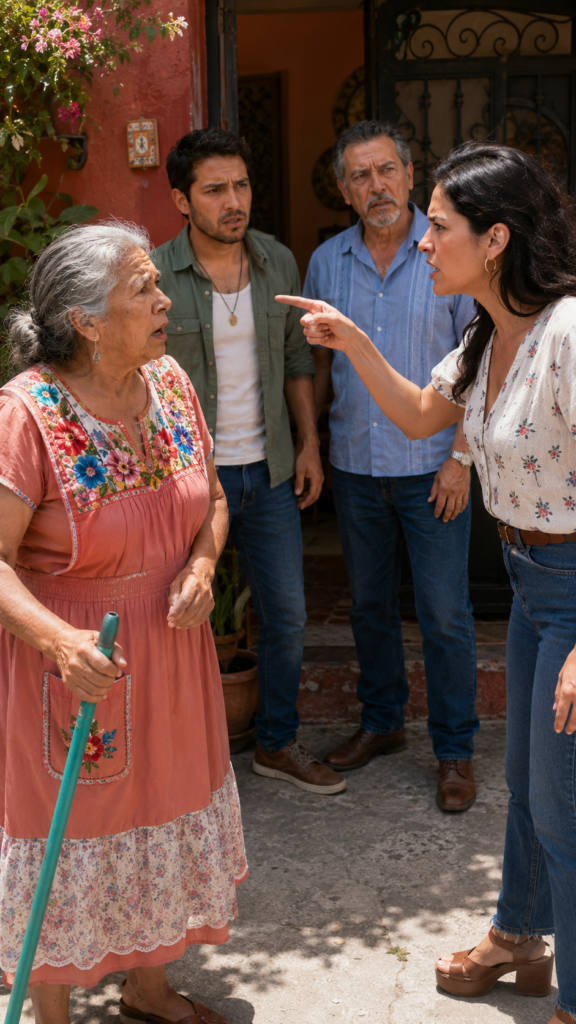
—Doña Mercedes… I didn’t mean to say that.
Mercedes walked towards the laundry room without answering. She stuffed three dresses, her medicines, and the photo of Jacinto into a small suitcase.
Karla followed her.
—You’re overreacting. Families help each other. Or did you want to live like a queen while we drowned in debt?
Mercedes turned slowly.
—I didn’t live like a queen. I lived in my house. The one my husband and I paid for with years of exhaustion. You didn’t want help. You wanted an inheritance before its time.
Karla clenched her mouth.
—Andrés is still your son.
—And I’m still his mother. But you only remembered that when you needed my papers and my money.
Andrés arrived 20 minutes later. He looked pale, sweating, with his tie loose.
—Mom, please. Let’s talk.
Mercedes looked at him as if she were seeing him for the first time.
—Did you talk to me before forging my signature?
He didn’t respond.
—Did you ask me if I wanted to sell my house?
Silence.
—Did you defend me when your wife sent me to sleep next to the washer?
Andrés lowered his eyes.
That silence was crueller than any insult.
Emiliano appeared in the hallway with his backpack.
—Grandma, are you leaving?
Mercedes felt her anger crack.
She bent down and hugged him tightly.
—I’m going to a place where I’m respected, my child. But you’re not to blame for anything.
—Mom says you want to take everything from us.
Mercedes looked at Karla.
—No, Emiliano. I’m just going to reclaim what was mine.
Before leaving, Mercedes placed the list of chores that Karla had written on the table.
On top, she placed another sheet, with firm handwriting:
“A mother is not a servant. A grandmother is not a burden. And a woman with gray hair is still the owner of her life.”
That night, she didn’t sleep on the street or at any relative’s house.
Lawyer Abril found her a simple room in a boarding house downtown, near a church. The bed was small, the window faced a courtyard, and the bathroom was shared.
But no one woke her to wash dishes.
No one asked her for money.
No one treated her like old furniture.
Mercedes cried until she fell asleep, not because she doubted, but because sometimes defending oneself also hurts. It hurts to accept that the betrayal didn’t come from a stranger, but from the son for whom she once went without food to buy him school supplies.
The next day, the legal letter arrived at Andrés’s office.
It had four demands: return the advance received for the false sale, cancel any attempt at operation, recognize in writing Mercedes’s ownership, and return the documents he had taken from the house.
If he didn’t comply within 30 days, there would be a criminal complaint.
Andrés couldn’t take it.
He sold the truck, took out a loan, and went to Abril’s office with a folder of receipts.
Mercedes received him sitting down, with the shawl over her shoulders.
—Mom —he said with a broken voice—. I’ve gathered part of it. I’m going to return everything.
—That doesn’t repair what you did.
—I know.
For the first time, Andrés didn’t try to blame Karla.
—I was a coward. I convinced myself it was for my family, but the truth is I wanted to solve my problems with what was yours.
Mercedes closed her eyes.
That confession hurt, but it also opened a crack.
—Your family was also me, Andrés.
He started to cry.
—Can I still be your son?
Mercedes looked at him for a long time.
—you will always be my son. But you will no longer be the owner of my decisions.
Karla took longer to fall.
For weeks she sent messages saying that Mercedes had made a scene, that everything could have been resolved at home, that because of her Emiliano was sad.
Mercedes didn’t respond.
Until one Saturday, Karla arrived at the boarding house with a bag of sweet bread and swollen eyes.
—Doña Mercedes, I was horrible to you. I saw you as a solution, not as a person.
Mercedes didn’t hug her.
Nor did she insult her.
—I already knew that. The important thing is whether you understood it.
Karla looked down.
—Yes.
Mercedes served her coffee, but didn’t return her trust. Because forgiving doesn’t mean handing over the keys to dignity again.
The house in Cholula was not sold. Don Mauricio, embarrassed by what had happened, offered to rent it legally for 6,000 pesos a month while Mercedes decided what to do. He promised to take care of the geraniums, the lemon tree, and the room where Jacinto kept his tools.
Mercedes accepted.
With that rent and her savings protected, she moved to a small apartment near the market, with a window full of pots and a table where every Saturday Emiliano did his homework.
Andrés started therapy. He deposited the missing money. He visited his mother without asking for food, without asking for favors, without checking drawers.
One day he came with an old box.
Inside were Jacinto’s letters, two photo albums, and the wedding portrait that Karla had wanted to throw away.
—I rescued it from the house, Mom. It belonged with you.
Mercedes took the portrait with trembling hands.
—Your dad worked too hard for me to end up asking for permission to exist.
Andrés cried, but this time he didn’t seek comfort. He just listened.
Over time, the story spread through the neighborhood. Other older women began to seek out Mercedes: one because her children wanted to sell her land, another because her daughter-in-law was hiding her card, another because they told her she was no longer “of age” to decide.
Mercedes began to accompany them to the DIF, the Public Registry, and with lawyers.
The woman Karla had sent to the laundry room ended up becoming the voice that other grandmothers needed to speak up.
A year later, on Emiliano’s 10th birthday, the family gathered in Mercedes’s apartment.
There was cake, jelly, and soda. No discussions. No money. No reproaches in front of the child.
When they blew out the candles, Emiliano hugged his grandmother and said:
—My grandma is the strongest of all.
No one dared to correct him.
Mercedes smiled, looking at Jacinto’s portrait on the wall.
She didn’t exactly recover the life that was taken from her. She recovered a better one: one where her love was no longer a chain, her age was no longer an excuse, and her inner home had locks that no one could force again.
Because no mother becomes a burden for aging.
And no family has the right to rob the dignity of someone who taught them how to live.