PART 1
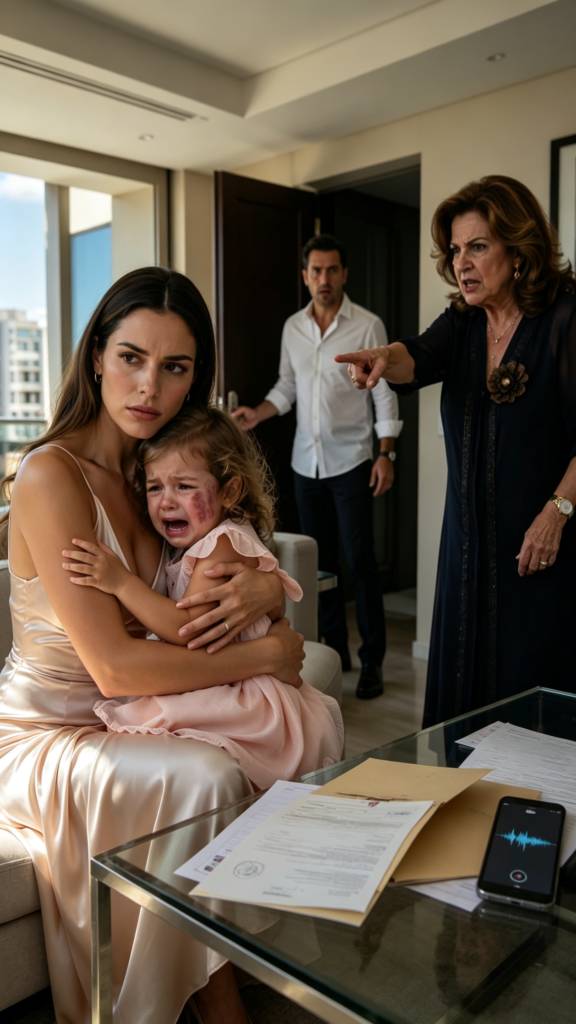
When Valeria saw the blood on her daughter's pink shirt and the complete five-finger mark on her cheek, she understood that something in her home had rotted a long time ago.
Doña Irma, her mother-in-law, didn’t even look remorseful.
She stood in the middle of the living room of their apartment in Portales, arms crossed and her face hard, as if she had just corrected an adult and not struck a two-year-old girl.
"That’s how nosy girls learn," she said. "If you don’t teach her, someone has to."
Valeria picked Camila up off the floor.
The child was crying with that choked sob that doesn’t come from a tantrum but from fear. Her nose was red, her lip trembling, and her eyes glued to her mother as if the world had suddenly turned dangerous.
On the couch, Santiago, the supposed nephew of her husband, continued watching a cartoon on the tablet.
He was nine years old.
Doña Irma had brought him to live with them nearly a year ago, saying he was the son of a cousin of Óscar who could no longer take care of him well in a town in Morelos. According to her, the boy needed school, a roof, and a decent family.
Valeria accepted.
She paid for enrollment, uniforms, sneakers, school supplies, medical consultations, and even remedial classes. Not because she had extra money, but because her scented candle and natural products business had grown, and she genuinely believed that helping a child was the right thing to do.
But since Santiago arrived, Camila started to become invisible.
If there was fruit, it was for him.
If there was dessert, it was first for him.
If Camila cried, Doña Irma said she was just being spoiled. If Santiago broke something, she said boys were mischievous, strong, men.
Óscar rarely intervened.
He always said his mother was “from another time” and that Valeria shouldn’t make a fuss about everything.
That Sunday, Óscar was supposedly in Puebla closing a sale of materials for his work. Valeria was preparing tlalpeño soup and rice when she left Camila playing with blocks near the coffee table.
Not even three minutes passed.
First, there was the thud.
Then the crying.
Valeria ran and found her daughter on the floor, with a bitten sausage beside her hand.
"What did you do to her?" she asked, her voice breaking.
"She took food from Santiago," Doña Irma replied. "You don’t take the plate from boys."
Valeria felt blood rush to her head.
"She’s two years old."
"Well, she'd better learn young. Your daughter is going to leave one day with any guy. Santiago will carry the last name."
That phrase was like a door opening to hell.
Valeria wiped Camila’s nose, hugged her, and then grabbed her phone. She cancelled in speaker mode the additional medical card for Doña Irma, blocked access to the household accounts, and called the pediatrician.
The mother-in-law began to scream.
"Óscar will put you in your place! You’re crazy! You want to leave me without a hospital!"
Valeria locked herself in the bedroom with Camila in her arms.
Then she heard Doña Irma talking on the phone, no longer pretending to cry.
"I told you this woman was going to explode... now you’ll have to tell her the truth about Santiago before she finds the folder."
Valeria stopped breathing.
Because she understood that her daughter’s blood hadn’t uncovered a family fight.
It had unearthed a buried lie within her own home.
PART 2
Valeria stood behind the door with Camila asleep against her chest and the phone recording silently.
She didn’t know what folder Doña Irma was mentioning.
She didn’t know what truth there was about Santiago.
She only knew that her mother-in-law no longer spoke like an offended woman, but like someone trapped in a moment too soon.
"Don’t take long," Irma said on the phone. "If he checks the papers, it’s all over. And don’t forget about the boy. That boy has more rights than the girl."
Valeria squeezed Camila gently.
The little one stirred in her sleep, touching her swollen nose.
Fifteen minutes later, the key turned in the door.
Óscar entered the apartment without running, without asking about his daughter, without anxiety. He wore his sleeves rolled up and the irritated expression of someone arriving to extinguish an annoying fire.
"What did you do now, Mom?" he asked.
Doña Irma immediately began to cry.
"Your wife hit me, took my insurance away, humiliated me. All because I corrected that spoiled child."
Óscar looked toward the bedroom.
He didn’t say, "How is Camila?"
He didn’t say, "Why did she bleed?"
He didn’t say, "Did you take her to the doctor?"
He simply said:
"Mom, I told you not to provoke her when I’m not here."
Valeria opened the door.
Her husband froze upon seeing her with the child in her arms. Camila’s cheek was still marked, red, swollen, impossible to ignore.
"Explain to me what truth you’ve been hiding about Santiago," Valeria said.
Óscar tightened his jaw.
"This isn’t the time for your outbursts."
"Curious," she replied. "Your daughter has blood on her clothes, but the problem is my outbursts."
Doña Irma pointed at the phone.
"Take that away from her."
Valeria raised the screen.
"It’s been recording since before you walked in."
Silence fell heavily.
Then Santiago appeared in the hallway, barefoot, hugging his tablet against his chest. He looked at Óscar with fear.
"Dad... are you going to tell her now?"
Valeria felt the floor shifting beneath her.
Doña Irma closed her eyes.
Óscar didn’t correct the boy.
He didn’t say he was wrong.
He didn’t say it was a joke.
He simply lowered his gaze.
And with that gesture, he confessed everything.
"Santiago isn’t your nephew," Valeria said slowly. "He’s your son."
Óscar took a step toward her.
"It wasn’t what you think."
Valeria let out a dry laugh, void of joy.
That phrase, at that moment, sounded dirtier than any insult.
"Then tell me how it was."
Óscar explained partially. He said he made a mistake before marrying. That Santiago's mother couldn’t provide stability. That his mom insisted on bringing him closer to the family. That he didn’t know how to tell Valeria he had a child.
But each word opened another hole.
Because Santiago hadn’t come as a son.
He’d arrived as a "needy nephew."
And Valeria had kept him, unaware that her husband was using her heart and wallet.
Doña Irma lost her patience.
"Oh, please. You had money. You could help. Besides, you only gave my son a girl. Santiago is a boy. He needs support."
Valeria looked at Camila.
Her baby, who barely spoke complete sentences, had lived under the disdain of a grandmother who saw her as a burden for not being born a boy.
"Since when were you planning to tell me?"
Óscar didn’t answer.
Santiago did.
"Grandma said that when you were married for four years, you wouldn’t be able to get me out. She also said that later they would fix the house and the company."
Valeria turned to Doña Irma.
"What house? What company?"
The mother-in-law clenched her mouth.
There Valeria remembered the dining room furniture where Irma kept recipes, saints, old envelopes, and papers that no one could touch. She walked over, opened the drawer, and pulled out a blue folder tied with a rubber band.
Óscar tried to stop her.
"Valeria, don’t do this."
"You already did."
Inside was Santiago's birth certificate.
Father: Óscar Medina Ríos.
There were also tuition receipts, therapy payments, deposits to a woman named Marisol, and transfers made from an account linked to Valeria's business.
Then there was a printed sheet.
"Plan for property protection for Santiago M. R."
Below it was a list with underlined phrases:
"Valeria: temperamental."
"Valeria: aggressive toward Óscar's mother."
"Valeria: rejection of minor Santiago."
"Valeria: possible emotional risk for children."
Valeria understood everything in one go.
They hadn’t just hidden a child.
They were constructing a narrative where she would be the villain, the crazy woman, the evil stepmother, the woman incapable of coexisting with an innocent child.
And the slap to Camila hadn’t been an accident.
It had been the spark to make her explode.
"You hit my daughter to provoke me," Valeria said, looking at her mother-in-law.
"Don’t make things up," Óscar responded.
But Doña Irma, nervous, made the mistake that sank them.
"I didn’t think she would bleed so much."
Óscar turned to her with fury.
Valeria felt ice in her chest.
Because it was no longer a suspicion.
It was a confession.
Without stopping the recording, she called the pediatrician.
"Doctor, I need you to check my two-year-old daughter today. She received a blow to the face and has a nosebleed."
Then she called her lawyer, Lucía Herrera.
She didn’t shout.
She didn’t cry.
She only spoke with a calmness that was terrifying.
"My mother-in-law hit my daughter. My husband brought his son to live with me as if he were a nephew. I found papers to accuse me of being violent and money movements from my company."
Lucía didn’t ask if she was sure.
"Don’t argue anymore. Keep everything. I’m on my way."
Óscar tried to take the folder from her.
Valeria stepped back.
"Don’t you dare."
He changed his expression.
He was no longer the worried husband.
He was a cornered man.
"You’re not going to destroy my family over a sausage."
Valeria looked at the dried blood on Camila's shirt.
"Your family was destroyed when they thought my daughter was worth less than your lie."
The doorbell rang twenty minutes later.
Lucía arrived with a private doctor and two police officers from the precinct, because there was a minor injured and possible evidence at risk. Doña Irma began to cry again, this time louder.
"Are you going to bring police into my house?"
Lucía looked at her firmly.
"This is not your house, ma'am."
No one had said that truth out loud.
The apartment was in Valeria's name.
The rent came from her account.
She paid for the furniture.
The food, the bills, Santiago's school, Irma's medicines, all came from the business they initially called "a woman’s whim."
The doctor examined Camila in the bedroom. The girl woke up crying when she heard Doña Irma's voice from the living room.
"No, grandma," she murmured.
Valeria felt those two words break something inside her.
The doctor confirmed nasal contusion, swelling, and a mark consistent with an open-hand impact. He documented it.
Meanwhile, Lucía reviewed the folder.
"This isn’t a family misunderstanding," she said. "There’s concealment, misuse of resources, and a prepared narrative against you."
Doña Irma screamed that Valeria was unstable.
Lucía played the audio.
Irma's voice filled the room:
"I didn’t think she would bleed so much."
The mother-in-law fell silent.
But the worst was still to come.
Santiago approached with the tablet.
"There’s a video," he said quietly. "I didn’t know she was going to hit her like that."
Óscar tried to silence him.
"Santiago, go to your room."
Lucía raised her hand.
"Don’t intimidate him."
The boy opened a file folder.
The video lasted fifty-two seconds.
It showed the living room from the tablet resting on the couch. Camila walked clumsily toward the table. She took a sausage from Santiago’s plate, but not to take it away.
She was offering it.
The girl wanted to share.
Then Irma's voice was heard:
"Let her. Let’s see if that makes your mom come."
Doña Irma advanced.
The hand went up.
The slap sounded sharp.
Camila fell to the floor.
And the mother-in-law said:
"Now cry loud."
Valeria felt the air leaving her.
It hadn’t been a brutal correction.
It hadn’t been anger.
It had been a trap.
Her two-year-old daughter had been used as bait to manufacture a scene against her.
Óscar covered his face.
"Mom, what did you do?"
Irma began to cry, but now no one believed her.
"I just wanted to show how Valeria is. She always thinks she’s better than us. She always flaunts her money. We needed to protect Santiago."
"From whom?" Valeria asked. "From a girl who wanted to share food?"
Santiago started to cry.
"Grandma said Camila was going to take everything from me. That if you had another daughter, I wouldn’t matter anymore."
Valeria looked at him.
For the first time, she didn’t see the spoiled child who denied Camila dessert.
She saw another child used by adults sick with ambition, name, and pride.
"You’re a child," she told him. "This wasn’t your fault. But when someone hurts someone smaller, staying quiet also hurts."
Santiago lowered his head.
That night, with the medical report, the video, the audio, and the blue folder, Lucía initiated the charges and requested protection measures.
Óscar had to leave the apartment.
Doña Irma too.
She screamed at the door that she was sick, that she had nowhere to go, that Valeria was a bad woman for leaving her without support.
Valeria simply replied:
"You left a child unprotected in her own home."
The next day, she changed the lock.
She cancelled all the additional cards.
She blocked Óscar’s access to the business accounts.
Marisol, Santiago’s mother, appeared four days later. She wasn’t the irresponsible woman Irma described. She was a nursing assistant who worked double shifts and had accepted help from Óscar thinking he would honestly acknowledge the boy.
She didn’t know Santiago was living as a "nephew."
She didn’t know Valeria was paying for almost everything.
And when she saw the video of Camila, she cried with shame.
"I didn’t raise my son to watch how they hurt a girl," she said.
Santiago left with her a week later.
Before leaving, he apologized. Valeria didn’t hug him, but she didn’t humiliate him either.
She told him that the fault lay with the adults but that the truth should always be told before someone bleeds.
The following months were tough.
Óscar sent long messages about family, mistakes, fear, and pressure.
He never wrote the only thing that mattered.
He never wrote: "I cheated on you."
He never wrote: "I used your money."
He never wrote: "I let my mother hit our daughter to manufacture evidence against you."
Doña Irma ended up living with a sister in Toluca. She had to have her surgery in a public hospital. Many people said Valeria was cruel.
That a mother-in-law was still family.
That Santiago was innocent.
That Óscar was Camila's father.
Valeria listened to it all.
Then she looked at her daughter.
She saw her touch her nose some nights, as if checking that it no longer hurt. She saw her hide behind her legs when an older woman raised her voice in the supermarket. She saw her gradually return to playing, laughing, asking for sausages without fear.
One day, Camila took a piece of bread and gave it to her mom.
"For you, Mommy."
Valeria cried in silence.
Because her daughter remained generous, even though someone wanted to punish her for sharing.
That Sunday, Doña Irma didn’t just hit a girl.
She ripped the mask off Valeria’s marriage.
She revealed the lie, the disdain, and that rotten idea that a child is worth more for carrying a surname.
And Valeria understood something that many women take years to accept: forgiving too much can also become a form of abandoning children.
That’s why she didn’t look back.
Not for Óscar.
Not for Irma.
Not for a family accustomed to calling respect obedience.
That day, they lost their power within her home.
And for Camila, at last, a life began where no one would ever make her feel less for being born a girl.





